Study Notes

Overview
Ratio and Proportion (OCR Topic 1.4) is a cornerstone of the GCSE Mathematics curriculum, acting as a critical bridge between numerical reasoning and more abstract algebraic concepts. For examiners, it is a powerful tool to test a candidate's fluency in multiplicative reasoning—the ability to think in terms of scaling factors and relationships rather than just additive steps. This topic isn't just about sharing amounts; it’s about understanding the fundamental relationships that govern how quantities interact. From scaling a recipe up for a party, to calculating the best value mobile phone contract, to understanding how the time to complete a job changes with the number of workers, ratios and proportions are everywhere. In the exam, questions can range from straightforward Foundation-tier problems like dividing a quantity in a given ratio, to complex Higher-tier challenges involving algebraic ratios or non-linear inverse proportion, often integrated into multi-step, problem-solving contexts (AO3). A solid grasp of this topic is essential, as the principles of proportional reasoning are synoptically linked to fractions, percentages, geometry (similar shapes), and graphical representations.
Key Concepts
1. Simplifying Ratios and Equivalent Ratios
A ratio is a comparison of two or more quantities. The key to earning marks is to present it in its simplest integer form. This requires finding the highest common factor (HCF) of all parts of the ratio and dividing each part by it. However, a common trap set by examiners is to provide quantities with different units. Credit is only given if units are standardised before simplifying.
Example: Simplify the ratio of 90cm to 3m.
- Standardise Units: Convert 3m to 300cm. The comparison is now 90cm : 300cm.
- Remove Units: The ratio is 90 : 300.
- Simplify: Divide both parts by their HCF, which is 30.
90 ÷ 30 = 3
300 ÷ 30 = 10
The simplest form is 3 : 10.
2. Dividing a Quantity in a Given Ratio
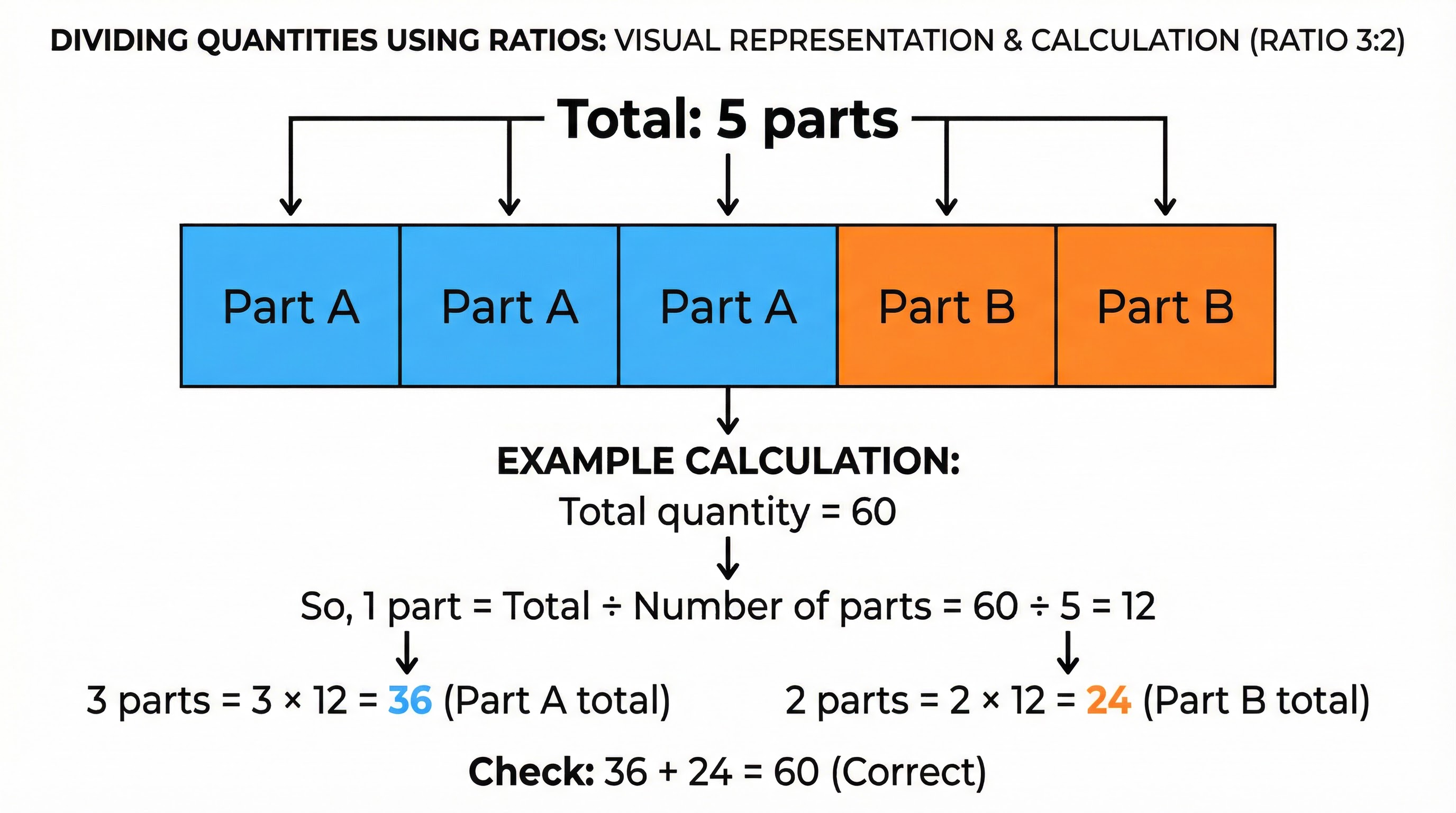
This is a foundational skill. The core principle is the 'unitary method'—finding the value of one single part of the ratio first. A frequent error is for candidates to divide the total amount by one of the numbers in the ratio, rather than the sum of the parts.
Method:
- Sum the Parts: Add together all the numbers in the ratio to find the total number of equal parts.
- Find One Part: Divide the total quantity by the sum of the parts.
- Multiply: Multiply the value of one part by each number in the ratio to find the value of each share.
3. Ratios in the form 1:n or n:1
Examiners often ask for a ratio to be expressed in a specific format, such as 1:n. This requires you to make one side of the ratio equal to 1 by dividing both sides by that part's value.
Example: Express 5:4 in the form 1:n.
- Identify Target: We want the left side to be 1.
- Divide: Divide both sides by 5.
5 ÷ 5 = 1
4 ÷ 5 = 0.8
The ratio is 1 : 0.8.
4. Direct and Inverse Proportion
This is where candidates must read the question carefully to identify the relationship.
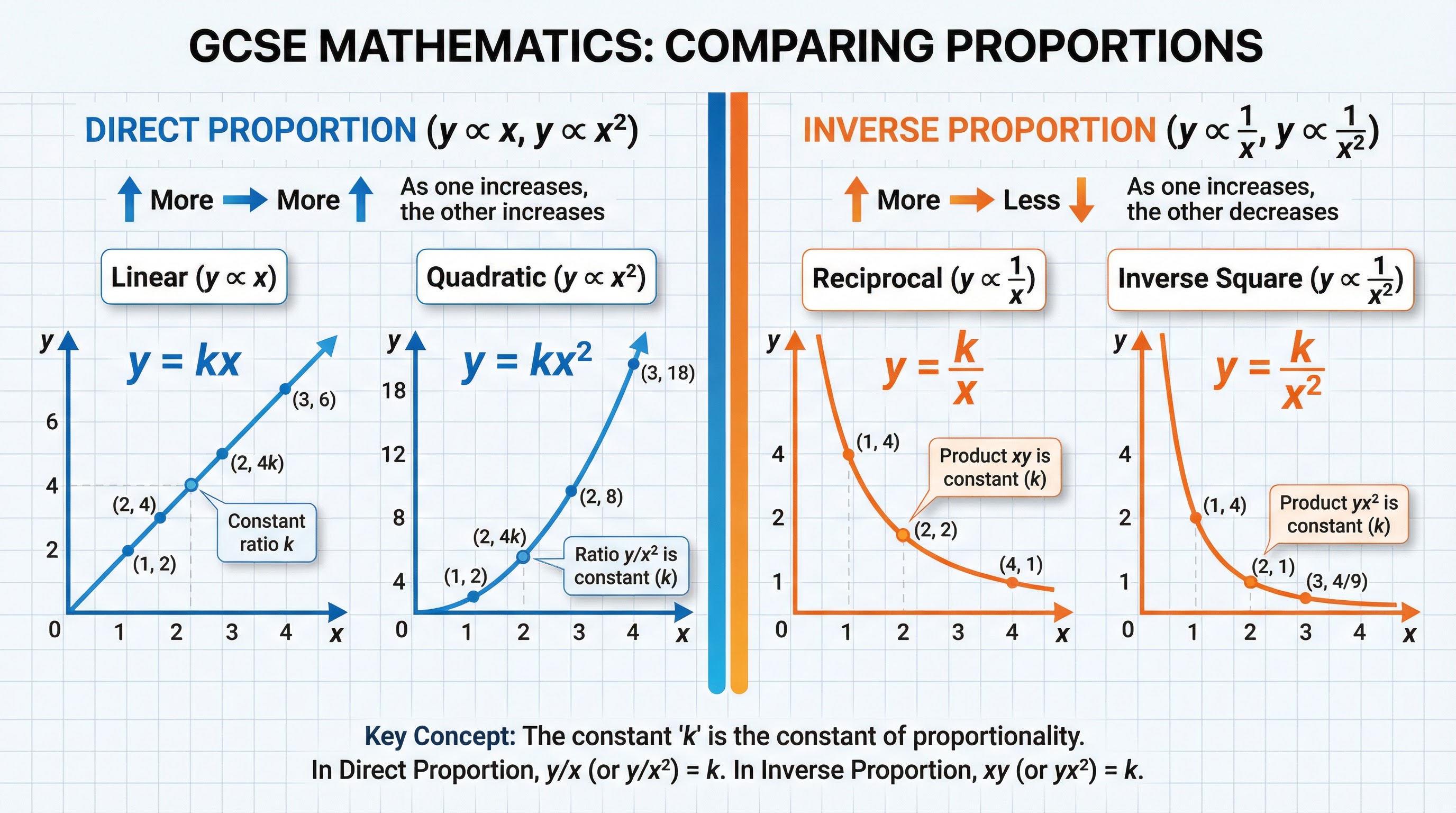
- Direct Proportion: As one quantity increases, the other increases at the same rate (e.g., more hours worked, more pay earned). The graph is a straight line through the origin. The key relationship is y = kx.
- Inverse Proportion: As one quantity increases, the other decreases proportionally (e.g., more workers on a job, less time it takes). The graph is a hyperbola. The key relationship is y = k/x.
For Higher tier, this extends to non-linear relationships, such as y being proportional to the square of x (y = kx²) or inversely proportional to the square root of x (y = k/√x). The first mark in these questions is almost always for writing down the correct proportionality equation.
Mathematical Relationships
| Relationship | Formula (Must Memorise) | When to Use | Tier |
|---|---|---|---|
| Direct Proportion | y = kx | When two quantities increase or decrease together at a constant rate. | Both |
| Inverse Proportion | y = k/x or xy = k | When one quantity increases as the other proportionally decreases. | Both |
| Direct Proportion (squared) | y = kx² | When one quantity is proportional to the square of another. | Higher |
| Inverse Proportion (squared) | y = k/x² or x²y = k | When one quantity is inversely proportional to the square of another. | Higher |
| Direct Proportion (root) | y = k√x | When one quantity is proportional to the square root of another. | Higher |
| Inverse Proportion (root) | y = k/√x or √x * y = k | When one quantity is inversely proportional to the square root of another. | Higher |
In all cases, k is the constant of proportionality, which you must find by substituting a known pair of values for x and y.
Practical Applications
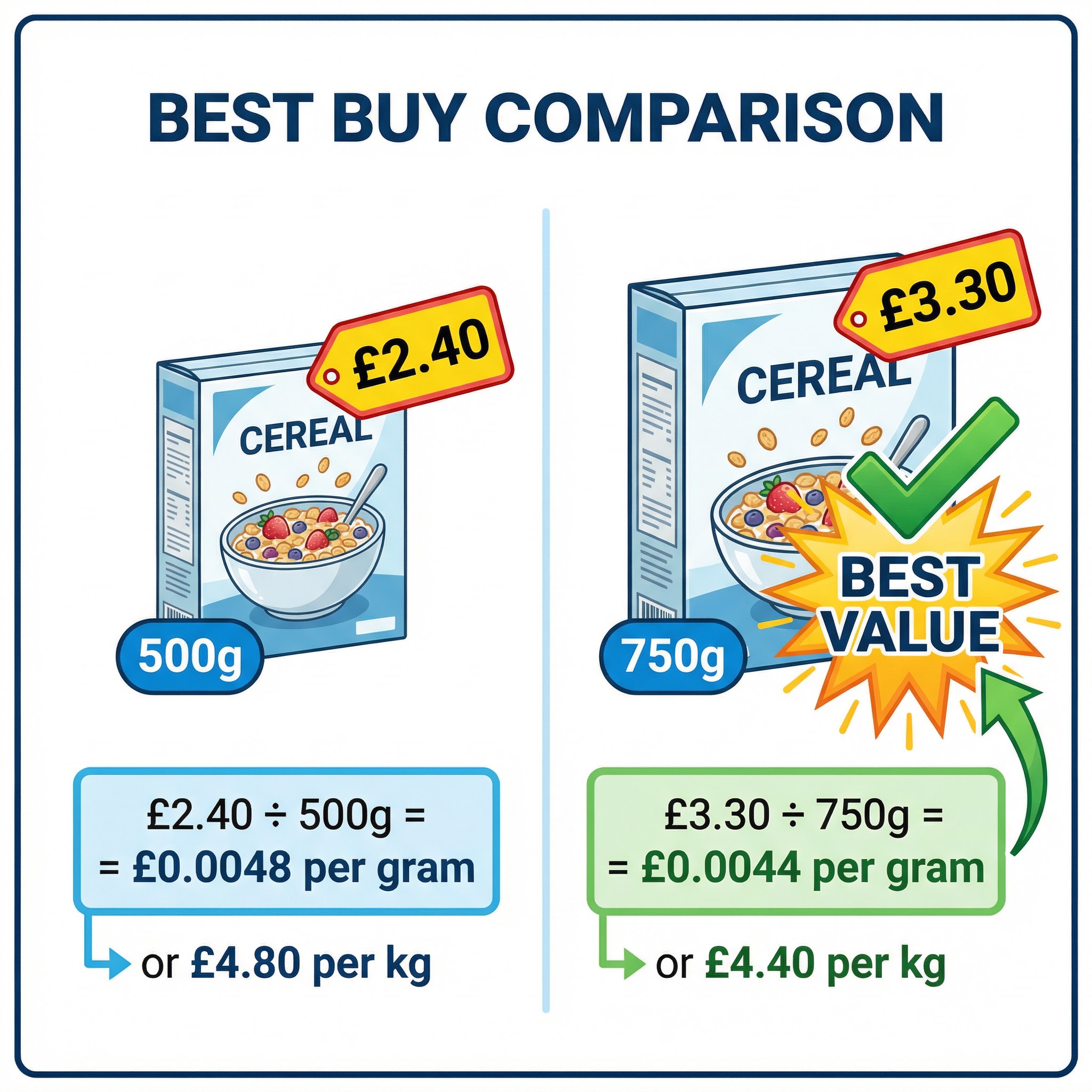
- Best Buy Problems: Determining which product offers better value for money by comparing cost per unit (e.g., cost per 100g or per litre). This is a classic AO2 application question.
- Recipes: Scaling ingredient quantities up or down. If a recipe for 4 people needs 200g of flour, how much is needed for 6? (A scale factor of 6/4 = 1.5 is used).
- Currency Conversion: Using an exchange rate as a ratio (e.g., £1 : $1.25) to convert between currencies.
- Map Scales: Using a map scale (e.g., 1 : 50,000) to calculate real-world distances from map measurements.
- Physics: Inverse square laws, such as the intensity of light or gravity, are applications of inverse proportion with squares (I ∝ 1/d²).