Sequences

    Unlock the patterns and master progressions in OCR GCSE Maths. This guide breaks down linear, quadratic, and Fibonacci sequences to help you secure crucial exam marks.

    5
    Min Read
    3
    Examples
    5
    Questions
    6
    Key Terms
    🎙 Podcast Episode
    Sequences
    6:09
    0:00-6:09

    Study Notes

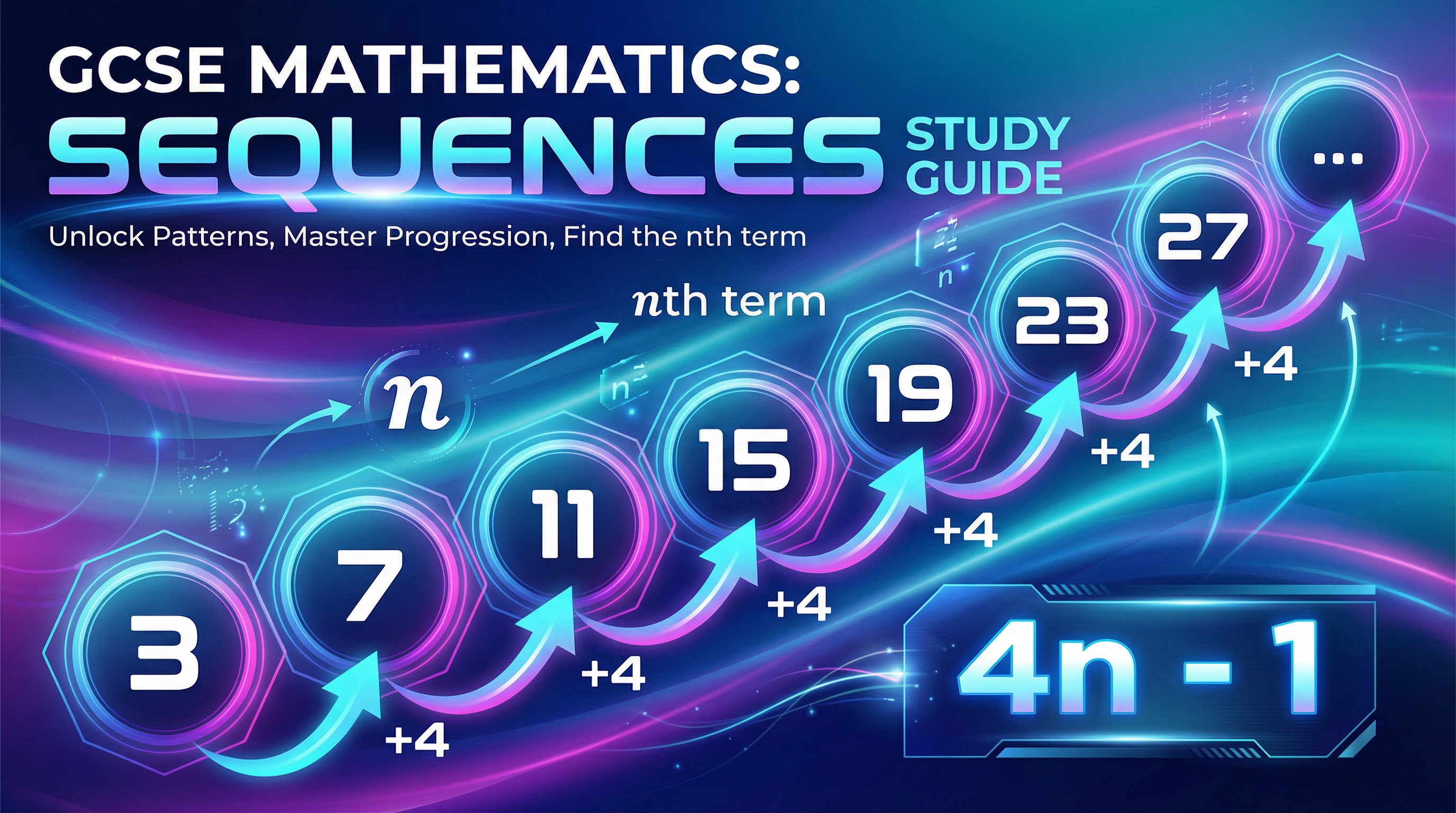
    GCSE Mathematics: Sequences Study Guide Header

    Overview

    Sequences are a fundamental concept in mathematics, testing your ability to identify patterns, formulate algebraic rules, and predict future terms. For the OCR GCSE exam, this topic is a reliable source of marks if you master the core techniques. It involves understanding the structure of different types of progressions, from simple linear sequences to more complex quadratic and geometric series. A strong grasp of sequences not only prepares you for direct questions but also builds foundational skills for algebra, graph work, and problem-solving across the entire specification. Examiners will test your ability to move from a term-to-term rule to a position-to-term rule (the nth term) and apply these rules in various contexts.

    Listen to our 10-minute podcast guide on Sequences.

    Key Concepts

    Concept 1: Linear Sequences

    A linear sequence is a series of numbers where the difference between any two consecutive terms is constant. This is known as the common difference. The key skill is finding the nth term, which is always in the form an + b.

    • Finding 'a': The coefficient 'a' is simply the common difference. If the sequence goes up by 4 each time, the rule starts with 4n.
    • Finding 'b': To find the adjustment 'b', compare your 'an' sequence (e.g., the 4 times table) with the actual sequence. The difference between them is your value for 'b'. A useful shortcut is to find the '0th term' by stepping back from the first term.

    Example: For the sequence 7, 10, 13, 16...

    • The common difference is +3, so the rule starts with 3n.
    • The 3 times table is 3, 6, 9... Our sequence is 7, 10, 13... To get from 3 to 7, we add 4. To get from 6 to 10, we add 4.
    • The adjustment is +4. So, the nth term is 3n + 4.
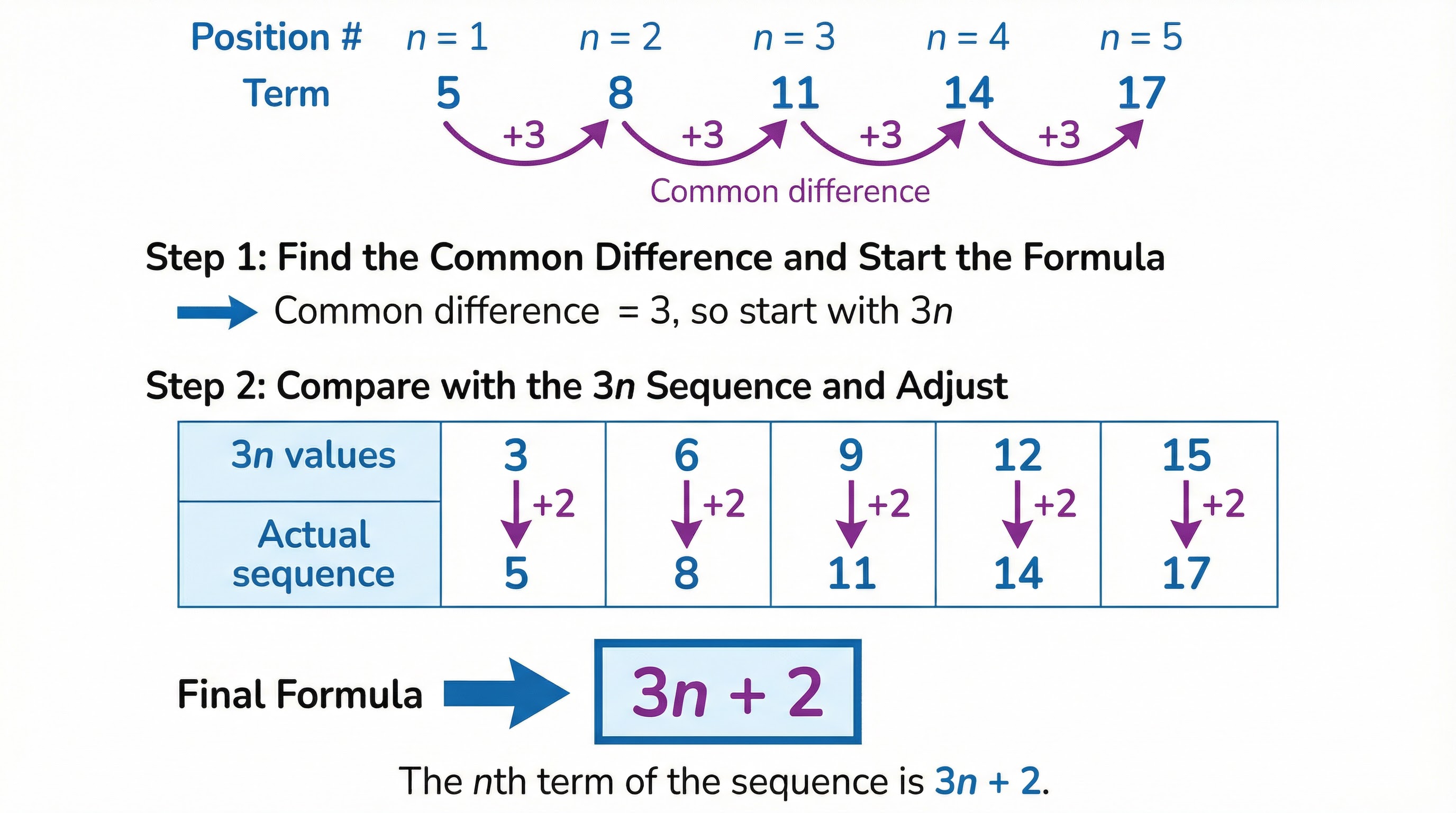
    How to find the nth term of a linear sequence.

    Concept 2: Quadratic Sequences (Higher Tier Only)

    A quadratic sequence has an n² term in its rule. The first differences between terms are not constant, but the second differences are. The general form of the nth term is an² + bn + c.

    • Finding 'a': The coefficient 'a' is always half the value of the constant second difference. If the second difference is 4, 'a' is 2.
    • Finding 'bn + c': Once you have your an² term, subtract it from the original sequence. The remaining numbers will form a new linear sequence. You then find the nth term of this new linear sequence to get your 'bn + c' part.

    Example: For the sequence 3, 8, 17, 30, 47...

    • First differences: +5, +9, +13, +17
    • Second differences: +4, +4, +4
    • The second difference is 4, so 'a' = 4 / 2 = 2. The rule starts with 2n².
    • Subtract 2n² from the original sequence:
      • Term 1: 3 - 2(1)² = 1
      • Term 2: 8 - 2(2)² = 0
      • Term 3: 17 - 2(3)² = -1
    • The remaining linear sequence is 1, 0, -1... which has the rule -n + 2.
    • Combine the parts: The final nth term is 2n² - n + 2.
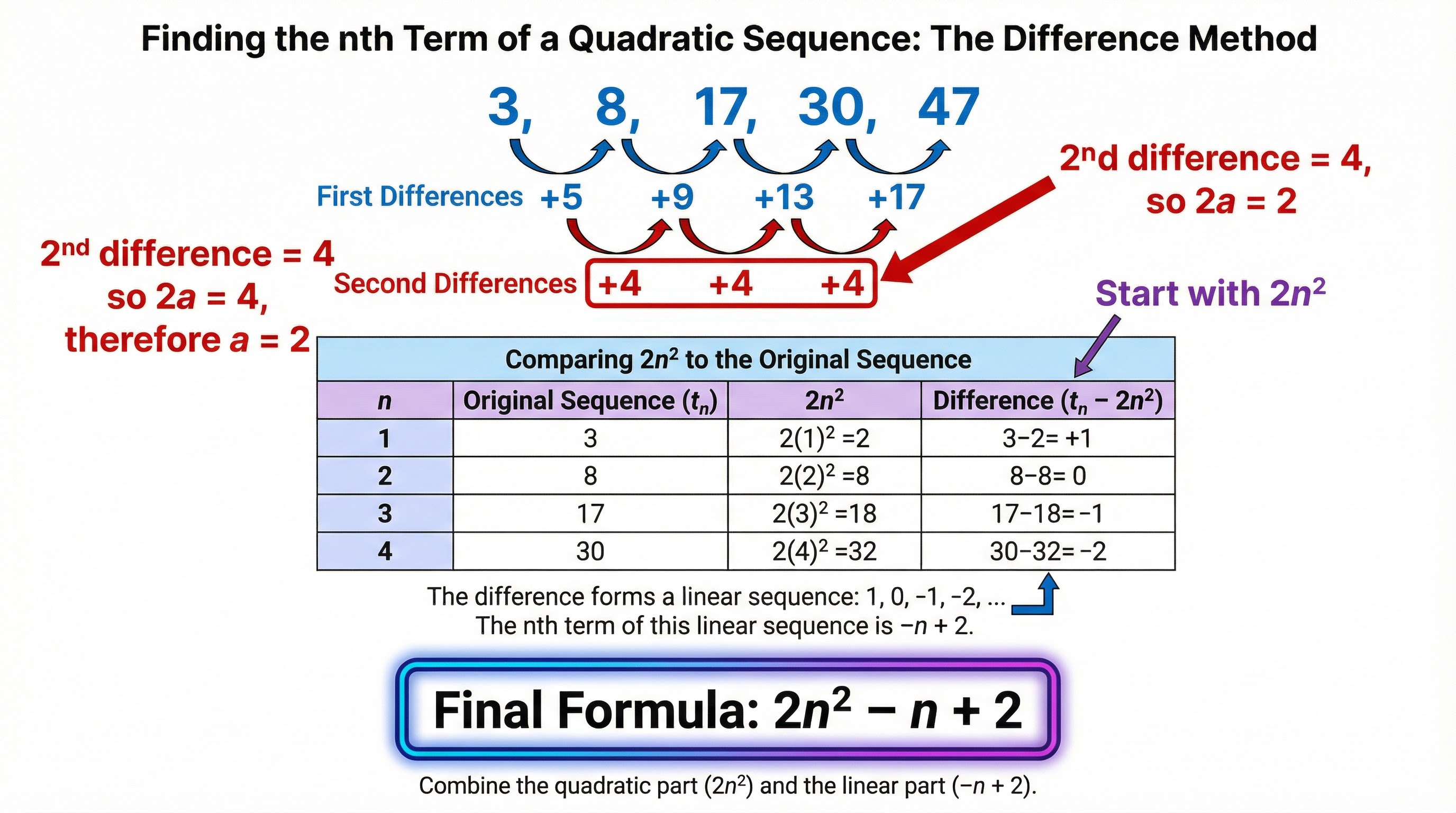
    The difference method for finding the nth term of a quadratic sequence (Higher Tier).

    Concept 3: Special Sequences

    • Fibonacci-type sequences: A sequence where each term is the sum of the two preceding terms. The exam question will always define this rule for you. Example: If the first two terms are 2 and 5, the sequence is 2, 5, 7, 12, 19...
    • Geometric Progressions: A sequence where you multiply each term by a constant value, the common ratio, to get the next term. The nth term is given by arⁿ⁻¹, where 'a' is the first term and 'r' is the common ratio. Example: 2, 6, 18, 54... (common ratio is 3). The nth term is 2 x 3ⁿ⁻¹.

    Mathematical/Scientific Relationships

    • Linear nth Term Formula: T(n) = an + b

      • T(n): The value of the nth term
      • a: The common difference
      • n: The term's position number
      • b: The '0th term' or adjustment value
      • Must memorise
    • Quadratic nth Term Formula: T(n) = an² + bn + c

      • a: Half the second difference
      • bn + c: The linear sequence remaining after subtracting an²
      • Must memorise (Higher Tier)
    • Geometric nth Term Formula: T(n) = arⁿ⁻¹

      • a: The first term
      • r: The common ratio
      • n: The term's position number
      • Given on formula sheet (for some specifications, but good to know)

    Practical Applications

    Sequences appear in many real-world scenarios, making them a powerful mathematical tool. They are used in:

    • Finance: Calculating compound interest or loan repayments involves geometric progressions.
    • Computer Science: Algorithms for searching and sorting often rely on sequence-based logic.
    • Biology: Modelling population growth can use sequence formulas.
    • Art & Nature: The Fibonacci sequence is famously observed in the patterns of snail shells, flower petals, and pinecones.

    Visual Resources

    2 diagrams and illustrations

    How to find the nth term of a linear sequence.
    How to find the nth term of a linear sequence.
    The difference method for finding the nth term of a quadratic sequence (Higher Tier).
    The difference method for finding the nth term of a quadratic sequence (Higher Tier).

    Interactive Diagrams

    2 interactive diagrams to visualise key concepts

    YesNoYesNoStart with a SequenceFind 1st DifferencesAre they constant?Linear Sequence: an + bFind 2nd DifferencesAre they constant?Quadratic Sequence: an² + bn + cOther type, e.g. Geometric

    Flowchart for identifying the type of sequence.

    Quadratic nth Term Method1. Find Differences2. Find Differences3. Halve it4. Subtract an²5. Find nth term6. Combine6. CombineSequence1st Diffs2nd DiffsFind 'a' in an²New Linear SequenceFind 'bn + c'Final Answer: an² + bn + c

    Step-by-step process for finding the nth term of a quadratic sequence (Higher Tier).

    Worked Examples

    3 detailed examples with solutions and examiner commentary

    Practice Questions

    Test your understanding — click to reveal model answers

    Q1

    The nth term of a sequence is 7n - 2. What is the 5th term?

    2 marks
    foundation

    Hint: Substitute the term number (n=5) into the expression.

    Q2

    A sequence starts 2, 6, 10, 14... Find the nth term.

    2 marks
    foundation

    Hint: Find the common difference first. Then see how it relates to the first term.

    Q3

    The first two terms of a Fibonacci-type sequence are -3 and 5. Find the first five terms of the sequence.

    3 marks
    standard

    Hint: Remember, to get the next term, you add the two previous terms together.

    Q4

    (Higher Tier) Find the nth term of the quadratic sequence: 4, 11, 22, 37, 56...

    3 marks
    challenging

    Hint: Find the second difference. Halve it to get the n² coefficient. Then subtract and find the rule for the linear sequence that remains.

    Q5

    The nth term of a sequence is n² + 5. Is 150 a term in this sequence? Show your reasoning.

    3 marks
    challenging

    Hint: Set up an equation and solve for n. What kind of number must n be?

    Explore this topic further

    View Topic PageAll Mathematics Topics

    Key Terms

    Essential vocabulary to know

    More Mathematics Study Guides

    View all

    Pythagoras' Theorem and Trigonometry

    OCR
    GCSE

    Master right-angled triangles with this essential guide to Pythagoras' Theorem and Trigonometry for OCR GCSE Maths. This guide breaks down complex concepts into easy-to-understand steps, packed with exam-style questions, memory aids, and examiner insights to help you secure top marks.

    Trigonometry

    AQA
    A-Level

    Master AQA A-Level Trigonometry, from reciprocal functions and compound angles to harmonic form and proofs. This guide provides everything you need to solve complex problems, secure top marks, and understand the maths of waves and oscillations."

    Probability

    OCR
    A-Level

    This guide provides a comprehensive overview of Probability for OCR A-Level Mathematics, focusing on the core concepts of set notation, conditional probability, and independence. It is designed to help students master the exam techniques required to secure top marks by breaking down complex ideas into manageable steps and providing extensive practice.

    Data Handling

    OCR
    GCSE

    Master OCR GCSE Data Handling with this guide, covering everything from basic charts to advanced histograms and cumulative frequency. Learn to interpret data, nail exam questions, and secure top marks.

    Vectors

    OCR
    GCSE

    Master OCR GCSE Vectors with this guide, packed with examiner tips and interactive content. We'll break down everything from basic column vectors to complex geometric proofs, showing you how to secure every mark and turn a tricky topic into one of your strengths.

    Probability

    OCR
    GCSE

    Master OCR GCSE Probability, from tree diagrams to conditional events. This guide breaks down complex concepts into mark-scoring techniques, using worked examples and examiner insights to show you exactly how to secure top grades.