Study Notes
Overview
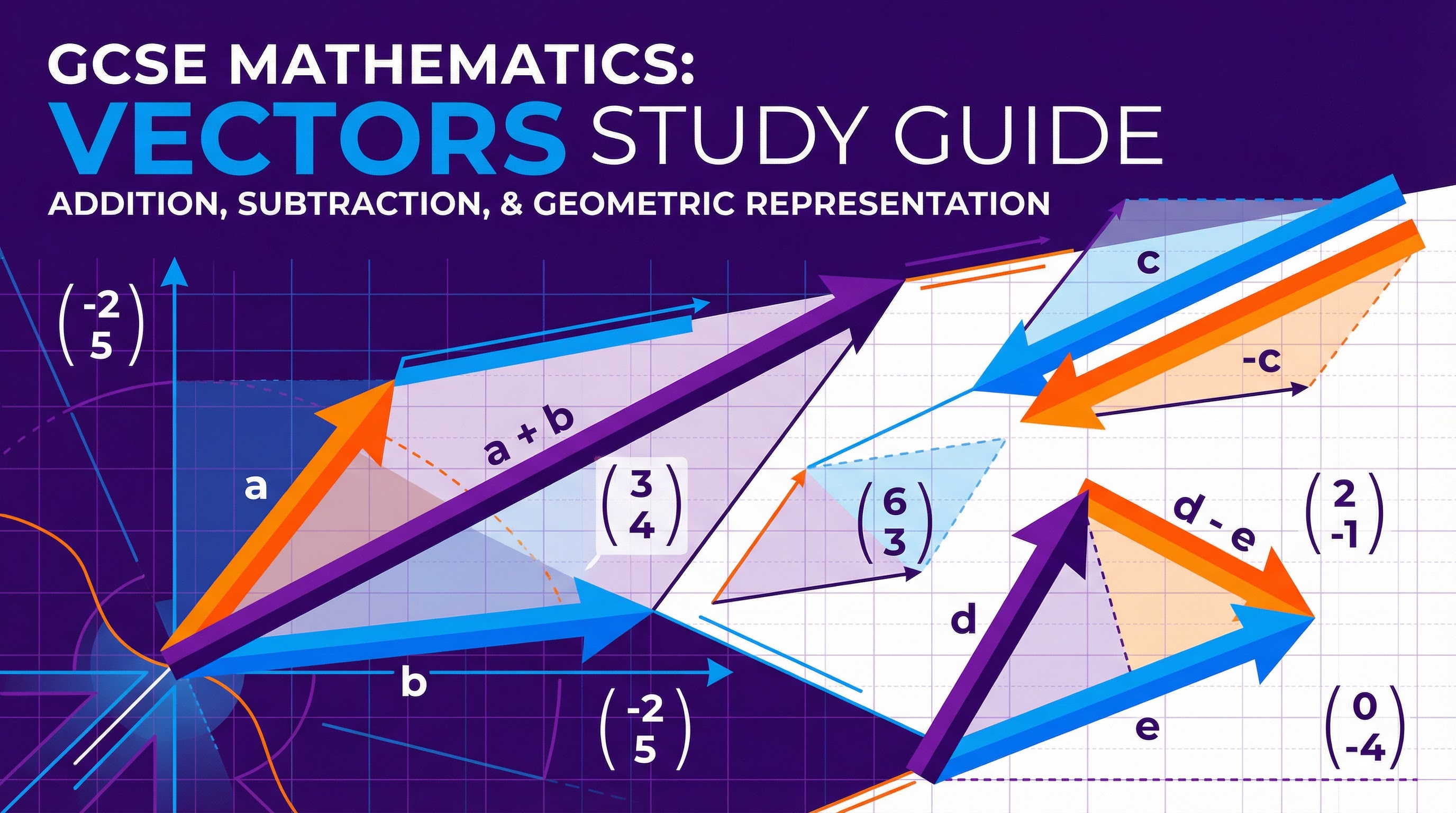
Vectors are a fundamental concept in mathematics, representing quantities that possess both a magnitude (size) and a direction. For your OCR GCSE exam, this topic is a bridge between straightforward arithmetic and more abstract geometric reasoning. At its core, it's about describing movement and displacement in a structured way. A solid understanding of vectors is not just about manipulating numbers in brackets; it's a vital skill for Higher-tier candidates aiming for top grades in geometric proof questions. It also forms the foundation for A-Level Mechanics, where vectors are used extensively to model forces and motion. Typical exam questions will range from simple vector addition and scalar multiplication (AO1) to multi-step problems involving geometric shapes like parallelograms and trapeziums, culminating in 'Show that' questions that test your logical reasoning (AO2 & AO3).
Key Concepts
Concept 1: Vector Notation and Representation
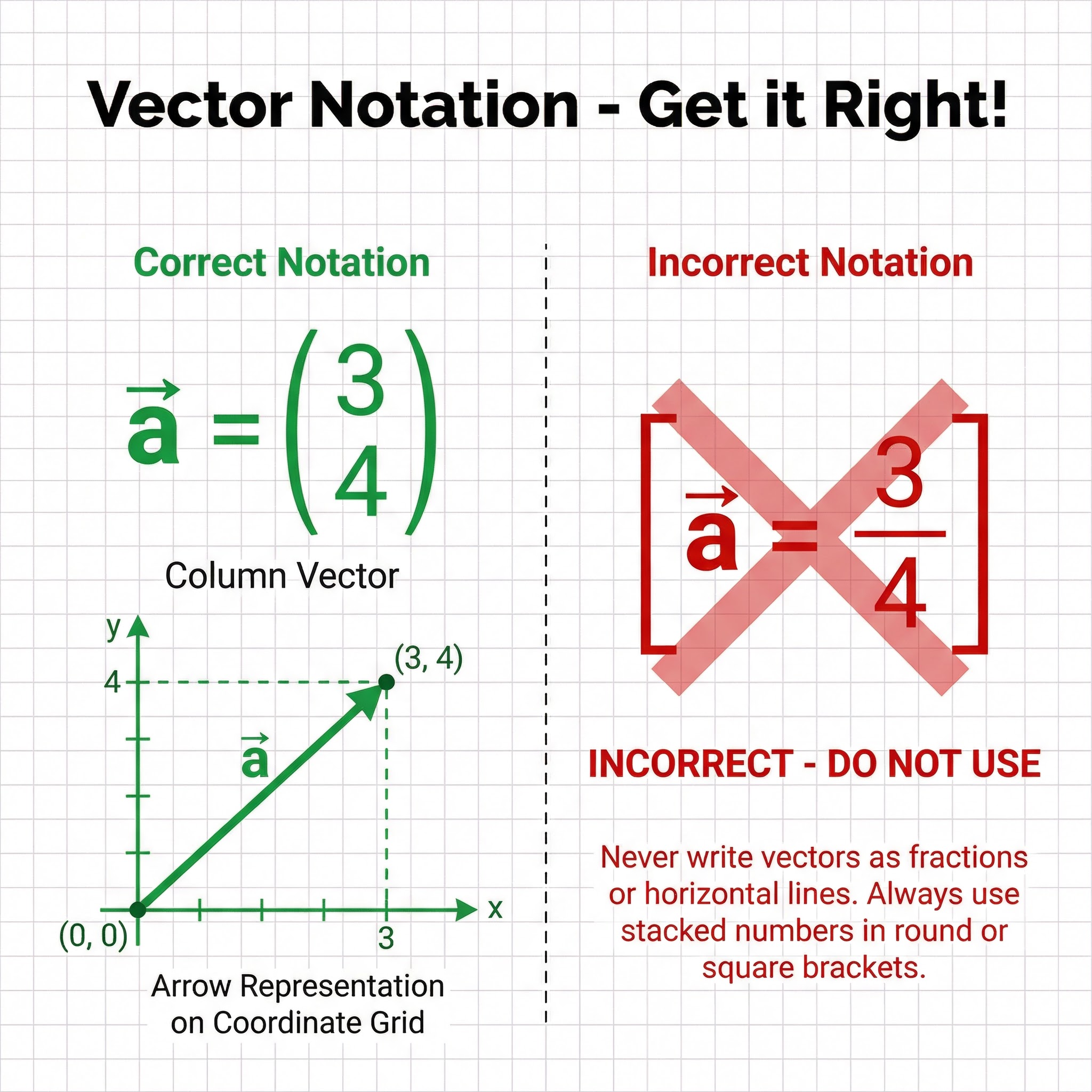
A vector is most commonly written as a column vector, such as
Concept 2: Vector Arithmetic
Vector arithmetic is the process of adding, subtracting, and multiplying vectors.
- Addition and Subtraction: This is done component-wise. To add or subtract two vectors, you simply add or subtract the corresponding x and y components.
- Scalar Multiplication: Multiplying a vector by a scalar (a regular number) means multiplying both the x and y components by that number. For example, 2a results in a vector that is twice as long as a and points in the same direction. Multiplying by a negative scalar, like -1, reverses the vector's direction.
Concept 3: Vector Pathways in Geometry
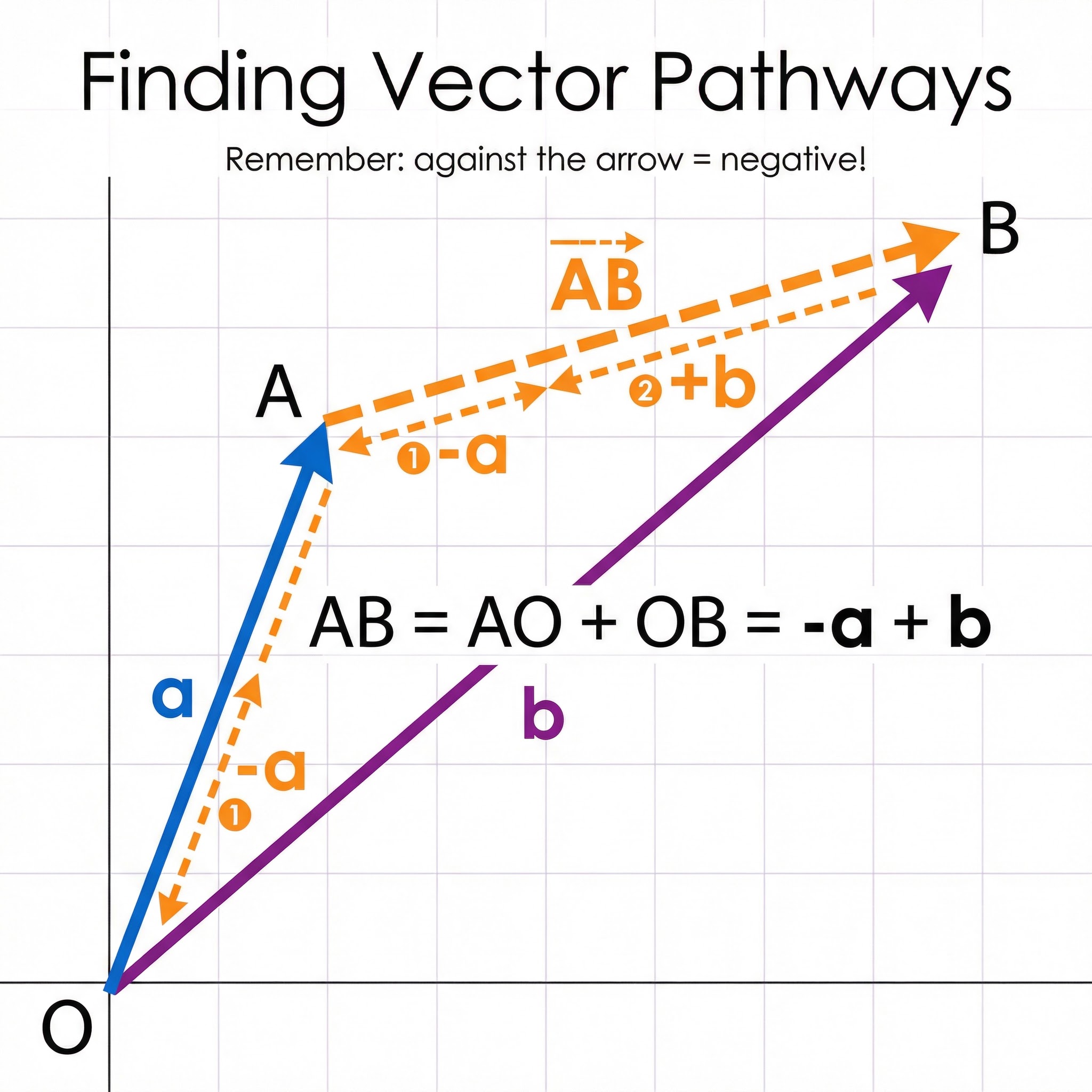
This is where vectors become a powerful tool for geometric proofs. To get from a point A to a point B, you can follow a path of other known vectors. The key principle is the 'head-to-tail' rule. If you have a triangle OAB, the vector AB can be found by taking an alternative route, such as from A to O and then from O to B. This gives the expression AB = AO + OB. Since AO is the reverse of vector OA (let's call it a), we write it as -a. If OB is b, then AB = -a + b, or more commonly, b - a.
Mathematical/Scientific Relationships
- Magnitude of a Vector: The magnitude (or modulus) of a vector a = $\begin{pmatrix} x \ y \end{pmatrix}$ is its length, found using Pythagoras' theorem: |a| = $\sqrt{x^2 + y^2}$. This must be memorised.
- Parallel Vectors: Two vectors a and b are parallel if one is a scalar multiple of the other. That is, a = kb for some scalar k. This is a fundamental test in exam questions.
- Collinear Points: Points A, B, and C are collinear (lie on the same straight line) if the vector AB is parallel to BC (i.e., AB = kBC) AND they share a common point (B). Both conditions must be stated for full marks.
Practical Applications
Vectors are essential in many real-world fields. In computer graphics and game design, vectors determine the position, direction, and speed of objects on screen. In aviation and navigation, pilots use vectors to calculate flight paths, accounting for wind speed and direction. In physics and engineering, vectors are used to model forces, such as gravity, friction, and tension, acting on an object."