Study Notes
Overview
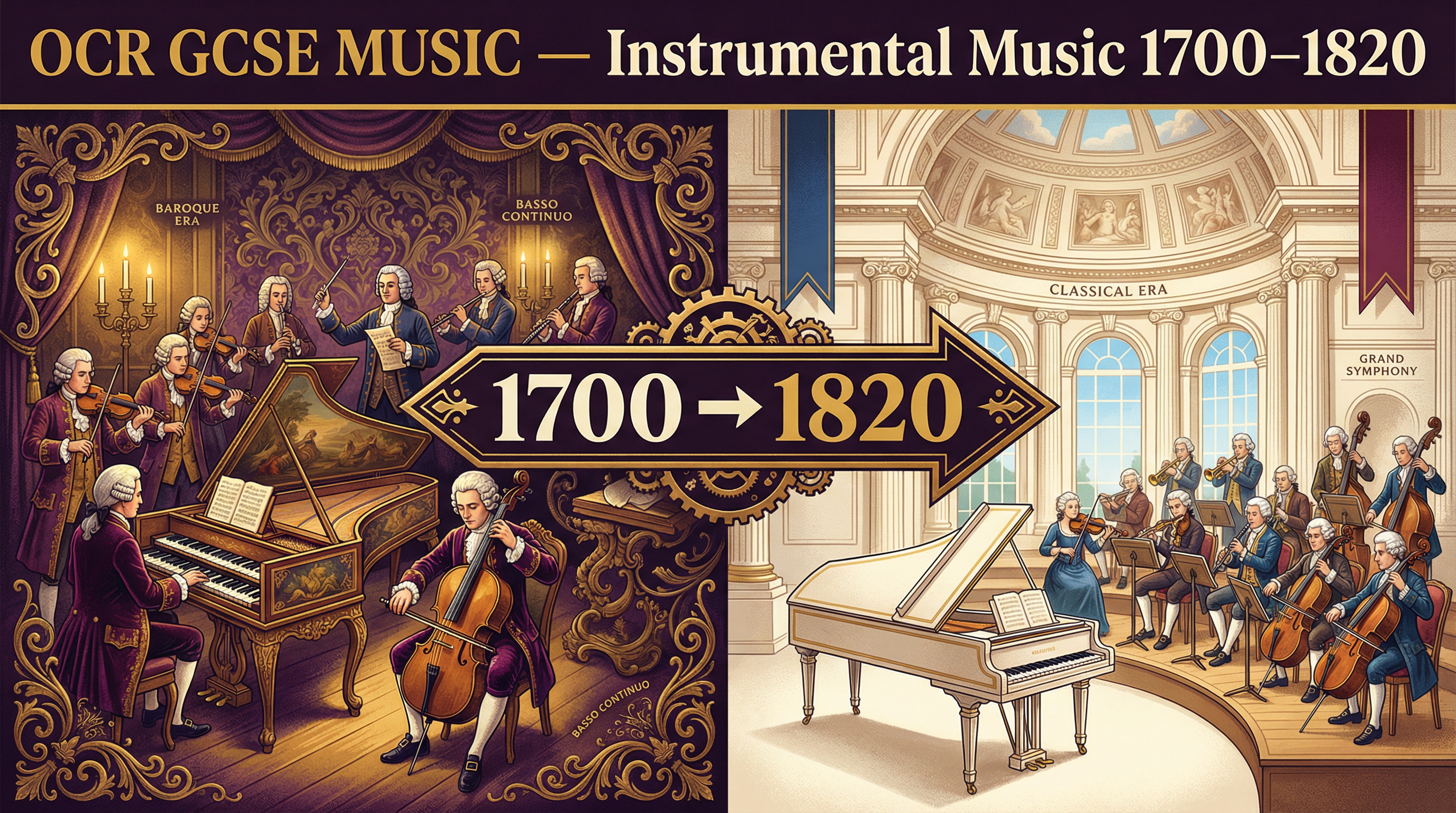
Welcome to your study guide for Instrumental Music, 1700-1820. This period, covering the late Baroque and the entirety of the Classical era, is fundamental to your OCR GCSE Music course. It charts a crucial evolution in musical language, from the intricate polyphony of Bach and Vivaldi to the elegant, balanced structures of Mozart and Haydn. In the listening exam, candidates will be expected to aurally identify and critically analyse unseen extracts, making this a test of both knowledge and perceptive listening. A secure understanding of this topic is essential for achieving high marks in AO4 (listening and appraising).
Key Knowledge & Theory
Core Concepts
The primary focus of this topic is the concerto, a work for a solo instrument (or sometimes a small group of soloists) accompanied by an orchestra. Your main task is to distinguish between the concertos of the Baroque era and those of the Classical era. This involves understanding the key differences in musical elements such as texture, structure, instrumentation, and dynamics.
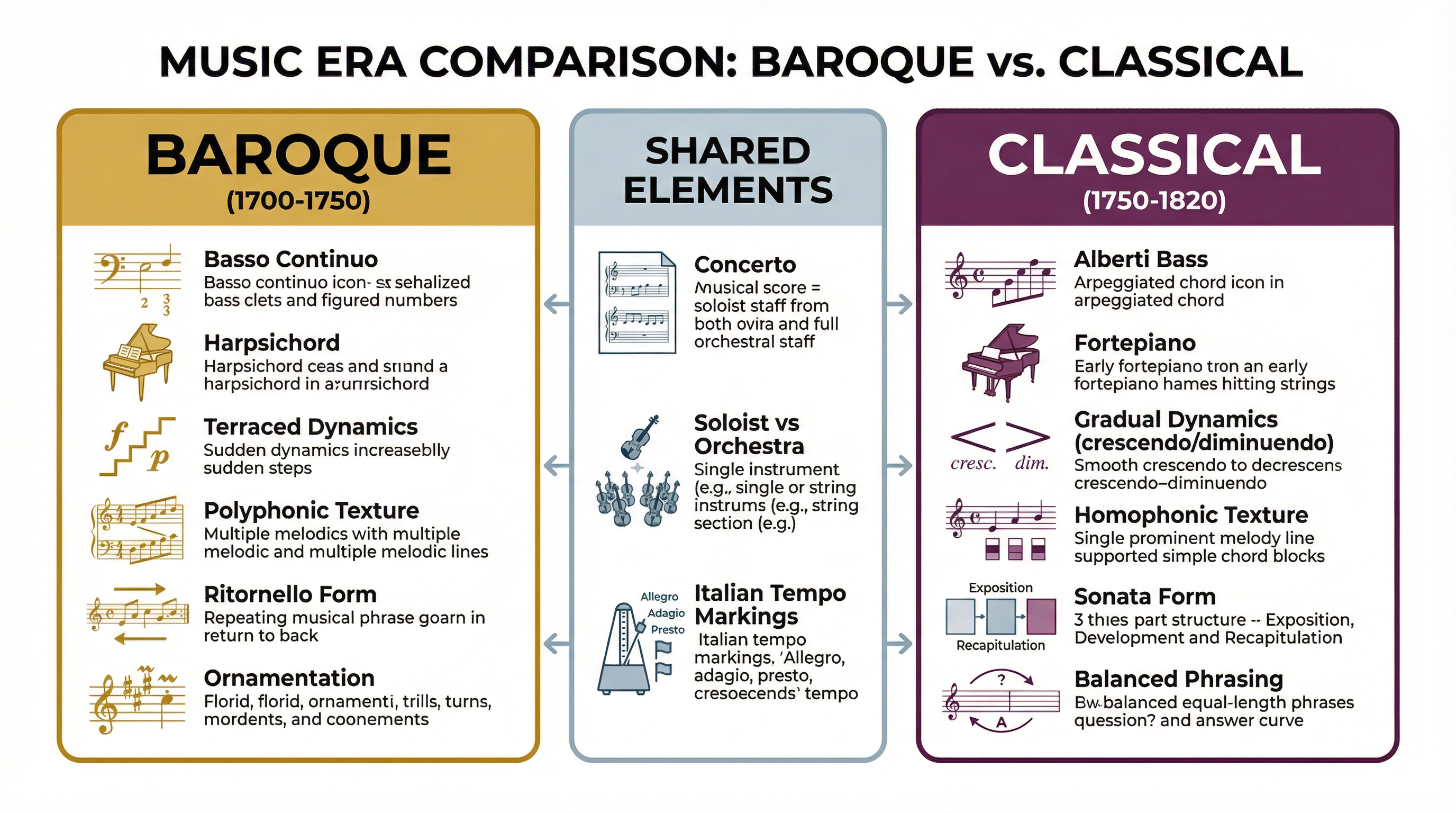
- Baroque Era (c. 1700-1750): Characterised by grandeur, ornamentation, and complex textures. The music is driven by a powerful sense of forward momentum.
- Classical Era (c. 1750-1820): Emphasises clarity, balance, and elegance. The music is structured around clear-cut phrases and well-defined forms.
Key Practitioners/Artists/Composers
| Name | Period/Style | Key Works | Relevance |
|---|---|---|---|
| Antonio Vivaldi | Baroque | The Four Seasons | A master of the Baroque solo concerto, he standardised the three-movement (fast-slow-fast) structure. |
| Johann Sebastian Bach | Baroque | Brandenburg Concertos | His concerti are renowned for their complex polyphonic texture and masterful use of counterpoint. |
| Wolfgang Amadeus Mozart | Classical | Piano Concerto No. 21, Clarinet Concerto | The quintessential Classical composer; his concerti are models of elegance, clarity, and formal perfection. |
| Joseph Haydn | Classical | Trumpet Concerto, Cello Concerto No. 1 | Known as the "Father of the Symphony", his work established many of the conventions of the Classical style. |
Technical Vocabulary
To gain credit in the exam, candidates MUST use the correct terminology. Vague descriptions like "busy texture" or "getting louder" will not be awarded marks.
- Texture: Polyphonic, Homophonic, Monophonic, Unison, Contrapuntal, Melody and Accompaniment.
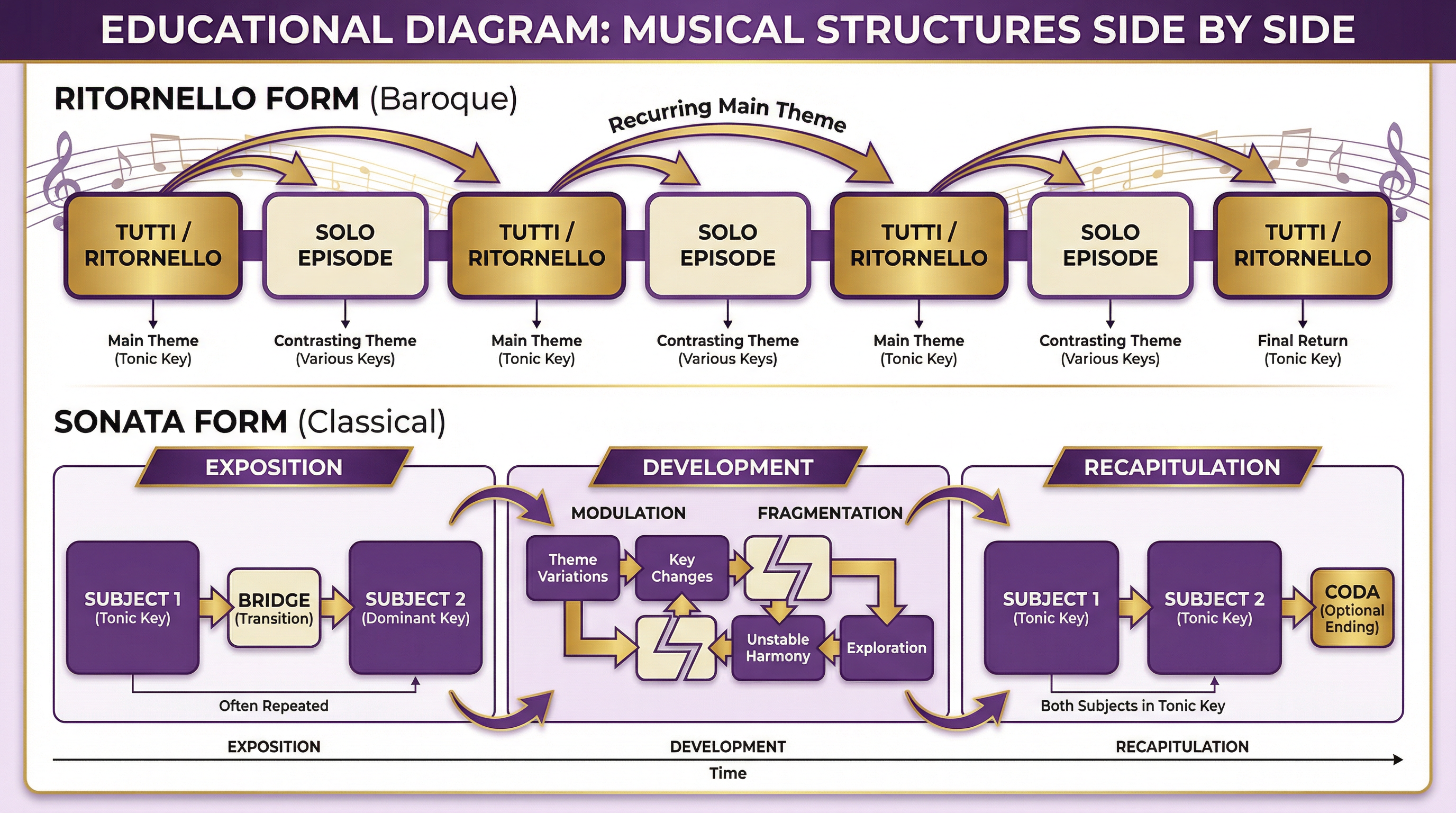
- Structure: Ritornello Form, Sonata Form, Binary, Ternary, Rondo.
- Instrumentation: Basso Continuo, Harpsichord, Fortepiano, Ripieno, Tutti, Concertino, Cadenza.
- Dynamics: Terraced Dynamics, Crescendo, Diminuendo, Forte, Piano, Sforzando.
- Harmony & Tonality: Diatonic, Chromatic, Major, Minor, Modulation, Tonic, Dominant, Perfect Cadence.
- Rhythm & Metre: Simple Time, Compound Time, Dotted Rhythms, Syncopation.
- Melody: Conjunct, Disjunct, Scalic, Triadic, Ornamentation (Trill, Mordent, Turn, Appoggiatura).
Practical Skills
Techniques & Processes
While this is primarily a listening topic, understanding the practical application of these concepts is vital. When composing in a Baroque or Classical style for AO2, consider the following:
- Baroque Composition: Build your piece around a basso continuo. Use a harpsichord sound for the chordal instrument. Create a polyphonic texture by weaving independent melodic lines together. Employ terraced dynamics by marking sections as either forte or piano. Use ornamentation like trills and mordents to decorate the melody.
- Classical Composition: Create a clear homophonic texture with a distinct melody and a supporting accompaniment. Use an Alberti bass pattern for the keyboard. Build your structure around balanced, four-bar phrases (question and answer). Incorporate gradual dynamics (crescendo and diminuendo) to create expressive shape. Structure your first movement in Sonata Form.
Materials & Equipment
In the context of this topic, your ‘materials’ are the sounds themselves. When using a DAW (Digital Audio Workstation) like Logic Pro or GarageBand:
- For Baroque: Select a ‘Harpsichord’ patch. For the basso continuo, use a ‘Cello’ or ‘Bassoon’ sound for the bassline. The string section should be smaller – select a ‘Chamber Strings’ patch rather than a full ‘Symphonic Strings’ patch.
- For Classical: Use a ‘Grand Piano’ or ‘Fortepiano’ patch. The orchestra is larger: use a full string section, and add woodwind instruments like flutes, oboes, clarinets, and bassoons. The clarinet is a key marker of the Classical era.
Portfolio/Coursework Guidance
Assessment Criteria
For your composition portfolio (AO2), examiners are looking for:
- Developing Musical Ideas: How you take a simple motif and develop it using techniques appropriate to the chosen style (e.g., sequencing in Baroque, fragmentation in Classical development sections).
- Compositional Technique: Your ability to control musical elements (melody, harmony, rhythm, texture) to create a coherent and stylistically convincing piece.
- Structure: A clear and logical structure that follows the conventions of the chosen form (e.g., Ritornello, Sonata Form).
Building a Strong Portfolio
- Annotate Your Score: Clearly label key features on your written score. Point out your basso continuo, your second subject in the dominant, your use of a crescendo. This is crucial evidence for the examiner.
- Show Development: Keep drafts of your work. A good portfolio shows a journey from initial ideas to a refined final piece. A short commentary explaining your choices can be very effective.
- Be Idiomatic: Write for the instruments as they would have been used in the period. Avoid asking a Baroque flute to play extremely high, loud passages, for example.
Exam Component
Written Exam Knowledge
The listening exam (AO4) will feature several questions on this Area of Study. You will be played an unheard extract of music and asked questions that require you to:
- Identify the era (Baroque or Classical) and provide musical reasons.
- Describe specific musical features using technical vocabulary.
- Compare and contrast two extracts.
- Complete a skeleton score, filling in missing notes or rhythms.
Practical Exam Preparation
There is no practical exam for this specific topic, but the knowledge underpins your own composition and performance work. Understanding how Mozart structured his concertos can directly inform how you structure your own compositions. Performing a piece from this era requires an understanding of the appropriate performance practice (e.g., how to execute ornaments correctly).