Study Notes

Overview
Melody is a fundamental element of music, defined as a sequence of single notes that is musically satisfying. In the context of OCR GCSE Music, a deep understanding of melody is not just optional; it is essential for success. This element is assessed across all four Areas of Study (AoS), from the concertos of the Baroque era (AoS 2) to the diverse sound worlds of World Music (AoS 3) and the emotive power of Film Music (AoS 4). Examiners are looking for candidates who can move beyond simple descriptions and use precise technical vocabulary to analyse how melodies are constructed and what effect they create. This guide will equip you with the knowledge and skills to deconstruct, describe, and create effective melodies, directly targeting the marking criteria for both the listening exam and the composition portfolio.
Key Knowledge & Theory
Core Concepts
To analyse melody effectively, you must be fluent in its core components. These are the building blocks that composers use to create memorable and impactful tunes.
**1. Contour and Movement:**The contour is the shape of the melody. When you listen, you should be able to trace its shape. Is it generally ascending (moving up), descending (moving down), or does it form an arch (rising then falling)? Some melodies are static, hovering around a single pitch. The movement between notes can be either conjunct (moving by step, e.g., C to D) or disjunct (moving by leap, e.g., C to G). Conjunct melodies often sound smooth and flowing, while disjunct melodies can feel more dramatic or angular. A common mistake is to confuse conjunct with chromatic. A conjunct melody moves by step within the key (diatonically), whereas a chromatic melody uses notes from outside the key, often moving by semitone.
**2. Intervals:**An interval is the distance between two pitches. Simply describing a leap as 'large' will not earn marks. You must identify the specific interval. For example, the leap from C to G is a Perfect 5th. You must be able to aurally recognise and name key intervals, as these are frequent discriminators in the listening exam. Use the reference chart below to solidify your knowledge.
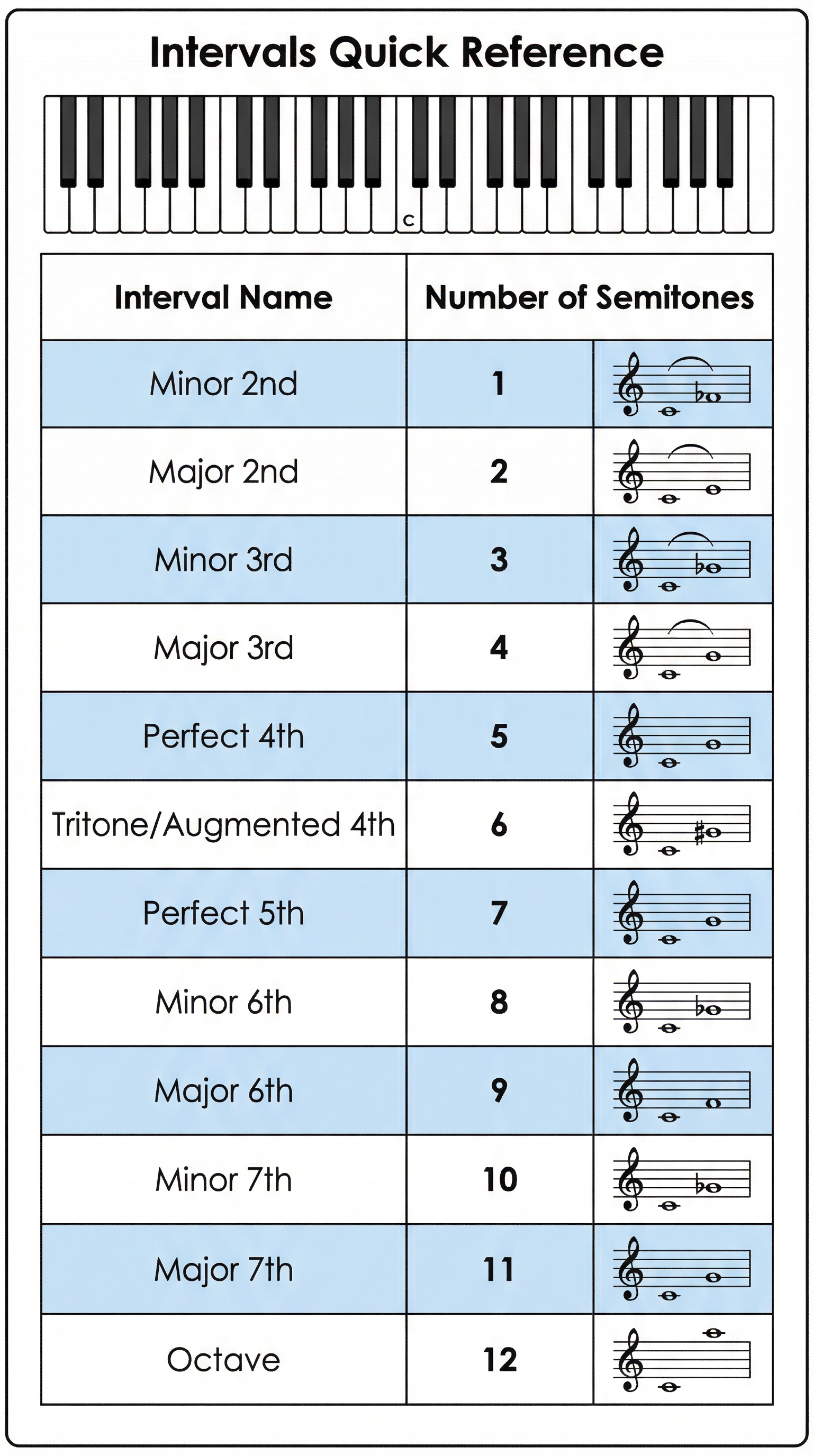
**3. Melodic Devices:**Composers use a range of devices to develop melodic ideas. Being able to spot and name these is a high-level skill that examiners reward.
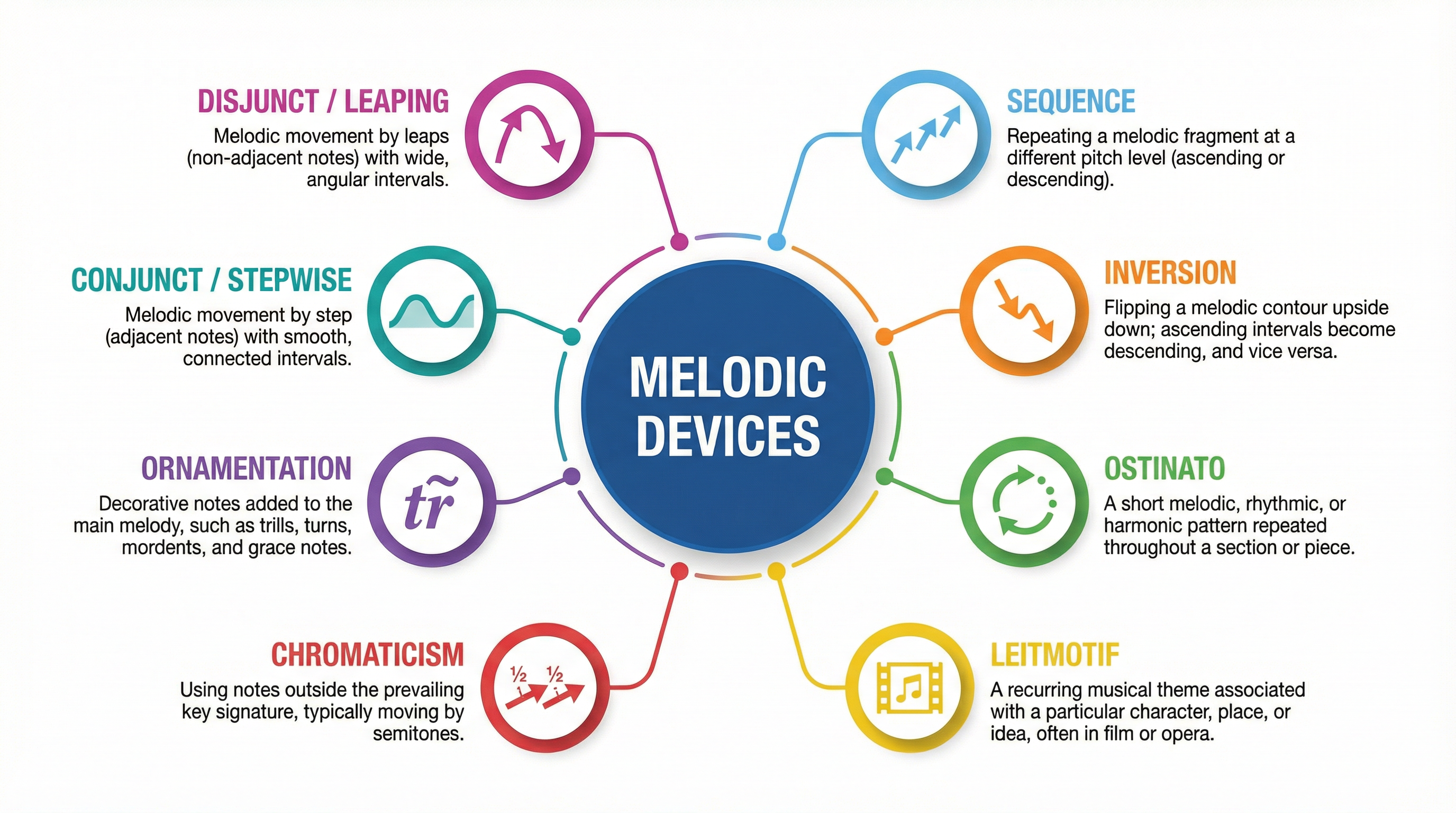
- Sequence: Repeating a melodic idea at a higher or lower pitch.
- Inversion: Flipping a melody's contour upside down. An ascending interval becomes a descending one of the same size.
- Ostinato (or Riff): A short, constantly repeated melodic or rhythmic pattern.
- Leitmotif: A recurring melodic idea associated with a person, place, or concept, most common in film music (AoS 4).
- Ornamentation: Adding decorative notes to a melody, such as trills, mordents, turns, or grace notes (acciaccaturas). In World Music (AoS 3), you may also hear pitch bends and glissandos.
4. Vocal Melody: Syllabic vs. MelismaticWhen analysing vocal music, you must describe how the melody is set to the lyrics. Is it syllabic, with one note per syllable? This makes the text clear and direct. Or is it melismatic, with multiple notes sung on a single syllable? This is often used for emphasis or emotional expression.
Key Practitioners/Composers
| Name | Period/Style | Key Works | Relevance to Melody |
|---|---|---|---|
| J.S. Bach | Baroque | Brandenburg Concertos, Cello Suites | Master of complex, polyphonic melodies and devices like sequence and inversion. His melodies are often highly ornate and built from small motifs. |
| W.A. Mozart | Classical | 'Eine kleine Nachtmusik', Symphony No. 40 | Known for creating clear, balanced, and memorable 'singable' melodies. His use of question-and-answer phrasing is a key feature. |
| John Williams | 20th/21st Century Film | Star Wars, Harry Potter, Jaws | The modern master of the leitmotif. His scores are a perfect case study for how melody can represent character and drive a narrative. |
Technical Vocabulary
Using precise terminology is non-negotiable. Integrate these words into your analysis:
- Contour: Ascending, Descending, Arch-shaped, Static
- Movement: Conjunct, Disjunct, Stepwise, Leaping
- Tonality: Diatonic, Chromatic, Pentatonic, Modal
- Devices: Sequence, Inversion, Ostinato, Pedal Note, Drone, Leitmotif
- Ornamentation: Trill, Mordent, Turn, Appoggiatura, Acciaccatura, Glissando, Pitch Bend
- Vocal Setting: Syllabic, Melismatic
- Phrasing: Antecedent & Consequent, Question & Answer
Practical Skills
Techniques & Processes
**1. Melodic Dictation (Listening Exam Skill):**This is often the most feared part of the exam, but a systematic approach makes it manageable. Follow the 'Look, Listen, Write' method:
- Look: Before the music starts, look at the key signature and time signature. Note them down. See how many bars you need to write.
- Listen (1st playing): Do not write. Tap the rhythm. Get the pulse and the rhythmic shape in your head.
- Write (after 1st playing): Notate the rhythm on a single line. This is your scaffold.
- Listen (2nd playing): Focus on the contour. Is it going up or down? Sketch the shape of the notes above your rhythm.
- Write (after 2nd playing): Refine the pitches. Use the starting note as your anchor and work out the intervals. Remember, credit is given for correct contour even if some pitches are wrong.
- Listen (Final playing): Check your work. Pay close attention to accidentals and the final note.
**2. Compositional Techniques (Coursework Skill):**When composing, don't just write random notes. Use melodic devices to create interest and structure:
- Start with a Motif: Create a short, memorable melodic idea (a motif).
- Develop with Sequence: Take your motif and repeat it at a higher or lower pitch. An ascending sequence builds excitement.
- Create Contrast with Inversion: Invert your motif to create a contrasting section.
- Use an Ostinato: Create a repeating bassline or accompanying pattern (an ostinato) and write a new melody over the top.
Portfolio/Coursework Guidance
Assessment Criteria
For your composition portfolio, examiners award marks for the development of musical ideas. A simple, undeveloped melody will not score highly, no matter how pleasant it sounds. You must show that you can take a melodic idea and manipulate it using compositional devices. Your annotation is crucial here; you must label where you have used a sequence, an inversion, or other techniques to show the examiner you understand the process.
Building a Strong Portfolio
- Evidence Your Process: Keep sketches of your initial motifs. Show how you experimented with them (e.g., trying a sequence, inverting it).
- Annotate with Precision: Don't just write 'melody'. Write 'The main theme is introduced by the oboe, featuring a disjunct contour and a prominent rising perfect 5th.' Label your use of devices clearly on the score.
- Refine and Edit: Your first idea is rarely your best. Show that you have reviewed your melody and made improvements, perhaps by altering the rhythm for more interest or adding ornamentation.
Exam Component
Written Exam Knowledge
In the listening exam, you will face two main types of melody question:
- Melodic Dictation: Notating a short melody played on an instrument.
- Descriptive/Analytical Questions: Describing the features of a melody from an extract (e.g., 'Describe the melody in the solo violin part between bars 5 and 10').
For descriptive questions, create a checklist: Contour, Movement, Devices, Ornamentation. Try to comment on each one.
Practical Exam Preparation
Your composition is worth 30% of your GCSE. Whether you are freely composing or working to a board-set brief, the quality of your melody is paramount. Spend time crafting a strong, memorable main theme, as this is the material you will develop throughout the rest of your piece. A weak initial melody will make it very difficult to create a convincing composition.