Study Notes
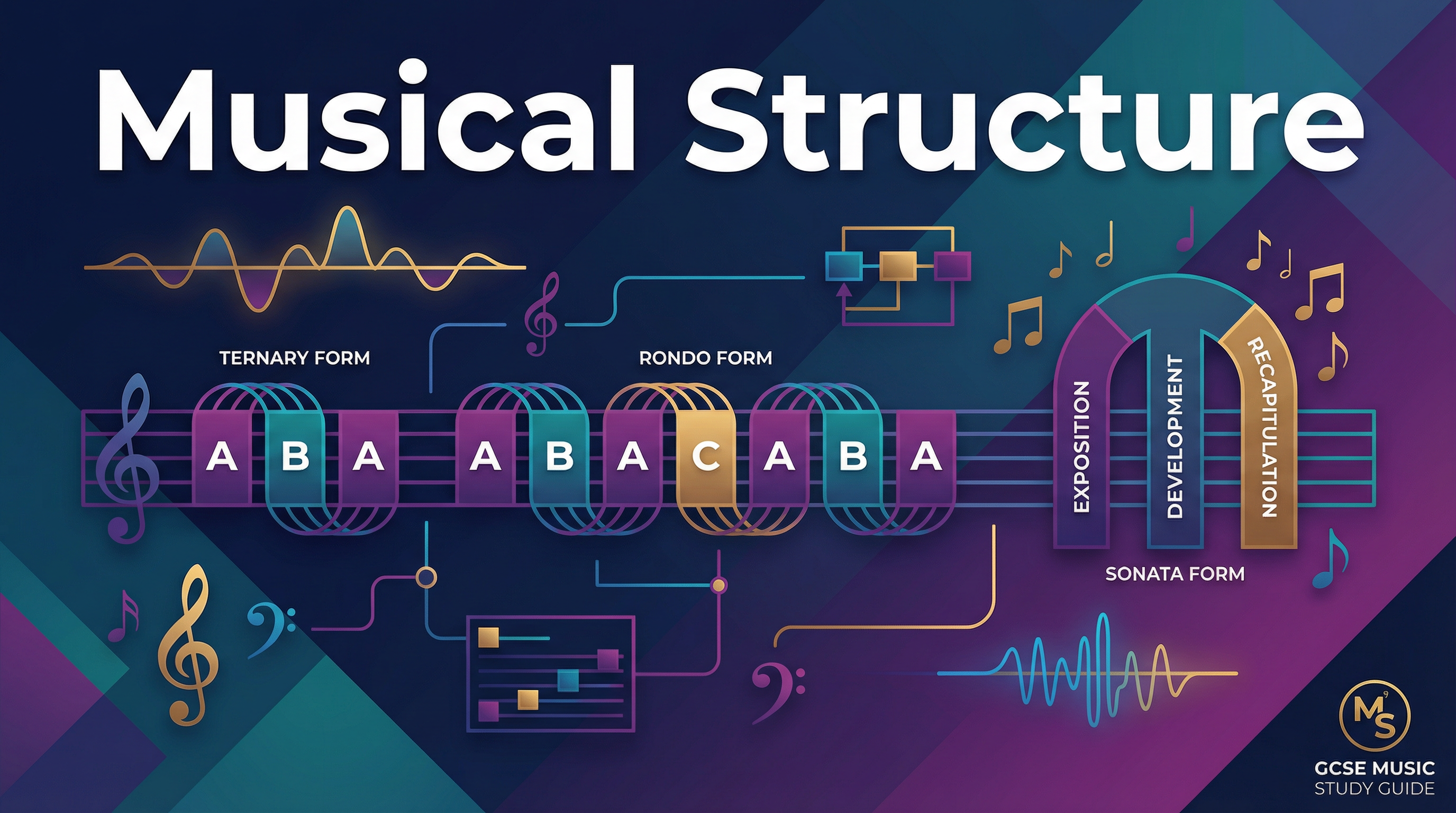
Overview
Structure is the architectural blueprint of music — the framework that determines how a composer organises musical ideas over time. In the OCR GCSE Music specification, Structure falls under Topic 4.8 and is assessed entirely through AO3 (Listening and Appraising), meaning every mark available for this topic comes from your ability to hear, identify, and describe structural forms in the Listening examination. Whether the extract comes from the Western Classical Tradition (AoS 2), Popular Music (AoS 5), or any other Area of Study, examiners expect candidates to deploy precise technical vocabulary and to link structural observations to related musical elements such as tonality, texture, and dynamics.
This guide covers every structural form you need to know, from the simplest Binary Form to the complex multi-section architecture of Sonata Form. It also addresses the Italian navigation terms (Da Capo, Dal Segno, Coda) that appear regularly in exam questions, and provides worked examples with full examiner commentary to show you exactly how marks are awarded.
Key Knowledge & Theory
Core Concepts
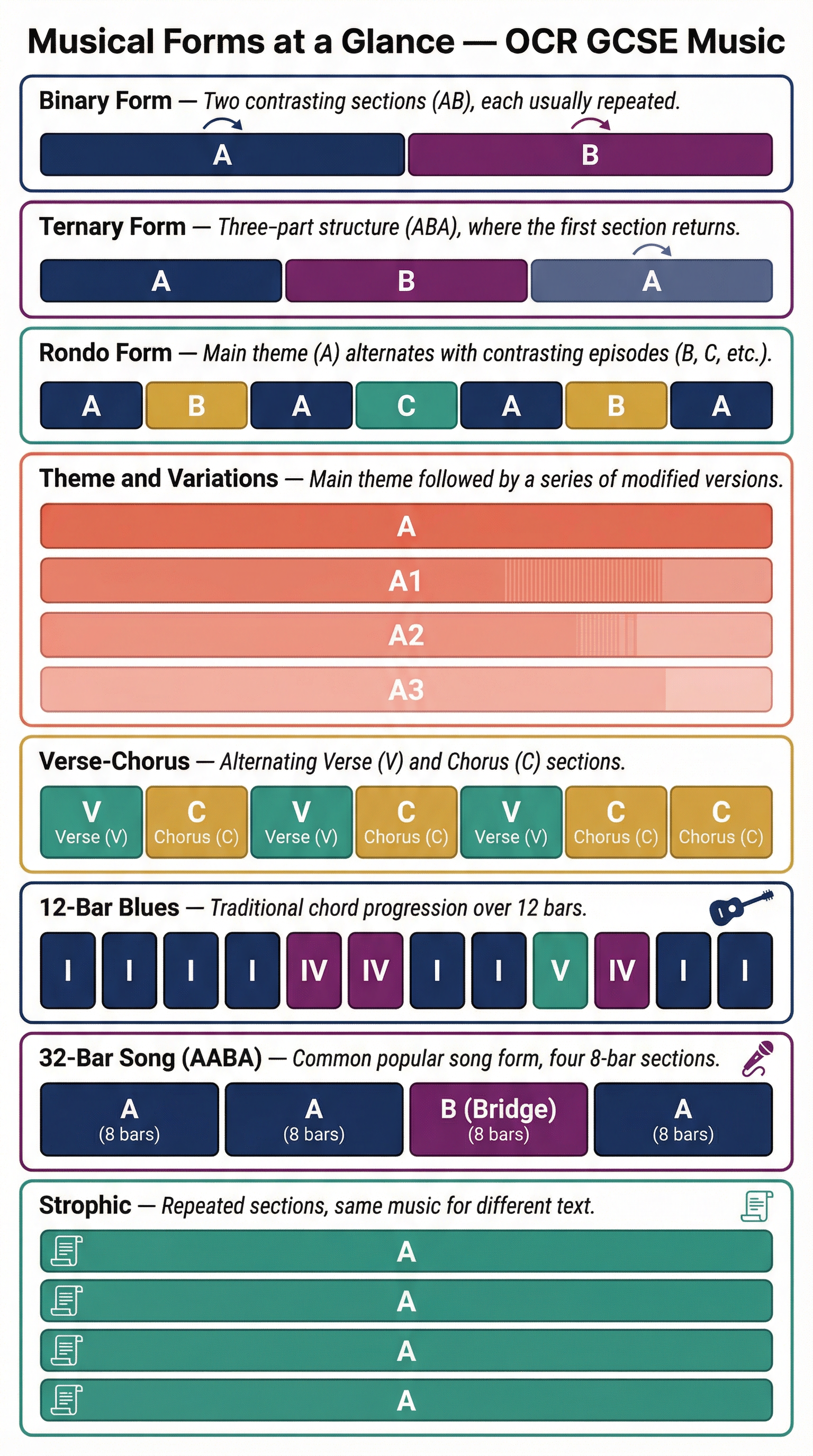
Binary Form (AB) is a two-section structure in which each section is typically repeated (A A B B). The A section begins and ends in the tonic key, while the B section modulates to a related key — most commonly the dominant (a perfect fifth above the tonic) in major-key pieces, or the relative major in minor-key pieces. Binary Form is strongly associated with the Baroque era and appears frequently in dance suites and keyboard pieces.
Ternary Form (ABA) extends Binary Form by returning to the opening material after a contrasting middle section. The return of A is the defining characteristic: it may be an exact repeat or a slightly varied version (sometimes notated A'). The B section provides contrast through a different key, mood, or texture. Ternary Form is found in Classical minuets, Romantic character pieces, and some popular songs.
Rondo Form (ABACABA...) features a recurring main theme (the refrain or ritornello) that alternates with contrasting episodes. The A section always returns in the tonic key, while episodes explore contrasting keys and material. Rondo is common in the final movements of Classical concertos and symphonies. The critical distinction from Ternary Form is the number of contrasting episodes: Ternary has one (B), Rondo has multiple (B, C, D...).
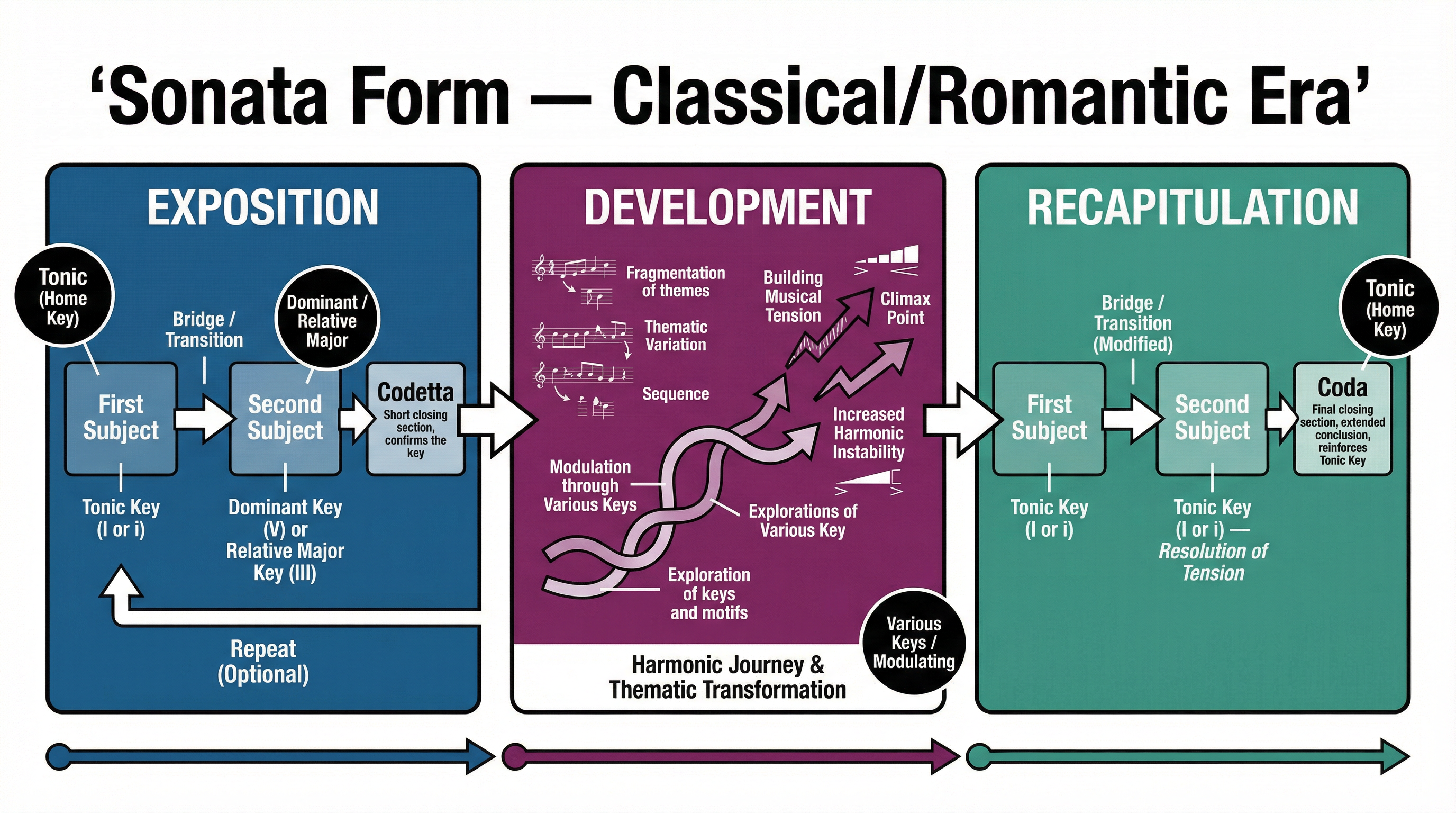
Sonata Form is the most complex structure at GCSE level and is essential for AoS 2 (Concerto Through Time). It comprises three sections:
- Exposition: First Subject in the tonic; Bridge/Transition; Second Subject in the dominant (or relative major); Codetta.
- Development: Thematic fragmentation, modulation through various keys, harmonic instability.
- Recapitulation: Both subjects return in the tonic key; Coda closes the movement.
The key diagnostic feature is the key relationship of the Second Subject: dominant in the Exposition, tonic in the Recapitulation.
Theme and Variations (A A1 A2 A3...) presents a theme followed by a series of modified versions. Variation techniques include melodic ornamentation, rhythmic augmentation or diminution, harmonic reharmonisation, textural changes (e.g., adding counterpoint), changes of mode (major to minor), and changes of tempo or metre. Candidates must specify the technique used, not merely state that the music 'changes'.
Minuet and Trio is a compound form in which a Minuet (itself in Ternary Form) is followed by a Trio (also in Ternary Form), after which the Minuet is repeated — indicated by the instruction Da Capo (return to the beginning). The Trio is typically in a contrasting key or texture.
Verse-Chorus Form is the dominant structure in popular music. The Verse carries the narrative (lyrics change each time; music is similar) while the Chorus provides the emotional peak (same lyrics repeated; usually louder, higher, and more memorable). Additional structural elements include the Pre-chorus (builds anticipation), Bridge or Middle 8 (contrasting section, often 8 bars), and Outro.
32-Bar Song Form (AABA) consists of four eight-bar sections: A, A, B, A. The B section (called the Bridge or Release) provides contrast before the final return of A. This form was ubiquitous in Tin Pan Alley and early jazz standards.
12-Bar Blues is a repeating harmonic pattern over exactly 12 bars using three chords:
| Bar | 1 | 2 | 3 | 4 | 5 | 6 | 7 | 8 | 9 | 10 | 11 | 12 |
|---|---|---|---|---|---|---|---|---|---|---|---|---|
| Chord | I | I | I | I | IV | IV | I | I | V | IV | I | I |
Candidates must know this pattern precisely for AoS 5 questions.
Strophic Form repeats the same music for each verse, with only the lyrics changing. There is no distinct contrasting chorus melody. Common in folk songs, hymns, and early ballads.
Ritornello Form is associated with the Baroque concerto. A recurring orchestral passage (the ritornello) alternates with solo episodes. The ritornello returns in the tonic at the end and may appear in other keys during the piece. Vivaldi's concertos are the primary examples for AoS 2.
Key Practitioners/Artists/Composers
| Name | Period/Style | Key Works | Relevance |
|---|---|---|---|
| J.S. Bach | Baroque (1685–1750) | Brandenburg Concertos, Well-Tempered Clavier | Binary Form in dance suites; Ritornello Form in concertos |
| Antonio Vivaldi | Baroque (1678–1741) | The Four Seasons | Ritornello Form; foundational for AoS 2 Concerto Through Time |
| W.A. Mozart | Classical (1756–1791) | Symphony No. 40, Piano Sonata K.331 | Sonata Form, Rondo Form, Theme and Variations |
| Joseph Haydn | Classical (1732–1809) | 'Surprise' Symphony No. 94 | Sonata Form, Theme and Variations |
| Ludwig van Beethoven | Classical/Romantic (1770–1827) | Piano Sonata 'Pathétique', Symphony No. 5 | Extended Sonata Form, Coda development |
| Robert Johnson | Blues/Early 20th C | Cross Road Blues | 12-bar Blues structure; AoS 5 relevance |
| Chuck Berry | Rock and Roll (1950s–60s) | Johnny B. Goode | 12-bar Blues, Verse-Chorus in popular context |
Technical Vocabulary
Candidates must use the following terms precisely in examination answers. Vague descriptive language will not be credited.
Structure terms: Binary, Ternary, Rondo, Sonata Form, Theme and Variations, Minuet and Trio, Strophic, Verse-Chorus, 32-bar Song Form (AABA), 12-bar Blues, Ritornello Form, Through-composed.
Sonata Form sections: Exposition, First Subject, Second Subject, Bridge/Transition, Codetta, Development, Recapitulation, Coda.
Popular music sections: Verse, Chorus, Pre-chorus, Bridge, Middle 8, Intro, Outro, Hook.
Italian navigation terms: Da Capo (D.C.) — return to the beginning; Dal Segno (D.S.) — return to the sign (𝄋); Coda — closing section; Codetta — short closing section; Fine — the end; Repeat signs.
Analytical terms: Modulation, Tonic, Dominant, Relative major/minor, Fragmentation, Sequence, Ostinato, Ground bass.
Practical Skills
Techniques & Processes
Active Listening for Structure: When a listening extract plays, use the rough working paper to map the structure in real time. Write letters (A, B, A1) as each new section begins. Note when the opening material returns — this is the key diagnostic moment for distinguishing Ternary from Rondo. Count bars where possible, especially for 12-bar Blues identification.
Linking Structure to Other Elements: Examiners award higher marks when candidates connect structural observations to related musical features. When identifying the Development section of a Sonata Form movement, note the harmonic instability and modulation. When identifying the Chorus in a Verse-Chorus song, note the increased dynamics, higher register, or fuller texture.
Using Italian Terms Correctly: Da Capo and Dal Segno are navigation instructions, not structural forms. Minuet and Trio uses Da Capo to indicate the return of the Minuet — this is a structural feature worth mentioning in exam answers.
Materials & Equipment
For the Listening examination, candidates will need: a pen, the question paper, and access to rough working paper. The examination uses audio extracts played through speakers or headphones. Candidates should practise active listening using past paper audio files available on the OCR website, training themselves to identify structural signposts within the first few seconds of an extract.
Portfolio/Coursework Guidance
Assessment Criteria
While Structure (4.8) is assessed primarily through the Listening exam (AO3), understanding of structure directly informs the Composition component. In Composition, candidates who demonstrate conscious structural planning — choosing an appropriate form for their brief and executing it with clear sectional organisation — will access higher mark bands. Annotations should reference the chosen structure explicitly (e.g., 'I have used Ternary Form: the B section modulates to the relative minor to create contrast before the return of A').
Building a Strong Portfolio
In the Composition portfolio, evidence of structural decision-making is highly valued. Candidates should annotate their scores or recordings to explain why they chose a particular form, how they created contrast between sections, and how they achieved a sense of return or resolution. Referencing named composers and their structural approaches (e.g., 'following Mozart's use of Sonata Form') demonstrates the synoptic understanding that examiners reward.
Exam Component
Written Exam Knowledge
Structure questions in the OCR Listening paper typically carry 1–4 marks and use command words including 'Identify', 'Describe', 'Explain', and 'Analyse'. For 1-mark questions, a single correct term suffices. For 2–4 mark questions, candidates must name the form and support their answer with specific structural observations linked to the music heard.
The OCR mark scheme awards credit for: precise identification of the form; correct labelling of sections (A, B, A1 etc.); reference to key relationships (tonic, dominant); identification of structural signposts (Codetta, Bridge, Pre-chorus); and use of Italian navigation terminology where relevant.
Practical Exam Preparation
For the Listening examination, candidates should practise with past paper audio extracts under timed conditions. The recommended strategy is: (1) listen to the extract once for overall impression; (2) on the second hearing, map the structure on rough paper; (3) on the third hearing, confirm key relationships and identify specific structural features; (4) write the answer using precise technical vocabulary.