Study Notes
Overview
Understanding musical structure is like having a map for a piece of music. It shows you the overall plan the composer has used, how the different sections are arranged, and how the musical journey unfolds. For the OCR GCSE Music exam, your ability to aurally identify these structures is a critical skill that accounts for a significant portion of the marks in the Listening and Appraising paper. This guide will break down the key forms, provide you with the technical vocabulary examiners expect, and give you practical strategies for identifying them under exam conditions.
Key Knowledge & Theory
Core Concepts
Musical structure, or form, is the organisation of musical ideas. Composers use principles of repetition, contrast, and variation to build a coherent and engaging piece. At GCSE level, you need to be able to recognise several key architectural patterns by ear.
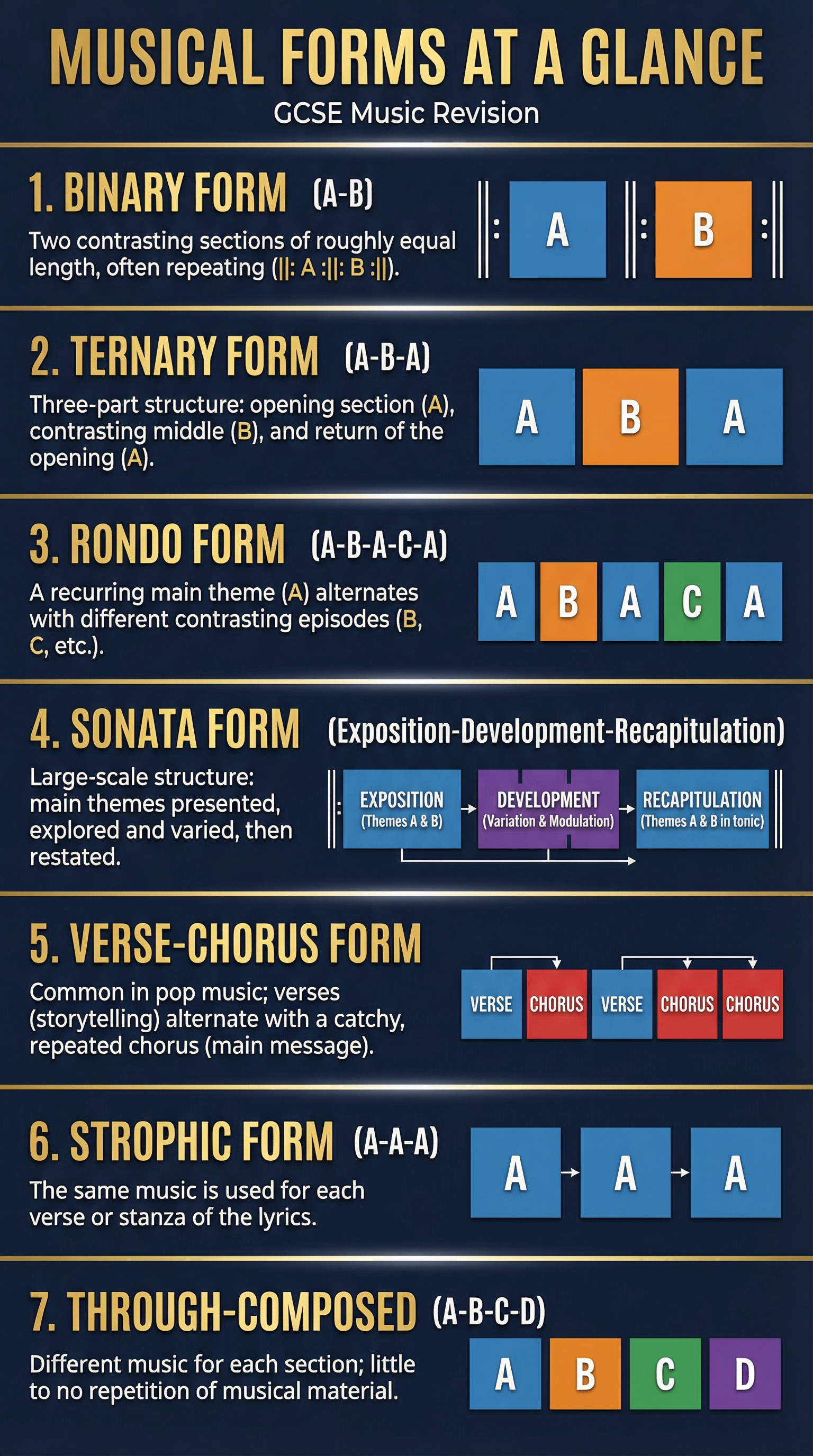
- Binary Form (A-B): Two contrasting sections. Section A often moves from the tonic to the dominant key, and Section B moves back. Common in Baroque dance suites.
- Ternary Form (A-B-A): A three-part structure. An opening section (A), a contrasting middle section (B), and a return to the opening material (A). The return of A provides a sense of balance and closure.
- Rondo Form (A-B-A-C-A): A principal theme (A) alternates with contrasting episodes (B, C, etc.). The recurring A section acts as a familiar anchor for the listener. Common in final movements of classical works.
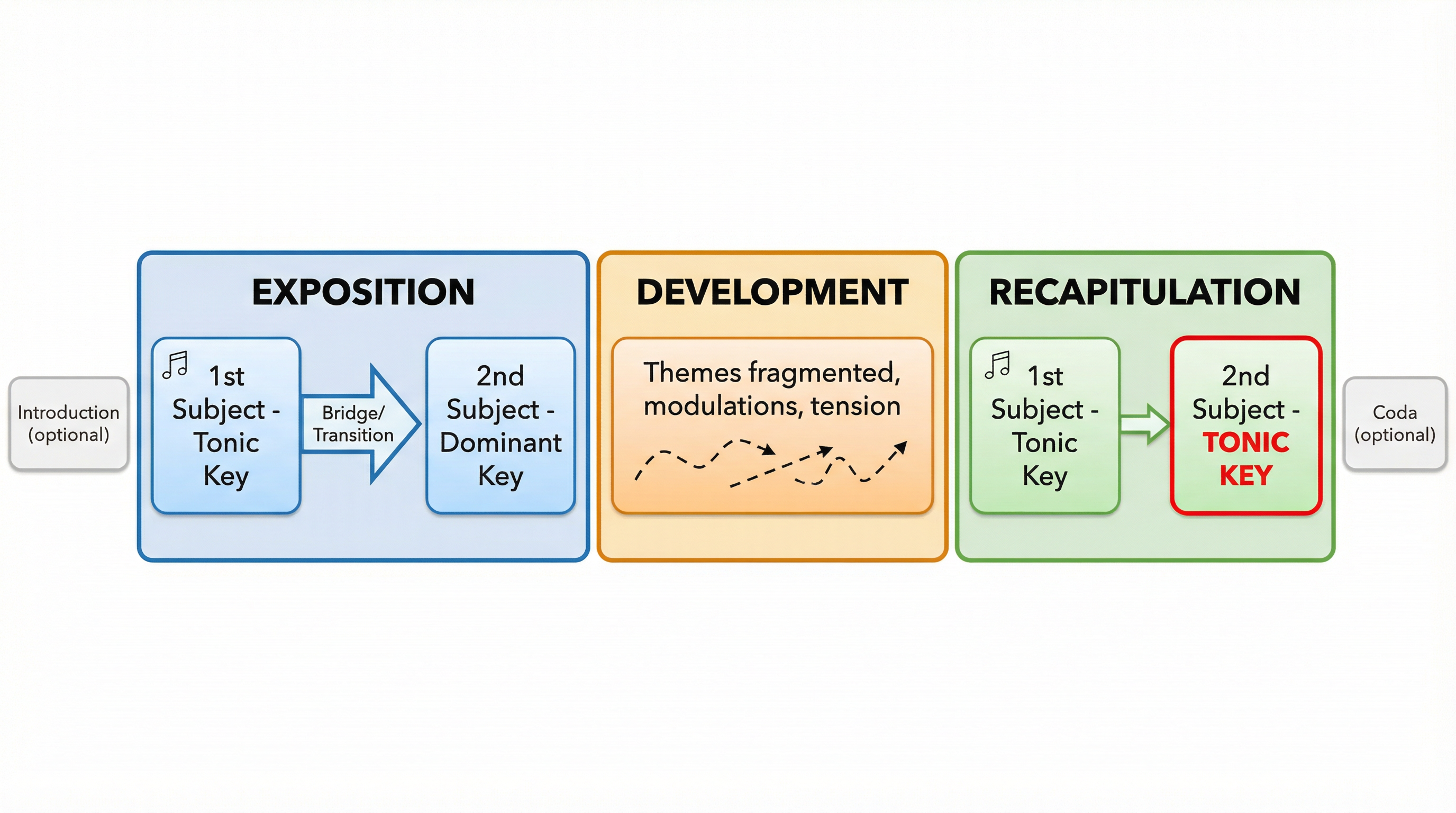
- Sonata Form: The most complex form at this level, often described as a musical drama. It has three main parts: Exposition, Development, and Recapitulation.
- Exposition: Introduces two contrasting themes (subjects). The 1st subject is in the tonic key; the 2nd subject is in a related key (usually the dominant).
- Development: The composer 'develops' the themes from the exposition, fragmenting them, changing keys, and building tension.
- Recapitulation: The themes from the exposition return, but this time both the 1st and 2nd subjects are in the tonic key, providing resolution.
- Verse-Chorus Form: The standard structure for most popular music. The verses tell the story and have different lyrics, while the chorus provides the main hook and has repeating lyrics and music.
- Strophic Form (A-A-A...): The same music is used for each verse or stanza of the lyrics. Common in hymns and folk songs.
- Through-Composed (A-B-C-D...): New music is used for each section, with little to no repetition. This allows the music to closely follow a narrative.
Key Practitioners/Artists/Composers
| Name | Period/Style | Key Works | Relevance |
|---|---|---|---|
| W.A. Mozart | Classical | Eine kleine Nachtmusik, Symphony No. 40 | A master of Sonata, Rondo, and Minuet & Trio forms. His works are classic examples. |
| L. van Beethoven | Late Classical/Romantic | Piano Sonata No. 8, Symphony No. 5 | Expanded and experimented with Sonata form, often using extended codas and dramatic developments. |
| Franz Schubert | Early Romantic | Erlkönig, Gretchen am Spinnrade | A key composer of German Lieder (art songs), frequently using Strophic and Through-Composed forms. |
| The Beatles | Pop/Rock | Yesterday, Hey Jude, A Day in the Life | Pioneers of popular song structures, using Verse-Chorus form but also experimenting with bridges, codas, and unconventional forms. |
Technical Vocabulary
Using precise terminology is essential for gaining marks. You MUST use these words in your analysis.
- Introduction: A preparatory section at the beginning of a piece.
- Coda: An ending section that brings the piece to a close.
- Ostinato: A short, constantly repeated rhythmic or melodic pattern.
- Bridge: A linking passage. In pop music, it's a contrasting section before the final chorus. In Sonata form, it's the transition between the 1st and 2nd subjects.
- Middle 8: A contrasting 8-bar section in a pop song, typically appearing after the second chorus.
- Modulation: The process of changing from one key to another.
Practical Skills
Techniques & Processes
The primary practical skill is Aural Analysis. This involves active listening to identify structural markers.
- First Listen - The Big Picture: On your first hearing, don't try to analyse. Just listen. What is the overall mood? Is it vocal or instrumental? What genre is it?
- Second Listen - Spotting Repetition: Now, listen specifically for repeated sections. Does the opening music come back? If so, it could be Ternary or Rondo. If not, it might be Binary or Through-Composed.
- Third Listen - Mapping the Sections: Use the timeline provided in the exam. Make a mark every time you hear a clear change in the music (e.g., new melody, change of key, different instruments). Label these sections A, B, C, etc. Now look at the pattern you've created.
- Fourth Listen - Refining the Details: Focus on the transitions. How does the composer move from one section to the next? Is there a clear modulation? Is there a linking bridge?
Materials & Equipment
Your primary equipment in the exam is your ears and a pencil! Use the provided exam paper and any timelines or score extracts to your advantage. When practising, use good quality headphones to ensure you can hear all the details in the music, especially subtle changes in texture and tonality.
Portfolio/Coursework Guidance
While Structure is primarily assessed in the listening exam, it is also fundamental to the Composition component (AO2). A well-structured composition will always score more highly.
Assessment Criteria
Examiners look for evidence of a clear and appropriate structure in your compositions. For high marks, your composition should demonstrate:
- Coherence: The structure makes sense and holds the piece together.
- Contrast and Variety: You have used contrasting sections to maintain the listener's interest.
- Development of Ideas: You have taken musical ideas and developed them, not just repeated them without change.
- Appropriateness: The chosen structure is suitable for the style and intention of your piece.
Building a Strong Portfolio
When composing, plan your structure from the outset. A simple mind map can be effective:
- Start with a form: Decide if you're writing a pop song (Verse-Chorus), a simple instrumental piece (Ternary), or something more ambitious.
- Map your sections: Block out the different sections (Intro, Verse 1, Chorus, Verse 2, Chorus, Bridge, Chorus, Outro).
- Plan your keys: Decide on the key for each section. A simple modulation from the tonic to the dominant for a contrasting section is a reliable technique.
- Annotate your score: Clearly label the sections in your score or DAW. This shows the examiner you have consciously thought about the structure.
Exam Component
Written Exam Knowledge
The Listening and Appraising exam (Component 03) is where your knowledge of structure will be directly tested. You will be played extracts of music from the four Areas of Study and asked questions that require you to identify and describe the form.
Practical Exam Preparation
For the composition component (Component 02), you will create two compositions. One is a free composition, and the other is to a brief set by OCR. In both cases, selecting and executing a clear structure is key to success. Practice creating short pieces in different forms (e.g., write a 16-bar piece in Binary form, a 32-bar piece in Ternary form) to build your confidence.