Study Notes
Overview
Component 03, the Listening and Appraising paper, is a test of your ability to listen critically and connect musical features to their specific context. This component accounts for a significant portion of your final mark and is split equally between AO3 (demonstrating knowledge of context) and AO4 (comparing and appraising). This guide will break down the four key Areas of Study, providing you with the core knowledge and analytical frameworks needed to excel.
Key Knowledge & Theory
Core Concepts
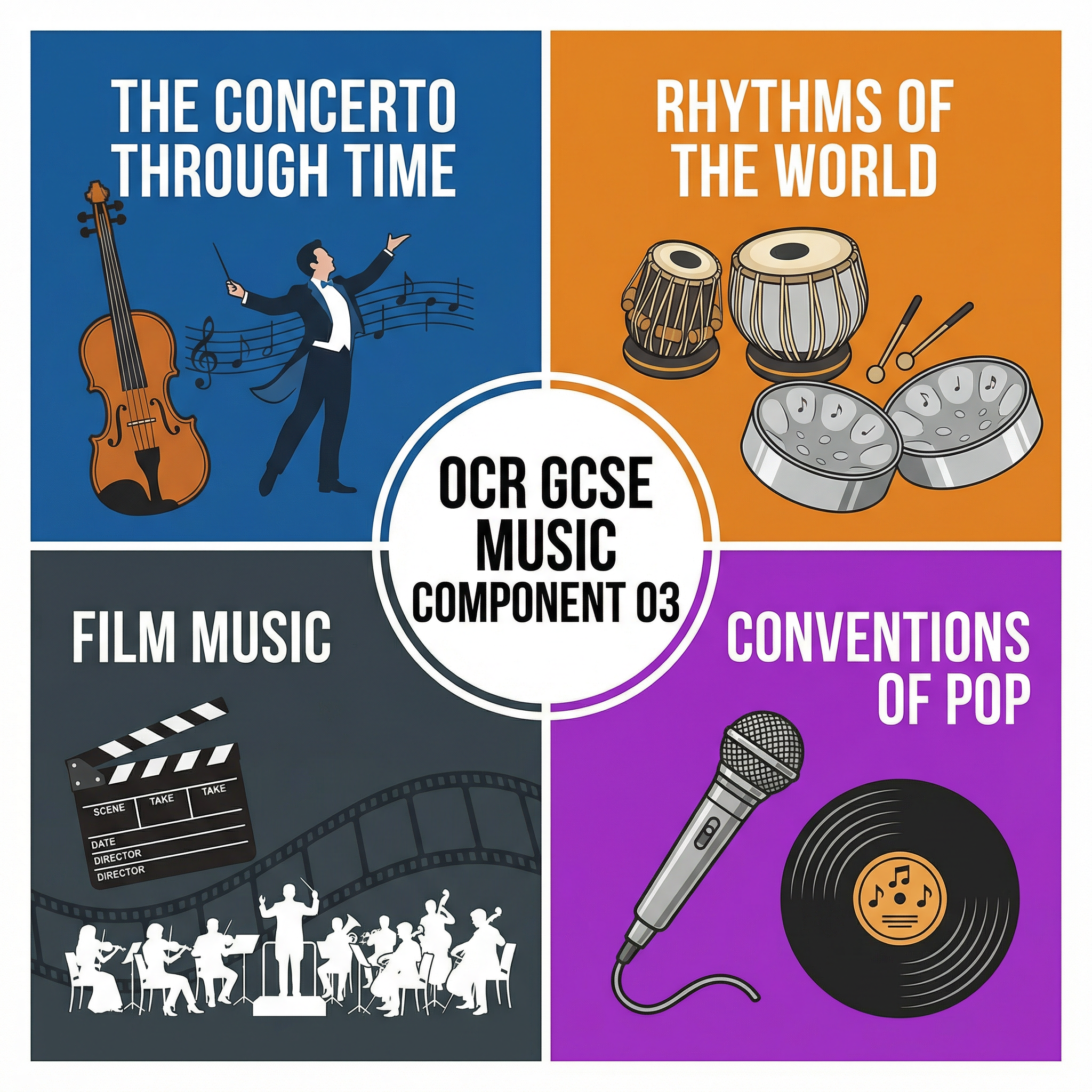
Success in this component hinges on your understanding of how musical elements are used differently across various historical periods, cultural traditions, and functional purposes. The four Areas of Study provide the foundation for this knowledge:
- The Concerto Through Time: Tracing the evolution of the concerto from the Baroque, through the Classical and Romantic periods, to the 20th Century.
- Rhythms of the World: Exploring diverse musical traditions from India, Africa, the Caribbean, and Latin America.
- Film Music: Analysing the techniques composers use to create atmosphere, support narrative, and evoke emotion in cinema.
- Conventions of Pop: Charting the development of popular music from the 1950s to the present day, focusing on stylistic and structural norms.
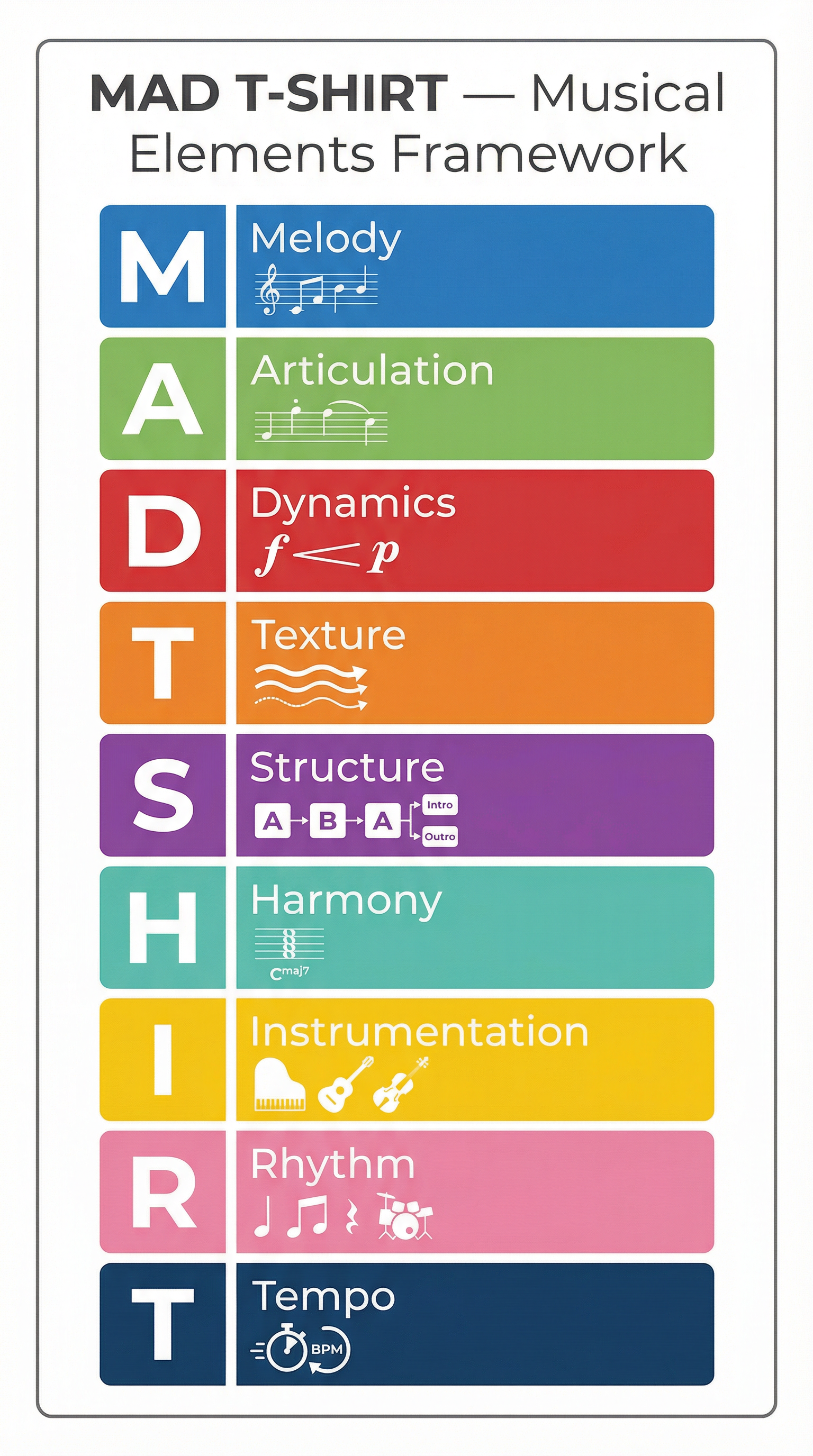
Across all these areas, you must be able to analyse the music using the core musical elements. The most effective way to structure your analysis is by using the MAD T-SHIRT mnemonic.
Key Practitioners/Artists/Composers
| Name | Period/Style | Key Works | Relevance |
|---|---|---|---|
| Antonio Vivaldi | Baroque | "The Four Seasons" | A quintessential example of the Baroque solo concerto, showcasing terraced dynamics and the use of a Basso Continuo. |
| Wolfgang Amadeus Mozart | Classical | Piano Concerto No. 21 | Embodies the principles of the Classical concerto, with clear sonata form structures and a focus on balanced, elegant melodies. |
| John Williams | Film Music | "Star Wars" Main Title | Master of the leitmotif, his scores are a textbook example of how music can define characters and build a cinematic universe. |
| The Beatles | 1960s Pop | "Sgt. Pepper's Lonely Hearts Club Band" | Revolutionised pop music with their studio experimentation, complex song structures, and departure from simple verse-chorus forms. |
| Ravi Shankar | Indian Classical | Various Ragas | A global ambassador for Indian Classical music, his work exemplifies the use of the sitar, tala, and raga systems. |
Technical Vocabulary
Using precise terminology is non-negotiable for achieving high marks. Candidates who use vague adjectives like "sad" or "fast" will not be credited. You MUST use the correct Italian terms and subject-specific vocabulary.
- Tonality: Major, Minor, Atonal, Modal
- Harmony: Diatonic, Chromatic, Consonant, Dissonant, Pedal Note, Drone
- Texture: Monophonic, Homophonic, Polyphonic, Call and Response
- Dynamics: pianissimo (pp), piano (p), mezzo piano (mp), mezzo forte (mf), forte (f), fortissimo (ff), crescendo, diminuendo, Terraced Dynamics
- Tempo: Grave, Largo, Adagio, Andante, Moderato, Allegro, Vivace, Presto, Accelerando, Rallentando
- Articulation: Staccato, Legato, Accent, Pizzicato, Arco
Practical Skills
While this is a listening exam, the skills required are practical in their application. You are demonstrating the practical skill of aural analysis.
Techniques & Processes
- Active Listening: When an extract begins, do not write immediately. Listen for 10-15 seconds to get your bearings. Ask yourself: What is the most distinctive feature? Is it the instrumentation? A rhythmic pattern? The overall style?
- First-Listen Triage: Your first listen should be focused on broad categorisation. For a Concerto question, your only goal is to identify the period. Listen for the 'big ticket' items: Is there a harpsichord? (Baroque). Is it a piano with a small, elegant orchestra? (Classical). Is it a huge orchestra with dramatic, emotional melodies? (Romantic).
- Second-Listen Analysis: Use the subsequent listening time to drill down into the details using MAD T-SHIRT. Jot down bullet points for each element (e.g., Melody: conjunct, Harmony: diatonic, Rhythm: syncopated).
- Structuring the Answer: For a 6-mark question, aim for 4-5 well-developed points, each linking a musical feature to its context. Start with your strongest point. For example: "The use of a harpsichord as part of the basso continuo firmly places this extract in the Baroque period."
Materials & Equipment
In the exam, your 'equipment' is your knowledge. You must have a mental toolbox of musical conventions for each Area of Study. Create mind maps or flashcards for each one, detailing the expected instrumentation, rhythmic features, and structural norms.
Exam Component
Written Exam Knowledge
Component 03 is a 1 hour 15 minute written paper based entirely on listening to musical extracts. The questions will require you to:
- Identify specific musical features.
- Recognise stylistic conventions.
- Compare and contrast two different pieces of music.
- Write extended responses justifying your aural analysis.
Practical Exam Preparation
- Listen Widely: Listen to the OCR-suggested listening list, but also listen beyond it. The more music you are familiar with, the more developed your ear will become.
- Timed Practice: Complete past papers under timed conditions. This is crucial for developing your ability to think and write quickly under pressure.
- Vocabulary Drills: Regularly test yourself on the definitions of key terms. You need to be able to recall them instantly in the exam.
- Focus on AO4: The comparison question is worth half the marks. Practice writing comparative sentences. A good structure is: "Extract A features [X], whereas Extract B uses [Y]. This suggests...".