Study Notes
Overview
Welcome to your deep-dive study guide for OCR GCSE Music, focusing on the critical skill of using musical terminology. This area, formally known as section 3.5 of the specification, is not just a small part of the course; it is the fundamental language you must use to succeed in the Listening and Appraising exam (Component 05). This component accounts for 50% of your total GCSE, split equally between Assessment Objective 3 (AO3: Analyse and evaluate music) and Assessment Objective 4 (AO4: Use musical elements and terminology). Mastering this vocabulary is therefore non-negotiable for achieving a high grade.
This guide will equip you with the precise Italian terms, structural language, and analytical vocabulary that examiners expect to see. We will move beyond simple descriptions to the level of analysis that earns the highest marks, ensuring you can confidently identify, describe, and explain the musical elements in both familiar and unfamiliar works.
Key Knowledge & Theory
Core Concepts
The core of this topic is understanding that music has its own specific, universal language. Using this language correctly shows an examiner that you are not just a passive listener, but an active, informed musician. The key is to replace vague, everyday English with precise, credited terminology.
- Dynamics & Tempo: These must always be described using the correct Italian terms. It is a direct requirement of the mark scheme. Describing a piece as 'getting louder' will receive no credit where a term like 'crescendo' is expected.
- Texture: This is about the relationship between the different layers of sound. It is one of the most frequently misunderstood concepts. Candidates often confuse it with timbre (the sound quality of an instrument) or use colloquial terms like 'busy' or 'thick', which are not creditworthy unless qualified with precise musical reasoning.
- Harmony & Tonality: These are related but distinct. Tonality refers to the key (e.g., major, minor, modal), while harmony refers to the chords and their relationships (e.g., consonant, dissonant, diatonic). Cadences, the punctuation marks of harmony, require specific labels (Perfect, Plagal, etc.).
- Structure: This refers to the overall plan or architecture of a piece of music. Identifying the correct form (e.g., Binary, Ternary, Rondo, Sonata) is a key analytical skill.
- Instrumentation & Timbre: This involves identifying the specific instruments or voices (the 'forces') and describing their sound quality (timbre) and any specific playing techniques used.
Key Practitioners/Artists/Composers
While this topic is about language, applying it to the works of key composers is essential. Examiners expect you to connect terminology to the music of the Areas of Study.
| Name | Period/Style | Key Works (Examples) | Relevance to Terminology |
|---|---|---|---|
| J.S. Bach | Baroque | Brandenburg Concerto No. 5, Badinerie | Master of polyphonic/contrapuntal texture. His fugues are the ultimate example of interwoven melodic lines. Also demonstrates clear use of terraced dynamics and basso continuo. |
| W.A. Mozart | Classical | Symphony No. 40 in G minor | Exemplifies Sonata form structure. His work shows clear, balanced phrasing and extensive use of diatonic harmony and perfect cadences. |
| Queen | Rock | 'Killer Queen' (from AoS4) | Demonstrates complex studio production, multi-tracking to create a rich homophonic texture, use of vibrato and glissando in vocals and guitar, and a clear verse-chorus structure. |
| John Williams | Film Music | Star Wars Main Title | A prime example of using leitmotifs. The score is rich in forte dynamics, fanfare figures, and demonstrates how instrumentation (e.g., brass for heroism) creates character and mood. |
Technical Vocabulary
This is the core of what you need to learn. Below is a non-exhaustive list of essential terms you MUST be able to use correctly.
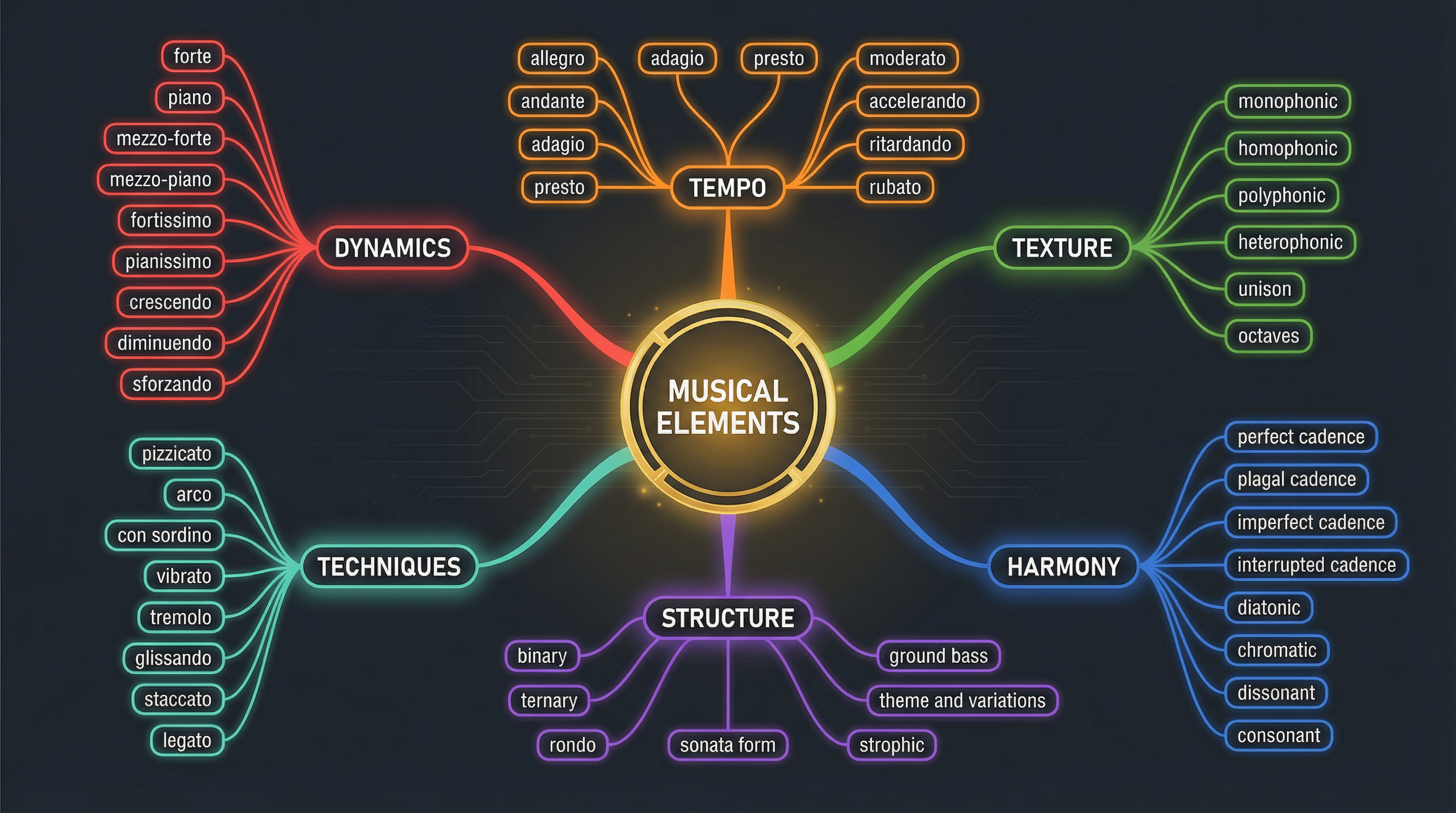
- Dynamics: pianissimo (pp), piano (p), mezzo-piano (mp), mezzo-forte (mf), forte (f), fortissimo (ff), crescendo, diminuendo, sforzando (sfz)
- Tempo: adagio, andante, moderato, allegro, presto, ritardando (rit.), accelerando (accel.), rubato
- Texture: monophonic, homophonic, polyphonic (contrapuntal), unison, octaves
- Structure: binary, ternary, rondo, sonata form, theme and variations, ground bass, strophic, through-composed, verse-chorus
- Harmony/Tonality: major, minor, modal, atonal, diatonic, chromatic, consonant, dissonant, pedal note, drone, perfect/plagal/imperfect/interrupted cadence
- Instrumentation/Techniques: pizzicato, arco, con sordino, tremolo, vibrato, staccato, legato, glissando, falsetto, belt
Practical Skills
This section translates theory into the practical skill of listening and appraising, which is what you are assessed on.
Techniques & Processes
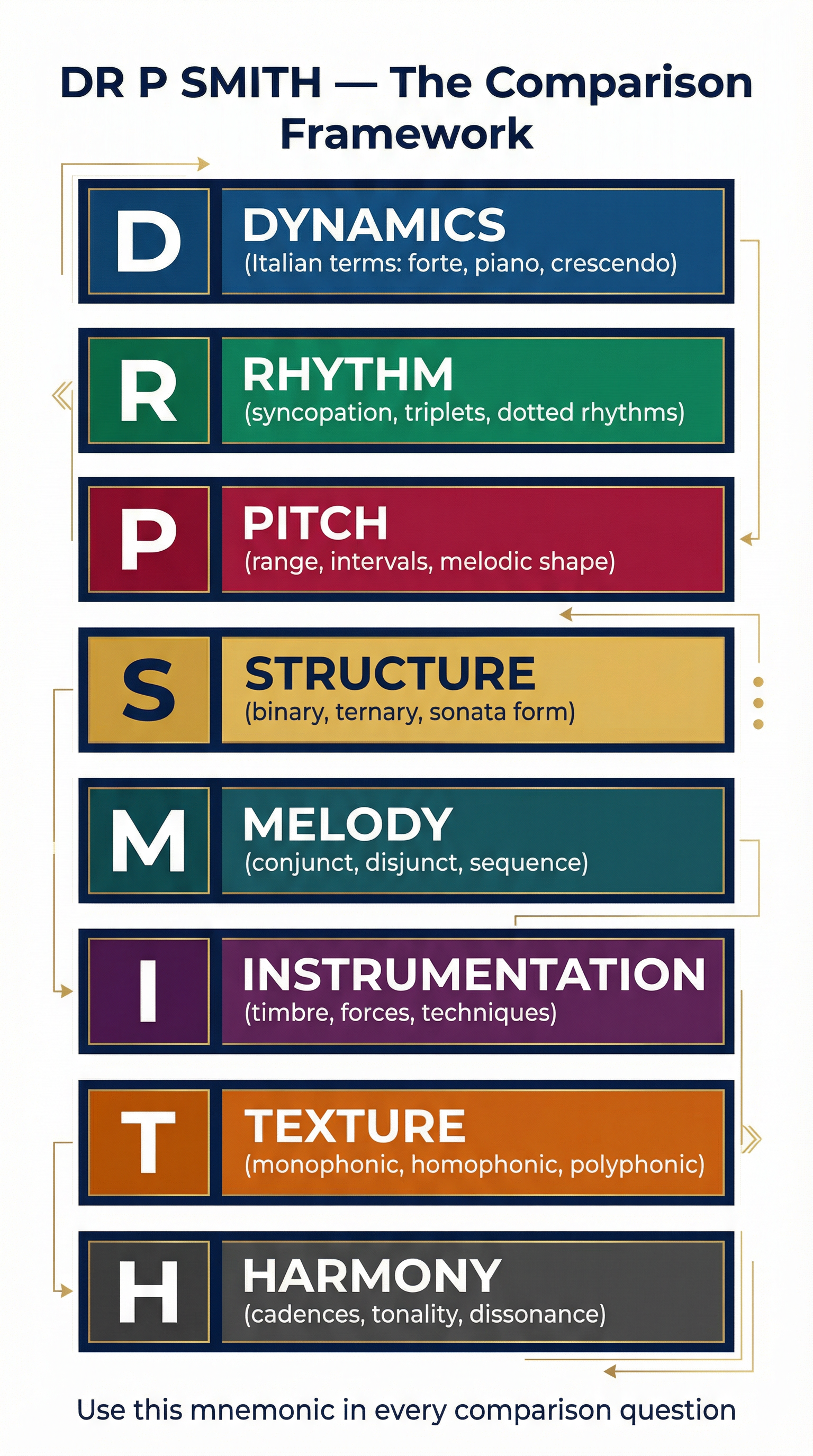
- Active Listening: When you listen to a piece (in class, for revision, or in the exam), have a mental or physical checklist. Use the DR P SMITH mnemonic (see Memory Hooks) to actively seek out features to identify.
- Linking Terminology to Effect: This is the single most important skill for high marks. It is the difference between AO4 (using terminology) and AO3 (analysing).
- Weak response: "The violins play pizzicato." (Identifies a technique — limited marks)
- Strong response: "The violins play pizzicato, creating a light, detached, and percussive texture. This contrasts with the smooth, legato melody in the flute, highlighting the melodic line." (Links technique to effect and context — high marks awarded).
- Comparative Analysis: In the comparison question (the final, 8-mark question in the exam), you must systematically compare and contrast two pieces of music. Use a structured paragraph approach, guided by DR P SMITH, to ensure you cover a broad range of elements with appropriate terminology.
Materials & Equipment
Your primary materials are the musical excerpts themselves. In the exam, you will have a CD player or digital audio source. Your equipment is your brain and your pen.
- Safe Use: The only 'danger' is mishearing or misidentifying. The best way to ensure 'safe' and accurate use of your knowledge is through repeated practice. Listen to a wide variety of music from all the Areas of Study and practise applying your vocabulary.
- Annotation: When you are allowed to make notes, do so. Jot down key terms as you hear them. This is invaluable for structuring your extended answers.
Portfolio/Coursework Guidance
While this topic directly relates to the listening exam, a strong command of musical language is also essential for success in your practical components (Composition and Performance).
Assessment Criteria
- Composition (Component 03/04): Your composition portfolio must include a commentary or annotation. In this, you must use correct terminology to explain your compositional choices. You will be credited for explaining how you have used dynamics, structure, and harmony to achieve your intended musical effect.
- Performance (Component 01/02): While you are not directly marked on your verbal analysis of your performance pieces, understanding the terminology (e.g., knowing what allegro con brio or dolce means) is fundamental to delivering a stylistically appropriate and technically accurate performance.
Building a Strong Portfolio
When annotating your composition, think like an examiner. Don't just describe what you did. Justify why you did it, using the language of this guide.
- Show Development: "I initially wrote a simple homophonic accompaniment, but changed it to a more complex polyphonic texture in the second verse to increase intensity."
- Evidence Experimentation: "I experimented with both a perfect and an interrupted cadence at the end of the middle 8, but chose the interrupted cadence to create a sense of surprise leading into the final chorus."
Exam Component
Written Exam Knowledge
This entire topic is geared towards the Component 05 Listening and Appraising exam. All the knowledge outlined above will be tested directly.
- Section A (Unfamiliar Music): You will be tested on your ability to apply terminology to music you have never heard before. This is where your deep learning of the terms, rather than rote memorisation of set work facts, is crucial.
- Section B (Familiar Music/Set Works): You will be expected to use terminology in relation to the prescribed set works you have studied.
Practical Exam Preparation
There is no practical exam for this component, but the listening exam is a practical application of your analytical skills under timed conditions. The best preparation is to complete past papers under exam conditions. Time yourself. Limit yourself to the number of times you can hear each excerpt. This will build your stamina and your confidence in identifying features quickly and accurately. Remember, you have approximately 1 minute per mark.