Study Notes
Overview
This guide focuses on the psychological management of schizophrenia as specified in AQA A-Level Psychology Paper 3, Option 2. We will explore two influential therapeutic approaches: Cognitive Behavioural Therapy (CBT) and Family Therapy. For A-Level candidates, it is crucial not just to describe these therapies (AO1), but also to critically evaluate their effectiveness and appropriateness, drawing on key research studies (AO3). Examiners expect a nuanced understanding, recognising that these therapies are not cures but management strategies, often used within an interactionist framework alongside medication. This topic requires you to understand the mechanisms of these therapies – how CBT targets cognitive distortions through reality testing and how Family Therapy aims to reduce high Expressed Emotion (EE) in the patient's environment. Mastery of this content involves not only memorising key terms and studies but also appreciating the real-world complexities of treating schizophrenia, including economic implications and ethical considerations.
Key Therapeutic Approaches
Cognitive Behavioural Therapy (CBT) for Schizophrenia
What it is: A talking therapy that aims to help patients identify, challenge, and modify their irrational or delusional beliefs. It helps patients make sense of their psychotic experiences and reduces the distress they cause.
How it works (The Mechanism): The core principle is that a patient's interpretation of their symptoms (e.g., hearing voices) is what causes distress, not the symptoms themselves. CBT helps patients to develop alternative, less threatening explanations for their experiences. Key techniques include:
- Normalisation: The therapist explains that psychotic experiences like hearing voices are more common than people think. This reduces fear and stigma, making the patient feel less isolated.
- Reality Testing: The therapist and patient work together to challenge delusional beliefs. For example, if a patient believes their thoughts are being controlled by an external force, the therapist might ask for evidence or collaboratively design an experiment to test this belief.
- The ABCDE Model: A framework for understanding and challenging beliefs.
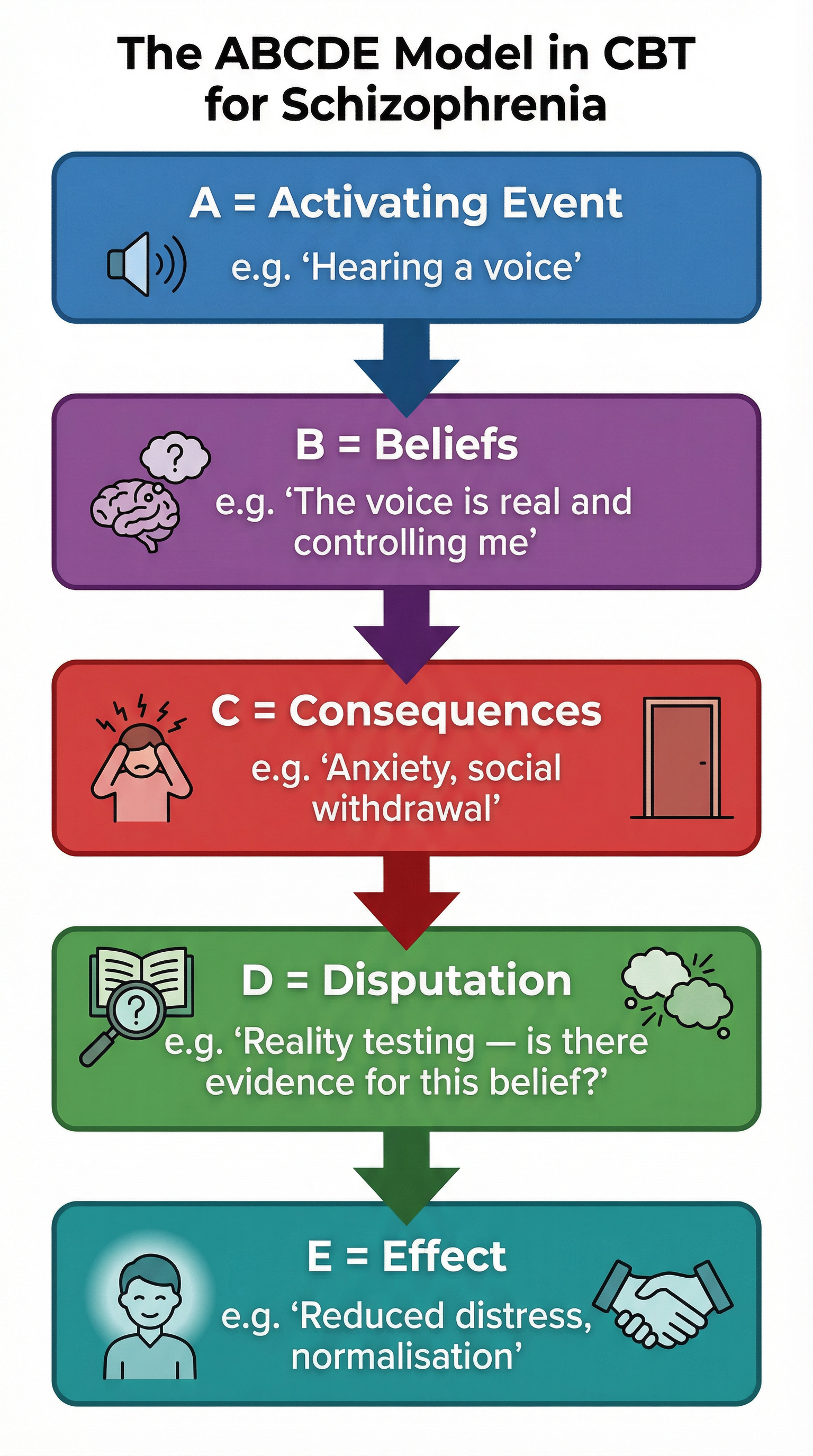
Specific Knowledge: Candidates must be familiar with the Jauhar et al. (2014) meta-analysis, which found that CBT has a small but significant effect on both positive and negative symptoms.
Family Therapy for Schizophrenia
What it is: A form of therapy that involves the patient and their family members. It is based on the idea that the family environment plays a significant role in the patient's recovery and relapse rates.
How it works (The Mechanism): The primary goal is to reduce the level of Expressed Emotion (EE) within the family. High EE, characterised by criticism, hostility, and emotional over-involvement, is a strong predictor of relapse. Family therapy strategies include:
- Psychoeducation: Providing the family with information about schizophrenia to increase their understanding and reduce blame or guilt.
- Improving Communication: Training the family to communicate in a less confrontational and more empathetic way.
- Reducing Stress: Helping the family develop effective problem-solving skills and coping strategies to manage the stress of caring for a person with schizophrenia.
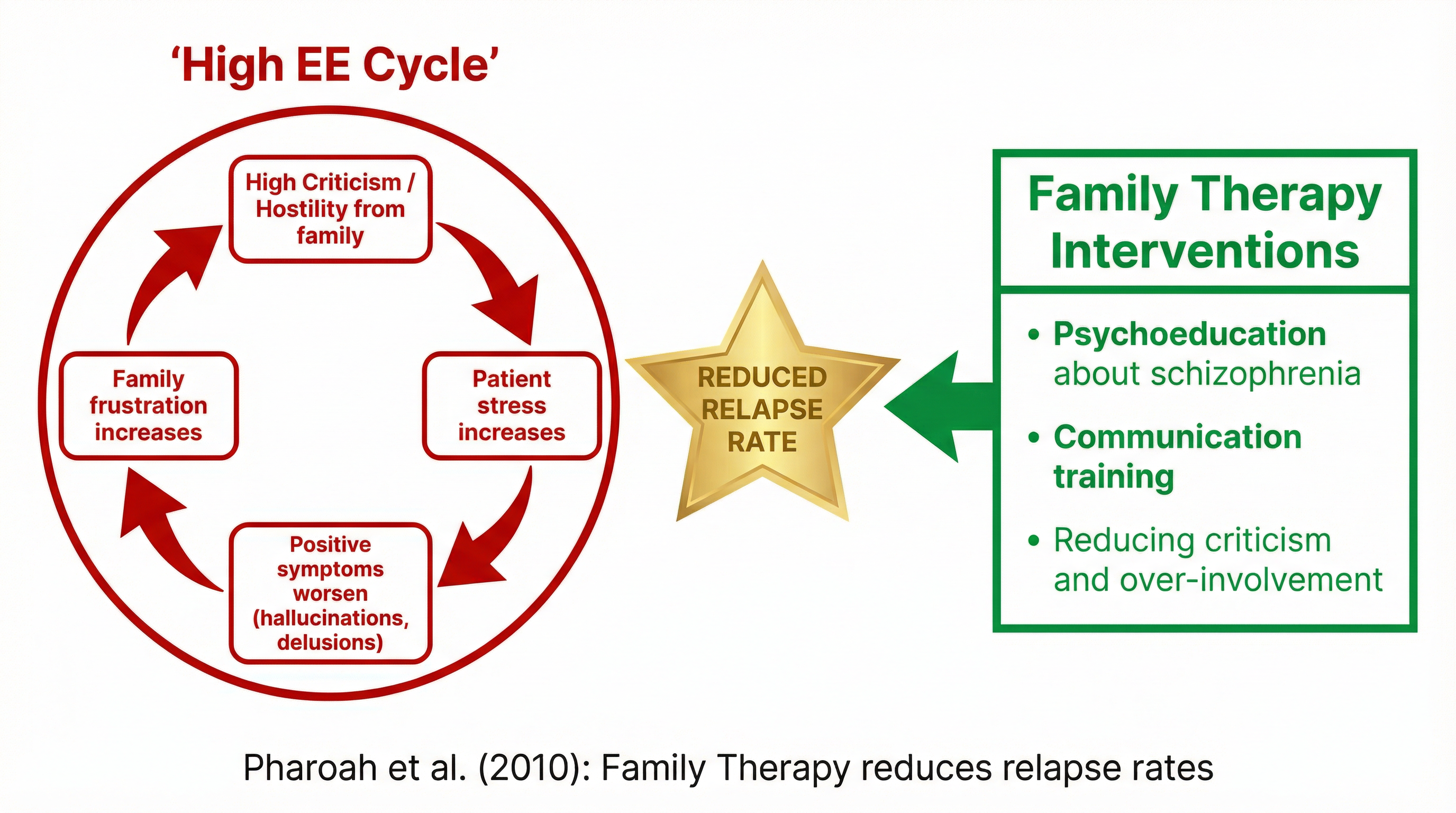
Specific Knowledge: The key study is Pharoah et al. (2010), a meta-analysis which concluded that family therapy is effective in reducing relapse rates and improving medication compliance.
Second-Order Concepts
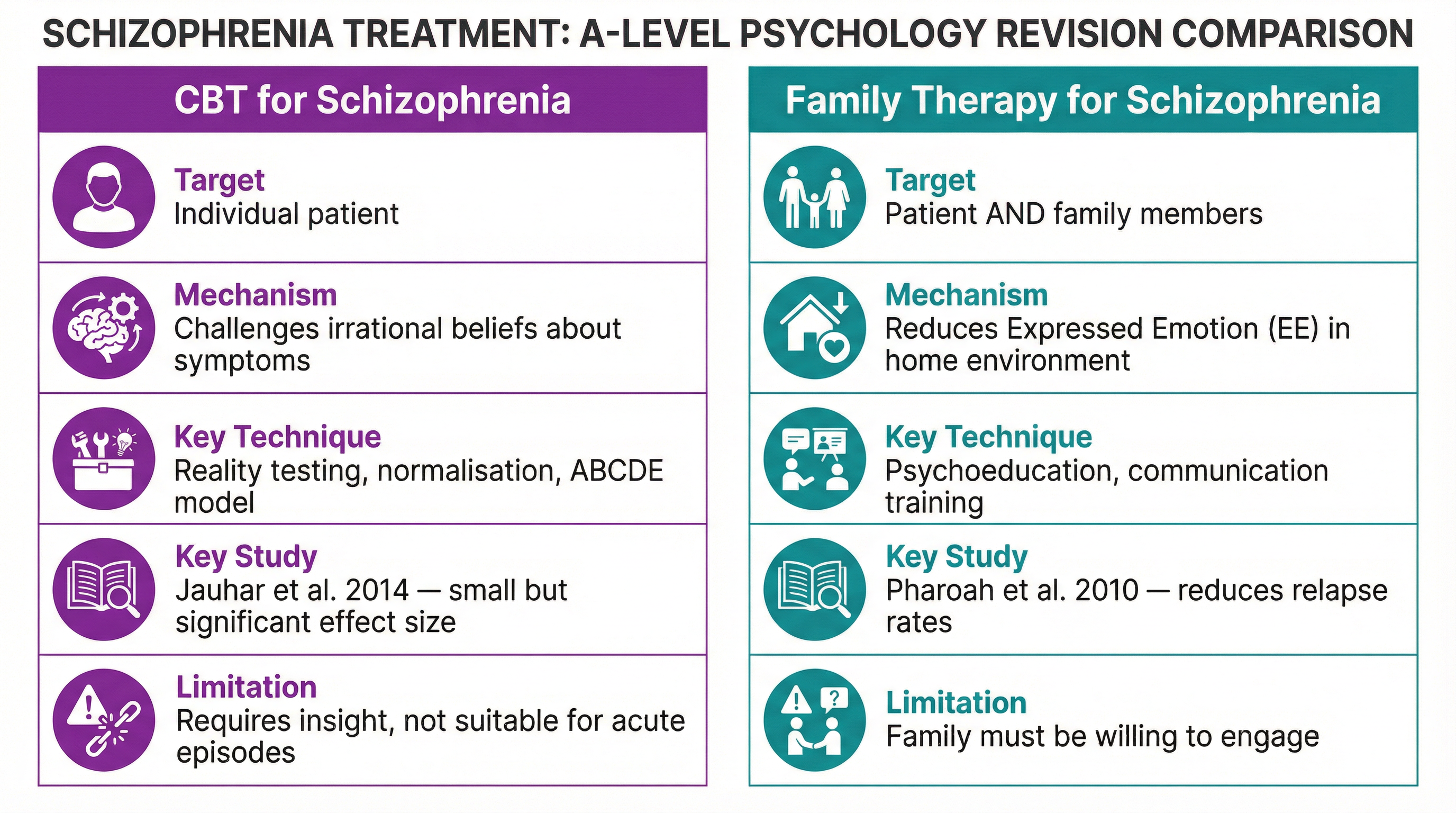
Comparison of Therapies
Causation
Psychological therapies are based on the understanding that cognitive and environmental factors contribute to the maintenance of schizophrenia. CBT is rooted in the cognitive model, suggesting that faulty thought processes are the cause of distress. Family therapy is based on the family systems theory, where dysfunctional communication patterns (high EE) are seen as a key factor in patient relapse.
Consequence
Effective application of these therapies leads to significant positive consequences. For the patient, this includes reduced symptom severity, lower distress, and improved social functioning. For the family and society, the consequences include reduced relapse and re-hospitalisation rates, which has a significant positive economic impact by lowering the long-term cost of care for the NHS.
Change & Continuity
The use of psychological therapies represents a significant change from a purely biological model of schizophrenia. It reflects a move towards an interactionist approach, where biological, psychological, and social factors are all seen as important. However, there is continuity in that these therapies are almost always used in conjunction with antipsychotic medication, not as a replacement for it.
Significance
The development and application of CBT and Family Therapy are significant because they provide evidence-based alternatives and adjuncts to drug therapy. They empower patients and families, improve quality of life, and offer a more holistic approach to managing a complex and chronic mental health condition. They highlight the importance of psychological well-being in managing severe mental illness.