Study Notes
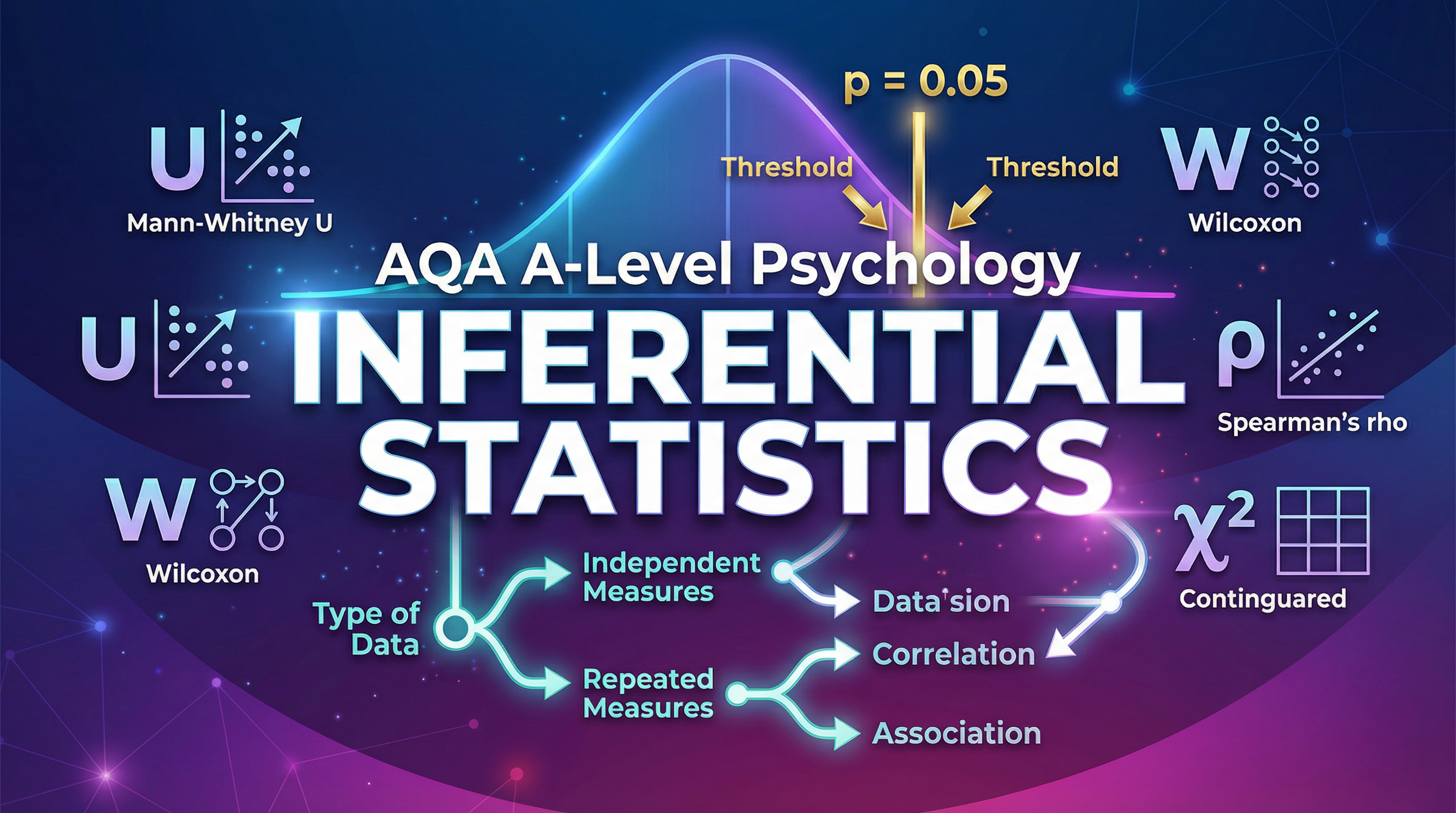
Overview
Inferential statistics are a cornerstone of AQA A-Level Psychology, forming a major part of the Research Methods (Paper 2) assessment. Unlike descriptive statistics (which merely summarise data), inferential tests allow psychologists to draw conclusions (inferences) about a target population based on data from a sample. Examiners expect candidates to demonstrate a robust understanding of the decision-making process for selecting the correct statistical test. This involves systematically evaluating the research for three key features: the aim (difference or correlation), the experimental design (independent or repeated measures), and the level of measurement (nominal, ordinal, or interval). Marks are awarded for the precise application of this algorithm, the accurate interpretation of statistical tables, and the ability to explain the meaning of significance, including the concepts of Type I and Type II errors. A solid grasp of this topic is essential for evaluating the validity and reliability of psychological research, a key AO3 skill.
Key Concepts in Inferential Statistics
1. Probability and Significance
- What it is: In psychology, we can never be 100% certain that an effect is real. There is always a chance that the results were a fluke. Probability (p) is a numerical measure of how likely an event is to occur, from 0 (impossible) to 1 (certain).
- Why it matters: Psychologists use a conventional level of probability to decide if results are significant. This is the significance level, usually set at p ≤ 0.05. This means there is a 5% (or less) probability that the observed results occurred by chance. If the probability is this low, we reject the null hypothesis and accept the alternative hypothesis.
- Specific Knowledge: Candidates must know that p ≤ 0.05 is the standard significance level in psychology. For research with higher stakes (e.g., drug trials), a more stringent level like p ≤ 0.01 might be used to reduce the chance of a Type I error.
2. The Test Selection Algorithm
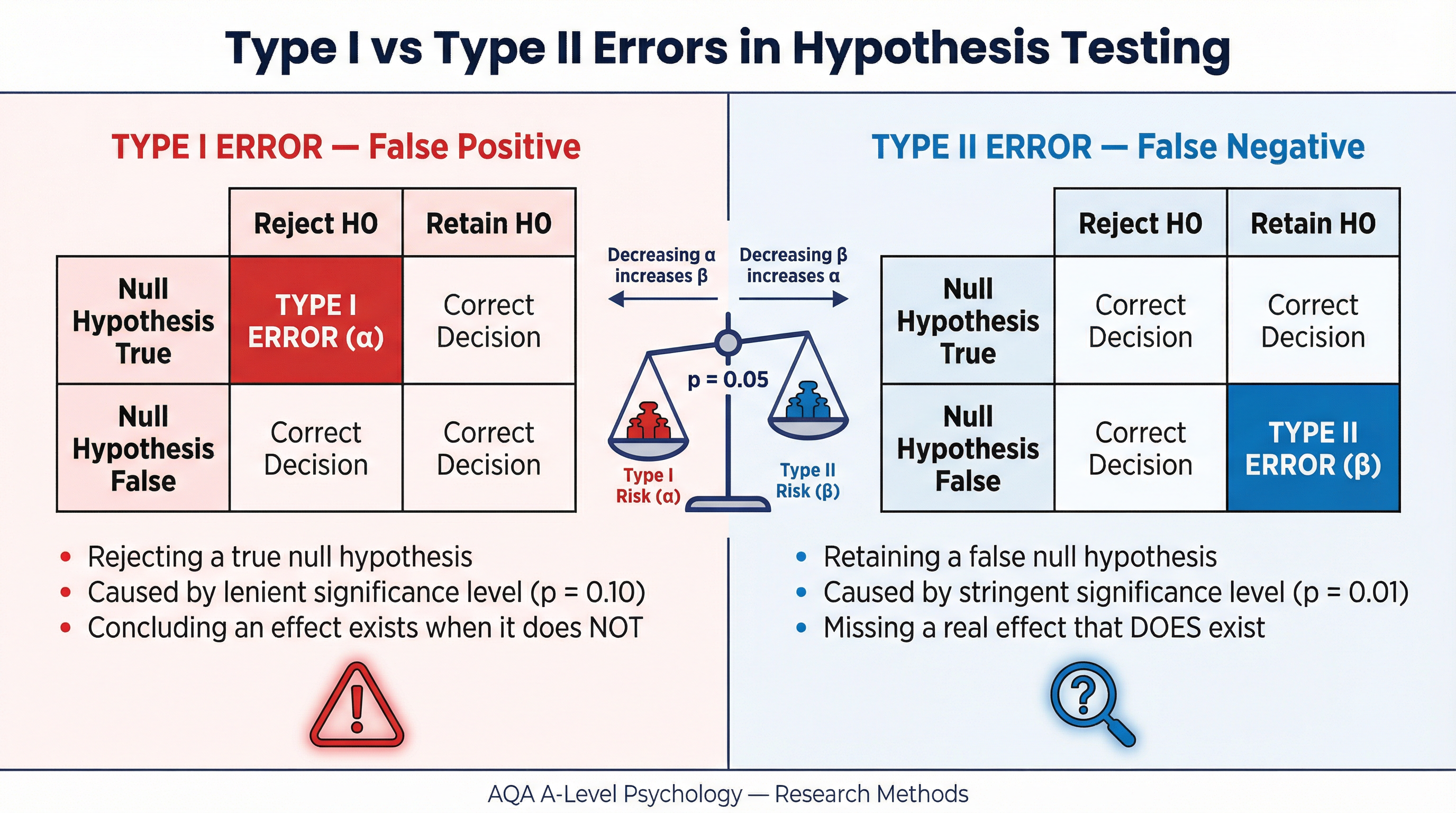
- What it is: A systematic process for choosing the correct inferential test. It involves asking three critical questions about the research study.
- Why it matters: This is the single most important skill for this topic. Almost every inferential statistics question requires you to justify your choice of test based on these criteria. Marks are explicitly awarded for identifying each one.
- The Three Questions:
- Aim: Is the research looking for a difference between two conditions or a correlation (relationship) between two co-variables?
- Design: If looking for a difference, is it an independent groups design (different participants in each condition) or a repeated measures/matched pairs design (the same or matched participants in each condition)?
- Level of Data: What type of data has been collected? Nominal (categories), Ordinal (ranked/ordered), or Interval (standardised, equal units)?
3. Type I and Type II Errors
- What they are: Errors made when interpreting the results of a statistical test.
- Why they matter: Understanding these errors is a key AO3 skill, allowing you to evaluate the conclusions drawn from research. Examiners often ask candidates to explain the difference or identify which error is more likely in a given scenario.
- Specific Knowledge:
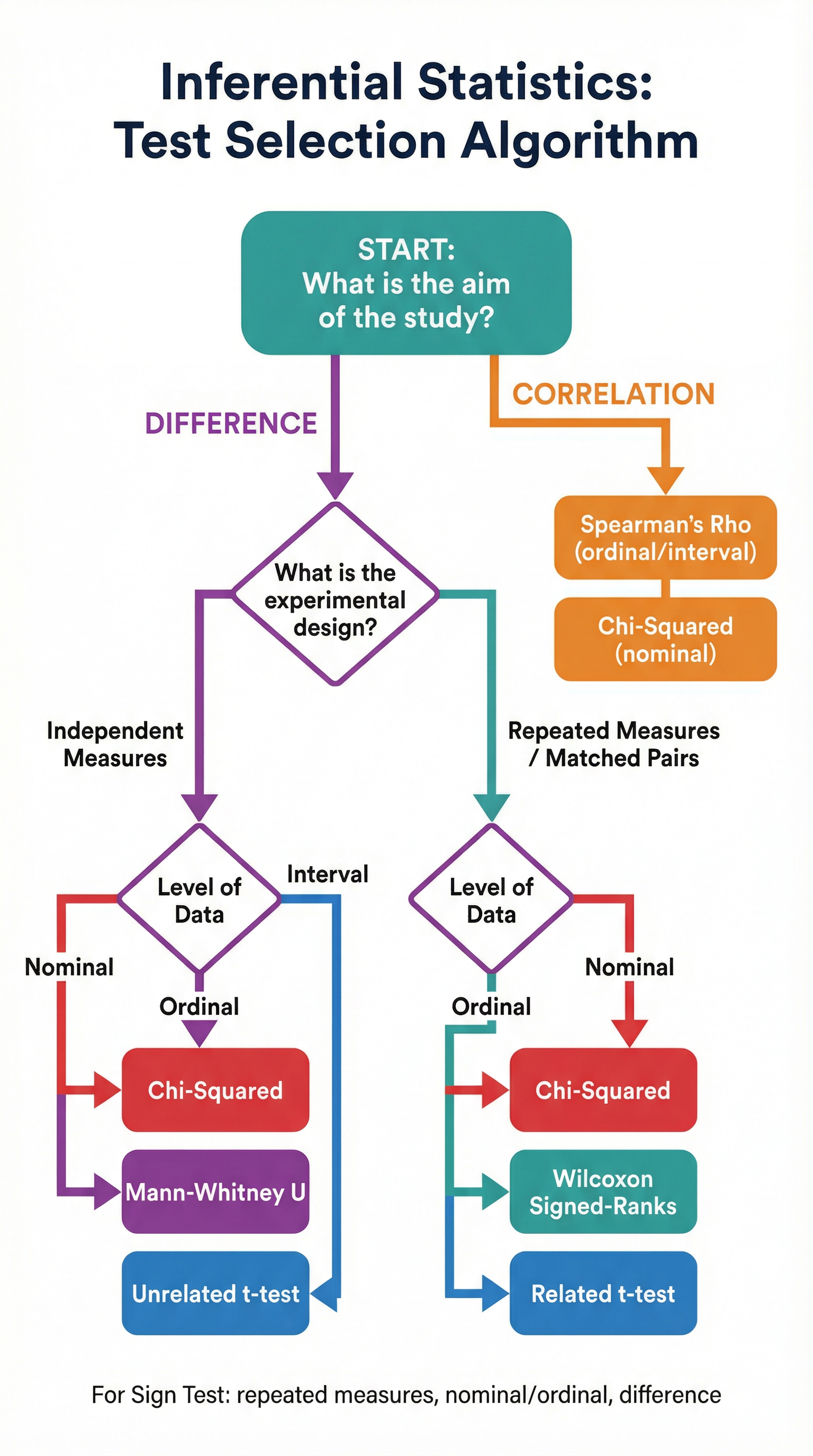
- Type I Error (False Positive): Rejecting a null hypothesis that is actually true. You conclude there IS an effect, but there ISN'T. This is more likely with a lenient significance level (e.g., p ≤ 0.10).
- Type II Error (False Negative): Retaining a null hypothesis that is actually false. You conclude there is NO effect, but there IS. This is more likely with a stringent significance level (e.g., p ≤ 0.01).
The Main Statistical Tests
| Test Name | Aim | Design | Data Level | Rule for Significance | Mnemonic Hook |
|---|---|---|---|---|---|
| Chi-Squared | Difference/Association | Independent | Nominal | Observed value ≥ Critical value | Carrots |
| Sign Test | Difference | Repeated Measures | Nominal* | Observed value (S) ≤ Critical value | Should |
| Mann-Whitney U | Difference | Independent | Ordinal | Observed value (U) ≤ Critical value | Mashed |
| Wilcoxon T | Difference | Repeated Measures | Ordinal | Observed value (T) ≤ Critical value | With |
| Spearman's Rho | Correlation | N/A | Ordinal | Observed value (rho) ≥ Critical value | Swede |
| Unrelated t-test | Difference | Independent | Interval | Observed value (t) ≥ Critical value | Under |
| Related t-test | Difference | Repeated Measures | Interval | Observed value (t) ≥ Critical value | Roast |
| Pearson's r | Correlation | N/A | Interval | Observed value (r) ≥ Critical value | Potatoes |
| Note: Sign test uses nominal data created from differences. | |||||
| " |