
Ethical Costs of Research

    WJEC
    A-Level
    Psychology

    This guide dissects the critical 'double obligation' dilemma in psychological research, balancing scientific progress against participant welfare. It provides a comprehensive breakdown of the BPS Code of Ethics, equipping WJEC A-Level candidates with the analytical tools needed to master AO2 application and AO3 evaluation.

    5
    Min Read
    3
    Examples
    5
    Questions
    6
    Key Terms
    🎙 Podcast Episode
    Ethical Costs of Research
    0:00-0:00

    Study Notes

    Header image for Ethical Costs of Research.

    Overview

    The study of ethics in psychology is not merely a set of rules, but a dynamic and challenging field of critical thinking. For WJEC A-Level candidates, mastery of this topic hinges on understanding the core conflict known as the 'double obligation': the researcher's duty to society to advance knowledge, versus their duty to the individual participant to ensure their rights and welfare are protected. This guide will deconstruct the BPS Code of Ethics and Conduct (2009), providing the framework to analyze complex scenarios. Examiners expect candidates to move beyond simple identification of issues like 'deception' and instead engage in a sophisticated cost-benefit analysis, weighing the scientific merit of a study against the ethical costs incurred by participants. This involves applying the four key principles—Respect, Competence, Responsibility, and Integrity—to novel situations and justifying judgements with precise terminology and evidence from stimulus material. Credit is awarded for demonstrating a nuanced understanding that ethical guidelines are not absolute bans, but frameworks for making difficult, justifiable decisions.

    The Four BPS Principles

    At the core of all ethical decision-making in UK psychology are the four principles from the BPS Code of Ethics and Conduct (2009). Candidates must not only memorize these but understand their practical application.
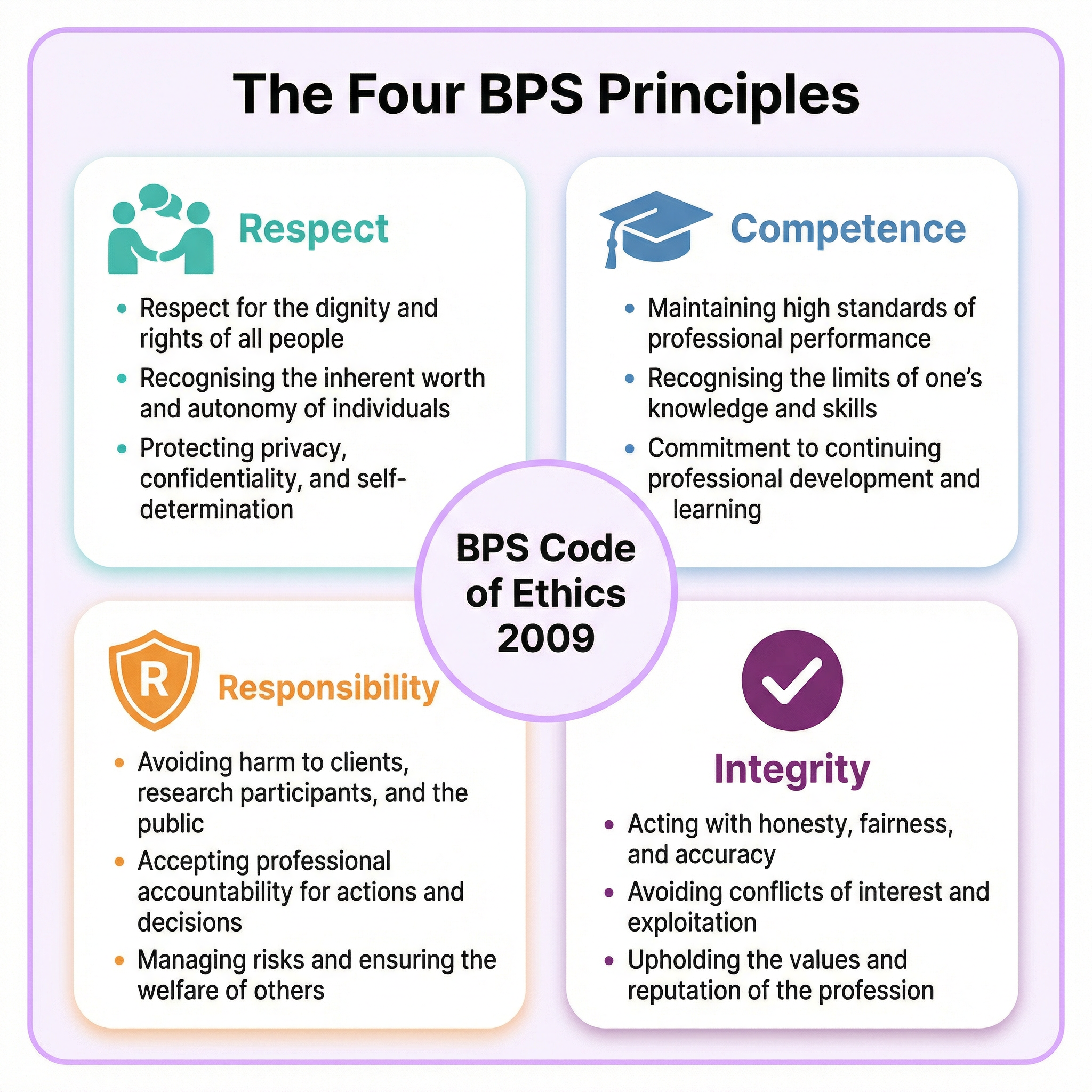
    The Four BPS Principles: Respect, Competence, Responsibility, and Integrity.

    1. Respect

    What it is: This principle is about valuing the dignity and worth of all persons. It involves respecting individual differences and protecting their rights to privacy, confidentiality, self-determination, and, crucially, valid consent.

    Why it matters: In exam scenarios, this is often breached when participants are not given enough information to make a truly informed decision, or when their privacy is compromised. Using the term 'valid consent' over 'informed consent' will be credited by examiners as it aligns with specific BPS and WJEC terminology.

    2. Competence

    What it is: A researcher must operate within the boundaries of their own knowledge, skill, and training. It is a commitment to maintaining high standards of professional work and recognizing the limits of one's expertise.

    Why it matters: Marks are awarded for identifying when a researcher might be stepping outside their area of competence, for example, by attempting to study a clinical population without the relevant qualifications, potentially leading to harm or misinterpretation of data.

    3. Responsibility

    What it is: This is the duty to protect participants from harm (both physical and psychological) and to uphold the reputation of the profession. It directly involves the process of risk management and the cost-benefit analysis.

    Why it matters: This is the principle most directly linked to the 'double obligation'. Candidates should explicitly reference a researcher's responsibility to weigh the costs (e.g., participant distress) against the benefits (e.g., new knowledge about treating a disorder). A failure to protect participants from harm is a clear breach of this principle.

    4. Integrity

    What it is: This principle demands honesty, accuracy, and fairness in all professional interactions. It covers the reporting of data and the justification for any necessary deception within a study.

    Why it matters: Deception is a key ethical issue, but simply stating 'deception is wrong' is a low-level response. A sophisticated answer will explain that while deception breaches the principle of Integrity, it may be justified if it is essential for the study's validity. This breach must then be mitigated through a comprehensive debriefing process.

    Second-Order Concepts

    Cost-Benefit Analysis

    This is the central evaluative tool for this topic. It is not a simple tallying of pros and cons. A good analysis involves a qualitative assessment of the severity of the costs versus the significance of the benefits. Aronson's (1992) rule is a key piece of specific knowledge here: he argued that the benefits must be seen to clearly outweigh the costs. If it is a borderline case, the research should not proceed. Candidates should structure their AO3 evaluation around this model.
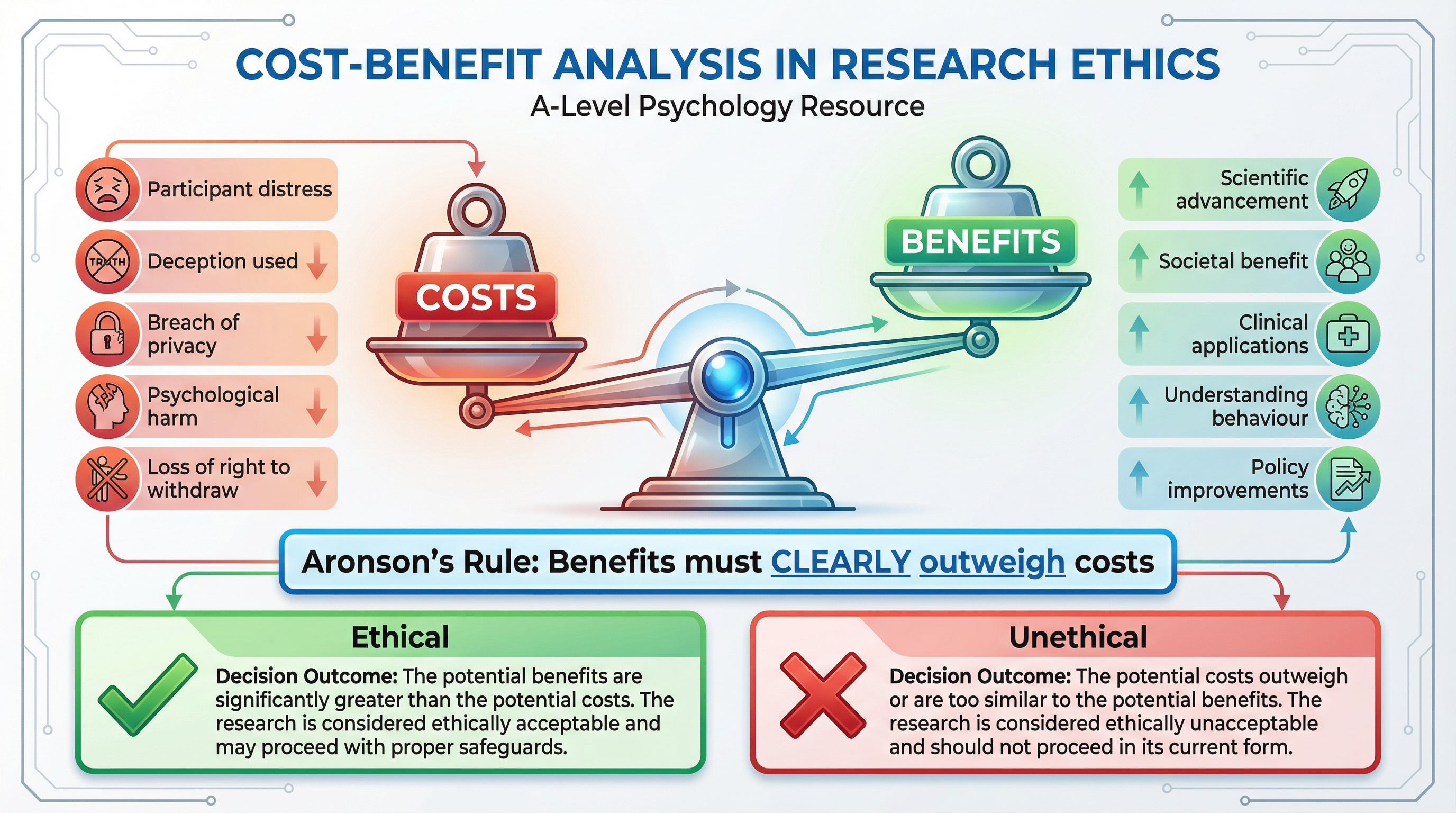
    Cost-Benefit Analysis in Research Ethics.

    Dealing with Ethical Issues

    Candidates often confuse ethical issues with the methods used to deal with them. It is vital to distinguish between the two for high marks.

    Ethical IssueMethod of Dealing with the Issue
    Lack of Valid ConsentGaining presumptive consent, prior general consent, or retrospective consent.
    DeceptionA full, restorative debrief that explains the true aim and offers aftercare.
    Risk of HarmA thorough risk assessment, and the participant's right to withdraw at any time.
    ConfidentialityAnonymising data by removing all personally identifiable information.

    Visual Resources

    2 diagrams and illustrations

    The Four BPS Principles: Respect, Competence, Responsibility, and Integrity.
    The Four BPS Principles: Respect, Competence, Responsibility, and Integrity.
    Cost-Benefit Analysis in Research Ethics.
    Cost-Benefit Analysis in Research Ethics.

    Interactive Diagrams

    1 interactive diagram to visualise key concepts

    1947The NurembergCodeEmphasizedvoluntary consentfollowing WWIIatrocities.1964Declaration ofHelsinkiGovernedinternationalmedical research.1979The BelmontReport (USA)EstablishedRespect,Beneficence,Justice.2009BPS Code ofEthics & ConductThe current UKframework forpsychologists.Evolution of Ethical Guidelines

    A timeline showing the historical development of key ethical codes that influence current practice.

    Worked Examples

    3 detailed examples with solutions and examiner commentary

    Practice Questions

    Test your understanding — click to reveal model answers

    Q1

    Describe what is meant by 'valid consent' in the context of psychological research. (3 marks)

    3 marks
    standard

    Hint: Think about the three components that make consent truly valid.

    Q2

    A study requires children to be observed in a playground. Explain how a researcher could deal with the ethical issue of consent in this situation. (4 marks)

    4 marks
    standard

    Hint: Who gives consent when the participants are children?

    Q3

    Evaluate the use of deception in psychological research. (8 marks)

    8 marks
    challenging

    Hint: Use a cost-benefit structure. What are the arguments FOR deception (benefits) and what are the arguments AGAINST it (costs)?

    Q4

    What is a debrief and why is it important? (4 marks)

    4 marks
    standard

    Hint: Think about the different functions of a debrief.

    Q5

    Explain the role of an ethics committee. (3 marks)

    3 marks
    standard

    Hint: Who is on an ethics committee and what do they do?

    Explore this topic further

    View Topic PageAll Psychology Topics

    Key Terms

    Essential vocabulary to know

    More Psychology Study Guides

    View all

    Idiographic and Nomothetic Approaches

    AQA
    A-Level

    This guide dissects the fundamental AQA A-Level Psychology debate between Idiographic and Nomothetic approaches. Understanding this is crucial for Paper 2, as it tests your ability to evaluate the scientific nature of psychology and appreciate the trade-off between in-depth individual insight and broad, generalisable laws."

    Inferential Statistics

    AQA
    A-Level

    Inferential statistics are the bedrock of psychological research, allowing us to move from sample data to general conclusions about human behaviour. Mastering this topic is non-negotiable for A-Level Psychology, as it provides the tools to determine if research findings are statistically significant or merely a fluke, a skill that unlocks the highest marks in the Research Methods paper."

    Environmental Psychology

    OCR
    A-Level

    Environmental Psychology explores the critical two-way relationship between our surroundings and our behaviour. This guide provides the essential OCR A-Level knowledge on how stressors like noise, the design of spaces, and even the view from a window can profoundly affect our minds and actions, equipping you with the specific studies and evaluation points needed to secure top marks.

    Observations

    OCR
    A-Level

    Mastering observational methods is crucial for OCR A-Level Psychology, as it forms a cornerstone of the research methods paper. This guide provides the precise language, design principles, and evaluation points needed to secure top marks in 'Design a Study' questions.

    CBT and Family Therapy for Schizophrenia

    AQA
    A-Level

    This study guide provides a comprehensive overview of two key psychological treatments for schizophrenia: Cognitive Behavioural Therapy (CBT) and Family Therapy. It is designed to equip AQA A-Level Psychology students with the detailed knowledge and evaluation skills needed to excel in Paper 3, focusing on practical application and examiner expectations.

    Interactionist Approach to Schizophrenia

    AQA
    A-Level

    The Interactionist Approach offers a sophisticated and holistic explanation for schizophrenia, moving beyond simplistic nature-nurture debates. It argues that a biological vulnerability (diathesis) only leads to schizophrenia when triggered by environmental or biological stressors, a framework crucial for understanding both the causes and modern treatments of the disorder."