Study Notes
Overview
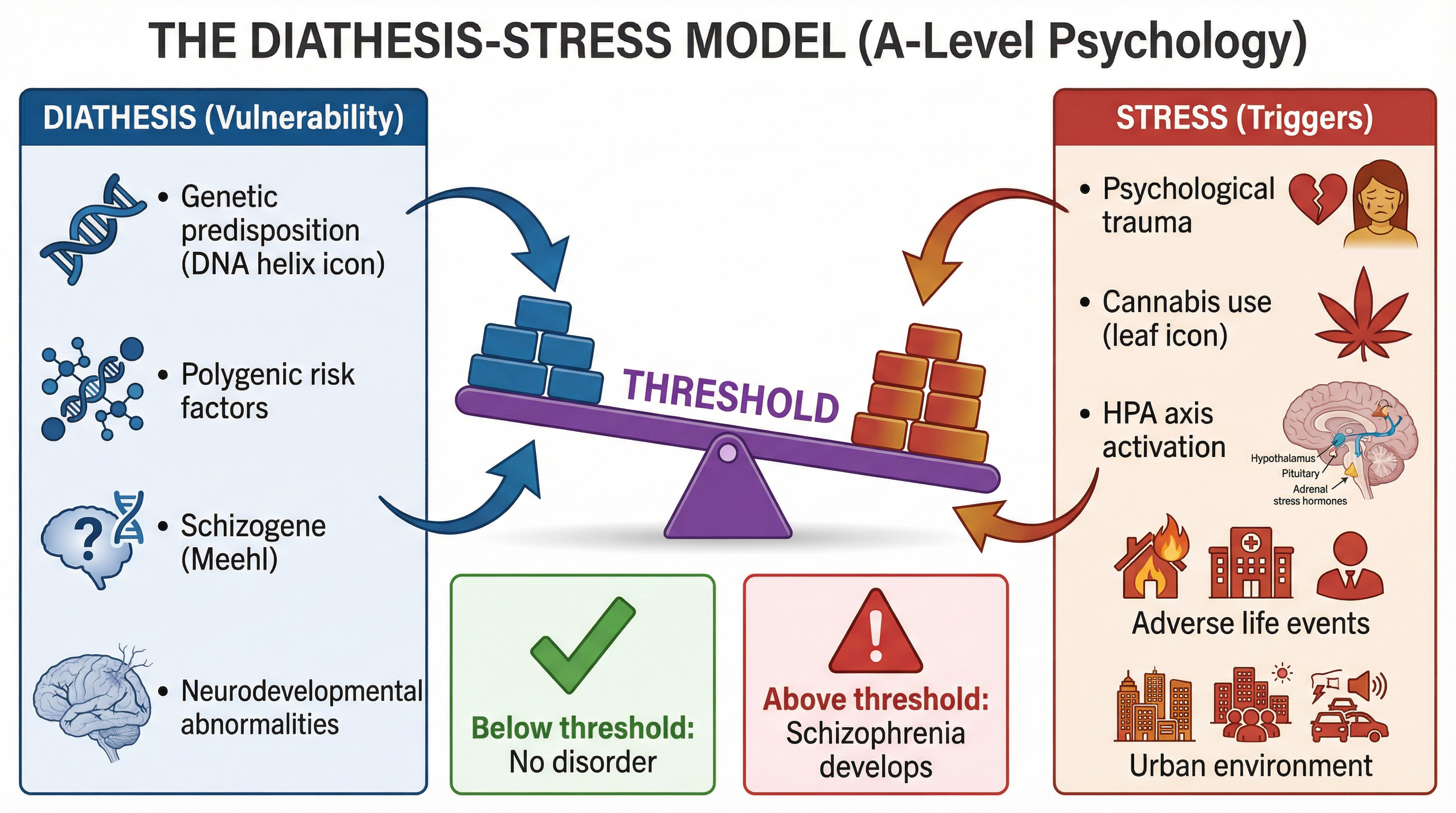
The Interactionist Approach to schizophrenia represents a pivotal shift from purely biological or psychological explanations to a more integrated model. For AQA A-Level candidates, this is not merely about stating ‘it’s both nature and nurture’; marks are awarded for a sophisticated understanding of the Diathesis-Stress Model. This model posits that a pre-existing vulnerability (the diathesis), most often biological, is triggered by environmental or biological stressors. Examiners expect a clear distinction between Meehl’s (1962) original, simplistic ‘schizogene’ concept and the modern, polygenic and neurodevelopmental understanding. Furthermore, a high-level response must evaluate the approach using key evidence, primarily the landmark Finnish Adoption Study (Tienari et al., 2004), and link the model to its logical treatment implication: combination therapy. This topic is a fantastic opportunity to demonstrate an appreciation for the complex, multi-faceted nature of psychopathology.
Key Concepts & Developments
The Original Diathesis-Stress Model
Developer: Paul Meehl
Date: 1962
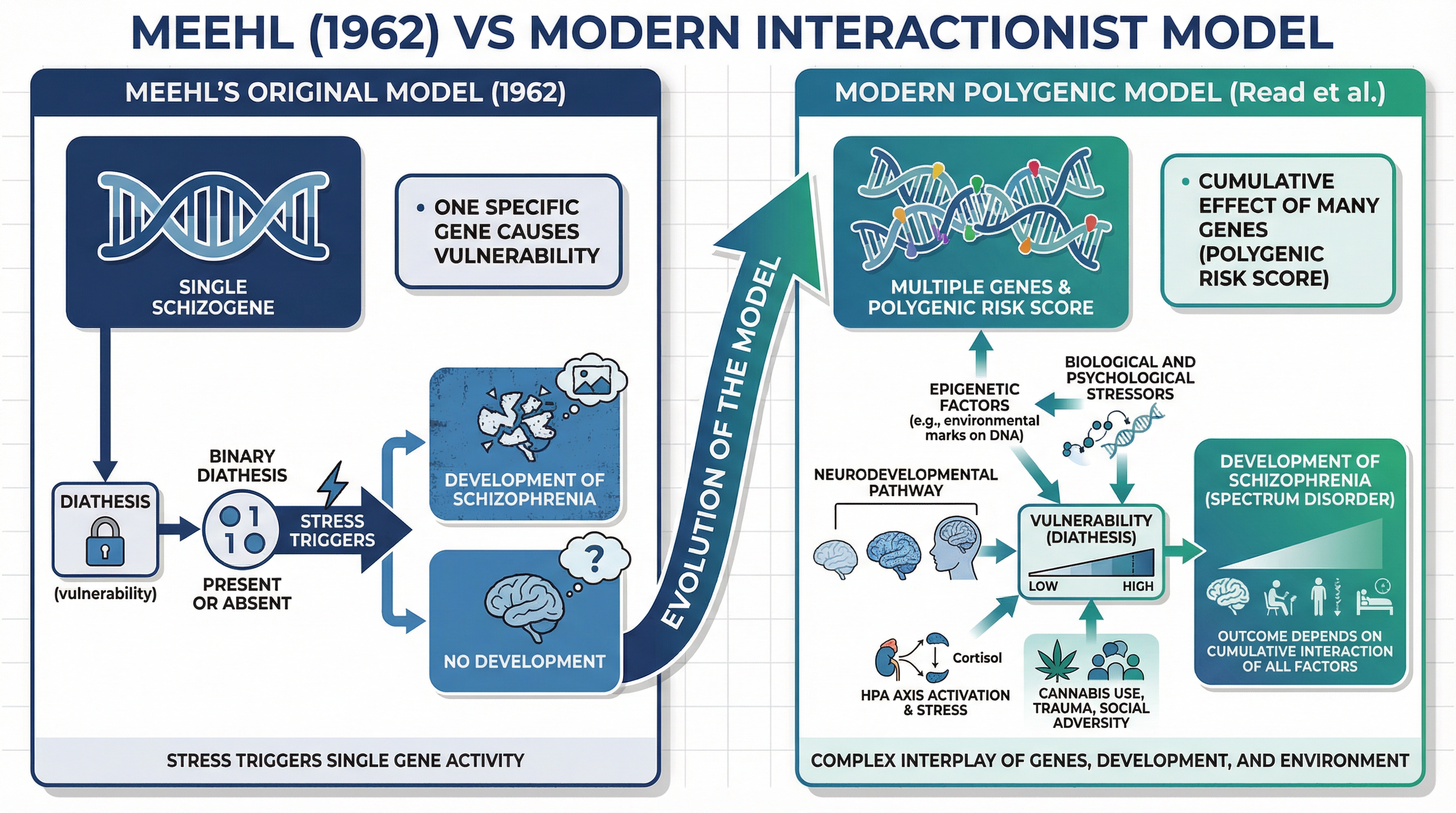
What happened: Meehl proposed the first systematic interactionist model for schizophrenia. He suggested that the diathesis was entirely genetic, caused by a single hypothetical ‘schizogene’. This gene resulted in a ‘schizotaxic’ brain, which was biologically different. If this individual experienced chronic, stressful life events during childhood (particularly from a schizophrenogenic mother), the result would be the development of schizophrenia.
Why it matters: This was a groundbreaking attempt to bridge the gap between biological and environmental camps. However, its simplicity is its downfall in the eyes of modern science. Credit is given for describing it as the historical foundation, but also for critiquing its overly simplistic, single-gene view.
Specific Knowledge: Meehl (1962), ‘schizogene’, ‘schizotaxic’.
The Modern Understanding of Diathesis
Developers: Researchers like Read et al. and evidence from genome-wide association studies (GWAS).
Date(s): 2000s onwards
What happened: The search for a single ‘schizogene’ failed. Instead, modern genetics shows schizophrenia is polygenic. Ripke et al. (2014) found 108 separate genetic variations associated with increased risk. The diathesis is now seen as a cumulative ‘polygenic risk score’ rather than a single gene. Furthermore, the modern view includes non-genetic diatheses, such as birth complications or early neurodevelopmental trauma.
Why it matters: This reflects a far more complex and accurate picture of genetic vulnerability. It explains why schizophrenia runs in families but isn't deterministic. Marks are awarded for showing you understand that the diathesis is not a single ‘thing’ but a complex vulnerability.
Specific Knowledge: Polygenic, Ripke et al. (2014), neurodevelopmental factors.
The Modern Understanding of Stress
What happened: The definition of ‘stress’ has expanded significantly. While psychological trauma is still relevant, examiners award marks for discussing modern, specific biological stressors.
Why it matters: This demonstrates a contemporary understanding. It moves beyond vague ‘life events’ to specific, evidence-based triggers.
Specific Knowledge: Cannabis Use: Heavy use of high-potency cannabis in adolescence is a major risk factor. It is thought to interfere with the dopamine system. HPA Axis Activation: Chronic stress activates the Hypothalamic-Pituitary-Adrenal system, leading to the release of cortisol, which can have neurotoxic effects on brain regions implicated in schizophrenia.
Key Individuals & Studies
Paul Meehl
Role: Originator of the Diathesis-Stress Model for schizophrenia.
Key Actions: In 1962, published his theory proposing a ‘schizogene’ and environmental stress interaction.
Impact: Set the stage for all subsequent interactionist research, even though his specific model is now considered outdated. He provided the essential framework of vulnerability + trigger.
Tienari et al. (2004) - The Finnish Adoption Study
Role: Provided the strongest empirical support for the interactionist model.
Key Actions: Conducted a large-scale, longitudinal adoption study in Finland. They compared the rates of schizophrenia in adopted children who had biological mothers with schizophrenia (high genetic risk) with a control group of adoptees (low genetic risk). They also assessed the quality of the adoptive family environment.
Impact: Found that the high-genetic-risk group only had a significantly higher rate of developing schizophrenia if they were raised in a family environment characterized by high levels of criticism and conflict. This powerfully demonstrates that genetic vulnerability alone is not enough; an environmental trigger is required. This is the go-to study for AO3 evaluation.
Tarrier et al. (2004) - Combination Therapy Study
Role: Provided indirect support for the interactionist model through treatment outcomes.
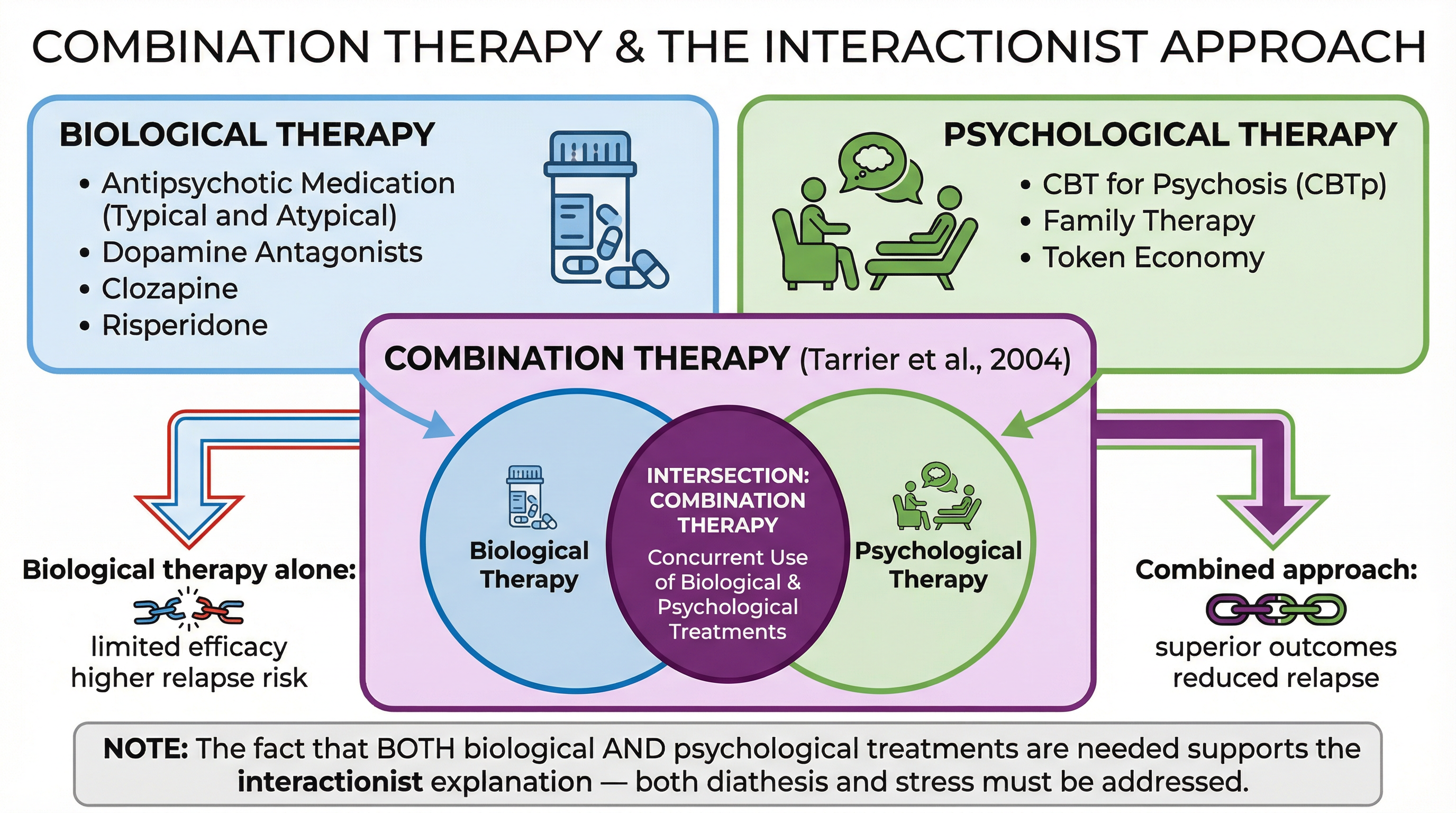
Key Actions: Conducted a study comparing the effectiveness of medication-only treatment with a combination of medication and psychological therapy (CBTp or supportive counselling).
Impact: Found that patients in the combination therapy groups had lower symptom levels and relapse rates than those in the medication-only group. This supports the interactionist model because it implies that both biological and psychological factors are involved in the disorder; if it were purely biological, medication alone should be sufficient.
Second-Order Concepts (Not directly applicable to Psychology A-Level, but useful for structuring essays)
Causation
- The model proposes a multi-causal explanation. The diathesis is the underlying, predisposing cause. The stress is the precipitating or triggering cause. Neither is sufficient on its own.
Consequence
- The immediate consequence of the interaction is the onset of schizophrenia. A long-term consequence of understanding this model is the development of combination therapies that are more effective than single-approach treatments.
Change & Continuity
- Continuity: The core idea of vulnerability + trigger has remained since Meehl (1962).
- Change: The understanding of both ‘diathesis’ (from single gene to polygenic/neurodevelopmental) and ‘stress’ (from purely psychological to include biological stressors like cannabis) has changed dramatically.
"