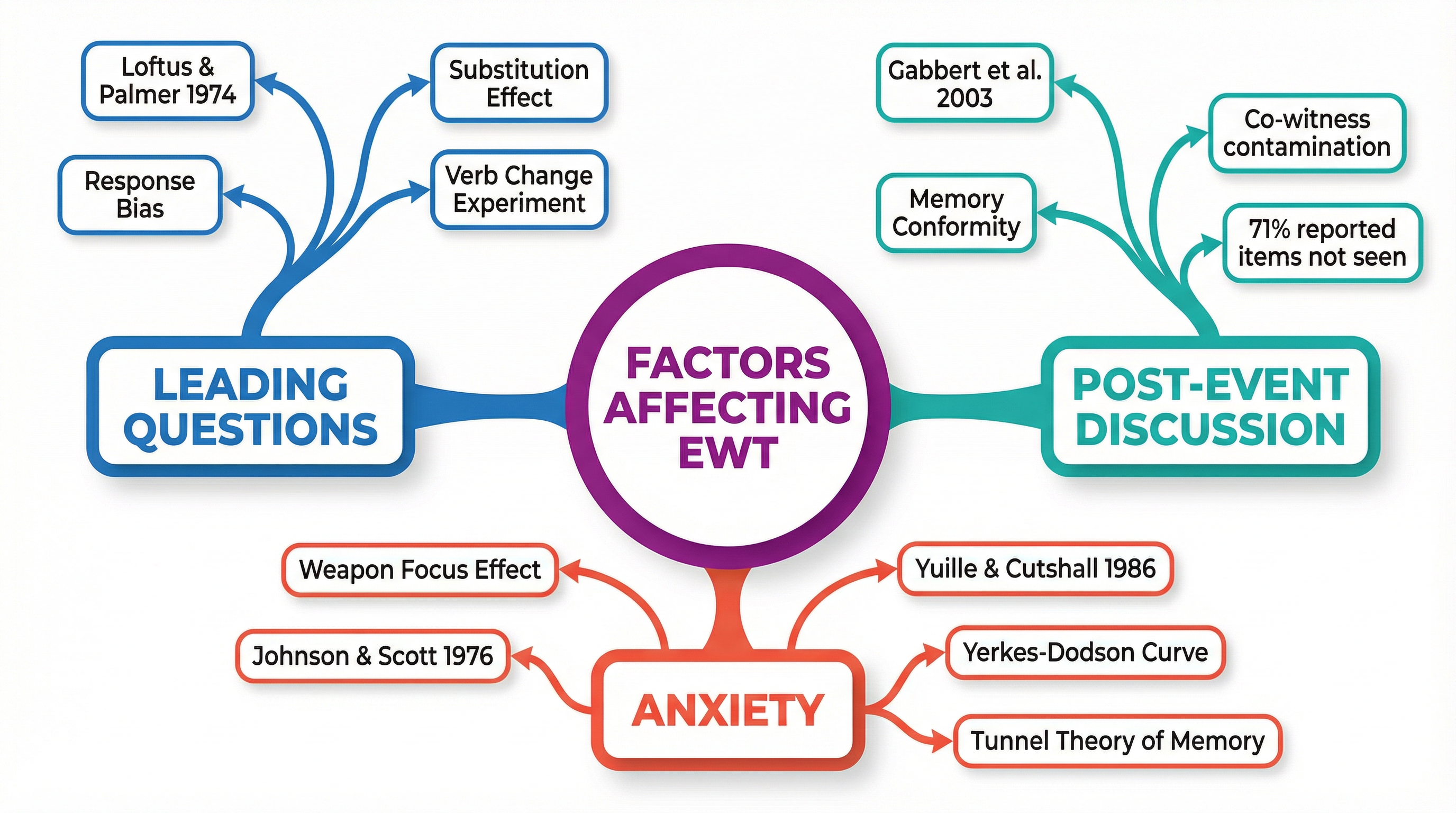
Study Notes
Overview
Eyewitness testimony (EWT) refers to the account given by people of an event they have witnessed. While it can be a powerful form of evidence in a court of law, psychological research has revealed that memory is not a faithful recording of events but is instead a reconstructive process, susceptible to distortion. For the AQA A-Level Psychology exam, candidates are expected to demonstrate detailed knowledge of three key factors that can affect the accuracy of EWT: misleading information (including leading questions and post-event discussion) and anxiety. Examiners will award marks for the ability to describe relevant research, explain the theoretical underpinnings, and critically evaluate the evidence. A sophisticated understanding requires not just knowing the studies, but appreciating their real-world implications and methodological limitations. This guide will equip you with the specific knowledge and exam technique required to achieve top marks in this area.
Key Factors & Research
Misleading Information: Leading Questions
What it is: Information, often in the form of a question, that suggests a particular answer or assumes a state of affairs. The phrasing of a question can alter a witness's memory.
Key Study: Loftus & Palmer (1974) - The Car Crash Study
What happened: Participants were shown films of car accidents and were later asked a critical question about the speed of the vehicles. The verb in the question was changed for different groups (e.g., "smashed", "collided", "bumped", "hit", "contacted").
Why it matters: The verb used had a significant effect on speed estimates. The group that heard the verb "smashed" estimated the highest speed (40.8 mph), while the "contacted" group estimated the lowest (31.8 mph). A week later, those in the "smashed" condition were more than twice as likely to falsely recall seeing broken glass.
Specific Knowledge: Candidates must know the different verbs and the key finding that this demonstrates two potential effects: a response-bias (the verb influences the answer but not the memory) and the substitution explanation (the verb actually changes the memory itself).
Misleading Information: Post-Event Discussion (PED)
What it is: When co-witnesses to a crime discuss it with each other, their testimonies can become contaminated. This is because they may combine information from other witnesses with their own memories.
Key Study: Gabbert et al. (2003) - The Memory Conformity Study
What happened: Participants were studied in pairs. Each partner watched a video of the same crime, but filmed from different points of view. This meant that each participant could see elements in the event that the other could not. The pairs were then encouraged to discuss what they had seen before individually completing a test of recall.
Why it matters: A staggering 71% of participants mistakenly recalled aspects of the event that they did not see in their video but had picked up in the discussion. This demonstrates the phenomenon of memory conformity, where individuals go along with each other to win social approval or because they believe the other witnesses are right.
Specific Knowledge: The 71% figure is a powerful statistic to use in an exam answer. Credit is given for explaining that this shows how memory can be distorted by the desire for social approval.
Anxiety
What it is: A state of emotional and physical arousal. The emotions of anxiety can include having worried thoughts and feelings of tension. Physical changes include an increased heart rate and sweating. Anxiety has complex and contradictory effects on EWT.
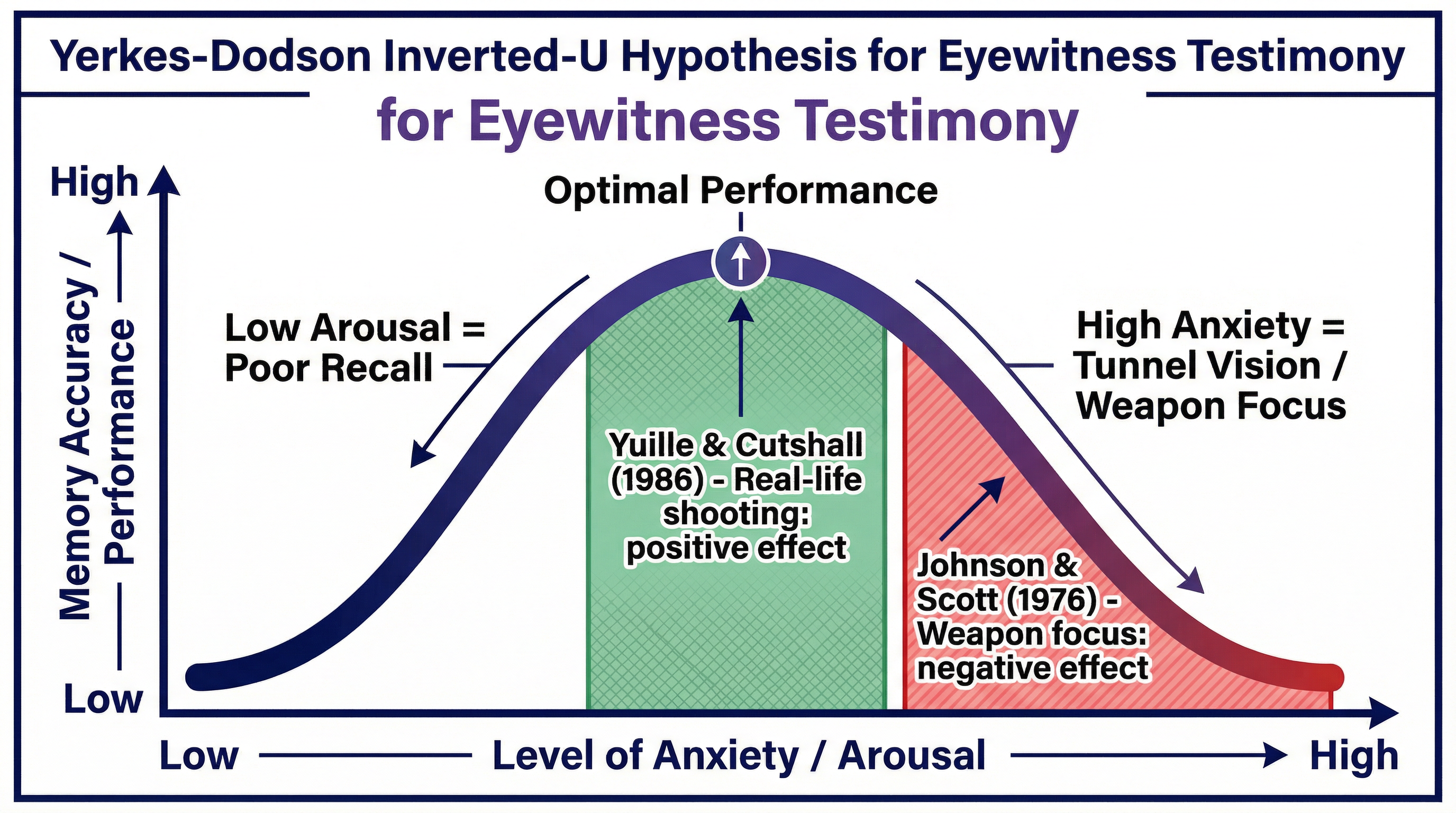
Key Study (Negative Effect): Johnson & Scott (1976) - The Weapon Focus Effect
What happened: Participants were led to believe they were taking part in a lab study. While seated in a waiting room, participants heard an argument in the next room. In the 'low-anxiety' condition, a man then walked through the waiting area, carrying a pen and with grease on his hands. In the 'high-anxiety' condition, the argument was accompanied by the sound of breaking glass and a man walked out of the room holding a paper knife covered in blood.
Why it matters: Participants who had seen the pen were able to identify the man from a line-up 49% of the time, compared to only 33% for those who had seen the knife. This is the weapon focus effect, where the witness's attention is drawn towards the weapon, away from the perpetrator's face, resulting in poorer recall. This is explained by the tunnel theory of memory.
Key Study (Positive Effect): Yuille & Cutshall (1986) - The Real-Life Shooting Study
What happened: In a real-life case, a gun-shop owner shot a thief dead. There were 21 witnesses, 13 of whom agreed to participate in the study. They were interviewed 4-5 months after the incident and their accounts were compared to the police interviews made at the time of the shooting.
Why it matters: The witnesses were very accurate in their accounts, and there was little change in the amount or accuracy of recall after 5 months. Crucially, those participants who reported the highest levels of stress at the time were the most accurate (88% compared to 75% for the less-stressed group). This suggests that anxiety can, in some circumstances, enhance recall.
Reconciling the Findings: The Yerkes-Dodson Inverted-U Hypothesis is used to explain these contradictory findings. It states that performance will increase with stress, but only up to a certain point, where it decreases drastically. This suggests that moderate anxiety can be beneficial for recall, while very high or very low levels are detrimental.
Exam Focus: Evaluation (AO3)
To earn high marks, you must evaluate the research. Here are some key evaluation points:
- Artificiality of Lab Studies: Loftus & Palmer's and Johnson & Scott's studies were conducted in labs. Watching a video of a car crash or hearing an argument next door is not the same as witnessing a real crime. The lack of genuine emotional arousal and consequences means these studies may lack ecological validity.
- Demand Characteristics: Participants in lab studies know they are being watched. This can lead them to behave in ways they think the experimenter wants, affecting the validity of the results.
- Field Studies & Lack of Control: Yuille & Cutshall's study has high ecological validity as it was a real event. However, the researchers had no control over what happened to the witnesses in the intervening months (e.g., post-event discussion, media reports). This lack of control makes it difficult to establish a clear cause-and-effect relationship.
- Ethical Issues: Deceiving participants and exposing them to anxiety-inducing situations (even if staged) raises ethical concerns. Researchers must conduct a cost-benefit analysis.
- The 'Unusualness' Argument: Pickel (1998) conducted an experiment using scissors, a handgun, a wallet, and a whole raw chicken as the hand-held items in a hairdressing salon video. Eyewitness accuracy was significantly poorer in the high unusualness conditions (chicken and handgun). This suggests that the weapon focus effect may be due to unusualness rather than anxiety.