Study Notes
Overview
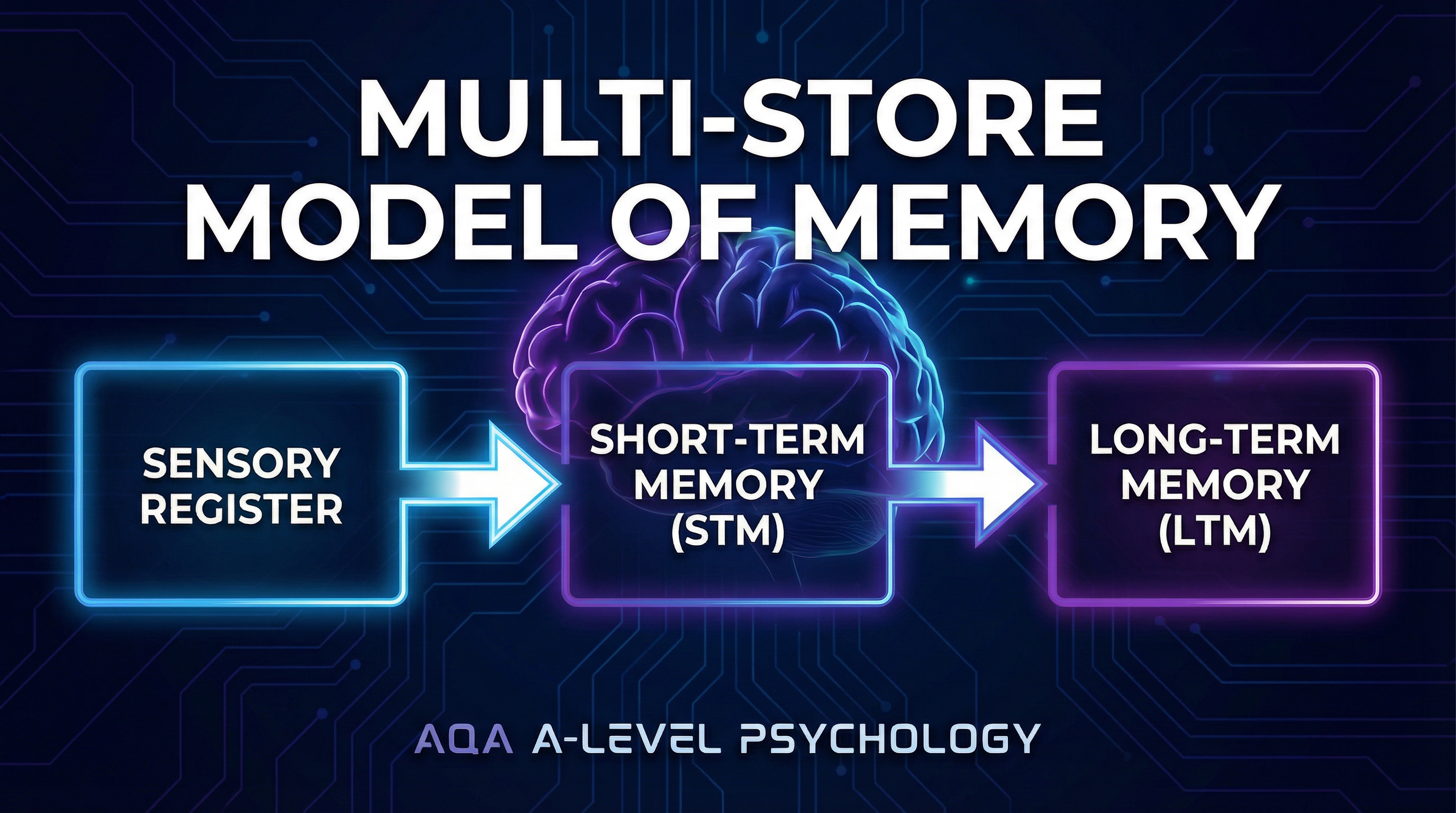
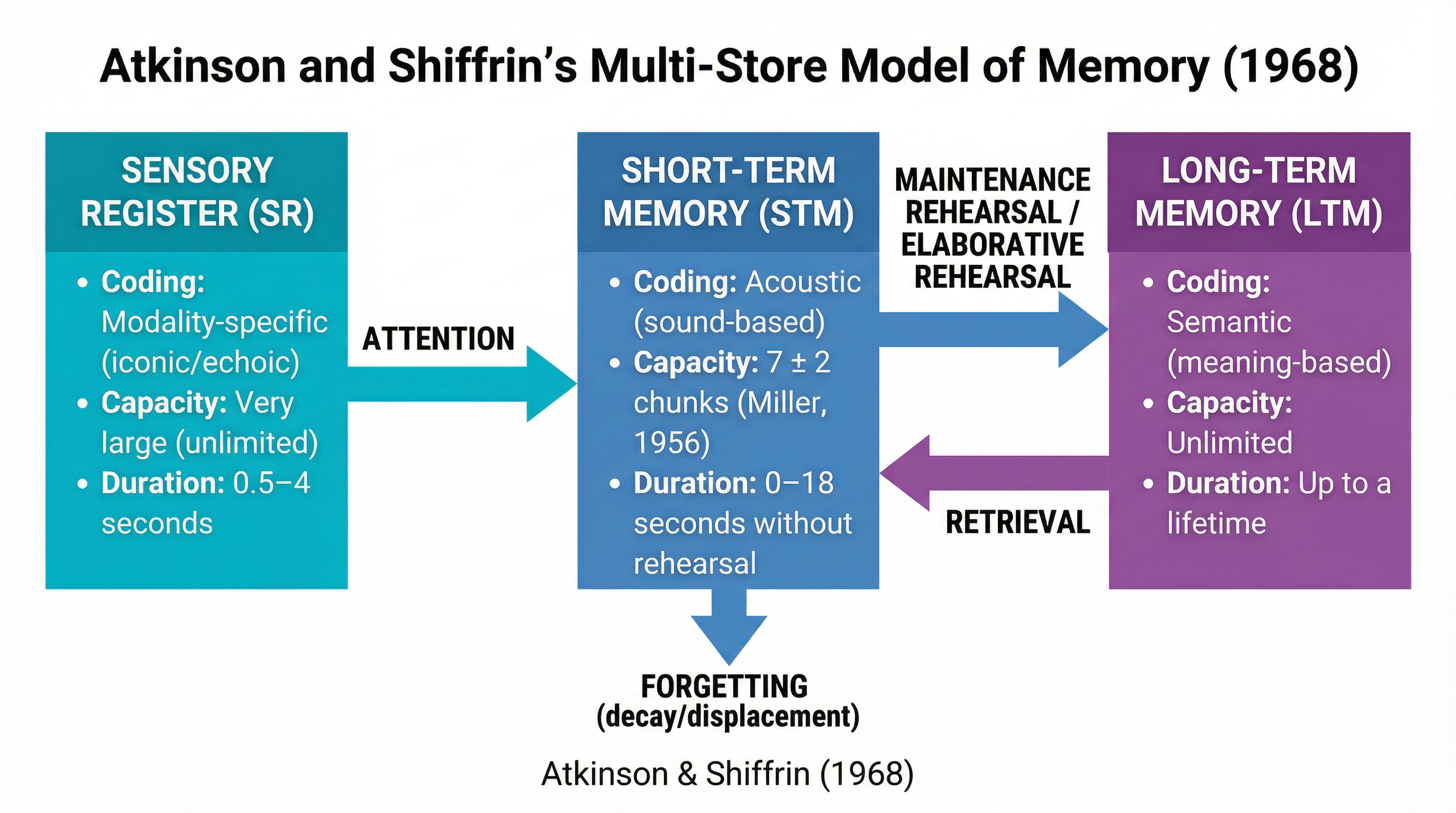
The Multi-Store Model of Memory (MSM) is a structural model proposed by Richard Atkinson and Richard Shiffrin in 1968. It describes memory in terms of information flowing through a system of three distinct, unitary stores: the Sensory Register (SR), Short-Term Memory (STM), and Long-Term Memory (LTM). This model was one of the first to present a clear, testable framework for memory, viewing it as an active information processing system, much like a computer. For AQA A-Level Psychology candidates, a precise understanding of this model is essential. Examiners expect candidates to be able to describe the characteristics of each store (coding, capacity, and duration) with accuracy, explain the transfer processes (attention and rehearsal) that move information between the stores, and critically evaluate the model using a range of supporting and refuting evidence. Marks are awarded for demonstrating a clear understanding of the model's linear nature and its limitations, particularly the idea that the stores are unitary.
The Three Stores of Memory
The Sensory Register (SR)
- What it is: The first point of contact for all sensory information from the environment. It is not a single store but comprises multiple registers for each sense (e.g., iconic for visual, echoic for auditory).
- Coding: Modality-specific. Information is stored in the same form it is sensed (e.g., visual information as images).
- Capacity: Very large, potentially unlimited. It can hold a vast amount of information from our senses at any one time.
- Duration: Extremely brief. Visual information in the iconic store lasts for about half a second, while auditory information in the echoic store lasts for 2-4 seconds. Information that is not attended to is lost through rapid decay.
- Transfer: Information passes from the SR to the STM only if attention is paid to it.
Short-Term Memory (STM)
- What it is: A temporary store for information currently in conscious awareness. It holds information that we are actively thinking about.
- Coding: Primarily acoustic. Information is stored based on how it sounds. This was supported by Conrad (1964), who found that participants made more errors recalling acoustically similar letters (e.g., 'B', 'P') than acoustically dissimilar ones.
- Capacity: Limited. George Miller (1956) famously described the capacity as the 'magical number seven, plus or minus two' (i.e., 5-9 chunks of information). A 'chunk' is a meaningful unit of information.
- Duration: Limited, typically 18-30 seconds without rehearsal. Peterson & Peterson (1959) demonstrated this by showing that recall of a three-consonant trigram dropped significantly after 18 seconds if participants were prevented from rehearsing.
- Transfer: Information is kept in STM through maintenance rehearsal (simple repetition). It is transferred to LTM through elaborative rehearsal (linking to existing knowledge).
Long-Term Memory (LTM)
- What it is: The potentially permanent memory store for information that has been rehearsed for a prolonged time.
- Coding: Primarily semantic. Information is stored based on its meaning. Baddeley (1966) found that participants had difficulty recalling semantically similar words from LTM, suggesting that LTM is organised by meaning.
- Capacity: Functionally unlimited. There is no known limit to the amount of information that can be stored in LTM.
- Duration: Potentially a lifetime. Some memories can last for an entire lifetime, although they can be lost through decay or interference.
- Transfer: Information is retrieved from LTM back into STM so that it can be used.
Evaluation of the Multi-Store Model
Supporting Evidence
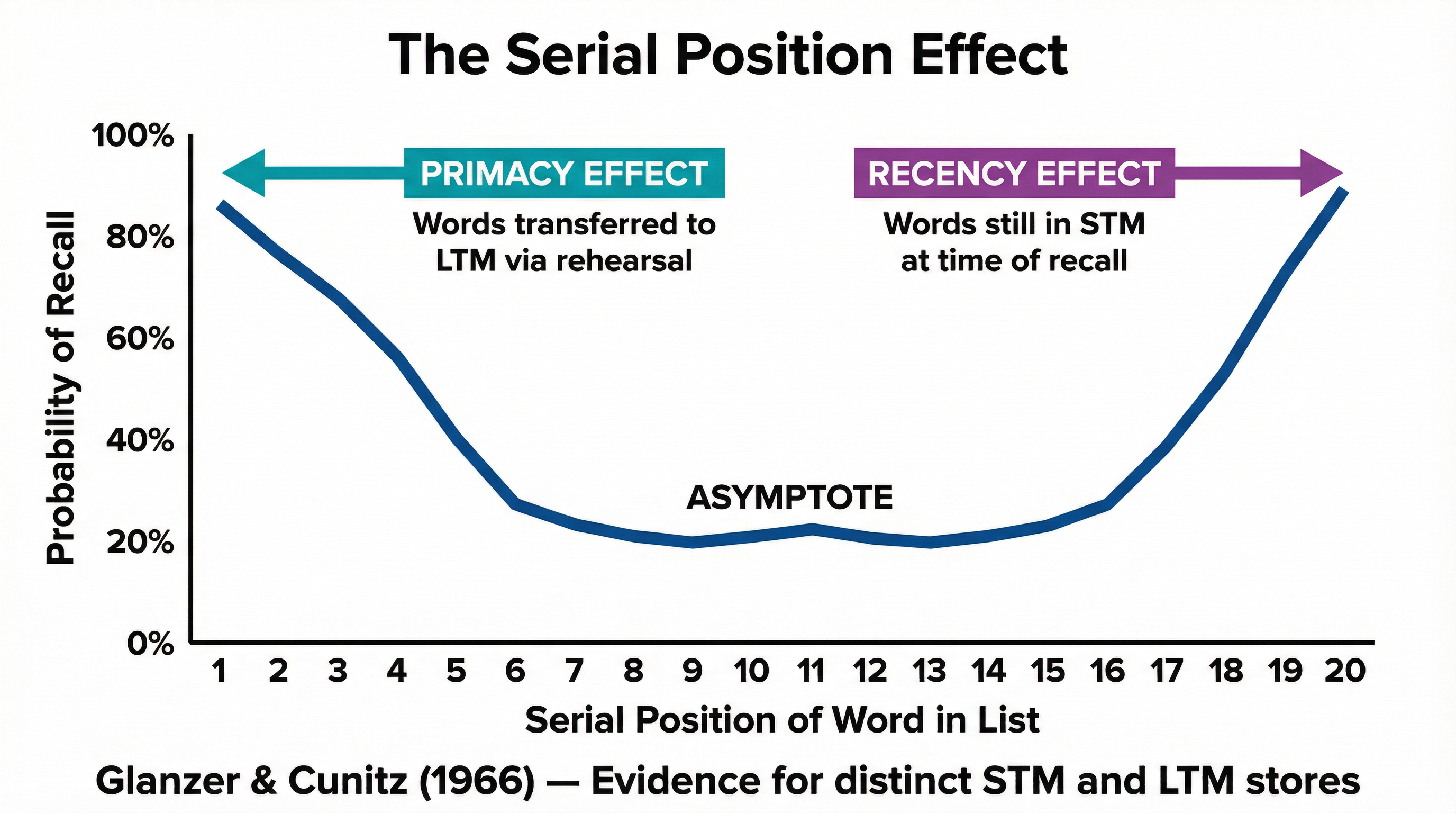
- Serial Position Effect: Glanzer and Cunitz (1966) found that when participants were asked to recall a list of words, they tended to remember the first few (the primacy effect) and the last few (the recency effect) best. The primacy effect occurs because the first words have been rehearsed and transferred to LTM, while the recency effect occurs because the last words are still in STM. This supports the idea of separate STM and LTM stores.
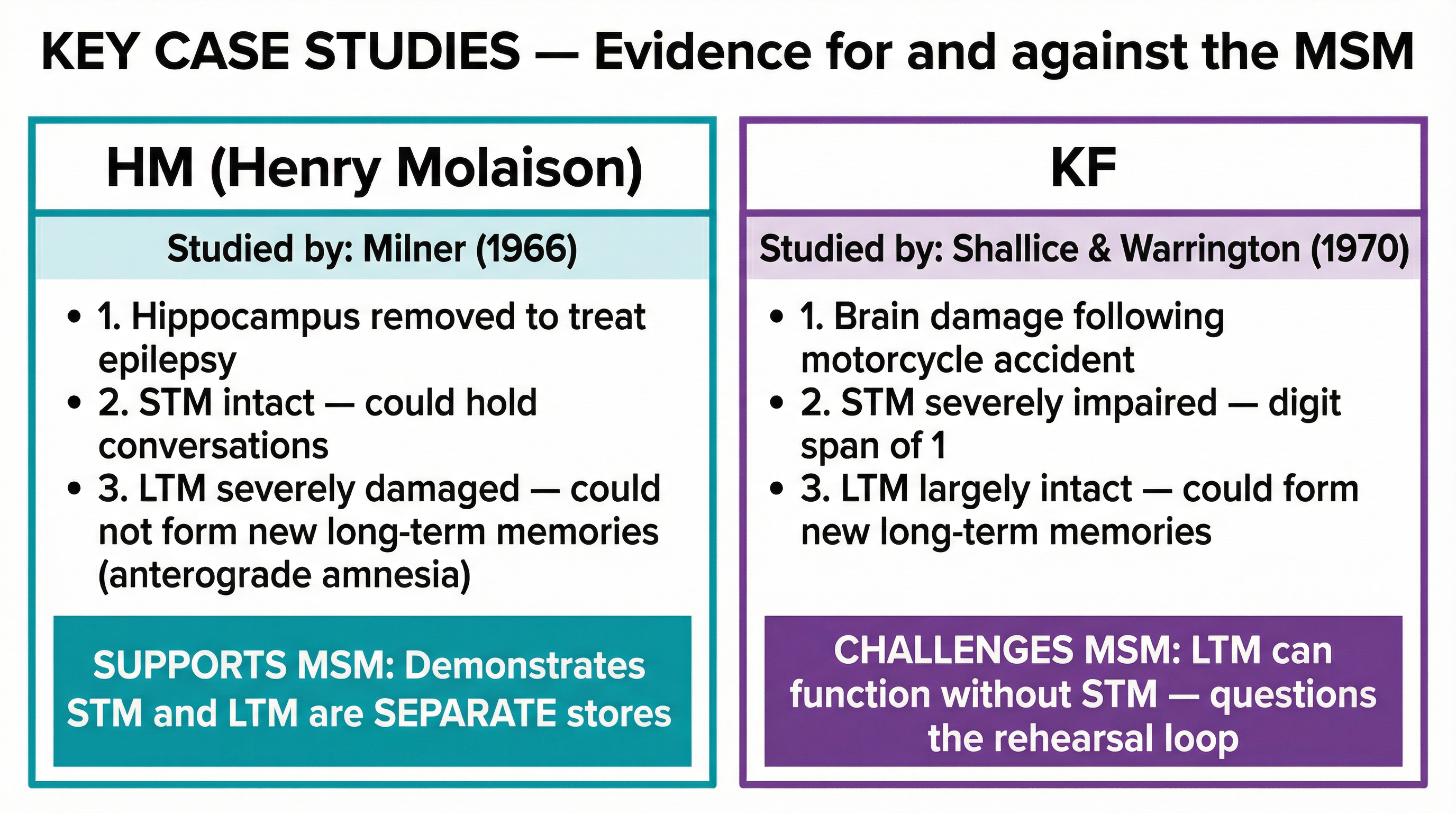
- Case Study of HM (Henry Molaison): After surgery to treat epilepsy which involved removing his hippocampus, HM was unable to form new long-term memories (anterograde amnesia). However, his short-term memory was largely intact. This dissociation between his damaged LTM and functioning STM provides strong evidence that these are separate and distinct memory stores.
Refuting Evidence
- The Model is Too Simplistic: The MSM suggests that both STM and LTM are single, unitary stores. However, evidence suggests this is not the case. The Working Memory Model (Baddeley & Hitch, 1974) shows that STM is a more complex, multi-component system. Similarly, research into LTM has identified different types, such as episodic, semantic, and procedural memory (Tulving, 1972).
- Case Study of KF: Shallice and Warrington (1970) reported on the case of KF, who suffered brain damage from a motorcycle accident. His STM was severely impaired (digit span of only 1 or 2), but his LTM was largely unaffected. According to the MSM, information must pass through STM to get to LTM, so KF should not have been able to form new long-term memories. This case challenges the linear, sequential nature of the model.
- Role of Rehearsal: The MSM emphasizes the role of maintenance rehearsal in transferring information to LTM. However, Craik and Watkins (1973) argued that the type of rehearsal is more important than the amount. Elaborative rehearsal, where information is processed more deeply and linked to existing knowledge, is more effective for LTM storage. This suggests the transfer process is more complex than the MSM suggests.