The Psychodynamic Approach

    AQA
    A-Level
    Psychology

    Dive into the mind of Freud with this essential AQA A-Level Psychology guide to the Psychodynamic Approach. Uncover the secrets of the unconscious, the dynamics of the Id, Ego, and Superego, and learn exactly what examiners want to see for top marks in AO1 description and AO3 evaluation.

    5
    Min Read
    3
    Examples
    5
    Questions
    6
    Key Terms
    🎙 Podcast Episode
    The Psychodynamic Approach
    14:16
    0:00-14:16

    Study Notes

    Header image for The Psychodynamic Approach

    Overview

    The Psychodynamic Approach, pioneered by Sigmund Freud, was one of the first 'talking cures' and represents a monumental shift in our understanding of the human mind. It proposes that our behaviour is driven by unconscious motives and unresolved childhood conflicts. For AQA A-Level Psychology candidates, mastery of this topic is non-negotiable. It requires a firm grasp of its core tenets: the structure of the personality, the role of the unconscious, the psychosexual stages, and defence mechanisms. Examiners expect candidates to not only describe these concepts accurately for AO1 marks but also to critically evaluate the approach's scientific standing, its evidence base, and its lasting impact for high-level AO3 credit. This guide will equip you with the detailed knowledge and exam technique required to deconstruct any question on this fascinating and complex topic.

    Revision Podcast: The Psychodynamic Approach

    Key Concepts of the Psychodynamic Approach

    The Role of the Unconscious

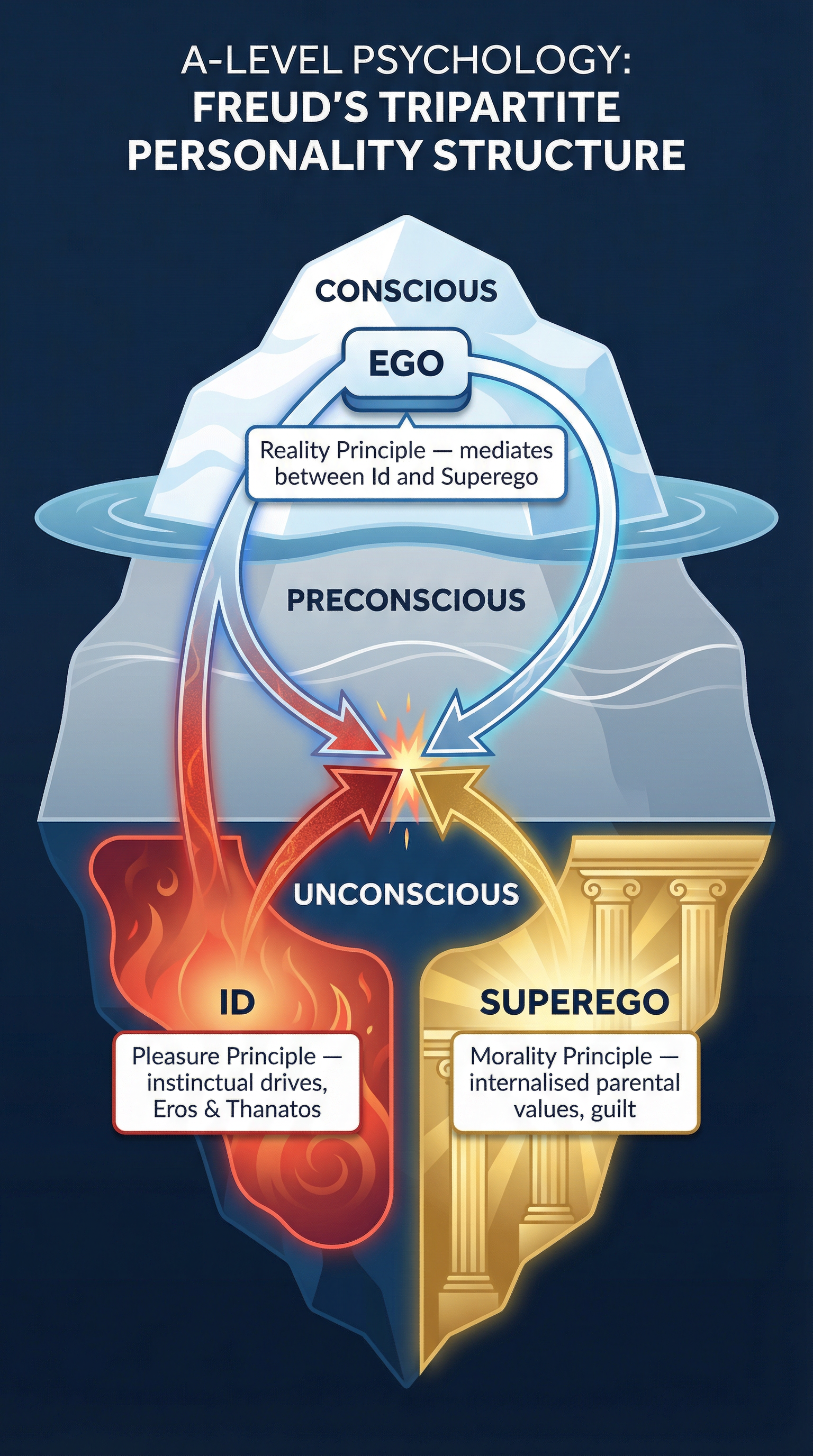
    Freud's most significant contribution was his concept of the unconscious mind. He used the analogy of an iceberg to explain this: the tip of the iceberg, visible above the water, is the conscious mind (everything we are aware of at any given moment). Just below the surface is the preconscious mind, containing thoughts and memories that are not currently in consciousness but can be easily accessed. The vast, submerged bulk of the iceberg is the unconscious mind, a reservoir of repressed memories, deep-seated fears, and powerful instinctual drives (Eros and Thanatos) that have a profound influence on our behaviour and personality, even though we are unaware of them. For Freud, the primary goal of psychoanalysis was to make the unconscious conscious.

    The Structure of Personality

    Freud proposed a tripartite (three-part) structure of personality, which develops during childhood. These three parts are in constant dynamic conflict.
    Freud's Tripartite Personality Structure

    • The Id: Present from birth, the Id is the primitive, instinctual part of the personality. It operates entirely in the unconscious and is driven by the Pleasure Principle, demanding immediate gratification for its desires. It is illogical and amoral.
    • The Ego: Developing around the age of two, the Ego is the 'reality check'. It operates on the Reality Principle, mediating between the selfish demands of the Id and the moralistic constraints of the Superego. It uses defence mechanisms to cope with the anxiety this conflict creates.
    • The Superego: Formed around the age of five during the Phallic stage, the Superego is our internalised sense of morality, learned from our parents and society. It operates on the Morality Principle and consists of the Conscience (which punishes with guilt) and the Ego Ideal (which rewards with pride).

    The Psychosexual Stages

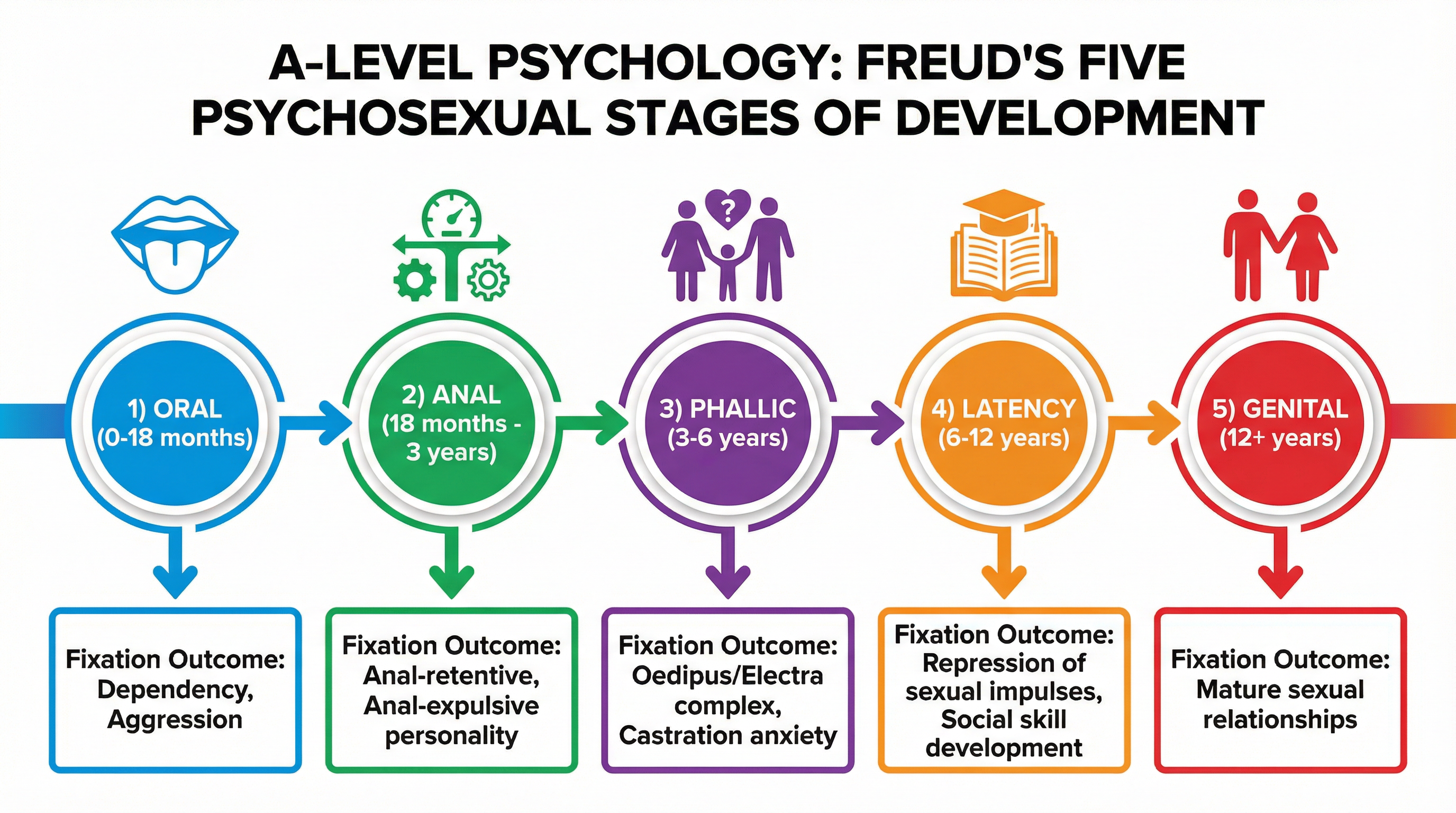
    Freud argued that personality develops through five psychosexual stages. At each stage, the libido (sexual energy) is focused on a different erogenous zone. Frustration or overindulgence at any stage can lead to fixation, where the individual becomes 'stuck' and carries the psychological traits of that stage into adulthood.
    Freud's Five Psychosexual Stages of Development

    1. Oral Stage (0-1 year): Focus on the mouth. Fixation can lead to dependency, gullibility, or sarcasm and aggression.
    2. Anal Stage (1-3 years): Focus on the anus (potty training). Fixation can lead to an anal-retentive personality (obsessively tidy, stubborn) or an anal-expulsive personality (messy, rebellious).
    3. Phallic Stage (3-5 years): Focus on the genitals. The Oedipus Complex (in boys) and Electra Complex (in girls) occur. Successful resolution leads to identification with the same-sex parent and the formation of the Superego.
    4. Latency Stage (5-puberty): Sexual drives are dormant. Focus is on social development.
    5. Genital Stage (puberty onwards): Sexual desires reawaken and are directed towards peers.

    Defence Mechanisms

    These are unconscious strategies used by the Ego to protect itself from anxiety arising from the Id-Superego conflict. They distort reality to reduce stress.

    • Repression: Unconsciously pushing threatening memories into the unconscious (e.g., forgetting childhood trauma).
    • Denial: Refusing to acknowledge a painful reality (e.g., an alcoholic insisting they don't have a problem).
    • Displacement: Redirecting feelings from a threatening target to a safer one (e.g., shouting at your family after being told off by your boss).

    Visual Resources

    2 diagrams and illustrations

    Freud's Tripartite Personality Structure
    Freud's Tripartite Personality Structure
    Freud's Five Psychosexual Stages of Development
    Freud's Five Psychosexual Stages of Development

    Interactive Diagrams

    1 interactive diagram to visualise key concepts

    ConflictConflictDefence MechanismsUnconscious MindId: Pleasure PrincipleSuperego: Morality PrincipleConscious MindEgo: Reality Principle

    A diagram showing the dynamic conflict between the Id, Ego, and Superego.

    Worked Examples

    3 detailed examples with solutions and examiner commentary

    Practice Questions

    Test your understanding — click to reveal model answers

    Q1

    Outline the role of the unconscious in the psychodynamic approach. (4 marks)

    4 marks
    standard

    Hint: Think about the iceberg analogy. What is the unconscious and how does it influence behaviour?

    Q2

    Describe the Oedipus complex as an explanation for gender development. (4 marks)

    4 marks
    standard

    Hint: Focus on the Phallic stage. What happens to boys, and how does it lead to them identifying as male?

    Q3

    Briefly evaluate the use of case studies as a method of investigation in the psychodynamic approach. (4 marks)

    4 marks
    challenging

    Hint: Think about the strengths and weaknesses. Are they scientific? Are they generalisable?

    Q4

    Apart from its unscientific nature, explain one limitation of the psychodynamic approach. (3 marks)

    3 marks
    standard

    Hint: Consider its view on free will, or its cultural and historical context.

    Q5

    Outline and evaluate the psychodynamic approach. (16 marks)

    16 marks
    challenging

    Hint: This is a full essay. You need 6 marks of AO1 (description) and 10 marks of AO3 (evaluation). Structure it with an introduction, 2-3 paragraphs of AO1, 3-4 paragraphs of AO3 (PEEL), and a conclusion.

    Explore this topic further

    View Topic PageAll Psychology Topics

    Key Terms

    Essential vocabulary to know

    More Psychology Study Guides

    View all

    Idiographic and Nomothetic Approaches

    AQA
    A-Level

    This guide dissects the fundamental AQA A-Level Psychology debate between Idiographic and Nomothetic approaches. Understanding this is crucial for Paper 2, as it tests your ability to evaluate the scientific nature of psychology and appreciate the trade-off between in-depth individual insight and broad, generalisable laws."

    Inferential Statistics

    AQA
    A-Level

    Inferential statistics are the bedrock of psychological research, allowing us to move from sample data to general conclusions about human behaviour. Mastering this topic is non-negotiable for A-Level Psychology, as it provides the tools to determine if research findings are statistically significant or merely a fluke, a skill that unlocks the highest marks in the Research Methods paper."

    Environmental Psychology

    OCR
    A-Level

    Environmental Psychology explores the critical two-way relationship between our surroundings and our behaviour. This guide provides the essential OCR A-Level knowledge on how stressors like noise, the design of spaces, and even the view from a window can profoundly affect our minds and actions, equipping you with the specific studies and evaluation points needed to secure top marks.

    Observations

    OCR
    A-Level

    Mastering observational methods is crucial for OCR A-Level Psychology, as it forms a cornerstone of the research methods paper. This guide provides the precise language, design principles, and evaluation points needed to secure top marks in 'Design a Study' questions.

    Ethical Costs of Research

    WJEC
    A-Level

    This guide dissects the critical 'double obligation' dilemma in psychological research, balancing scientific progress against participant welfare. It provides a comprehensive breakdown of the BPS Code of Ethics, equipping WJEC A-Level candidates with the analytical tools needed to master AO2 application and AO3 evaluation.

    CBT and Family Therapy for Schizophrenia

    AQA
    A-Level

    This study guide provides a comprehensive overview of two key psychological treatments for schizophrenia: Cognitive Behavioural Therapy (CBT) and Family Therapy. It is designed to equip AQA A-Level Psychology students with the detailed knowledge and evaluation skills needed to excel in Paper 3, focusing on practical application and examiner expectations.