Study Notes
Overview
Synaptic transmission is the process occurring at the synapse that allows a neuron to pass an electrical or chemical signal to another neuron. For Edexcel A-Level Psychology, candidates are expected to demonstrate a precise understanding of this electrochemical process. This begins with the arrival of an action potential at the pre-synaptic terminal, leading to the release of chemical messengers called neurotransmitters. These neurotransmitters diffuse across the synaptic cleft, bind to receptors on the post-synaptic membrane, and generate a new electrical signal. Examiners award significant credit for detailing the roles of calcium ions, the distinction between excitatory and inhibitory potentials (EPSPs and IPSPs), and the critical concept of summation. Understanding this topic is not just about memorising steps; it is the foundation for explaining the mechanisms of drug action, the biological basis of mental illness, and the overall functioning of the nervous system.
The Electrochemical Cascade: Step-by-Step
This is the core knowledge (AO1) that you must be able to describe in detail. Marks are awarded for a clear, sequential explanation where the consequence of each step is explained.
1. Arrival of the Action Potential
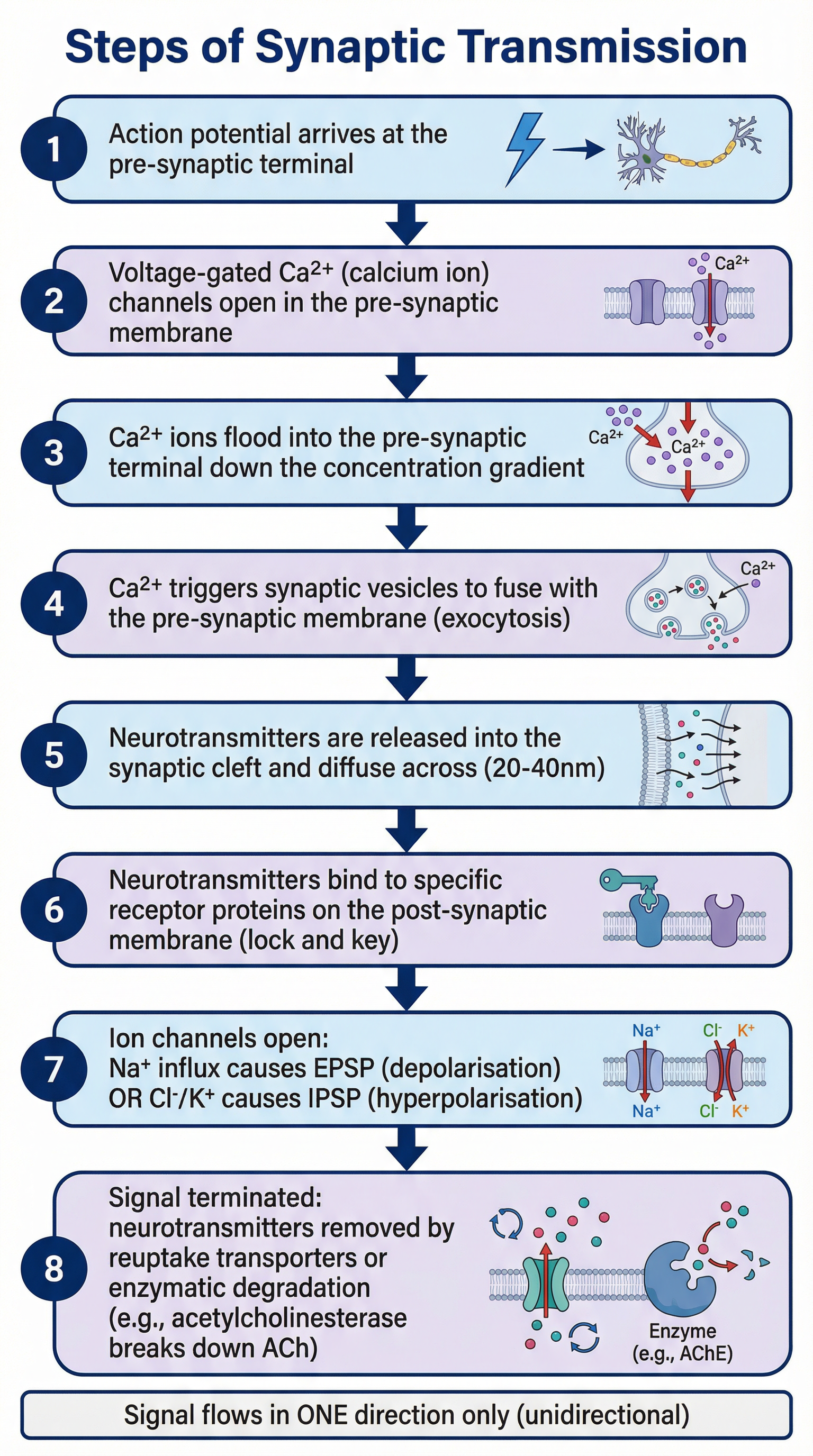
What happens: An electrical impulse, the action potential, propagates down the axon of the pre-synaptic neuron and arrives at the axon terminal.
Why it matters: This is the trigger for the entire process. The change in voltage from the action potential is what initiates the conversion from an electrical to a chemical signal.
Specific Knowledge: The membrane potential rapidly depolarises from a resting state of -70mV to a peak of around +40mV.
2. Calcium Ion Influx
What happens: The depolarisation of the pre-synaptic terminal membrane causes voltage-gated calcium ion (Ca2+) channels to open. Calcium ions, which are more concentrated outside the neuron, flood into the terminal.
Why it matters: This influx of calcium is the direct trigger for the release of neurotransmitters. Without calcium entry, the signal would stop here. Examiners specifically credit the mention of voltage-gated calcium ion channels.
3. Exocytosis of Vesicles
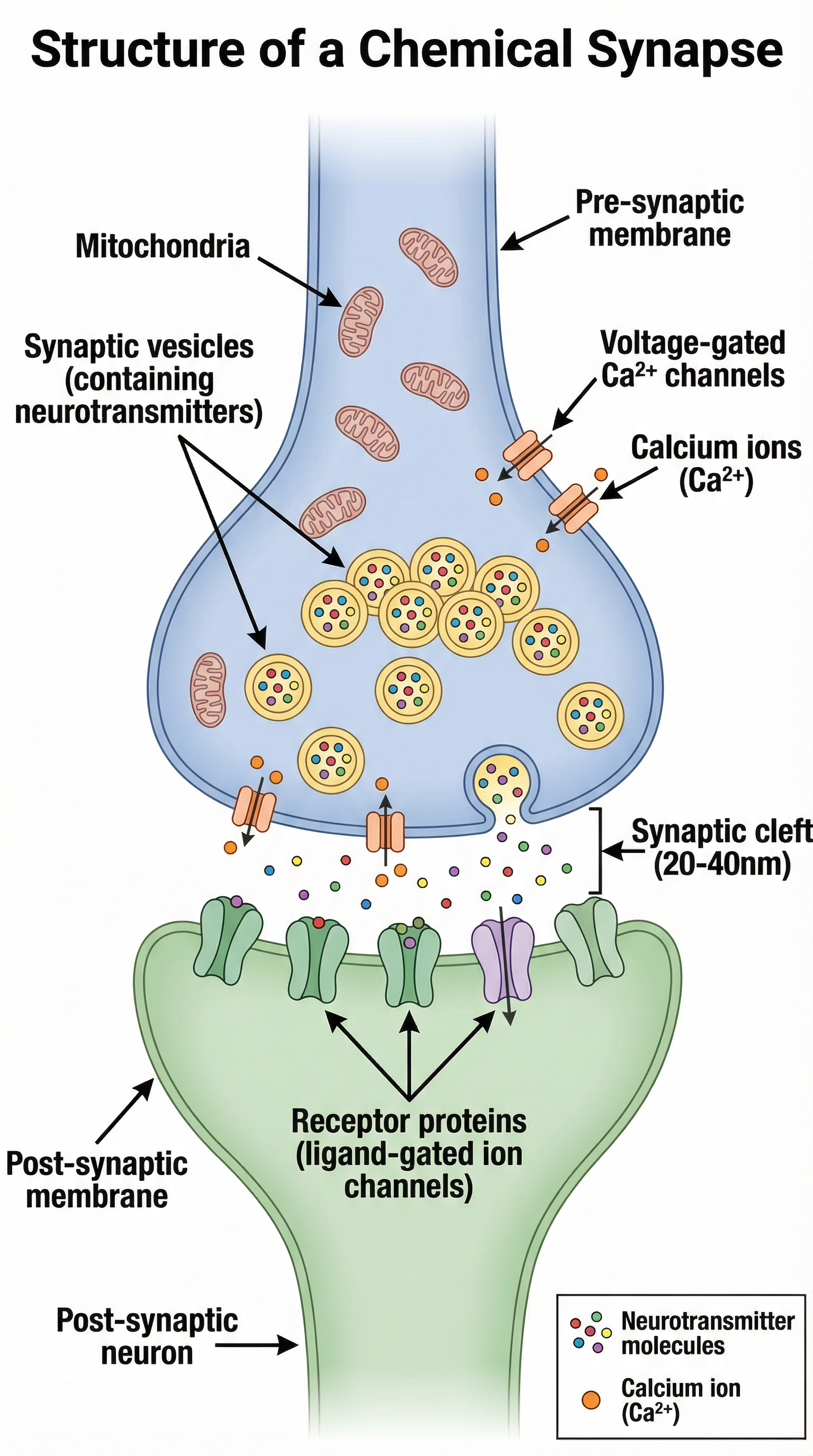
What happens: The increased intracellular calcium concentration causes synaptic vesicles (small sacs filled with neurotransmitters) to fuse with the pre-synaptic membrane. This process, known as exocytosis, releases the neurotransmitter molecules into the synaptic cleft.
Why it matters: This is the point of conversion from an electrical signal (the action potential) to a chemical signal (the neurotransmitter).
4. Diffusion and Receptor Binding
What happens: The released neurotransmitter molecules diffuse across the narrow synaptic cleft (approx. 20-40nm). They then bind to specific protein receptors on the post-synaptic membrane.
Why it matters: This is often described as a 'lock and key' mechanism, as each neurotransmitter has a specific molecular shape that fits a particular receptor. This ensures the signal is transmitted accurately. The binding action is what influences the post-synaptic neuron.
5. Post-Synaptic Potentials (EPSPs & IPSPs)
What happens: When the neurotransmitter binds, it causes ion channels on the post-synaptic membrane to open. This generates a post-synaptic potential (PSP). There are two types:
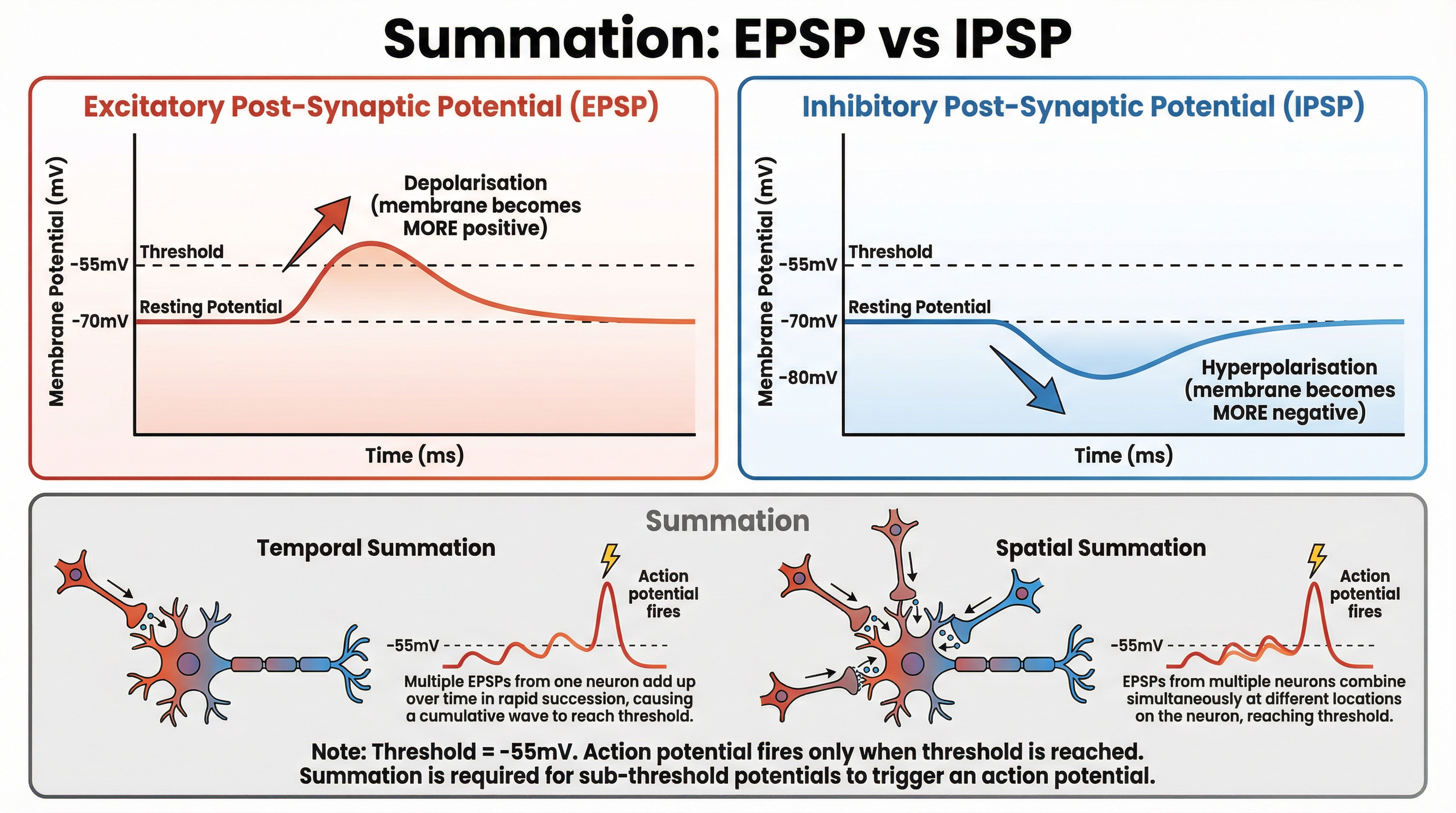
- Excitatory Post-Synaptic Potential (EPSP): If excitatory receptors are activated (e.g., by acetylcholine or noradrenaline), sodium (Na+) channels open, and Na+ ions flow in. This causes the post-synaptic membrane to depolarise (become more positive), making it more likely to fire an action potential.
- Inhibitory Post-Synaptic Potential (IPSP): If inhibitory receptors are activated (e.g., by GABA or serotonin), chloride (Cl-) channels may open, and Cl- ions flow in. This causes the membrane to hyperpolarise (become more negative), making it less likely to fire an action potential.
Why it matters: This is the decision-making point of the nervous system. The neuron 'decides' whether to pass the signal on based on the balance of excitatory and inhibitory inputs.
6. Summation and Signal Termination
What happens: A single EPSP is rarely enough to trigger an action potential. Instead, the post-synaptic neuron sums up all the incoming EPSPs and IPSPs. If the net effect of this summation reaches the threshold potential (around -55mV), a new action potential is generated. The signal is then terminated by either reuptake (neurotransmitters are transported back into the pre-synaptic terminal) or enzymatic degradation (an enzyme breaks down the neurotransmitter in the cleft, e.g., acetylcholinesterase breaks down acetylcholine).
Why it matters: Summation is the key to neural integration and is a frequent discriminator for top-band marks. Signal termination is vital to prevent continuous, uncontrolled firing of the post-synaptic neuron.