Study Notes
Overview
Bocchiaro et al. (2012) is a pivotal study in the Social Area of psychology, investigating why people obey unjust authority, and what distinguishes those who disobey or even become whistleblowers. Conducted at VU University in Amsterdam, it employed a controlled laboratory paradigm to create a moral dilemma, contrasting what people predict they would do with what they actually do. Examiners expect candidates to understand this 'obedience gap' and to use the study to argue for the strength of situational factors over dispositional (personality) traits. Credit is given for precise knowledge of the procedure, the quantitative results, and the key finding that personality, as measured by the HEXACO-PI-R, did not significantly predict who would obey, disobey, or whistleblow. This study is essential for evaluating the core assumptions of the Social Area and for application questions concerning workplace misconduct.
The Experimental Paradigm
The Cover Story
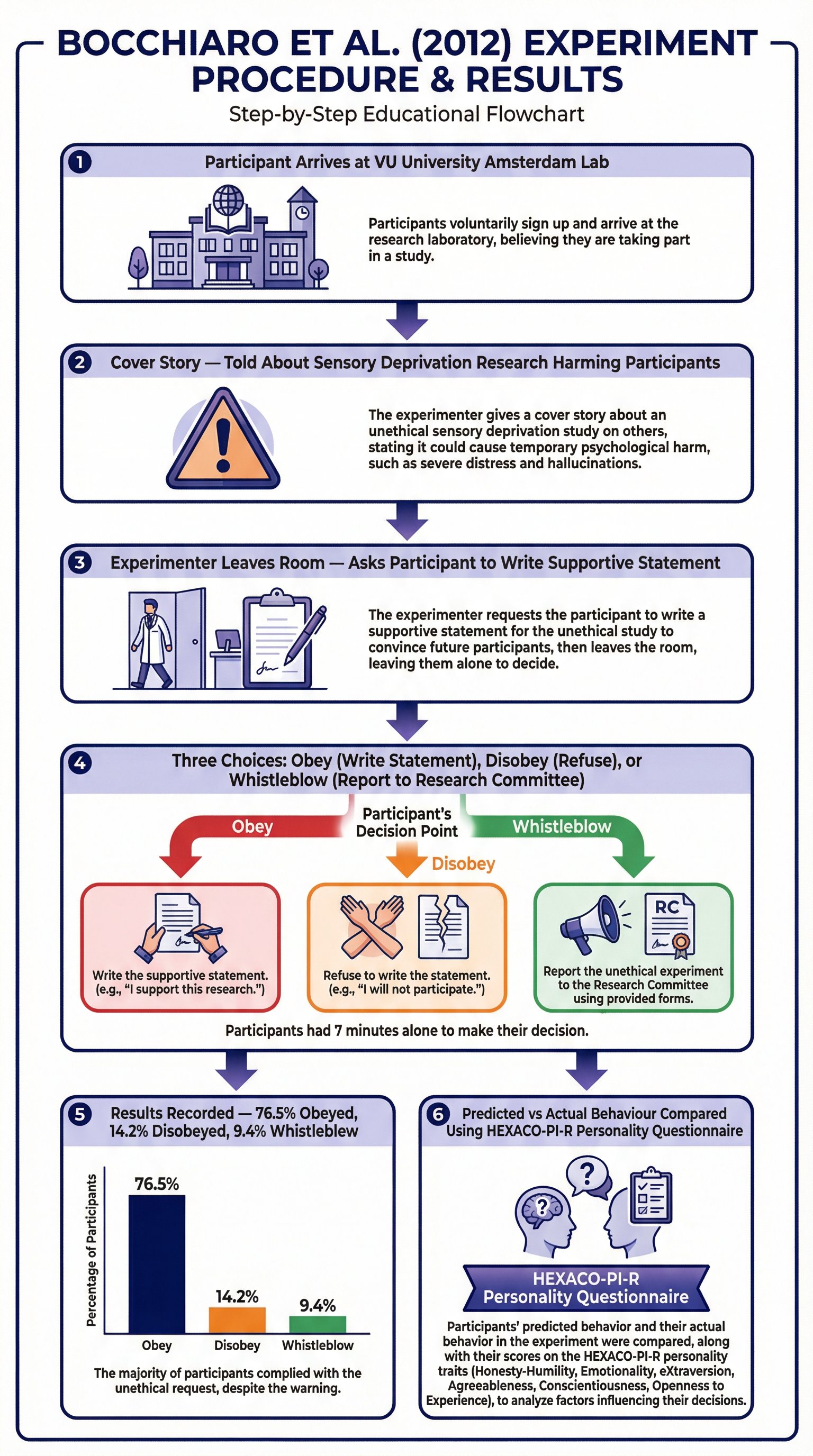
What happened: Participants were greeted by a stern, formally dressed experimenter who explained he was seeking help with a study on sensory deprivation. He claimed a previous study had gone wrong, causing severe psychological distress to participants, and that the University Research Committee had forbidden it from continuing. He then asked the participant to write a statement enthusiastically recommending this harmful study to other students, using words like 'exciting' and 'incredible'.
Why it matters: This elaborate deception created a situation with high experimental realism. The cover story was designed to be ethically questionable, forcing participants into a moral conflict between obeying the authority figure and protecting future participants. Marks are awarded for describing the specific details of this setup.
Specific Knowledge: VU University, Amsterdam; sensory deprivation; request to write a supportive statement.
The Three Choices
What happened: After delivering the instructions, the experimenter left the participant alone in a room for seven minutes to make their decision. They had three options:
- Obey: Write the supportive statement as requested.
- Disobey: Refuse to write the statement.
- Whistleblow: Report the unethical study to the University's Research Committee using a form left in the room.
Why it matters: This provided clear, quantifiable dependent variables. It allowed the researchers to move beyond a simple obey/disobey dichotomy and investigate the rarer behaviour of active whistleblowing. Candidates must distinguish clearly between these three behaviours.
Specific Knowledge: Obey, Disobey, Whistleblow; Research Committee form.
Key Findings
The Obedience Gap
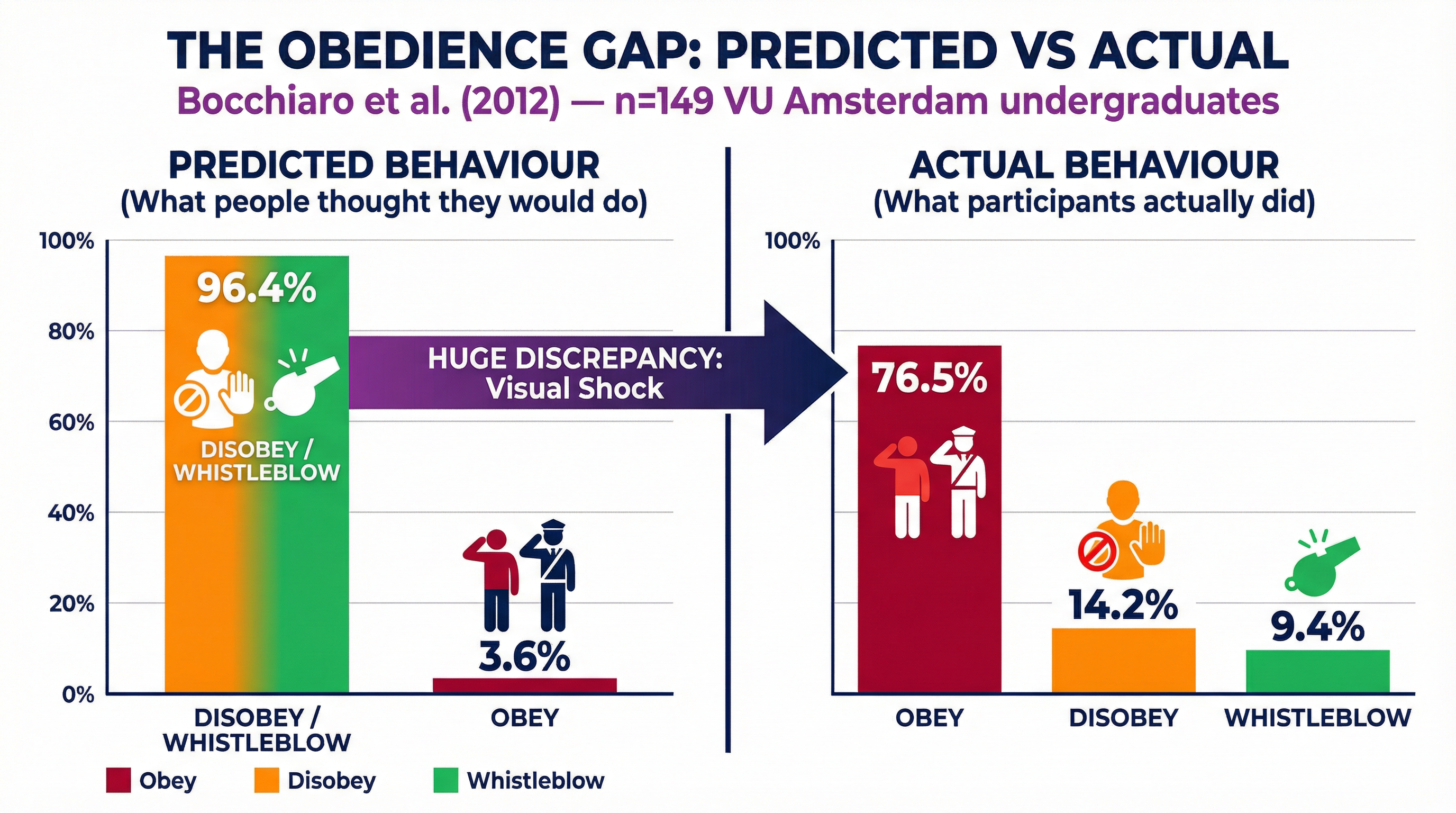
What happened: Before the main study, a separate group of 138 students were asked to predict how they would behave. They overwhelmingly predicted they would disobey or whistleblow. In the actual experiment, the results were the complete opposite.
Why it matters: This is the central finding. The huge discrepancy between predicted and actual behaviour demonstrates that we are very poor judges of how we will act under situational pressure. This 'obedience gap' is a powerful piece of evidence for the power of the situation.
Specific Knowledge: Predicted obedience: 3.6%. Actual obedience: 76.5%. Predicted disobedience/whistleblowing: 96.4%. Actual disobedience: 14.1%. Actual whistleblowing: 9.4%.
Personality & Behaviour
What happened: All participants completed the HEXACO-PI-R personality test, which measures six major dimensions of personality (Honesty-Humility, Emotionality, eXtraversion, Agreeableness, Conscientiousness, Openness to Experience). The researchers looked for correlations between personality traits and the participants' choices.
Why it matters: The results showed no significant correlation between any personality trait and the likelihood of obeying, disobeying, or whistleblowing. This is a crucial finding that candidates often get wrong. It provides strong evidence against a dispositional explanation for behaviour and supports the situational hypothesis.
Specific Knowledge: HEXACO-PI-R; no significant correlation found.