Study Notes
Overview
The Ontological Argument stands apart from every other argument for God's existence because it requires no empirical evidence whatsoever. It is an a priori argument — one that proceeds from reason and concept alone — and it is deductive in structure, meaning that if the premises are accepted, the conclusion follows with logical necessity. Candidates must be absolutely clear on these two terms from the outset, as examiners award credit for their accurate application throughout both AO1 and AO2 responses.
The argument originates with St Anselm of Canterbury (1033–1109), whose Proslogion (1078) contains two distinct formulations that candidates must not conflate. It was later developed by René Descartes in his Meditations on First Philosophy (1641) and defended in the twentieth century by Norman Malcolm (1960). The principal critics are Gaunilo of Marmoutiers (a contemporary of Anselm) and Immanuel Kant, whose Critique of Pure Reason (1781) contains the most celebrated objection to the argument. AQA examiners expect candidates to engage with all five of these thinkers with precision and philosophical depth.
For assessment, AO1 carries 40% of marks and rewards accurate, detailed knowledge of the argument's logical structure. AO2 carries 60% and rewards sustained, well-reasoned evaluation. The split means that evaluation skills are the primary determinant of grade, and candidates who can move beyond description to genuine philosophical analysis will access the highest mark bands.
Key Arguments and Developments
Anselm's Proslogion 2 — The First Formulation (1078)
Date: 1078
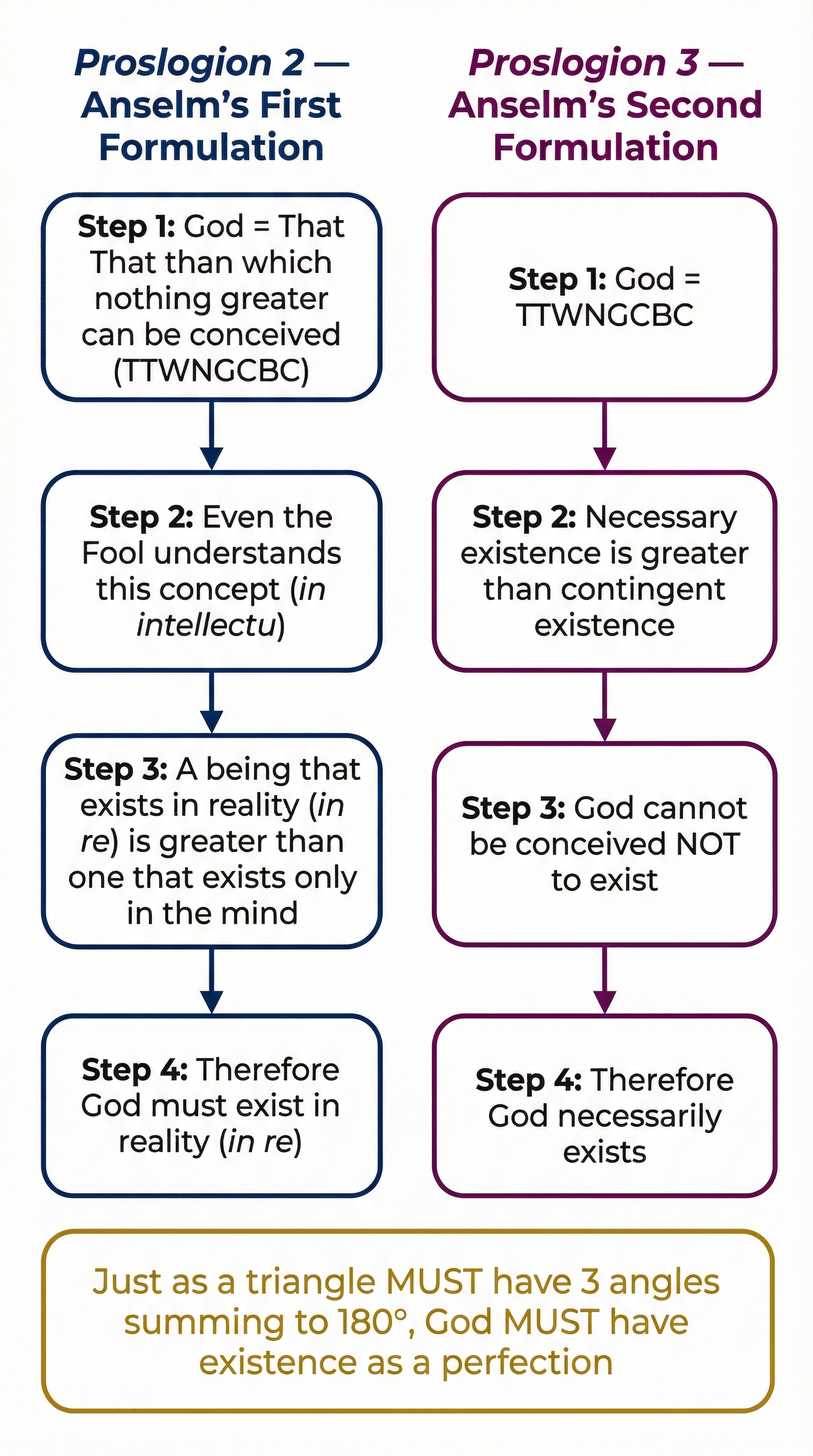
What it argues: Anselm begins by defining God as 'that than which nothing greater can be conceived' — abbreviated in revision as TTWNGCBC. This definition, he argues, is understood even by the atheist, whom he calls 'the Fool' (referencing Psalm 14:1). The Fool may deny God's existence, but he understands the concept; therefore God exists at least in intellectu (in the mind). Anselm then introduces the crucial logical step: a being that exists both in intellectu and in re (in reality) is greater than a being that exists only in the mind. If God existed only in the mind, we could conceive of something greater — a God that also existed in reality. But this contradicts the definition of God as TTWNGCBC. Therefore, God must exist in reality.
Why it matters: This formulation introduces the foundational distinction between in intellectu and in re that underpins the entire argument. Candidates who fail to use these Latin terms and explain their meaning precisely will not access the higher AO1 mark bands. The argument is analytic — the conclusion is contained within the definition of the subject — and this feature is what makes it a priori.
Specific Knowledge: Anselm, Proslogion Chapter 2, c.1078; the term 'the Fool' from Psalm 14:1; Latin terms in intellectu and in re.
Anselm's Proslogion 3 — The Second Formulation (1078)
Date: 1078
What it argues: In Proslogion 3, Anselm advances a stronger version of the argument by introducing the concept of necessary existence. He argues that God cannot even be conceived not to exist. A being whose non-existence is inconceivable is greater than a being whose non-existence is conceivable. Since God is TTWNGCBC, God must possess necessary existence — existence that cannot fail to be. Contingent existence (the kind you and I have, which might not have been) is a lesser mode of being. Therefore God exists necessarily.
Why it matters: This is the formulation that Norman Malcolm defends against Kant's objection. Candidates who conflate Proslogion 2 and Proslogion 3 — one of the most penalised errors in mark schemes — will fail to demonstrate the depth of understanding required for Level 4 and 5 AO1 responses. The key distinction is: Proslogion 2 argues God exists; Proslogion 3 argues God necessarily exists and cannot be conceived not to exist.
Specific Knowledge: Anselm, Proslogion Chapter 3, c.1078; the distinction between necessary existence and contingent existence.
Descartes' Version — The Triangle Analogy (1641)
Date: 1641
What it argues: In his Meditations on First Philosophy, René Descartes reformulates the Ontological Argument by arguing that existence is a perfection. God, as a supremely perfect being, must possess all perfections. Since existence is a perfection, God must exist. Descartes uses the triangle analogy: just as a triangle necessarily has three angles summing to 180 degrees — this property is analytically contained within the very definition of a triangle — so too, existence is analytically contained within the definition of God. To deny God's existence is as logically contradictory as claiming a triangle lacks three sides.
Why it matters: Descartes' version is the primary target of Kant's predicate objection. Candidates must explain the triangle analogy not merely by stating it, but by articulating why it works: the properties of a triangle are analytically entailed by its definition, and Descartes claims the same is true of God's existence. Examiners credit responses that make this logical link explicit.
Specific Knowledge: Descartes, Meditations on First Philosophy, Meditation V, 1641; the concept of analytic propositions; existence as a perfection.
Gaunilo's Perfect Island Objection (c.1078)
Date: c.1078
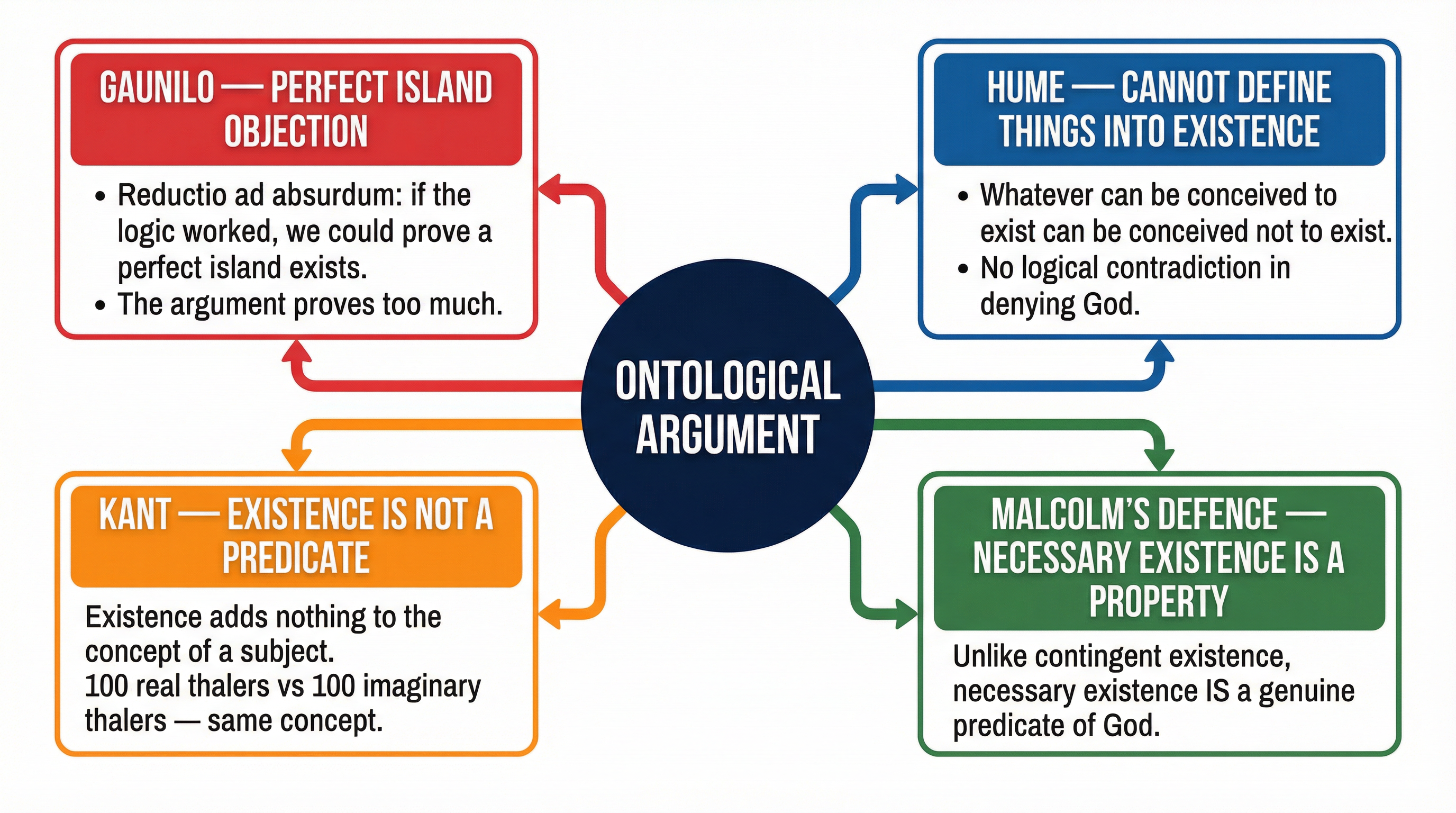
What it argues: Gaunilo of Marmoutiers, a Benedictine monk and contemporary of Anselm, wrote On Behalf of the Fool as a direct response to the Proslogion. His criticism is a reductio ad absurdum — a technique that demonstrates a flaw in an argument by showing that the same logical structure leads to an absurd conclusion. Gaunilo argues: if Anselm's logic were valid, we could use it to prove the existence of a perfect island. We can conceive of the most perfect island possible; an island that exists in reality is greater than one that exists only in the mind; therefore the most perfect island must exist in reality. Since this conclusion is clearly absurd, there must be a flaw in Anselm's logic.
Why it matters: Candidates must be precise about what Gaunilo is and is not claiming. He is not arguing that God does not exist; he is attacking the logical structure of the argument, not the concept of God. Examiners specifically credit responses that identify the reductio ad absurdum technique by name and explain its purpose. Anselm's response — that his argument applies only to a being of absolute perfection, since an island could always be improved — should also be noted.
Specific Knowledge: Gaunilo, On Behalf of the Fool, c.1078; the technique of reductio ad absurdum; Anselm's response regarding the uniqueness of God's perfection.
Kant's Objection — Existence is Not a Predicate (1781)
Date: 1781
What it argues: Immanuel Kant, in his Critique of Pure Reason, delivers what many regard as the definitive objection to the Ontological Argument. Kant argues that existence is not a real predicate — that is, existence is not a determining property that adds information to the concept of a subject. A predicate, properly understood, adds content to a concept: 'the cat is fluffy' adds the property of fluffiness to the concept of the cat. But 'the cat exists' adds nothing to the concept of the cat; it merely asserts that the concept is instantiated in reality. Kant illustrates this with the hundred thalers analogy: a hundred real thalers contain no more thalers than a hundred imaginary thalers. The concept is identical whether the thalers exist or not. Applied to Descartes: if existence is not a perfection — not a real property — then it cannot be included in God's definition, and the argument collapses.
Why it matters: This is the most important criticism for AO2 purposes, and the one most frequently cited in mark schemes. Candidates must explain why existence is not a predicate — not merely assert that Kant said so. The hundred thalers analogy should be used to illustrate the point. High-level responses will then assess whether Malcolm's response successfully rescues the argument.
Specific Knowledge: Kant, Critique of Pure Reason, 1781; the hundred thalers analogy; the distinction between logical predicates and real predicates.
Norman Malcolm's Defence (1960)
Date: 1960
What it argues: In his paper 'Anselm's Ontological Arguments' (1960), Norman Malcolm concedes that Kant's objection successfully defeats Proslogion 2 and Descartes' version. However, he argues that Proslogion 3 — the necessary existence formulation — survives. Malcolm's key distinction is between contingent existence and necessary existence. Kant is right that contingent existence is not a real predicate. But necessary existence — the property of existing in such a way that non-existence is logically impossible — IS a genuine property. It is not merely asserting that God exists; it is making a claim about the mode of God's existence. Malcolm also argues that God's existence must be either necessary or impossible: if God is possible, God necessarily exists; if God is impossible, God cannot exist. Since the concept of God involves no logical contradiction, God is possible, and therefore necessarily exists.
Why it matters: Malcolm's argument is the key to the highest AO2 marks. Candidates who can articulate the distinction between contingent and necessary existence, and explain why Malcolm believes the latter is a genuine predicate, will demonstrate the philosophical sophistication that examiners reward. The conclusion of an AO2 essay must assess whether Malcolm's response is ultimately convincing.
Specific Knowledge: Norman Malcolm, 'Anselm's Ontological Arguments', Philosophical Review, 1960; the necessary/contingent existence distinction; the modal logic structure of Malcolm's argument.
Key Individuals
St Anselm of Canterbury (1033–1109)
Role: Archbishop of Canterbury, Benedictine monk, and originator of the Ontological Argument.
Key Actions: Wrote the Proslogion (c.1078) containing two formulations of the argument. Responded to Gaunilo's criticism by arguing that the argument applies uniquely to God as a being of absolute perfection.
Impact: Established the foundational framework — TTWNGCBC, in intellectu vs in re, necessary existence — that all subsequent versions of the argument build upon.
René Descartes (1596–1650)
Role: French philosopher and mathematician, often called the 'father of modern philosophy'.
Key Actions: Reformulated the Ontological Argument in Meditations on First Philosophy (1641), arguing existence is a perfection and using the triangle analogy.
Impact: Provided the version of the argument most directly targeted by Kant's predicate objection, making his formulation central to AO2 evaluation questions.
Immanuel Kant (1724–1804)
Role: German philosopher, author of the Critique of Pure Reason (1781).
Key Actions: Argued that existence is not a real predicate, using the hundred thalers analogy to demonstrate that existence adds nothing to the concept of a subject.
Impact: Widely regarded as having delivered the most powerful objection to the Ontological Argument, particularly against Descartes' version.
Gaunilo of Marmoutiers (fl. c.1078)
Role: Benedictine monk and contemporary critic of Anselm.
Key Actions: Wrote On Behalf of the Fool, deploying the Perfect Island reductio ad absurdum to challenge the logical structure of Anselm's argument.
Impact: Introduced the technique of reductio ad absurdum as a tool for critiquing the Ontological Argument, a technique still used by contemporary philosophers.
Norman Malcolm (1911–1990)
Role: American analytic philosopher, student of Ludwig Wittgenstein.
Key Actions: Published 'Anselm's Ontological Arguments' in the Philosophical Review (1960), distinguishing between contingent and necessary existence and defending Proslogion 3 against Kant's objection.
Impact: Revived serious philosophical interest in the Ontological Argument in the twentieth century and provided the most sophisticated modern defence of the necessary existence formulation.
Second-Order Concepts
Causation
The Ontological Argument is significant precisely because it claims to require no causal reasoning from the world. Unlike the Cosmological Argument, which traces a causal chain back to a First Cause, the Ontological Argument derives God's existence analytically from the concept of God itself. The 'cause' of the argument's conclusion is purely logical: the definition of God as TTWNGCBC is said to entail God's existence by logical necessity.
Consequence
If the Ontological Argument succeeds, it would establish God's existence with the same certainty as a mathematical proof — not merely as probable or likely, but as logically necessary. This would be the most powerful possible foundation for theism. If it fails — as Kant argues — it demonstrates the limits of a priori reasoning in metaphysics and suggests that God's existence cannot be established by reason alone, only by empirical evidence or faith.
Change and Continuity
The argument has shown remarkable continuity across nine centuries, with each generation of philosophers finding new ways to formulate and critique it. What has changed is the philosophical vocabulary: Anselm's medieval Latin formulation has been recast in Cartesian terms, then in Kantian epistemology, and most recently in twentieth-century modal logic (Alvin Plantinga's modal version, for instance, uses possible worlds semantics). The core logical structure — deriving existence from the concept of a maximally perfect being — has remained constant.
Significance
The Ontological Argument is philosophically significant as a test case for the limits of a priori reasoning. It raises fundamental questions about the relationship between concepts and reality, between logic and existence, that extend far beyond the philosophy of religion into epistemology and metaphysics. For the AQA specification, it is significant as the purest expression of rationalist theology and as the argument most directly challenged by Kant's critical philosophy.
Source Skills
For this topic, candidates are not typically required to analyse historical sources in the same way as History examinations. However, the ability to engage closely with primary philosophical texts is rewarded. When quoting Anselm, Descartes, or Kant, candidates should: (1) identify the precise claim being made; (2) explain the logical role that claim plays in the argument; (3) assess whether the claim is philosophically defensible. Treat philosophical texts as you would historical sources — consider the author's purpose, the context of writing, and the limitations of their position.