Study Notes
Overview
This topic delves into the heart of the debate about God's interaction with the world. For Edexcel GCSE Religious Studies (Specification B), candidates are required to move beyond simple storytelling and engage in rigorous analysis of miracles and religious experiences as evidence for God's existence. This involves contrasting biblical examples, such as Jesus turning water into wine at Cana (John 2:1-11), with modern claims of miraculous healings at places like Lourdes. Examiners expect a clear understanding of the philosophical challenges, most notably David Hume's critique, and the ability to evaluate the evidential force of personal testimony against scientific skepticism. A key skill is distinguishing between realist (literal) and anti-realist (symbolic) interpretations of miracles. Marks are awarded for demonstrating how these concepts support or challenge religious belief, and for using specific Sources of Wisdom and Authority (SOWA) to justify arguments. This guide will equip you with the precise knowledge and analytical frameworks required to achieve the highest marks.
Key Concepts & Debates
The Nature of Miracles
Definition: A miracle is a supernatural event, an apparent violation of a law of nature, attributed to divine power. This definition, heavily influenced by the philosopher David Hume, is critical. It distinguishes a miracle from a lucky coincidence or a rare natural event. For example, surviving a plane crash is fortunate, but the laws of physics weren't broken. Jesus walking on water, however, directly contravenes the law of gravity.
Purpose: From a religious perspective, miracles are not random acts of magic. They are seen as 'signs' (a term used frequently in John's Gospel) that reveal something about the nature of God. They can demonstrate God's omnipotence, his benevolence (love and care for humanity), and, in the case of Jesus's miracles, his divine identity.
Types of Miracles (with Named Examples)
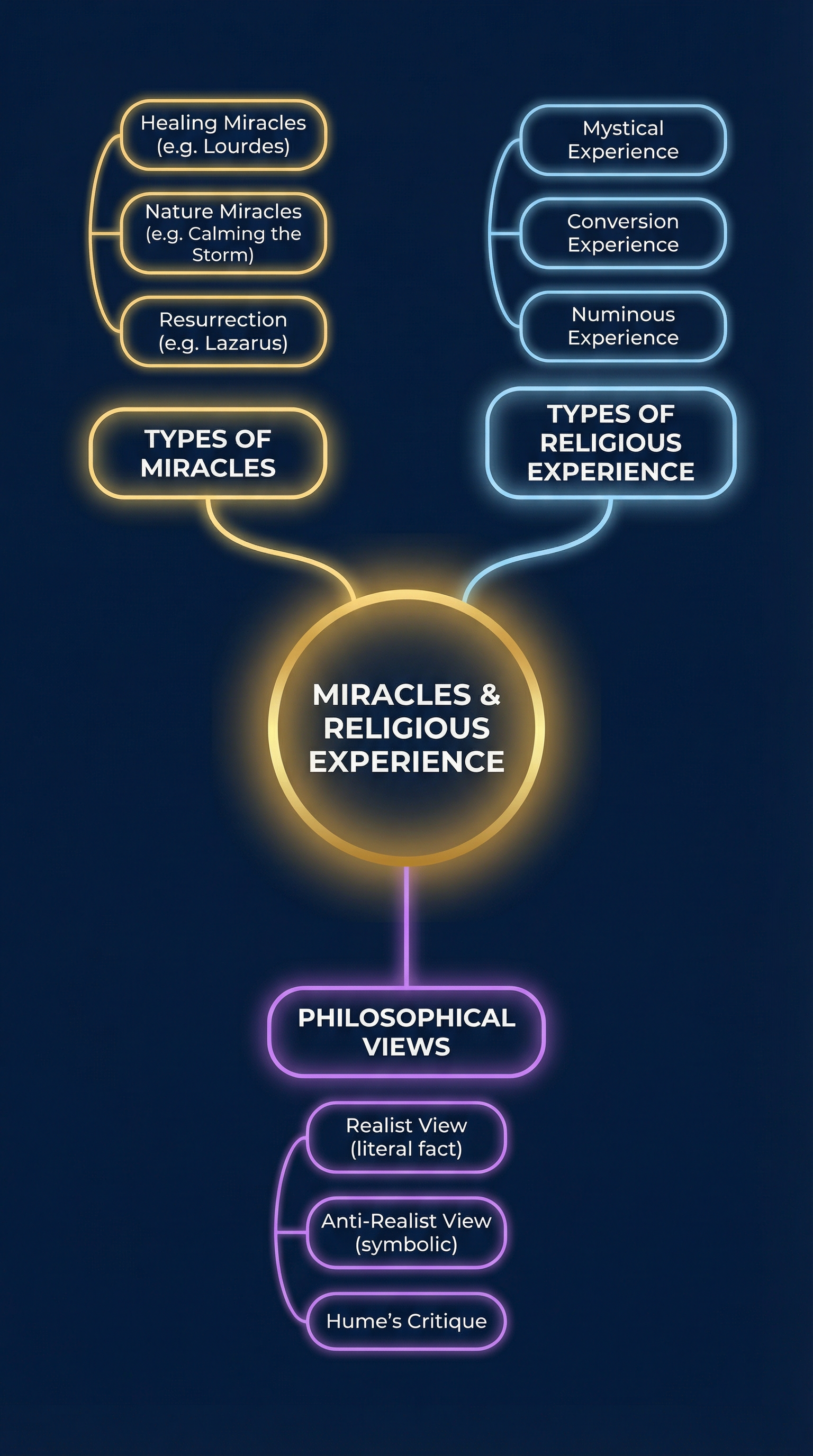
| Type | Description | Key Example (SOWA) | Significance |
|---|---|---|---|
| Healing Miracles | Events where individuals are cured of illnesses or disabilities in a way that medical science cannot explain. | The Healing of the Paralysed Man (Mark 2:1-12): Jesus not only heals a man who cannot walk but also forgives his sins, showing a link between physical healing and spiritual salvation. | Demonstrates God's omnibenevolence and power over human suffering. |
| Nature Miracles | Events where the laws of nature themselves are suspended or altered. | The Wedding at Cana (John 2:1-11): Jesus turns a large quantity of water into high-quality wine. This is his first 'sign', revealing his glory to his disciples. | Shows God's omnipotence and creative power over the natural order. |
| Resurrection | Bringing someone back from the dead. This is the ultimate category of miracle. | The Raising of Lazarus (John 11:1-44): Jesus brings Lazarus back to life after he has been dead and buried for four days, a detail included to remove any doubt. | The ultimate demonstration of power over life and death, foreshadowing Jesus's own resurrection. |
Religious Experience
Religious experience is a broad term for a personal encounter with the divine. It is a cornerstone of the argument for God from experience.
Types of Religious Experience:
- Mystical Experience: A profound sense of unity with the divine. The philosopher William James identified four key characteristics: Ineffable (beyond words), Noetic (providing knowledge), Transient (short-lived), and Passive (not controlled by the individual).
- Conversion Experience: An experience that causes a radical change in a person's life and beliefs. The classic example is St. Paul on the road to Damascus (Acts 9), who went from being a persecutor of Christians to the faith's most influential missionary after a vision of the risen Christ.
- Numinous Experience: Coined by Rudolf Otto, this refers to the feeling of being in the presence of an awesome yet terrifying power. It is the experience of God as 'wholly other' than humanity.
Philosophical Challenges
David Hume's Critique of Miracles
The Scottish Enlightenment philosopher David Hume (1711-1776) mounted the most famous philosophical assault on miracles. His argument is a crucial part of this topic and a favourite for evaluation questions.
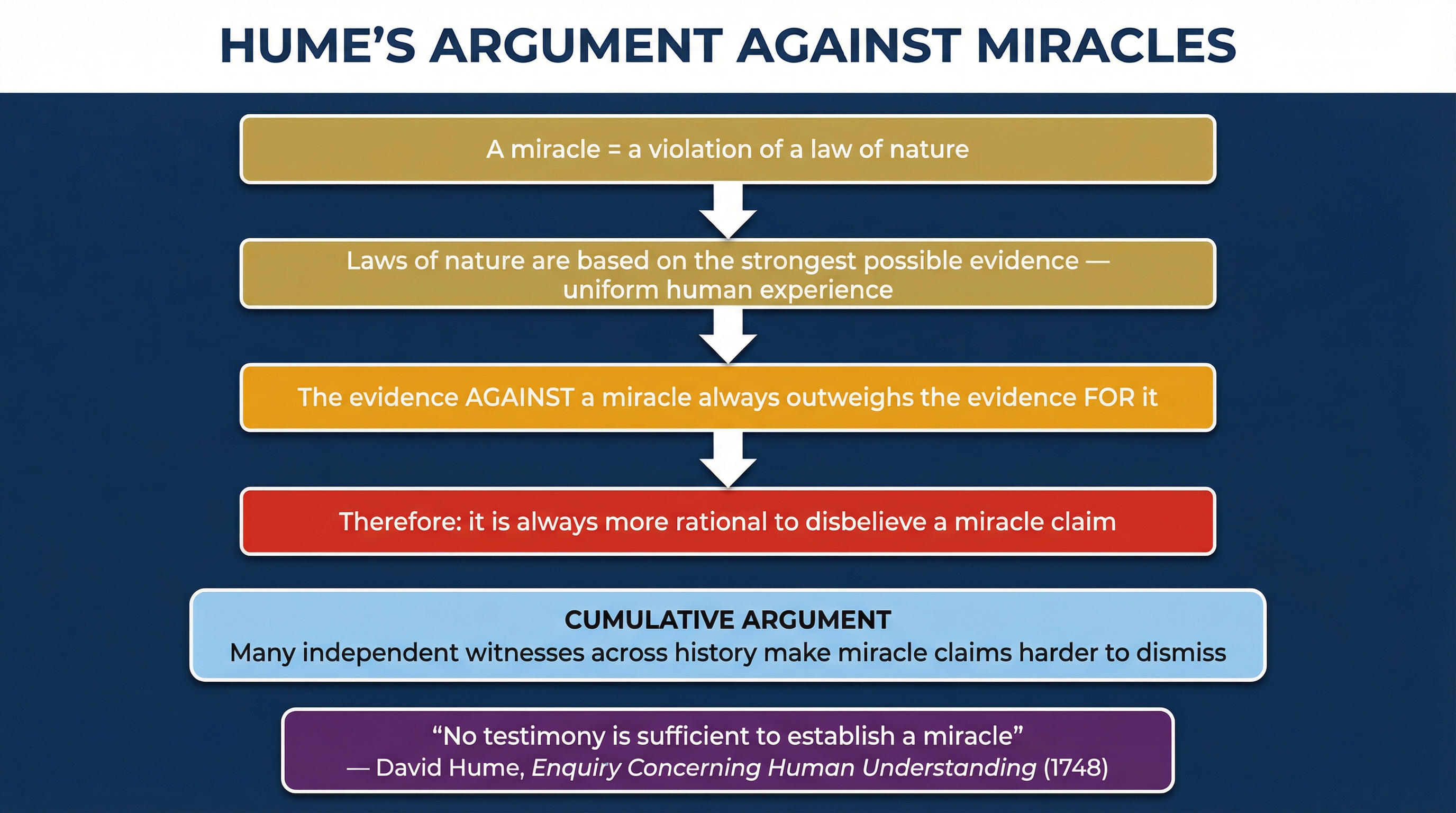
Hume's Argument in Steps:
- A miracle is defined as a violation of a law of nature.
- A law of nature is, by definition, supported by the maximum possible evidence: the firm and unalterable experience of all humanity.
- The evidence for a miracle is the testimony of a witness or group of witnesses.
- Therefore, the evidence against the miracle (the law of nature) is always greater than the evidence for the miracle (the testimony).
- Conclusion: It is always more rational to believe that the witness is mistaken or lying than to believe a law of nature has been violated.
The 'God of the Gaps' Argument
This is a common scientific and philosophical objection. It argues that attributing unexplained events to 'God' is simply a way of filling gaps in our scientific knowledge. As science advances, these gaps shrink. For example, what was once seen as a miraculous healing might now be understood as a spontaneous remission or a misdiagnosis. Theists are accused of retreating into ever-smaller 'gaps' of knowledge, which is seen as an intellectually weak position."