Study Notes
Overview
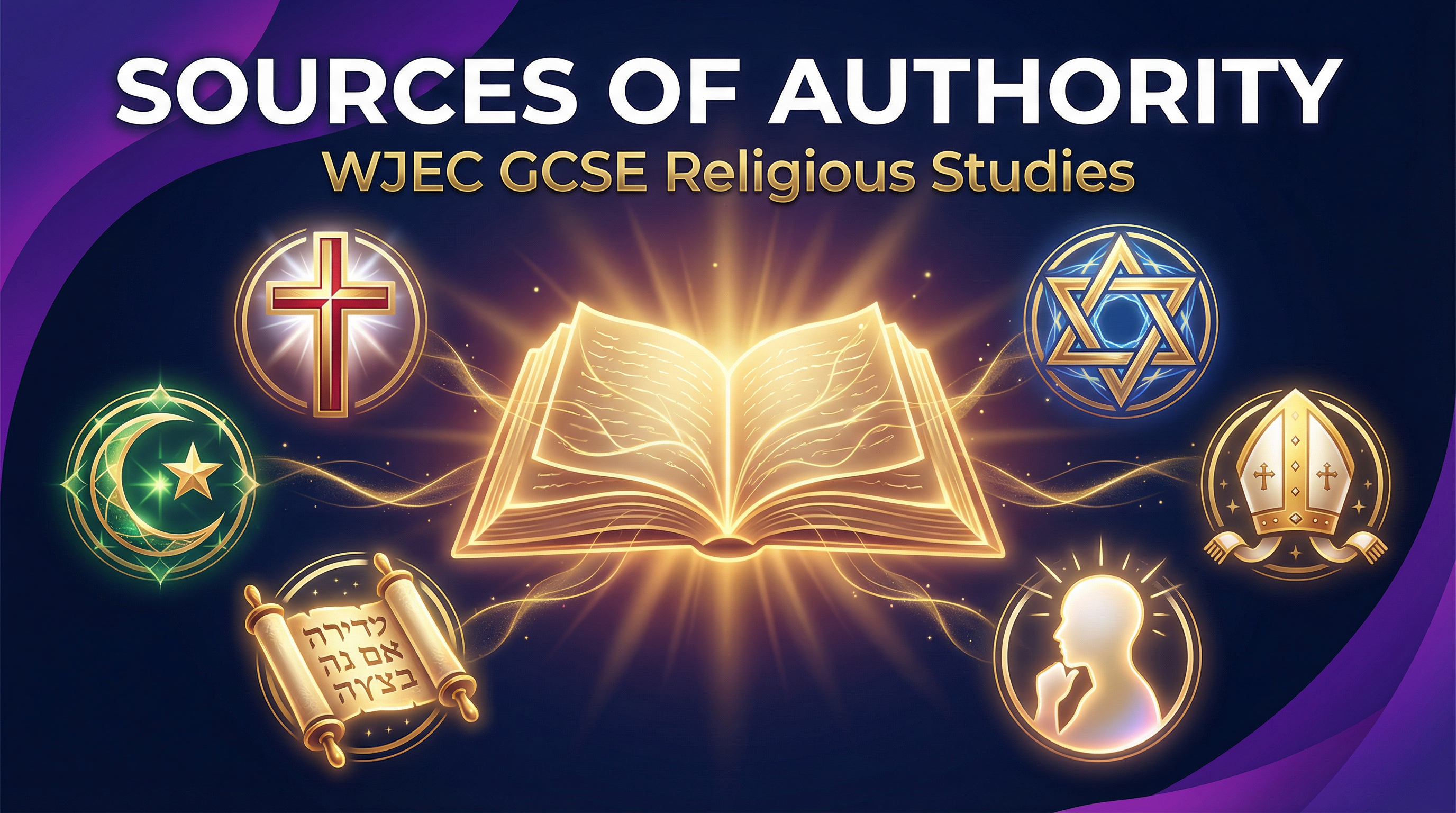
Welcome to your deep dive into Sources of Wisdom and Authority (SoWA) for WJEC GCSE Religious Studies. This topic is the bedrock of the entire specification; a solid understanding here will unlock marks across every module you study. Examiners expect candidates to demonstrate a nuanced understanding of how different religious believers turn to various sources for guidance on belief and moral decision-making. This includes not just knowing what the sources are, but critically evaluating how they are used in practice. You will explore the authority of sacred texts like the Bible and Qur'an, the role of religious leaders and institutions such as the Pope and the Magisterium, and the significance of internal sources like reason and conscience. Credit is awarded for moving beyond generic statements to provide specific, well-explained examples and for appreciating the diversity of interpretation within religious traditions. This guide will equip you with the detailed knowledge and exam technique needed to analyse, evaluate, and excel.
Key Sources of Authority
Sacred Texts
What they are: The foundational holy books of a religion, believed to be divinely inspired or the direct word of God.
Why they matter: For many believers, sacred texts are the ultimate source of authority. They contain core beliefs, laws, and ethical teachings. Examiners look for specific textual evidence to support your arguments.
Specific Knowledge:
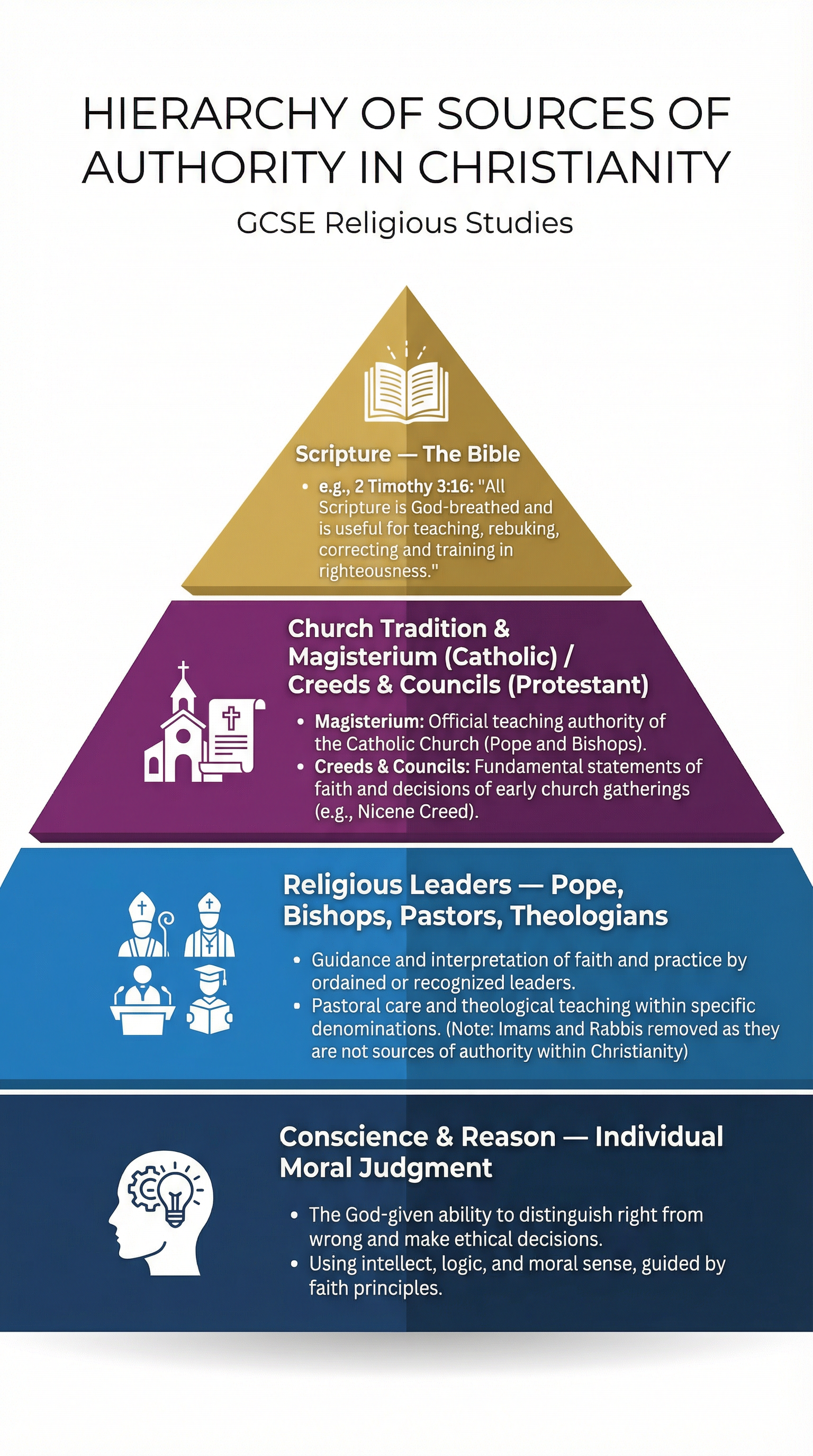
- Christianity: The Bible (Old and New Testaments). Key quote: 2 Timothy 3:16 - "All Scripture is God-breathed and is useful for teaching, rebuking, correcting and training in righteousness." This is your go-to quote for biblical authority.
- Islam: The Qur'an, believed to be the literal word of Allah revealed to the Prophet Muhammad. The Hadith (sayings of the Prophet) is also a major source.
- Judaism: The Torah (first five books of the Hebrew Bible) and the Talmud (rabbinic commentary).
Religious Leaders & Institutions
What they are: Individuals or bodies who hold authority to interpret sacred texts and guide the community.
Why they matter: They provide a living tradition of interpretation, ensuring ancient texts remain relevant. Acknowledging their role shows the examiner you understand that authority is not just about texts.
Specific Knowledge:
- Catholicism: The Magisterium (the teaching authority of the Church, exercised by the Pope and Bishops). The Pope can make infallible statements on faith and morals.
- Protestantism: Rejects a central authority figure, following the principle of Sola Scriptura (Scripture Alone). Authority rests with individual conscience and interpretation, guided by pastors.
- Islam: Imams (in Sunni Islam) and Ayatollahs (in Shia Islam) are respected scholars and leaders.
Conscience & Reason
What they are: Internal sources of moral and spiritual guidance.
Why they matter: Many believers see these as God-given faculties to help make moral choices. This is a key area for AO2 evaluation, especially when conscience conflicts with other sources.
Specific Knowledge:
- Thomas Aquinas: A Catholic theologian who taught that conscience is "the voice of God" and that to go against your conscience is a sin.
- Joseph Butler: An Anglican philosopher who argued conscience is the ultimate, God-given moral authority.
Second-Order Concepts
Diversity of Interpretation
What is it? The idea that believers within the same religion can interpret the same source in different ways.
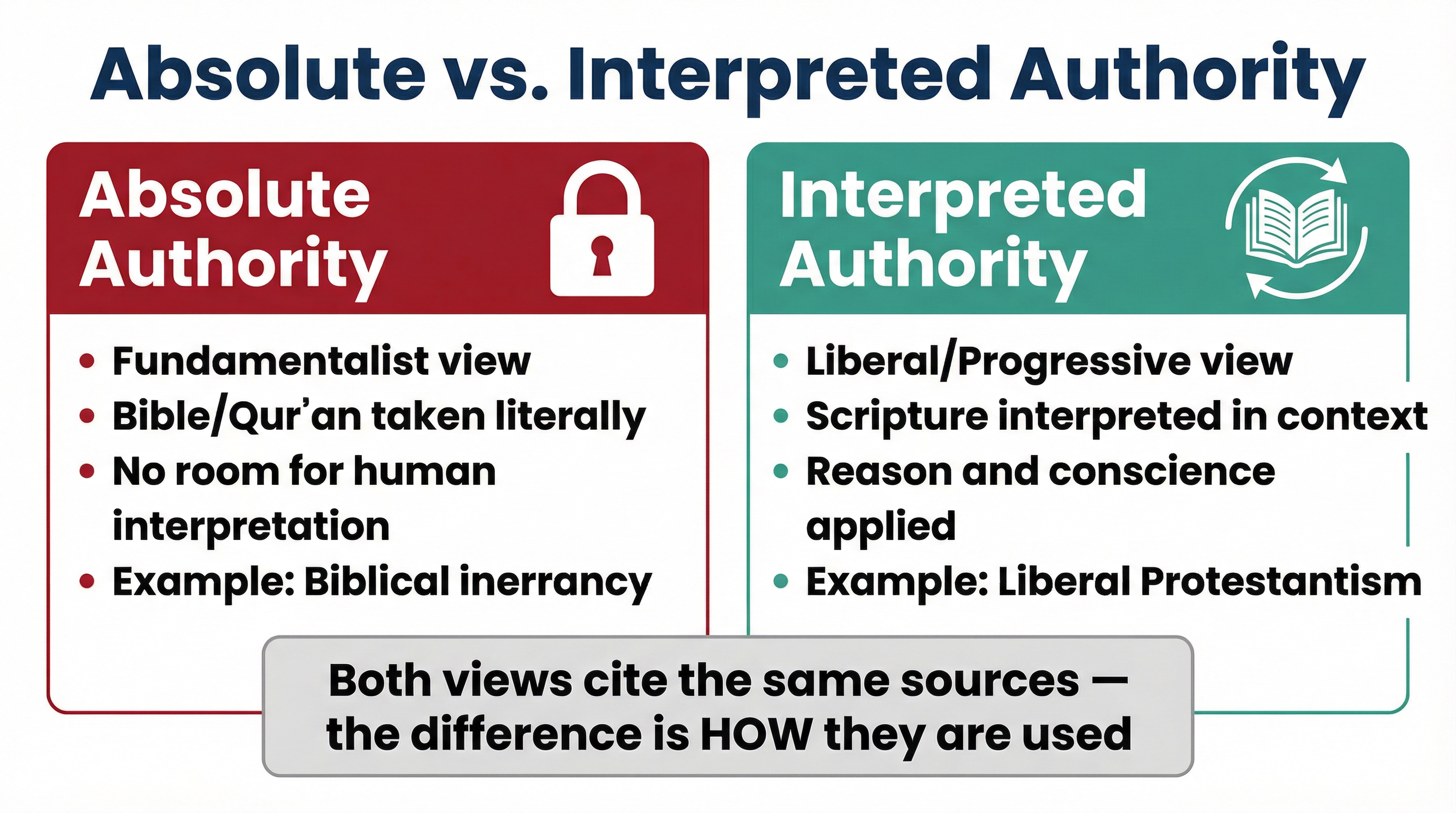
Why it matters: This is a high-level skill. Avoid treating religions as monoliths. For example, contrast Fundamentalist (literal) and Liberal (interpreted) approaches to the Bible. A Fundamentalist might reject homosexuality based on a literal reading of Leviticus, while a Liberal might argue the core Christian message of love (e.g., "Love thy neighbour") is more important and that historical context matters.
Application of Sources
What is it? Using sources to address modern ethical issues (e.g., war, poverty, medical ethics).
Why it matters: AO1 and AO2 questions require you to apply these sources to specific scenarios. Simply quoting a text is not enough; you must explain how it informs a believer's response to the issue. For example, when discussing pacifism, a candidate should explain how Jesus' teaching in Matthew 5:9 ("Blessed are the peacemakers") directly leads some Christians, like the Quakers, to reject all forms of violence.",
"podcast_script": "Welcome to your GCSE Religious Studies revision podcast. I'm your tutor, and today we're diving into one of the most important and versatile topics in the entire WJEC specification: Sources of Wisdom and Authority — or SoWA, as we'll call it throughout this episode.
Whether you're studying Christianity, Islam, Judaism, or any combination of religions, understanding how believers use sources of authority is absolutely central to your exam success. This topic threads through every single theme paper — from relationships and families, to war and peace, to matters of life and death. So get comfortable, because by the end of this episode, you'll have a rock-solid grasp of what examiners are looking for.
Let's start with the big picture. What exactly is a Source of Wisdom and Authority? Simply put, it's anything a believer turns to for guidance on how to live, what to believe, and how to make moral decisions. These sources can be texts, people, institutions, or even internal faculties like conscience and reason. The key word here is authority — these sources carry weight because believers trust them to reflect divine will or accumulated wisdom.
Now, let's break down the main categories. First up: Sacred Texts.
For Christians, the primary sacred text is the Bible — a collection of 66 books divided into the Old and New Testaments. The critical verse you must know is 2 Timothy chapter 3, verse 16, which states: "All Scripture is God-breathed and is useful for teaching, rebuking, correcting and training in righteousness." This verse is your golden ticket in any exam question about biblical authority, because it directly explains why Christians treat the Bible as authoritative — it comes from God.
But here's where it gets interesting, and where many candidates lose marks. Not all Christians use the Bible in the same way. Fundamentalist Christians — sometimes called Biblical Literalists — believe the Bible is the direct, inerrant word of God. Every word is literally true. No room for human error, no room for reinterpretation. For them, the Bible has absolute authority.
Liberal Christians, on the other hand, take what we call an interpreted approach. They believe the Bible was written by humans inspired by God, which means it reflects the cultural context of its time. So while its spiritual truths are timeless, some specific teachings may need to be reinterpreted for a modern context. This is why Liberal Christians might reach different conclusions on issues like gender roles or sexuality than Fundamentalist Christians — even though they're reading the same text.
For Muslims, the equivalent sacred text is the Qur'an — believed to be the direct, literal word of Allah as revealed to the Prophet Muhammad through the Angel Jibril. Muslims believe the Qur'an is perfect and unchanged since its revelation in the 7th century CE. The Hadith — the recorded sayings and actions of the Prophet Muhammad — also carries significant authority, particularly in Sunni Islam. Together, the Qur'an and Hadith form the basis of Sharia law.
For Jewish believers, the Torah — the first five books of the Hebrew Bible — is the foundational text, believed to have been given directly to Moses at Mount Sinai. The Talmud, a vast collection of rabbinical commentary and legal discussion, is also hugely important for guiding Jewish practice.
Now let's move to our second category: Religious Leaders and Institutions.
In Roman Catholicism, the Pope holds a unique position of authority. Catholics believe the Pope speaks with special authority on matters of faith and morals — a concept known as Papal Infallibility, formally defined at the First Vatican Council in 1870. The Magisterium — the official teaching authority of the Catholic Church, exercised by the Pope and bishops — interprets scripture and tradition for the faithful. So for a Catholic, the Magisterium sits alongside scripture as a co-equal source of authority. This is fundamentally different from Protestant Christianity.
Protestants, following the principle of Sola Scriptura — Latin for "Scripture alone" — reject the authority of the Pope and Magisterium. For them, the Bible is the sole ultimate authority. This principle was championed by Martin Luther during the Protestant Reformation in the 16th century, and it remains a defining feature of Protestant denominations today.
In Islam, Imams serve as religious leaders and scholars who guide their communities in understanding and applying the Qur'an and Hadith. In Sunni Islam, there is no single supreme religious authority equivalent to the Pope — instead, authority is distributed among scholars and jurists. In Shia Islam, however, the role of the Imam carries much greater theological significance, with senior clerics known as Ayatollahs holding considerable authority.
In Judaism, Rabbis serve as teachers, interpreters of Jewish law, and community leaders. The Sanhedrin — the ancient Jewish council — historically held legislative and judicial authority, though this institution no longer exists in its original form.
Our third major category is Conscience and Reason.
Conscience is the inner sense of right and wrong that many believers understand as God-given. The Catholic theologian Thomas Aquinas, writing in the 13th century, argued that conscience is the voice of God speaking within us — our rational faculty applying divine law to specific situations. For Aquinas, following your conscience was not optional — it was a moral obligation.
The philosopher Joseph Butler, an 18th-century Anglican bishop, went further, arguing that conscience is the supreme moral authority, placed by God above all other faculties. This view has significant implications: if conscience is supreme, what happens when it conflicts with scripture or Church teaching? This tension is a rich area for AO2 evaluation questions.
Reason — our capacity for rational thought — is closely linked to conscience. Many theologians argue that God gave humans reason precisely so they could interpret scripture wisely and make sound moral judgements. This is particularly important in Natural Law ethics, associated with Aquinas, which holds that through reason we can discern God's purposes in the natural world.
So to summarise our core categories: we have Sacred Texts — the Bible, Qur'an, and Torah; Religious Leaders and Institutions — the Pope, Magisterium, Imams, and Rabbis; and Internal Sources — Conscience and Reason. Each of these can be a source of wisdom and authority, and the key skill examiners are looking for is your ability to explain how different believers use these sources differently, and why.
Now let's talk exam technique — because knowing the content is only half the battle. The other half is knowing how to use it to earn marks.
The WJEC Religious Studies exam is split equally between AO1 and AO2. AO1 tests your knowledge and understanding — can you accurately describe what believers think and why? AO2 tests your evaluation — can you assess different viewpoints and reach a justified conclusion?
Let's start with the most common mistake I see in exam scripts. Candidates write things like "The Bible says you should love your neighbour." Full stop. No reference. No context. No application. That will earn you very limited credit. What examiners want to see is specificity. Instead, write: "Christians might cite Jesus's teaching in Matthew 22:39 — 'Love your neighbour as yourself' — as a source of authority when arguing that we have a duty to help those in need." Do you see the difference? You've named the text, given the reference, quoted it accurately, and applied it to an argument. That's how you climb the mark bands.
The second major mistake is treating all members of a religion as identical. Examiners specifically look for awareness of diversity. Never write "Christians believe" without qualifying which Christians. Say "Catholic Christians look to the Magisterium" or "Evangelical Protestants prioritise Scripture alone through the principle of Sola Scriptura." This shows the examiner you understand that religions are not monolithic — they contain rich internal diversity.
Third mistake: confusing the authority of the Bible with the authority of the Church. These are distinct. For Catholics, both Scripture and Tradition — as interpreted by the Magisterium — carry authority. For Protestants, Scripture alone is the final authority. Getting this distinction right is worth marks.
Now, let's talk about command words, because these tell you exactly what the examiner wants.
When you see "Describe," you need to give two or more developed features with supporting detail. Don't just list — explain.
When you see "Explain," you need to give reasons or causes with development. Use connective language: "This means that...", "As a result...", "This is significant because..."
When you see "Discuss" or "Evaluate" — and this is crucial for the 15-mark questions — you must present multiple viewpoints, weigh them against each other, and reach a clear, justified conclusion. A one-sided answer, no matter how detailed, cannot reach the top mark band.
For 15-mark evaluation questions, I recommend this structure. Start with a brief introduction that sets up the debate. Then write two or three paragraphs supporting the statement, each one using a different Source of Wisdom and Authority. Then write two or three paragraphs challenging the statement, again using specific sources. Finally, write a conclusion that doesn't just summarise — it makes a judgment. Which side of the argument do you find more convincing, and why?
Here's a pro tip: use the SoWA acronym as a mental checklist when planning your answer. For every paragraph, ask yourself: what is my Source of Wisdom and Authority here? Have I named it specifically? Have I quoted or referenced it accurately? Have I explained how it supports my argument? If you can tick all three boxes, you're writing at the top of the mark scheme.
Let me give you a worked example. The question is: "The Bible is the most important source of authority for Christians." Discuss. Fifteen marks.
A strong opening paragraph might read: "Many Christians would agree with this statement, particularly those from Evangelical or Fundamentalist traditions who hold to the principle of Biblical inerrancy — the belief that the Bible is without error in all it affirms. They would cite 2 Timothy 3:16, which describes Scripture as 'God-breathed,' suggesting its authority comes directly from God and therefore supersedes all human institutions."
Then a counter-paragraph: "However, Catholic Christians would challenge this view. For Catholics, the Magisterium — the official teaching authority of the Church, exercised by the Pope and bishops — carries co-equal authority with Scripture. The First Vatican Council of 1870 formally defined Papal Infallibility, meaning that when the Pope speaks ex cathedra on matters of faith and morals, his pronouncements are considered free from error. For Catholics, Scripture cannot be properly understood without the guidance of the Church's interpretive tradition."
And a conclusion: "On balance, while the Bible is undeniably central to Christian faith across all denominations, its role as the most important source of authority depends entirely on one's denominational tradition. For Protestants, Sola Scriptura places the Bible above all else; for Catholics, it is one pillar among several. A nuanced answer must acknowledge this diversity."
That answer demonstrates specific knowledge, uses named sources with references, presents multiple perspectives, and reaches a justified conclusion. That's a top-band response.
Now, let's do a quick-fire recall quiz. I'll ask a question, give you a few seconds to think, then give the answer. Ready?
Question one: What does the Latin phrase "Sola Scriptura" mean, and which tradition is it associated with?
Think about it...
Answer: "Scripture alone." It's the Protestant principle, championed by Martin Luther during the Reformation, that the Bible is the sole ultimate authority for Christians.
Question two: Name the verse that describes the Bible as "God-breathed."
Think...
Answer: 2 Timothy chapter 3, verse 16.
Question three: What is the Magisterium?
Think...
Answer: The official teaching authority of the Roman Catholic Church, exercised by the Pope and bishops in communion with him.
Question four: Which philosopher argued that conscience is the supreme moral authority placed by God above all other faculties?
Think...
Answer: Joseph Butler, the 18th-century Anglican bishop and philosopher.
Question five: What is the Hadith?
Think...
Answer: The recorded sayings and actions of the Prophet Muhammad, which alongside the Qur'an form the basis of Islamic law and guidance.
How did you do? If you got all five, you're in great shape. If not, go back and review those specific points — they're the kind of precise knowledge that separates a grade 7 from a grade 9.
Let's wrap up with a quick summary of the key points from today's episode.
Sources of Wisdom and Authority fall into three main categories: Sacred Texts — the Bible, Qur'an, and Torah; Religious Leaders and Institutions — the Pope, Magisterium, Imams, and Rabbis; and Internal Sources — Conscience and Reason.
The most important distinction to master is between absolute authority — where texts are taken literally and without question — and interpreted authority — where texts are read in context and filtered through reason and tradition.
In the exam, always name your denomination specifically, always cite your sources with references where possible, and always apply the source directly to your argument. Never just quote and move on.
For evaluation questions, present multiple viewpoints, use the SoWA checklist for every paragraph, and make sure your conclusion offers a genuine, reasoned judgment.
This topic is your foundation for the entire course. Every theme you study — whether it's relationships, justice, or the nature of God — will ask you to use Sources of Wisdom and Authority. Master this topic, and you've built the scaffolding for everything else.
Good luck with your revision. You've got this. See you in the next episode."