Study Notes
Overview
Capital Punishment, or the death penalty, is one of the most contentious ethical issues within the AQA GCSE Religious Studies specification. For Theme E: Crime and Punishment, candidates are expected to demonstrate a detailed understanding of the arguments for and against state-sanctioned execution, grounded in both religious and non-religious perspectives. This topic requires a careful evaluation of the four key purposes of punishment: Retribution, Deterrence, Reformation, and Protection. A high-level response will move beyond simple statements to a nuanced analysis, weighing the principle of 'Lex Talionis' (the law of retaliation) against the profound concept of the 'Sanctity of Life' (Imago Dei). Examiners award significant credit for the ability to contrast different Christian viewpoints, such as literalist interpretations of the Old Testament versus the pacifist teachings of Jesus in the New Testament. Furthermore, understanding the UK's legal context—specifically the abolition of capital punishment in 1965 for murder and its complete removal in 1998—is essential knowledge that is frequently tested. This guide will break down these complex ideas, provide specific scriptural and ethical evidence, and offer clear strategies to help you construct the analytical and evaluative answers required to achieve top marks.
Key Concepts & Ethical Frameworks
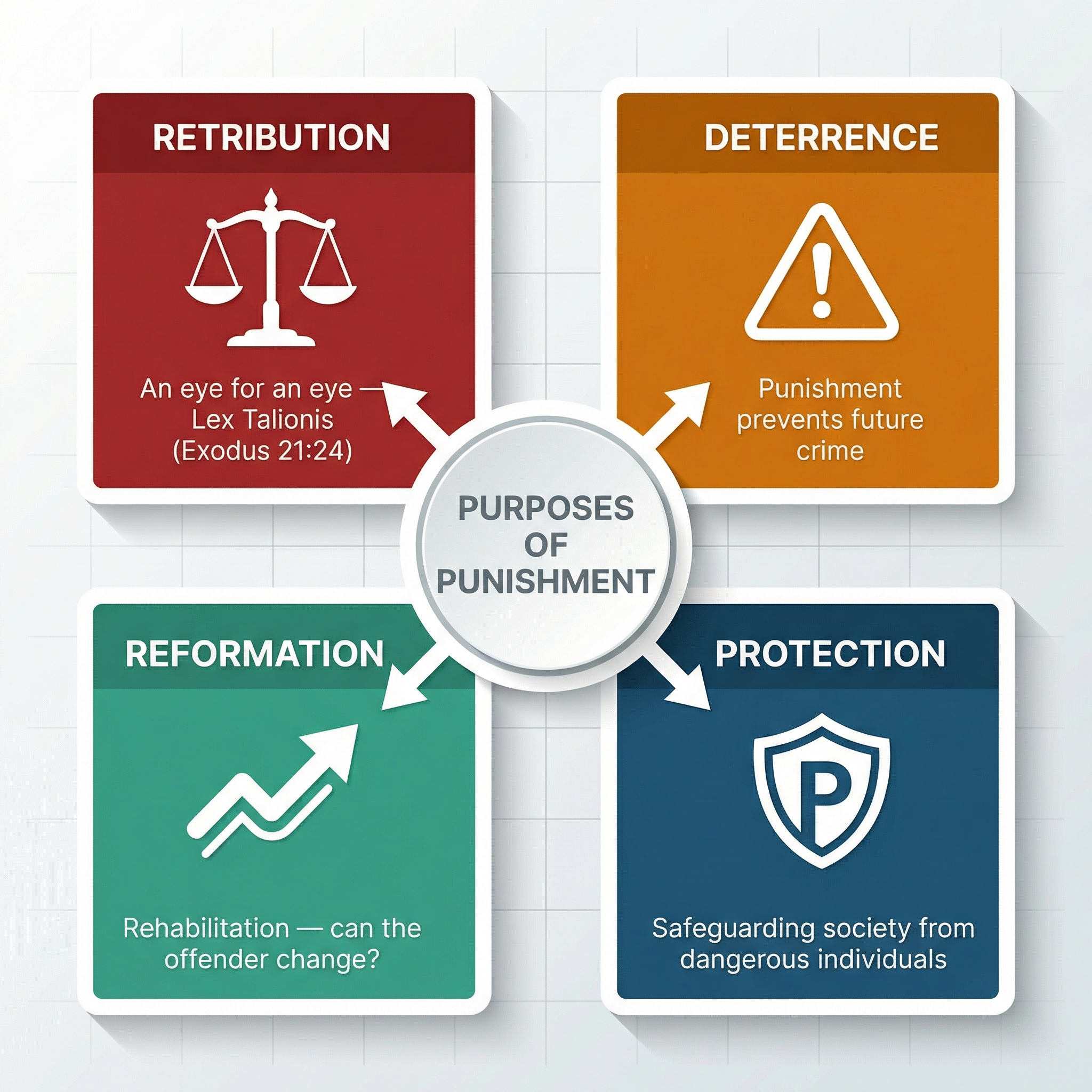
To analyse Capital Punishment effectively, you must be fluent in the four aims of punishment. These provide the essential framework for any evaluative question on this topic.
Retribution
What it is: This is the principle of 'just deserts'. It argues that the punishment should be proportionate to the crime. For the most heinous crimes, such as murder, supporters of retribution argue that the only proportionate punishment is for the offender to forfeit their own life.
Why it matters: This is the oldest argument for punishment and is rooted in the concept of justice as balance. In an exam, you can link this directly to the Old Testament teaching of Lex Talionis, found in Exodus 21:24: "an eye for an eye, a tooth for a tooth." This source provides a powerful religious justification for capital punishment, and candidates who can explain this link will be credited.
Specific Knowledge: The concept of Lex Talionis is not about uncontrolled revenge, but about state-administered, proportional justice. It was intended to limit blood feuds.
Deterrence
What it is: This argument claims that executing offenders will prevent other potential criminals from committing the same crime. The severity of the punishment is intended to act as a public warning.
Why it matters: This is a forward-looking, consequentialist argument. It justifies the act of execution by its supposed positive effect on society. However, its effectiveness is highly debated.
Specific Knowledge: Candidates should be aware that there is no conclusive statistical evidence that the death penalty is a more effective deterrent than life imprisonment. For example, many US states that have abolished the death penalty have lower murder rates than those that retain it. Citing this lack of evidence is a strong point for an AO2 evaluation.
Reformation (Rehabilitation)
What it is: This aim of punishment focuses on helping the offender to change their ways and become a law-abiding member of society. It is about healing and transformation, not just punishment.
Why it matters: Capital punishment makes reformation impossible. This is a key argument used by its opponents. Many Christians, particularly those who follow the teachings of Jesus, believe in the power of forgiveness and the potential for any individual to change. Executing someone denies them this chance.
Specific Knowledge: The case of Karla Faye Tucker in the USA is a powerful example. While on death row, she converted to Christianity and expressed deep remorse. Her supporters argued she had reformed, but she was executed in 1998. This case highlights the tension between reformation and retribution.
Protection
What it is: This is the most straightforward argument. Executing a convicted murderer permanently protects society from them. They cannot escape and cannot harm anyone again.
Why it matters: This argument appeals to a fundamental duty of the state to keep its citizens safe. Supporters of capital punishment argue that life imprisonment carries a small but real risk of escape or of the prisoner harming guards or other inmates.
Specific Knowledge: Opponents counter this by arguing that a whole-life tariff in a maximum-security prison offers sufficient protection without resorting to what they see as the barbaric act of execution. The cost of a life sentence versus the lengthy and expensive legal appeals process for death row inmates is also a relevant point of debate.
Religious Perspectives on Capital Punishment
Christianity offers a range of views, and you must be able to explain and contrast them.
Christian Arguments FOR Capital Punishment
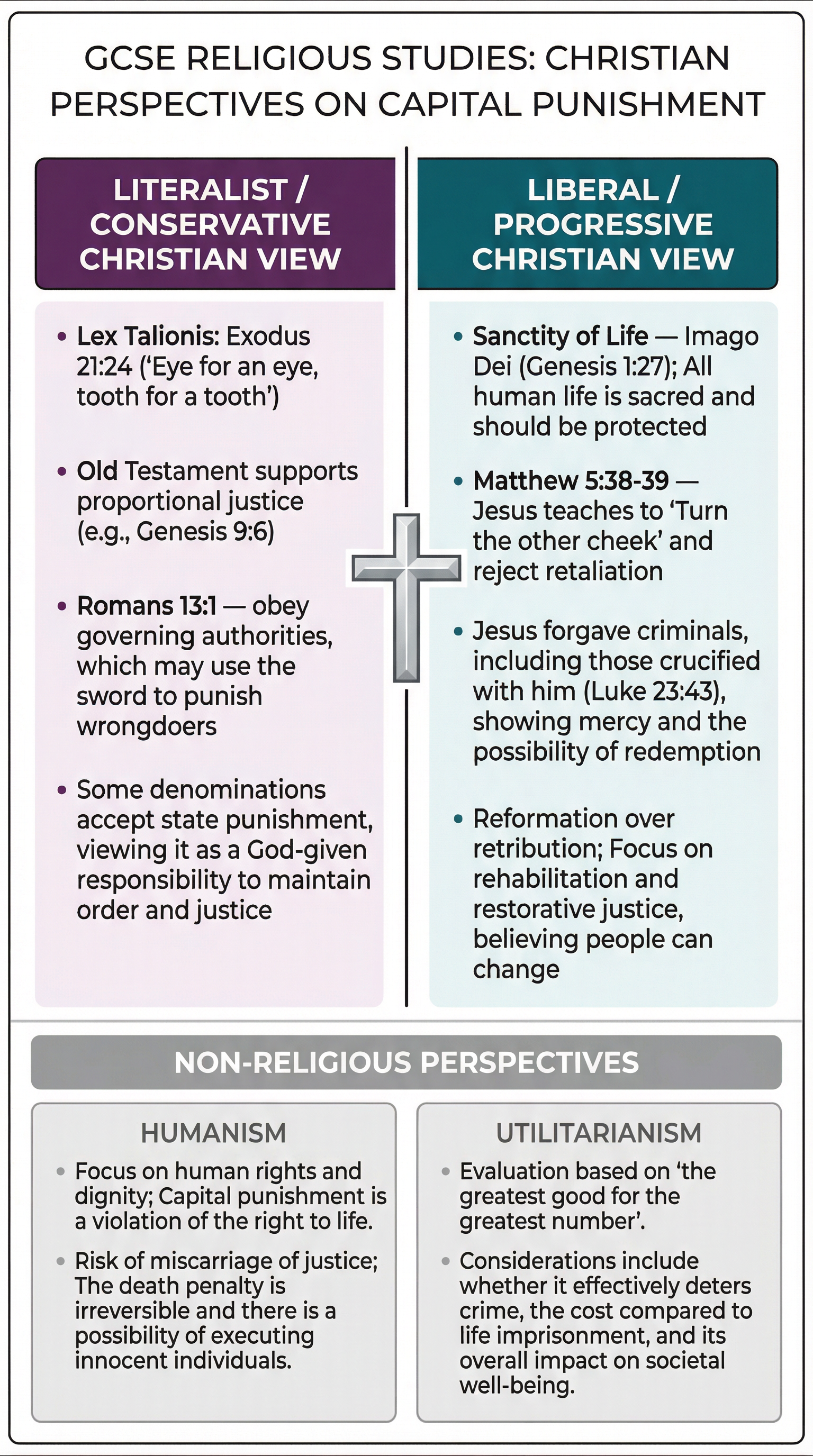
Some Christians, often described as Literalists or Conservatives, argue that the Bible permits, or even commands, the use of the death penalty for certain crimes.
- Old Testament Law: The primary source is the principle of Lex Talionis in Exodus 21:24. Another key text is Genesis 9:6: "Whoever sheds human blood, by humans shall their blood be shed; for in the image of God has God made mankind." This is seen as a direct mandate for capital punishment for murder.
- Role of the State: In the New Testament, Romans 13:1-4 states that believers should obey the governing authorities, as they are established by God to maintain justice. Paul writes that the ruler "does not bear the sword for no reason. They are God’s servants, agents of wrath to bring punishment on the wrongdoer." Some interpret the 'sword' as a symbol of the state's right to use lethal force, including capital punishment.
Examiner Tip: When using these sources, explain how they lead to a belief in capital punishment. For example, "A literalist reading of Genesis 9:6 suggests that because humans are made in God's image, the act of murder is so uniquely terrible that the only just response is the death of the murderer."
Christian Arguments AGAINST Capital Punishment
Many other Christians, often described as Liberals or Progressives, argue that the overall message of the Bible, and particularly the life and teachings of Jesus, points towards the abolition of the death penalty.
- The Sanctity of Life: This is the core argument. The belief in Imago Dei (Genesis 1:27) means that all life is sacred and a gift from God. Therefore, only God has the right to take a life. To execute a person, no matter what they have done, is to usurp God's authority and destroy something created in His image.
- Jesus' Teachings on Forgiveness and Retaliation: In the Sermon on the Mount (Matthew 5:38-39), Jesus directly contradicts the Old Testament principle of retribution: "You have heard that it was said, ‘Eye for eye, and tooth for tooth.’ But I tell you, do not resist an evil person." This is a radical call to a new kind of justice based on mercy, not retaliation.
- Jesus' Example: Jesus' own actions reinforce this message. He saved a woman from being stoned to death (a form of capital punishment) in John 8:1-11. On the cross, he forgave one of the criminals executed alongside him (Luke 23:43), demonstrating grace and the possibility of redemption even at the point of death.
- Focus on Reformation: The Christian belief in forgiveness implies a belief in the possibility of change (reformation). Capital punishment denies any chance for an offender to repent and be reconciled with God.
Non-Religious Perspectives
Humanism
Humanists are non-religious people who base their moral principles on reason, empathy, and a concern for human beings. They are strong opponents of capital punishment.
- Right to Life: Humanists argue that the right to life is the most fundamental human right. They believe it is wrong for the state to kill anyone, as it is a violation of this basic right.
- Risk of Miscarriage of Justice: This is a critical argument. Legal systems are fallible and can make mistakes. If an innocent person is executed, the mistake is irreversible. Humanists point to cases like that of Timothy Evans, who was hanged in 1950 for murders later found to have been committed by his neighbour, John Christie. This case was a major factor in the campaign to abolish the death penalty in the UK.
- Cruel, Inhuman, and Degrading Punishment: Organisations like Amnesty International campaign against the death penalty, arguing that it is the ultimate cruel, inhuman, and degrading punishment, regardless of the method used.
Utilitarianism
Utilitarianism, a theory developed by Jeremy Bentham and John Stuart Mill, judges the morality of an action by its consequences. The best action is the one that produces the greatest amount of good for the greatest number of people.
- A Utilitarian Calculation: A Utilitarian would not say capital punishment is inherently right or wrong. Instead, they would ask: does it produce the best overall outcome? They would weigh the suffering of the executed person against the potential benefits to society (e.g., deterrence, protection, and a sense of justice for victims' families).
- The Evidence: Most Utilitarians today oppose the death penalty because the evidence suggests it does not produce the best consequences. As mentioned, its deterrent effect is unproven. The lengthy and costly legal appeals process in many countries (like the USA) means it can be more expensive than life imprisonment. The risk of executing an innocent person creates a massive negative outcome (utility) that is hard to justify.
Source Skills for Capital Punishment
When given a source in the exam, you must analyse its content and provenance.
- Common Source Types: You might be given a quote from the Bible (e.g., Exodus 21:24), a statement from a Christian leader (e.g., the Pope), a quote from a Humanist organisation, or statistics about crime rates.
- Provenance Considerations: Ask yourself: Who wrote this? When? Why? A quote from the Old Testament has authority for a literalist Christian, but a Humanist would see it as irrelevant. A statement from Amnesty International is likely to be biased against the death penalty because that is their campaign focus. Acknowledging this purpose/bias is key to a good source evaluation. For example, "The provenance of this source, a statement from Pope Francis, is significant as he is the leader of the Catholic Church, which officially opposes the death penalty. This gives the source great authority for Catholics, but its purpose is to persuade people to adopt this view."
"