Study Notes
Overview
This topic, 'Causes of Conflict and Pacifism', is a cornerstone of the AQA GCSE Religious Studies specification. It requires candidates to analyse the interplay between human motivations for violence—specifically greed, self-defence, and retaliation—and the religious imperatives for peace. Assessment focuses on the application of Just War criteria versus the principles of Pacifism, supported by specific Sources of Wisdom and Authority from Christianity and Islam. Examiners expect a nuanced understanding, moving beyond simple descriptions to a critical evaluation of whether violence can ever be justified in the eyes of faith. High-level responses will demonstrate an ability to apply concepts like the Just War theory and Jihad with precision, using sacred texts and key theological figures to support their arguments. This guide will equip you with the detailed knowledge and analytical frameworks necessary to achieve the highest marks.
Key Concepts & Beliefs
The Causes of Conflict
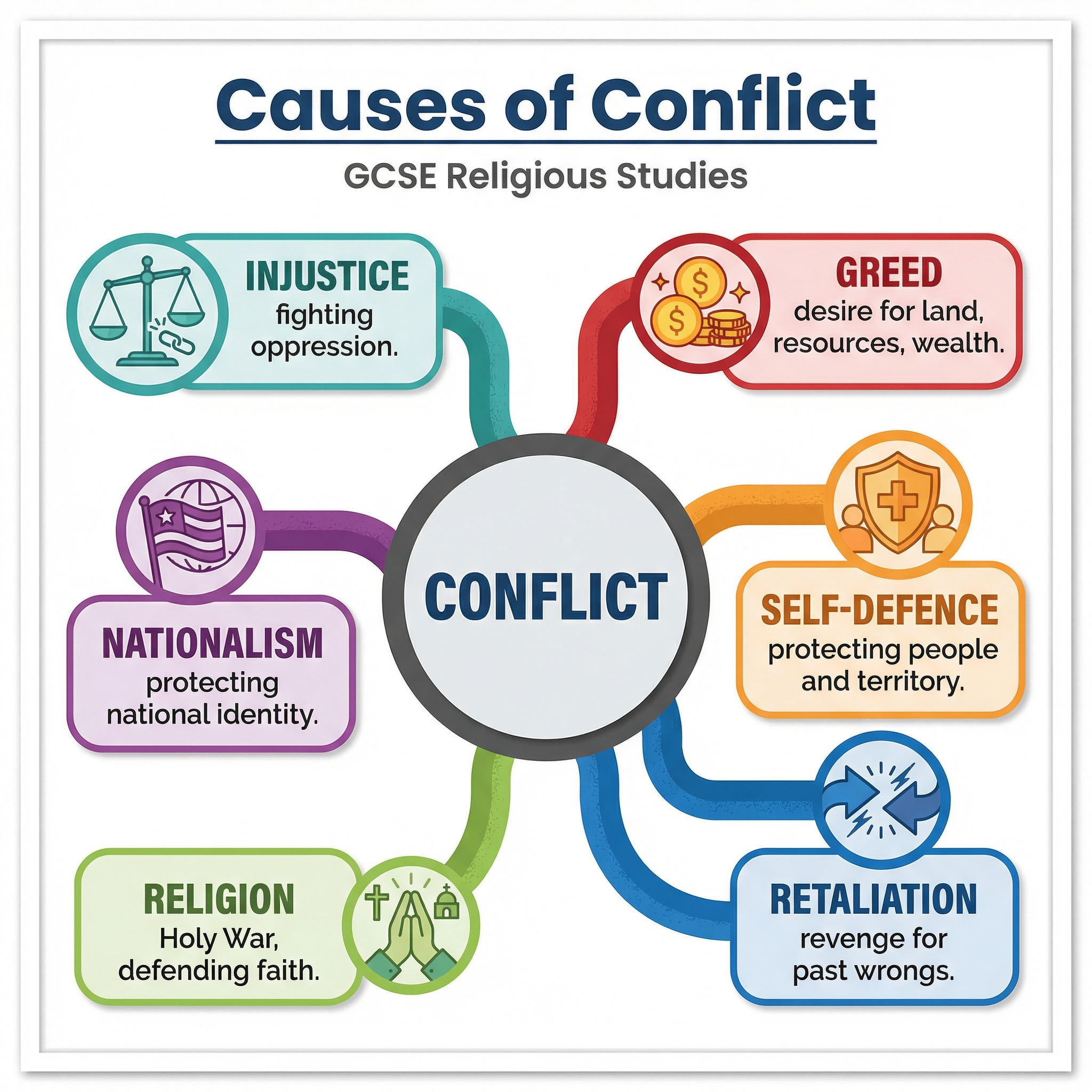
What it is: The AQA specification identifies three primary reasons why wars begin. Understanding and being able to explain these is fundamental.
- Greed: The selfish desire for something that belongs to another, such as land, natural resources (like oil or water), or wealth. From a religious standpoint, greed is almost universally condemned as it prioritises material gain over spiritual and moral well-being. For example, Christianity warns that the 'love of money is the root of all evil' (1 Timothy 6:10).
- Self-Defence: The act of protecting one's nation, people, or values from attack. This is often seen as the most justifiable reason for war. Most religions permit self-defence, as it aligns with the duty to protect the innocent. The Qur'an states, "Fight in the way of Allah those who fight you, but do not transgress" (2:190), permitting defensive but not aggressive warfare.
- Retaliation: Responding to a past wrong with force; seeking revenge. This is the most morally problematic cause. While the Old Testament mentions 'an eye for an eye', Jesus directly counters this in the New Testament, commanding his followers to 'turn the other cheek' (Matthew 5:39), forming a key basis for Christian pacifism.
Why it matters: In a 4 or 5-mark 'Explain' question, you will be expected to detail two of these causes, linking them to religious beliefs. For 12-mark 'Evaluate' questions, you must weigh these causes against the arguments for peace.
Just War Theory
What it is: A Christian philosophical framework, developed by thinkers like St. Augustine and St. Thomas Aquinas, that sets out conditions under which a war could be considered morally justifiable. It is NOT a justification for any war, but a strict set of criteria that must ALL be met. The Anglican Church, for example, accepts Just War theory, which is why it is incorrect to state that 'all Christians are pacifists'.
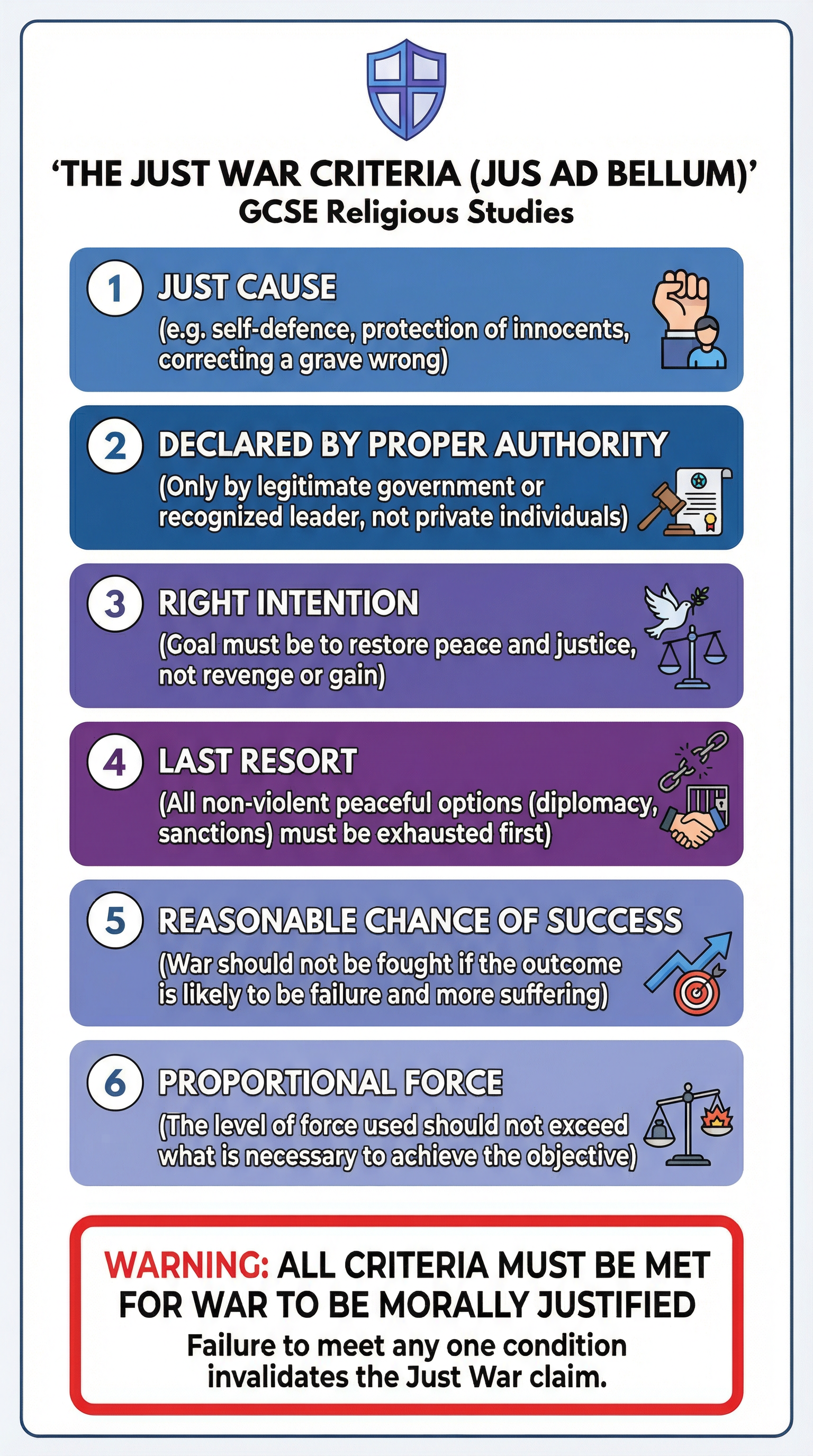
The Criteria (Jus ad Bellum):
- Just Cause: The war must be in response to a grave injustice, e.g., self-defence.
- Declared by Proper Authority: Only a legitimate, recognised government can declare war.
- Right Intention: The primary goal must be to restore peace and justice.
- Last Resort: All peaceful options (diplomacy, sanctions) must have been exhausted.
- Reasonable Chance of Success: A war should not be fought if it is futile.
- Proportional Force: The force used should not be excessive or cause more harm than the original injustice.
Why it matters: Candidates must know these criteria and be able to apply them to a given scenario. A common mistake is to think that meeting some of the criteria is enough; examiners will award marks for explaining that all conditions must be satisfied.
Pacifism
What it is: The belief that all violence and war are wrong, and that conflicts must be resolved through peaceful means. Crucially, pacifism is not passivity; it involves active work for peace through non-violent methods like protest, negotiation, and civil disobedience.
Key Examples:
- The Quakers (Religious Society of Friends): A Christian denomination that holds an absolute pacifist stance, based on their 'Peace Testimony'. They refuse to participate in any war.
- Ahimsa: A principle in Hinduism, Jainism, and Buddhism meaning 'non-harm'. Mahatma Gandhi famously used Ahimsa as a political tool of non-violent resistance.
- Jesus' Teachings: The Sermon on the Mount, particularly the command to 'turn the other cheek' and 'blessed are the peacemakers', provides a scriptural basis for Christian pacifism.
Why it matters: You must be able to contrast pacifism with the Just War theory. Avoid the common mistake of confusing pacifism with being passive. Credit is given for using specific examples like the Quakers.
Islamic Beliefs on Conflict
What it is: Islamic teachings on conflict are often misunderstood. It is essential to distinguish between the different forms of Jihad.
- Greater Jihad (Al-Jihad al-Akbar): The internal, spiritual struggle every Muslim faces to live a righteous life, overcome temptation, and submit to the will of Allah. This is considered the most important form of Jihad.
- Lesser Jihad (Al-Jihad al-Asghar): The external, physical struggle to defend Islam. This can include military action, but it is governed by strict ethical rules very similar to the Just War theory (e.g., it must be defensive, declared by a proper authority, and must not harm civilians).
- Holy War (Harb al-Muqaddasah): A war fought to defend the faith, with very specific theological conditions. This is distinct from both forms of Jihad.
Why it matters: Marks are awarded for showing a precise understanding of these terms. A common error is to equate Jihad with terrorism or to fail to distinguish between its greater and lesser forms. Explaining this distinction clearly will elevate your response.
Second-Order Concepts
Causation
Conflict rarely has a single cause. Examiners look for answers that recognise the interplay of factors. A conflict might be triggered by a desire for retaliation, but its underlying cause could be greed for resources. For example, a nation might claim it is acting in self-defence, but its deeper motivation could be to secure oil supplies.
Significance
The concepts of Just War and Pacifism are significant because they represent thousands of years of ethical debate on the most serious decision a nation can make. For believers, the question of whether they can reconcile their faith with the act of killing is of ultimate significance. Understanding this topic is not just about memorising facts, but about appreciating the profound moral weight of the issues involved.
Change & Continuity
While the weapons of war have changed dramatically, the reasons for fighting have remained remarkably consistent: greed, defence, and revenge. Similarly, the arguments for peace have been made for centuries. The core principles of Just War theory, formulated by Augustine in the 4th century, are still debated and applied by governments today. The challenge for modern believers is to apply these ancient principles to contemporary conflicts involving new technologies like drones and cyber-warfare.
Source Skills
When presented with a source, such as a quote from the Bible or a statement from a religious leader, your approach should be analytical, not just descriptive. Ask yourself:
- Content: What is the source saying about conflict or peace?
- Provenance: Who said it, and when? Is it from a sacred text, a modern theologian, or a political leader? This affects its authority.
- Application: How does this source support a specific argument? For example, how does "Blessed are the peacemakers" support the idea of active pacifism? Do not just quote the source; explain its relevance to the question.
- Context: How does this source compare or contrast with other religious teachings? For example, how does Jesus' command to 'turn the other cheek' contrast with the Old Testament idea of 'an eye for an eye'?
",
"podcast_script": "Welcome to your GCSE Religious Studies revision podcast. I'm your tutor today, and we're diving into one of the most fascinating and exam-critical topics on the AQA specification: Causes of Conflict and Pacifism. Whether you're revising for the first time or doing a final check before your exam, this episode is packed with everything you need. Grab a pen — you might want to jot a few things down.
Let's start with why this topic matters. Conflict and peace sit at the heart of religious ethics. Every major world religion has had to wrestle with a fundamental question: is violence ever justified? And if so, when? Examiners love this topic because it demands real evaluation — you can't just describe things, you have to weigh them up. So let's build your understanding from the ground up.
SECTION ONE: THE CAUSES OF CONFLICT.
The AQA specification asks you to understand why conflicts arise. There are three core causes you must know inside out: greed, self-defence, and retaliation.
First, greed. This refers to the selfish desire for more — more land, more resources, more wealth, more power. Think about how wars throughout history have been driven by nations wanting to expand their territory or control valuable resources like oil or water. From a religious perspective, greed is condemned across traditions. In Christianity, the Bible warns in 1 Timothy chapter 6 verse 10 that "the love of money is the root of all evil." In Islam, excessive greed is seen as a violation of the principle of justice — or Adl — which is one of Islam's core values. Candidates who link greed specifically to these religious condemnations will earn higher marks.
Second, self-defence. This is the idea that conflict is justified when you are protecting yourself, your community, or innocent people from attack. This is perhaps the most widely accepted justification for violence across religious traditions. Even pacifist-leaning traditions acknowledge that protecting the innocent is a serious moral duty. In Christianity, the Just War theory — which we'll come to shortly — explicitly includes self-defence as a just cause. In Islam, the Quran in Surah 2 verse 190 states: "Fight in the way of Allah those who fight you, but do not transgress. Indeed, Allah does not like transgressors." This verse is crucial — it permits defensive fighting but immediately limits it. That nuance is exactly what examiners want to see you discuss.
Third, retaliation. This is conflict motivated by revenge — responding to a past wrong with force. Religiously, this is the most morally complex cause. On one hand, there is a human instinct for justice — an eye for an eye. In the Old Testament, Exodus 21:24 references this principle. But Jesus directly challenges it in the Sermon on the Mount, recorded in Matthew chapter 5 verses 38 to 39, saying: "You have heard that it was said, an eye for an eye and a tooth for a tooth. But I say to you, do not resist the one who is evil. But if anyone slaps you on the right cheek, turn to him the other also." This is the foundation of Christian pacifism. Examiners will credit candidates who explain not just what the quote says, but how it challenges retaliation as a cause of conflict.
Beyond these three core causes, you should also be aware of religion itself as a cause of conflict. Holy Wars — conflicts fought in the name of God — appear across history. The Crusades are a key Christian example. In Islam, the concept of Jihad is often misunderstood, and we'll address that in detail shortly.
SECTION TWO: JUST WAR THEORY.
Just War theory is the framework most Christian denominations — including the Church of England — use to evaluate whether a war is morally acceptable. It was developed by Saint Augustine in the 4th century and later refined by Saint Thomas Aquinas in the 13th century. The criteria are known by the Latin term jus ad bellum, meaning "justice before war."
There are six criteria, and here's a memory trick for you: use the acronym J-D-R-L-R-P. Just cause. Declared by proper authority. Right intention. Last resort. Reasonable chance of success. Proportional force.
Let me go through each one. Just cause means the reason for fighting must be morally valid — typically self-defence, protecting innocents, or correcting a grave injustice. Declared by proper authority means only a legitimate government or recognised leader can declare war — not private individuals or terrorist groups. Right intention means the goal must be to restore peace and justice, not to seek revenge or gain territory. Last resort means all peaceful alternatives — diplomacy, sanctions, negotiation — must have been genuinely tried and failed before resorting to violence. Reasonable chance of success means war should not be fought if it is likely to fail and cause more suffering without achieving its aim. And proportional force means the level of violence used must not exceed what is necessary to achieve the objective.
Here's the critical exam point: ALL six criteria must be met for a war to be considered just. If even one is missing, the war fails the Just War test. Examiners will credit candidates who can explain this cumulative requirement clearly.
The Anglican Church — the Church of England — officially accepts Just War theory. This is why it is wrong to say "all Christians are pacifists." That is one of the most common mistakes in this topic, and it will cost you marks.
SECTION THREE: PACIFISM.
Pacifism is the belief that violence and war are never justified and that conflicts should always be resolved through peaceful means. But — and this is crucial — pacifism is NOT the same as passivity. A pacifist is not someone who does nothing in the face of injustice. A pacifist actively works for peace through non-violent means: protest, diplomacy, civil disobedience, prayer.
In Christianity, the Quakers — formally known as the Religious Society of Friends — are the strongest example of absolute pacifism. Their testimony of peace, established in 1660 in the Peace Testimony document, states that they "utterly deny all outward wars and strife." Quakers refuse to serve in the military under any circumstances. This is a named example you should use in exam answers.
Another powerful Christian example is Dietrich Bonhoeffer — though his case is complex. He was a German pastor who initially held pacifist views but eventually participated in a plot to assassinate Hitler during World War Two. His story illustrates the tension between pacifist principles and the moral imperative to stop extreme evil. Examiners reward candidates who can use Bonhoeffer to show that even committed Christians have wrestled with these questions.
In Hinduism, the concept of Ahimsa — meaning non-violence or non-harm — is central to pacifist thought. Mahatma Gandhi, who led India's independence movement in the 20th century, applied Ahimsa as a political strategy, proving that non-violent resistance could achieve major social change. Gandhi's famous quote — "An eye for an eye only ends up making the whole world blind" — is a brilliant exam quotation that links pacifism to the retaliation debate.
In Buddhism, the First Precept — "do not harm any living being" — underpins a broadly pacifist worldview. The Dalai Lama, the spiritual leader of Tibetan Buddhism, is a contemporary example of a pacifist religious leader who advocates for dialogue over conflict.
SECTION FOUR: ISLAM AND CONFLICT — JIHAD.
This is an area where candidates frequently lose marks by oversimplifying. You must distinguish clearly between the two forms of Jihad.
Greater Jihad — Al-Jihad Al-Akbar — refers to the internal, spiritual struggle every Muslim faces in trying to live a good, faithful life. This is about resisting temptation, improving oneself, and submitting fully to Allah. The Prophet Muhammad, peace be upon him, reportedly said after returning from battle: "We have returned from the lesser jihad to the greater jihad — the struggle against the self." This hadith is essential knowledge.
Lesser Jihad — Al-Jihad Al-Asghar — refers to the external, physical struggle, which can include military defence of the Muslim community. However, Lesser Jihad has strict conditions very similar to Just War theory: it must be defensive, declared by a proper authority, fought with right intention, and conducted proportionally. Terrorism and attacks on civilians are explicitly forbidden.
Holy War in Islam — sometimes called Harb al-Muqaddasah — has even stricter theological conditions and is rarely declared. It is distinct from both forms of Jihad. Candidates who can articulate this three-way distinction — Greater Jihad, Lesser Jihad, Holy War — will demonstrate the kind of sophisticated understanding that earns Level 4 marks.
SECTION FIVE: EXAM TIPS AND COMMON MISTAKES.
Let's talk about how to actually score marks in the exam. The AQA GCSE Religious Studies paper uses specific command words. Let me walk you through the most important ones for this topic.
For "Outline" questions — usually 1 or 2 marks — keep it brief and factual. "Outline one cause of conflict" just needs a clear, accurate statement: "One cause of conflict is greed, which refers to the desire for land, resources, or wealth."
For "Explain" questions — usually 4 marks — use the PEEL structure. Point, Evidence, Explanation, Link. State your point, give a religious source or example as evidence, explain how it supports your point, and link it back to the question.
For 12-mark "Evaluate" questions — and this is where most marks are won or lost — use what I call the FARM technique. Farm your arguments: For the statement, Against the statement, then Reach a conclusion. The conclusion is not a summary — it is a final judgment. You must say which side you find more convincing and why, with a reason. Examiners explicitly state that candidates who list arguments without reaching a conclusion cannot access the top mark band.
Here are the most common mistakes to avoid. Number one: confusing pacifism with passivity. A pacifist is actively working for peace — they are not passive. Number two: claiming all Christians are pacifists. They are not. The Church of England accepts Just War theory. Only specific groups like Quakers hold absolute pacifist positions. Number three: confusing Lesser Jihad with terrorism. Lesser Jihad has strict ethical conditions and explicitly forbids attacks on civilians. Number four: quoting scripture without explaining it. Don't just write "Blessed are the peacemakers." Explain what it means: it implies that peacemaking is an active, blessed duty — not just the absence of fighting. Number five: in 12-mark questions, listing arguments without a conclusion. Always, always reach a judgment.
SECTION SIX: QUICK-FIRE RECALL QUIZ.
Right — let's test your knowledge. I'll ask a question, pause, then give the answer. Try to answer before I do.
Question one: What is the Latin term for the Just War criteria? Pause. The answer is Jus Ad Bellum.
Question two: Which Christian denomination holds an absolute pacifist position based on their Peace Testimony? Pause. The Quakers — the Religious Society of Friends.
Question three: What does Ahimsa mean, and which religion is it most associated with? Pause. Ahimsa means non-violence or non-harm, and it is central to Hinduism and Buddhism.
Question four: What is the difference between Greater Jihad and Lesser Jihad? Pause. Greater Jihad is the internal spiritual struggle against sin and temptation. Lesser Jihad is the external physical struggle, which may include military defence under strict conditions.
Question five: In Matthew 5:39, what does Jesus say about retaliation? Pause. "If anyone slaps you on the right cheek, turn to him the other also" — meaning Christians should not retaliate with violence.
Question six: Name one condition of Just War theory. Pause. Any one of: just cause, declared by proper authority, right intention, last resort, reasonable chance of success, or proportional force.
How did you do? If you struggled with any of those, go back and review that section before your exam.
SECTION SEVEN: SUMMARY AND SIGN-OFF.
Let's bring it all together. The key tension in this topic is between the human instinct for conflict — driven by greed, self-defence, and retaliation — and the religious imperative for peace. Different religious traditions resolve this tension differently. Most Christian denominations accept Just War theory as a framework for justified conflict, while Quakers and some other groups maintain absolute pacifism. Islam distinguishes between the internal Greater Jihad and the strictly regulated Lesser Jihad. Hinduism and Buddhism emphasise Ahimsa and non-violence as core principles.
In the exam, your job is not to say who is right — it is to demonstrate that you understand the different positions, can support them with specific religious sources, and can evaluate them with a clear, reasoned conclusion.
Remember: examiners are looking for AO1 knowledge and understanding, and AO2 analysis and evaluation — each worth 50% of your marks. So every answer needs both accurate content AND critical thinking.
You've got this. Keep revising, keep practising past papers, and remember — the more specific your knowledge, the more marks you earn. Good luck in your exam. This has been your GCSE Religious Studies revision podcast on Causes of Conflict and Pacifism. See you in the next episode!"