Study Notes
Overview
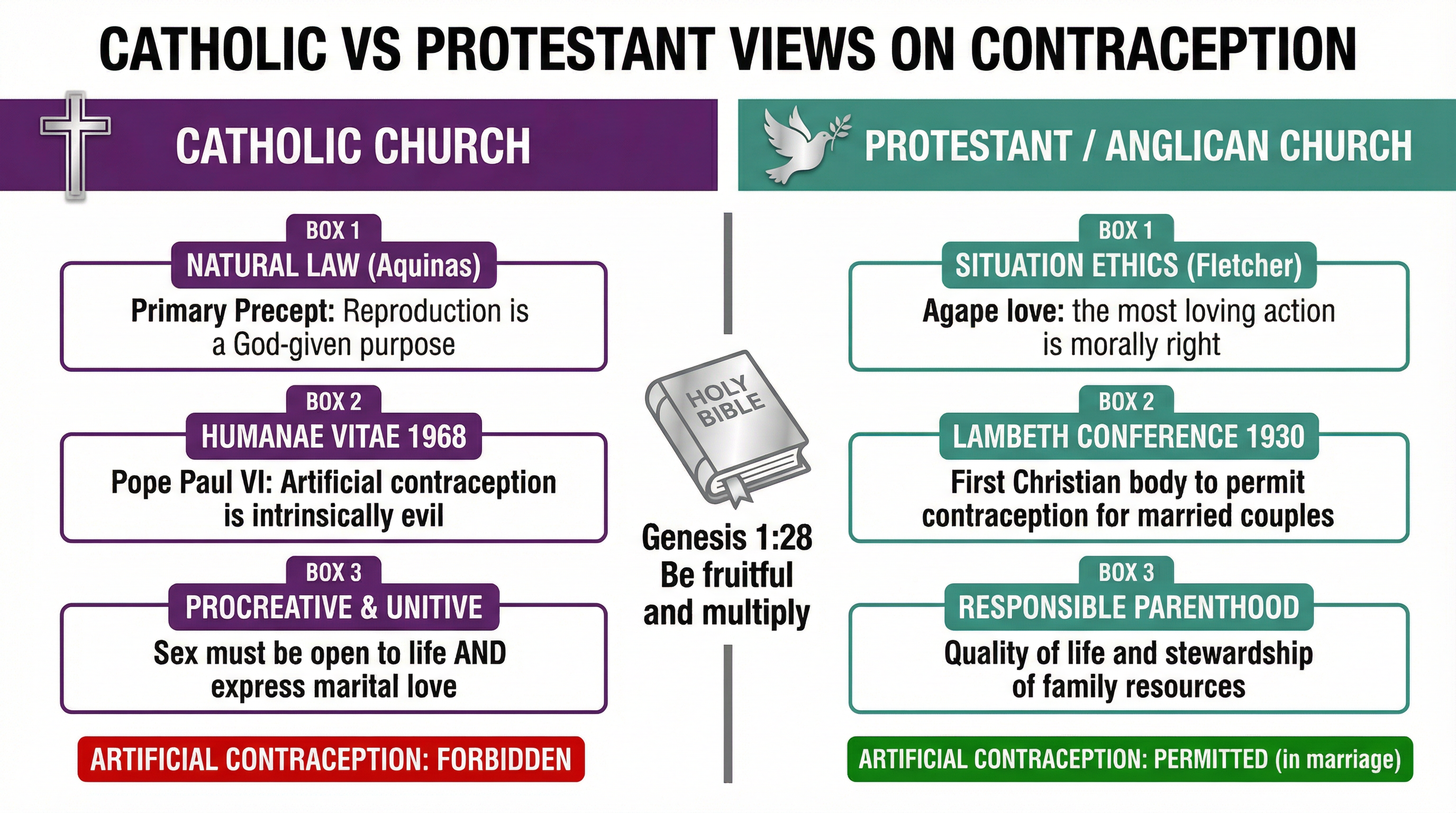
This topic explores the diverse Christian perspectives on contraception and family planning, a key area of ethical debate. For AQA GCSE Religious Studies, candidates are expected to demonstrate a detailed understanding of the theological principles underpinning these views. The core of the debate lies in the tension between the procreative (to have children) and unitive (to express love) purposes of marriage. Examiners will award marks for a clear analysis of the absolutist Catholic position, as defined by Natural Law and the papal encyclical Humanae Vitae, versus the more person-centered Protestant view, which prioritizes loving outcomes and responsible parenthood, a stance first formally adopted at the 1930 Lambeth Conference. A thorough grasp of these opposing viewpoints, supported by specific terminology and key dates, is essential for achieving high marks.
Key Events & Developments
Lambeth Conference
Date(s): 1930
What happened: The Anglican Church (Church of England) became the first major Christian denomination to officially approve the use of artificial contraception for married couples. This was a landmark decision, breaking with centuries of universal Christian condemnation of contraception.
Why it matters: This event marks the formal beginning of the split in Christian teaching on this issue. It established the principle of 'responsible parenthood' within Protestantism, arguing that the decision to use contraception could be a moral and loving one, based on the specific situation of the family. For the exam, this is the key counterpoint to the Catholic view.
Specific Knowledge: Candidates must know the date (1930) and the name of the conference. Credit is given for explaining that this decision was based on prioritizing the well-being and stability of the family.
Humanae Vitae
Date(s): 1968
What happened: Pope Paul VI issued this encyclical (a papal letter to bishops) which authoritatively reaffirmed the Catholic Church's ban on all forms of artificial contraception. It stated that the unitive and procreative aspects of the sexual act are inseparable.
Why it matters: In an era of increasing sexual liberation and the availability of the contraceptive pill, Humanae Vitae was a hugely significant and controversial declaration. It solidified the Catholic Church's absolutist position and remains the definitive teaching on the matter today. It is the primary source for the modern Catholic argument against contraception.
Specific Knowledge: Candidates must know the date (1968), the name of the encyclical, and the Pope who issued it (Paul VI). Marks are awarded for linking it directly to the principles of Natural Law.
Key Individuals
St. Thomas Aquinas
Role: 13th-century Catholic theologian and philosopher.
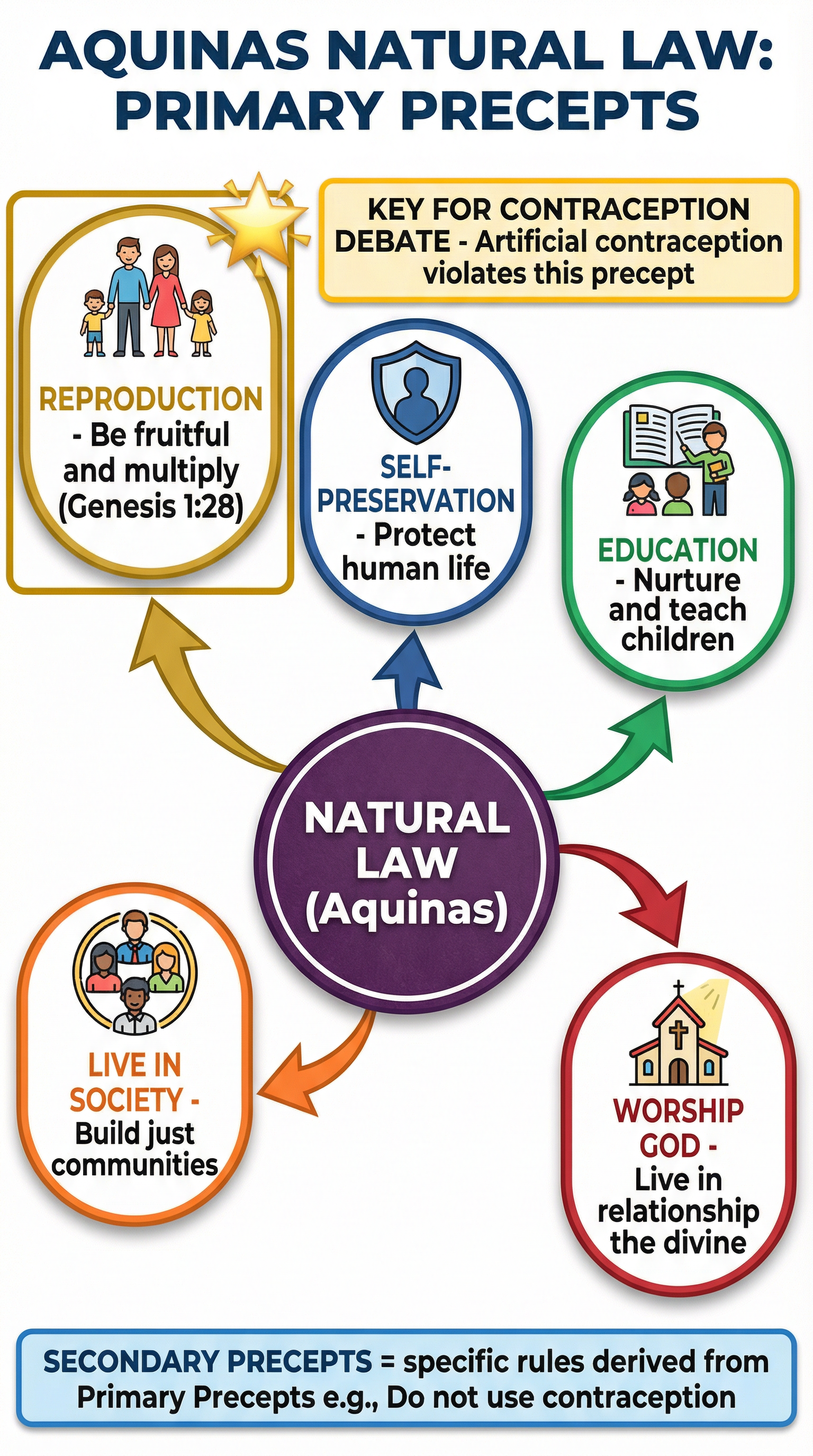
Key Actions: Developed the ethical theory of Natural Law, which is the foundation of Catholic moral teaching. He argued that God created the world with a rational order and purpose, and that humans, through reason, can discern this purpose.
Impact: Aquinas's concept of Primary Precepts, particularly the precept of Reproduction, is the bedrock of the Catholic argument against contraception. His work provides the intellectual framework for the belief that the primary purpose of sex is procreation, and that to intentionally frustrate this purpose is morally wrong.
Joseph Fletcher
Role: 20th-century American theologian.
Key Actions: Developed the theory of Situation Ethics, most famously in his 1966 book of the same name. He argued that moral decisions should be based on one guiding principle: agape (selfless, unconditional love).
Impact: Fletcher's work provided a theological justification for the more liberal Protestant approach. By applying Situation Ethics, one could argue that using contraception is the most loving action if it leads to a better outcome for the family (e.g., preventing poverty, protecting the mother's health). This directly challenges the legalistic, rule-based approach of Natural Law.
Second-Order Concepts
Causation
The divide in Christian teaching was caused by long-term theological differences (Natural Law vs. a focus on scripture and individual conscience) and triggered by short-term societal changes. The development of reliable contraception (the pill in the 1960s) and changing social attitudes towards sex and family forced the churches to respond, leading to the entrenchment of the Catholic view in Humanae Vitae and the liberalisation of the Protestant view.
Consequence
The immediate consequence was a clear and public division within Christianity on a major moral issue. Long-term, this has led to different cultural attitudes towards family size and planning in Catholic and Protestant communities. It also presents a significant challenge for many Catholics who may privately disagree with the official teaching.
Change & Continuity
Change: The major change was the Protestant acceptance of contraception from 1930 onwards. This was a radical departure from 1900 years of Christian tradition.
Continuity: The Catholic Church has demonstrated remarkable continuity, holding fast to the traditional teaching against artificial contraception from the early church fathers, through Aquinas, to Pope Paul VI and the present day.
Significance
The debate is significant because it encapsulates the clash between tradition and modernity, and between absolute moral laws and situational ethics. It forces a consideration of the purpose of sex, the meaning of marriage, and the authority of the Church in the lives of believers. For examiners, it is a perfect topic to test a candidate's ability to analyse and evaluate contrasting arguments.
Source Skills
When presented with a source, for example, an extract from Humanae Vitae, candidates should first identify its provenance: who wrote it (Pope Paul VI), when (1968), and what type of document it is (a papal encyclical). This immediately tells you it has high authority for Catholics. Then, analyse its content, identifying key phrases like "intrinsically wrong" or the link between the "unitive significance and the procreative significance". Finally, evaluate its usefulness and limitations for understanding the Christian view as a whole, noting it is highly useful for the Catholic view but not representative of the Protestant view.