Study Notes
Overview
Welcome to your deep dive into Crime and Punishment for Edexcel GCSE Religious Studies (Specification B). This topic requires a rigorous analysis of theological and ethical responses to crime, justice, and the treatment of offenders. Examiners are looking for candidates who can move beyond simplistic statements and apply specific Sources of Wisdom and Authority (SoA) to construct well-reasoned arguments. You will be expected to evaluate the aims of punishment, the contentious issue of capital punishment, and the Christian understanding of forgiveness. A key skill is the ability to differentiate between divergent views within Christianity, demonstrating that the faith is not monolithic. This guide will provide you with the detailed knowledge, analytical frameworks, and exam techniques necessary to achieve the highest levels. Remember, success in this topic is not just about what you know, but how effectively you can use that knowledge to analyse, evaluate, and justify your conclusions.
Key Concepts
Crime vs. Sin
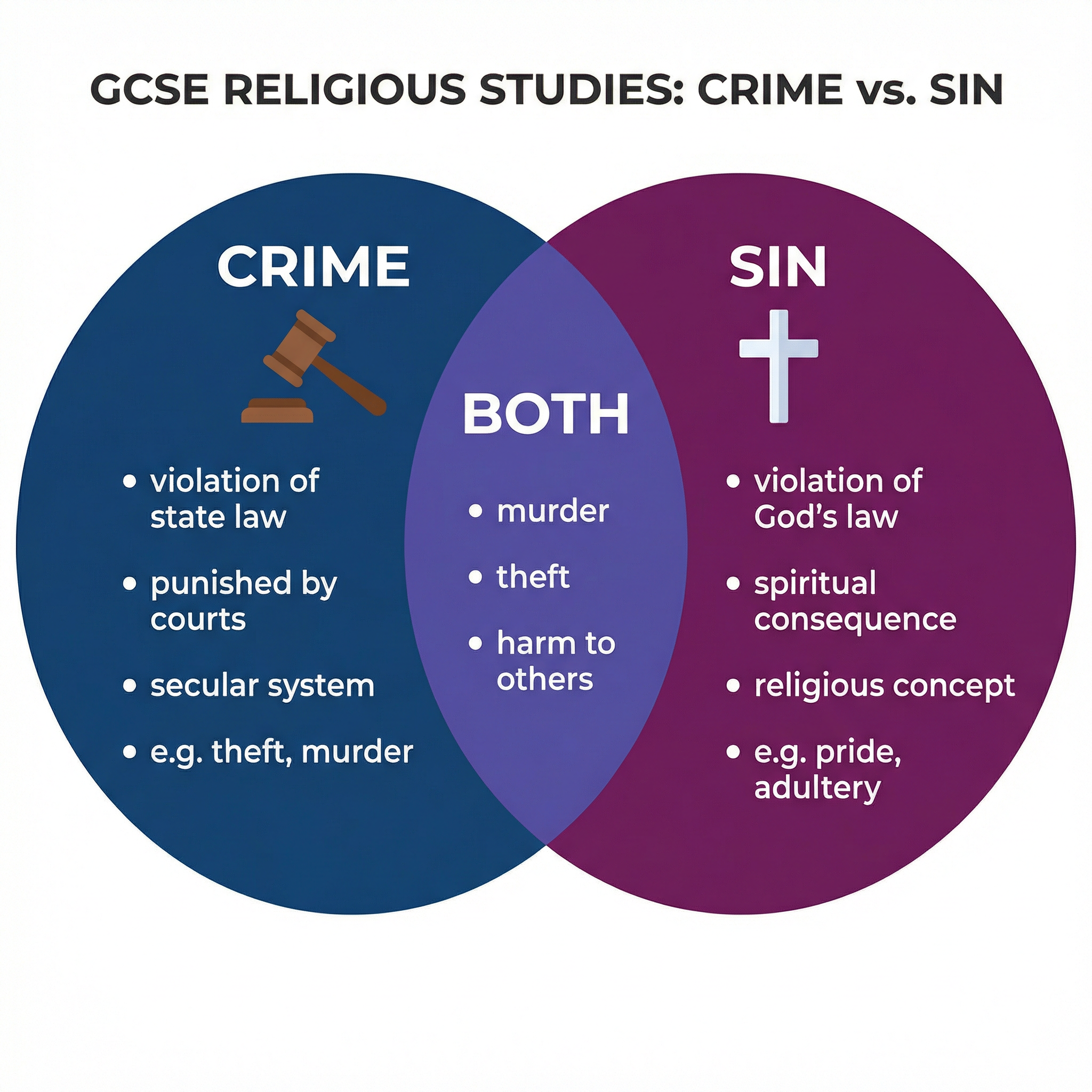
It is crucial for candidates to distinguish between 'crime' and 'sin'. A crime is an act against the law of the state, punishable by the legal system (e.g., imprisonment, fines). A sin is an act against the law of God, a transgression with spiritual consequences. While many acts, like murder or theft, are both crimes and sins, the two categories are not identical. For example, adultery is considered a sin in Christianity but is not a crime in the UK. Conversely, exceeding the speed limit is a crime but not necessarily a sin. Marks are awarded for this precise use of terminology.
The Aims of Punishment
Examiners expect a clear understanding of the four primary aims of punishment. Candidates should be able to explain and evaluate each one, using the correct terminology.
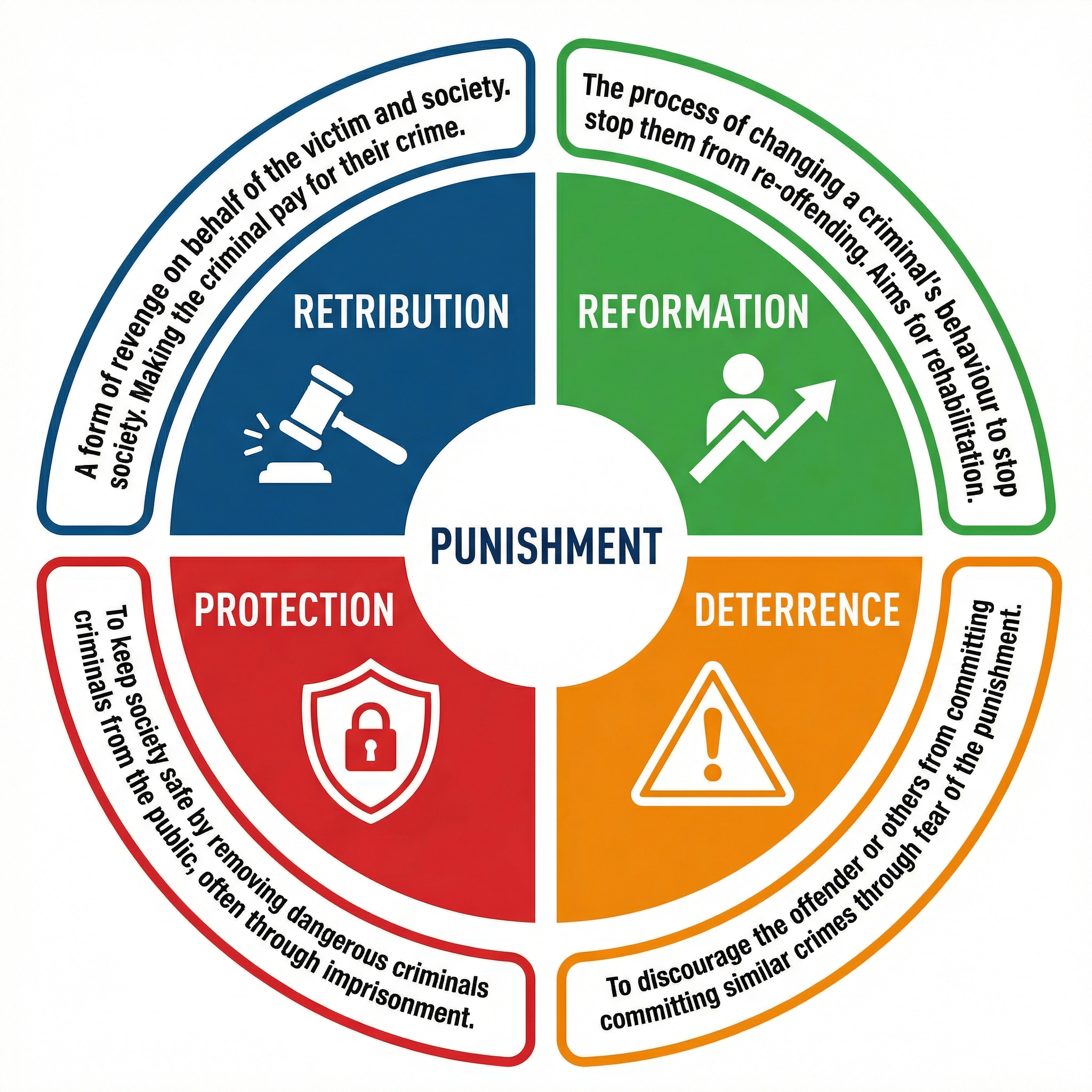
- Retribution: The idea that punishment should be proportional to the crime committed. It is about achieving justice, not personal revenge. The key Source of Wisdom here is the Old Testament principle of lex talionis: "an eye for an eye, a tooth for a tooth" (Exodus 21:24). Candidates must not confuse this with simple vengeance.
- Deterrence: The aim of putting people off committing crimes. This can be individual (dissuading the offender from reoffending) or general (sending a message to society). The severity of a punishment, such as a long prison sentence, is often justified on the grounds of deterrence.
- Reformation: The aim of changing a criminal's behaviour for the better. This is about rehabilitation and reflects the Christian belief in redemption and the idea that everyone is created in the imago Dei (the image of God). The Parable of the Prodigal Son (Luke 15) is an excellent example of forgiveness and reformation in action.
- Protection: The aim of keeping society safe from dangerous criminals by removing them from public life, most commonly through imprisonment. This is a pragmatic aim focused on the safety of the community.
Capital Punishment
A central and often-tested area of this topic. Candidates must be able to present and evaluate arguments for and against the death penalty, using specific Christian teachings.
Arguments FOR Capital Punishment:
- Retribution: Some Christians, often citing the Old Testament, argue that the death penalty is the only just retribution for murder. The principle of lex talionis is key here.
- Sanctity of Life: A counter-intuitive but valid argument is that executing a murderer demonstrates the ultimate value and sanctity of the life they took. Genesis 9:6 states, "Whoever sheds human blood, by humans shall their blood be shed."
- Deterrence: The belief that the death penalty deters others from committing murder.
Arguments AGAINST Capital Punishment:
- Sanctity of Life: The most common Christian argument against capital punishment. Life is a sacred gift from God, and only God has the right to take it away.
- Forgiveness and Reformation: The New Testament places a strong emphasis on forgiveness and the potential for all people to change. Jesus' teaching to "turn the other cheek" (Matthew 5:39) directly contradicts the principle of retribution.
- Risk of Error: An innocent person could be executed, an irreversible injustice.
- Official Church Teaching: The Catholic Church, along with most mainstream Protestant denominations like the Church of England, officially opposes the death penalty in all circumstances.
Forgiveness
Candidates often oversimplify the concept of forgiveness. Christian forgiveness is not about simply ignoring wrongdoing. It is a complex process that is often linked to repentance – the act of turning away from sin. The Parable of the Unforgiving Servant (Matthew 18) teaches that humans should forgive others as God has forgiven them, but it also shows that a lack of mercy has consequences. Forgiveness is seen as a path to reconciliation and spiritual healing, both for the victim and the offender.