Study Notes
Overview
Capital Punishment, or the death penalty, is a cornerstone topic in the 'Peace and Conflict' and 'Dialogue' themes of the OCR specification. It is a subject that forces a direct confrontation between deeply held principles of justice, mercy, and the value of human life. For the exam, candidates are not expected to simply narrate the history of execution; they must dissect the complex ethical arguments for and against the practice, grounding their analysis in specific Christian teachings and secular philosophies like Humanism and Utilitarianism. Examiners are looking for a nuanced understanding that moves beyond simplistic statements, rewarding responses that can distinguish between different Christian denominations, interpret sources of authority critically, and evaluate the strengths and weaknesses of various ethical positions. This guide will provide the detailed knowledge and analytical skills necessary to construct high-level arguments, focusing on the key scriptural passages, ethical concepts, and common pitfalls to avoid.
Key Concepts & Ethical Frameworks
The Principle of Retributive Justice
What it is: Retributive justice is the theory of punishment that holds that the best response to a crime is a punishment proportional to the offense. It is not primarily concerned with deterring future crimes or rehabilitating the offender, but with giving the criminal their 'just deserts'.
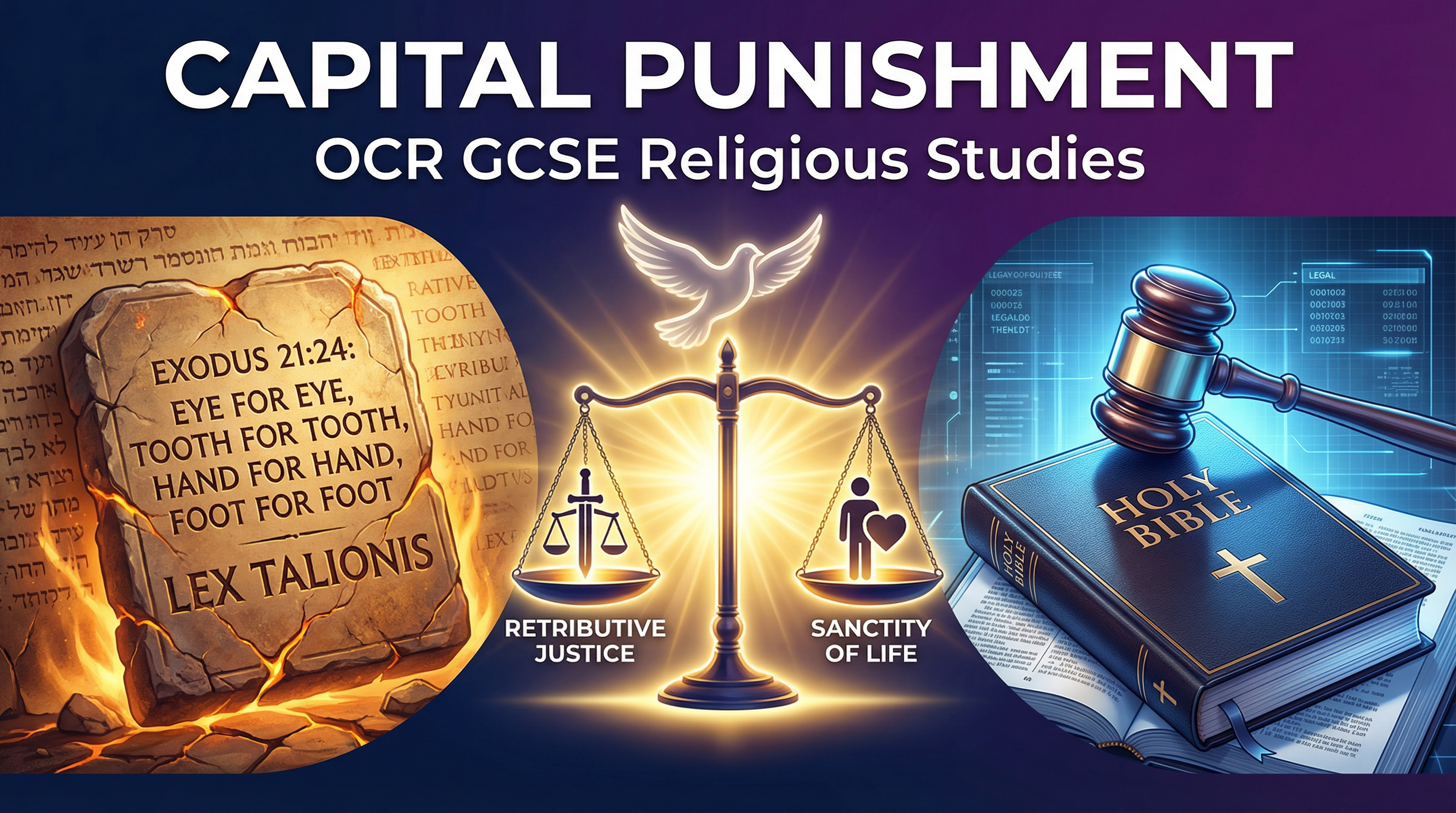
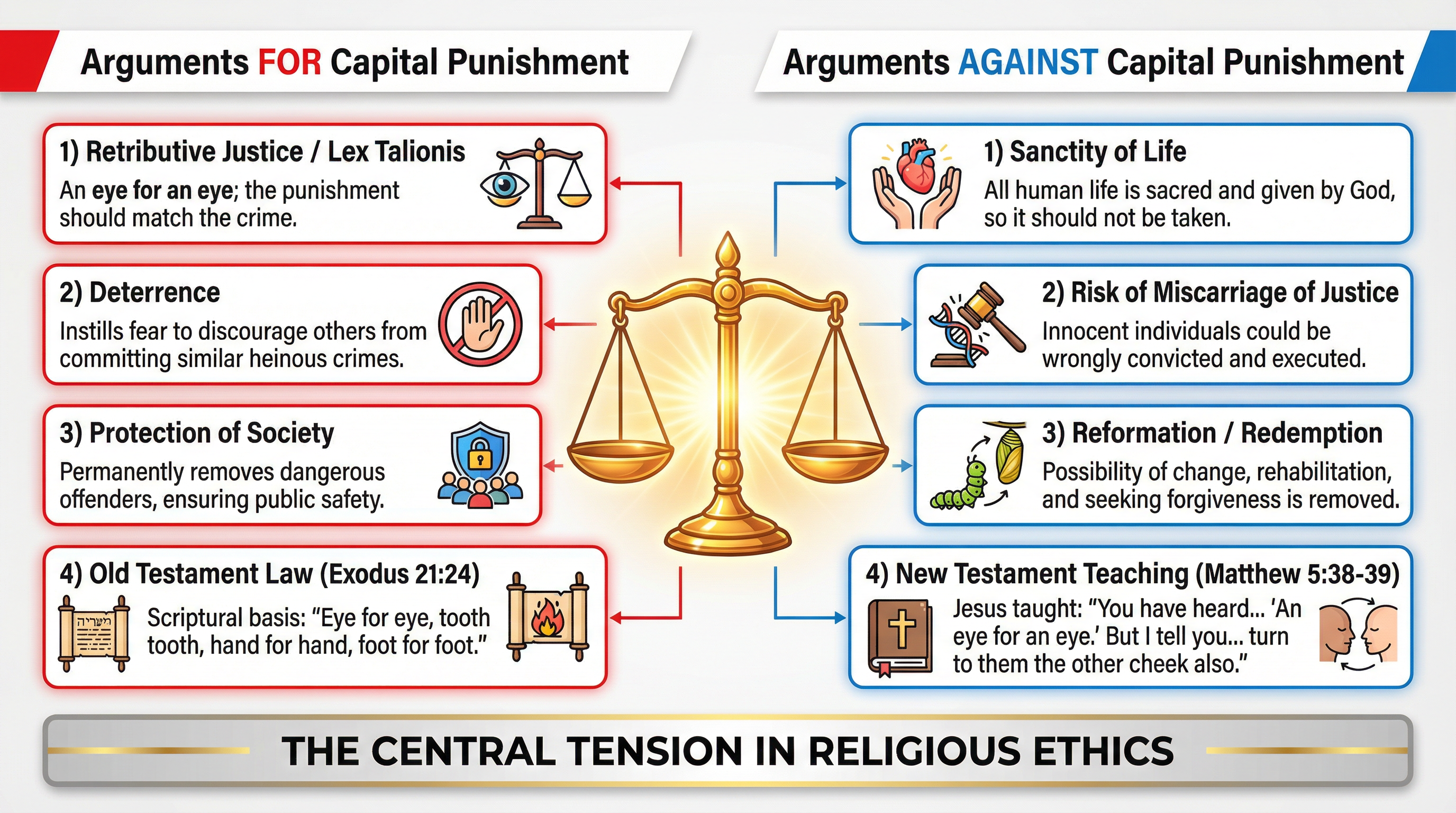
Why it matters: This is the primary philosophical justification FOR capital punishment. The argument is that for the most heinous crimes, such as premeditated murder, the only proportional punishment is the forfeiture of the offender's own life. This principle is famously encapsulated in the Latin phrase Lex Talionis (the law of retaliation).
Specific Knowledge: The key source of authority for Lex Talionis is Exodus 21:24, which states: "eye for an eye, tooth for a tooth, hand for hand, foot for foot." Candidates must be able to cite this passage and explain its significance as a foundational text for retributive justice. It is interpreted by some, particularly Conservative Evangelicals, as a divine command establishing the moral legitimacy of capital punishment.
The Principle of the Sanctity of Life
What it is: The Sanctity of Life is the belief that human life is sacred, holy, and belongs to God. Therefore, it should not be wrongfully taken by human beings.
Why it matters: This is the most powerful theological argument AGAINST capital punishment. It posits that all individuals, regardless of their actions, retain an intrinsic value and dignity because they are created in the image of God (Imago Dei - Genesis 1:27). To execute someone, therefore, is to usurp God's authority over life and death.
Specific Knowledge: Key sources of authority include Genesis 1:27 ("So God created mankind in his own image") and the Sixth Commandment, "You shall not murder" (Exodus 20:13). It is crucial to note that the Hebrew word for murder, ratsach, refers to unlawful killing, and the Old Testament itself prescribes capital punishment for certain crimes. High-level answers will explore this complexity rather than making a simplistic claim that the Sixth Commandment forbids all killing.
Christian Perspectives: Common & Divergent Views
Examiners explicitly reward candidates who can demonstrate that Christianity is not a monolith. You MUST discuss different viewpoints within the faith.
Conservative Evangelical Support
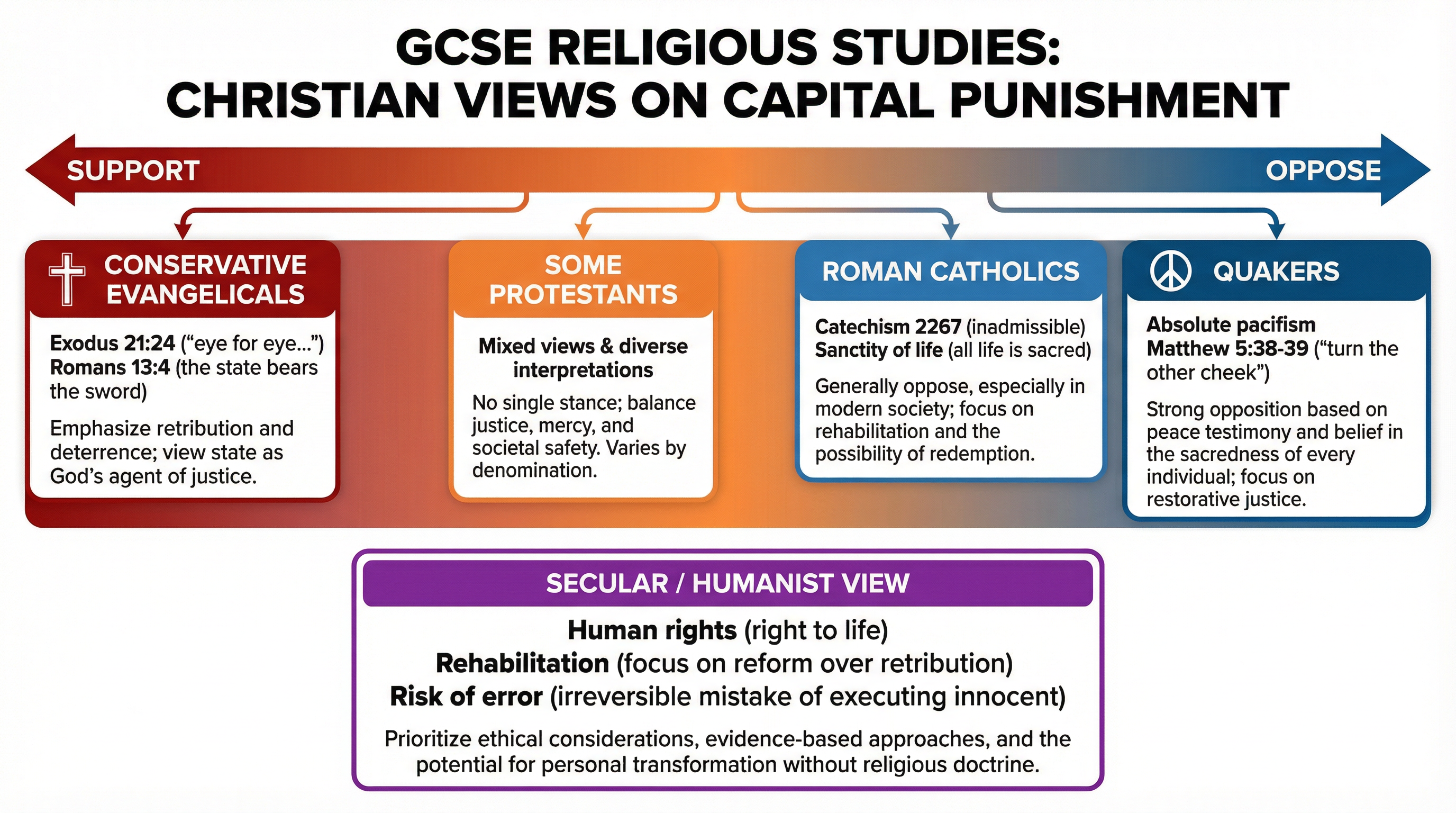
Key Stance: Generally support the state's right to use capital punishment for the most serious crimes.
Key Arguments: They often take a more literalist approach to the Bible. They argue that the principle of Lex Talionis in Exodus 21 is a timeless principle of justice. Furthermore, they cite Romans 13:4, where St. Paul states the governing authority "does not bear the sword in vain. For it is the servant of God, an avenger who carries out God's wrath on the wrongdoer." For them, the state has a God-given duty to enforce justice, which can include execution.
Roman Catholic Opposition
Key Stance: The modern Catholic Church is strongly against the death penalty in almost all circumstances.
Key Arguments: The Catechism of the Catholic Church (paragraph 2267), as revised by Pope Francis in 2018, declares that "the death penalty is inadmissible because it is an attack on the inviolability and dignity of the person". The Church emphasizes the Sanctity of Life and the possibility of reformation and redemption. It argues that non-lethal means, like life imprisonment, are sufficient to protect society from the offender.
Quaker (Religious Society of Friends) Opposition
Key Stance: Absolute opposition to capital punishment, rooted in their commitment to pacifism.
Key Arguments: Quakers believe all violence is wrong. Their core belief is in the 'inner light' of God in every person. They take Jesus' teachings in the Sermon on the Mount as a direct command. In Matthew 5:38-39, Jesus explicitly overturns the Old Testament principle of retribution: "You have heard that it was said, 'An eye for an eye and a tooth for a tooth.' But I tell you, do not resist an evil person. If anyone slaps you on the right cheek, turn to them the other cheek also." For Quakers, this teaching makes state-sanctioned killing completely incompatible with Christian ethics. They focus on restorative justice instead.
Secular & Non-Religious Perspectives
Humanism
Key Stance: Strong opposition to capital punishment.
Key Arguments: Humanists base their ethics on reason, empathy, and a concern for human beings. Their arguments are:
- The Right to Life: They uphold the principles of the Universal Declaration of Human Rights (Article 3), which states everyone has a right to life.
- Miscarriage of Justice: The judicial system is fallible and can make mistakes. Since 1973 in the USA, over 190 people sentenced to death have been exonerated. An execution is irreversible; you can release an innocent person from prison, but you cannot bring them back from the dead. This risk is unacceptable.
- Ineffectiveness as a Deterrent: Humanists point to a lack of credible statistical evidence that the death penalty deters violent crime more effectively than a long-term prison sentence.
Utilitarianism
Key Stance: A Utilitarian could argue for or against, depending on the evidence. The position is not fixed.
Key Arguments: Utilitarianism, founded by Jeremy Bentham, seeks to achieve "the greatest good for the greatest number." A Utilitarian analysis would weigh the suffering caused by an execution against the potential benefits to society.
- Argument FOR: If it could be proven that executing one murderer would deter several future murders, a Utilitarian might support it, as this would lead to a net reduction in suffering.
- Argument AGAINST: However, given the evidence that it is not a strong deterrent, the risk of executing an innocent person, and the immense cost of capital trials, most modern Utilitarians (like Peter Singer) argue that the death penalty fails the utility calculus and a sentence of life imprisonment is a better option."