Study Notes
Overview
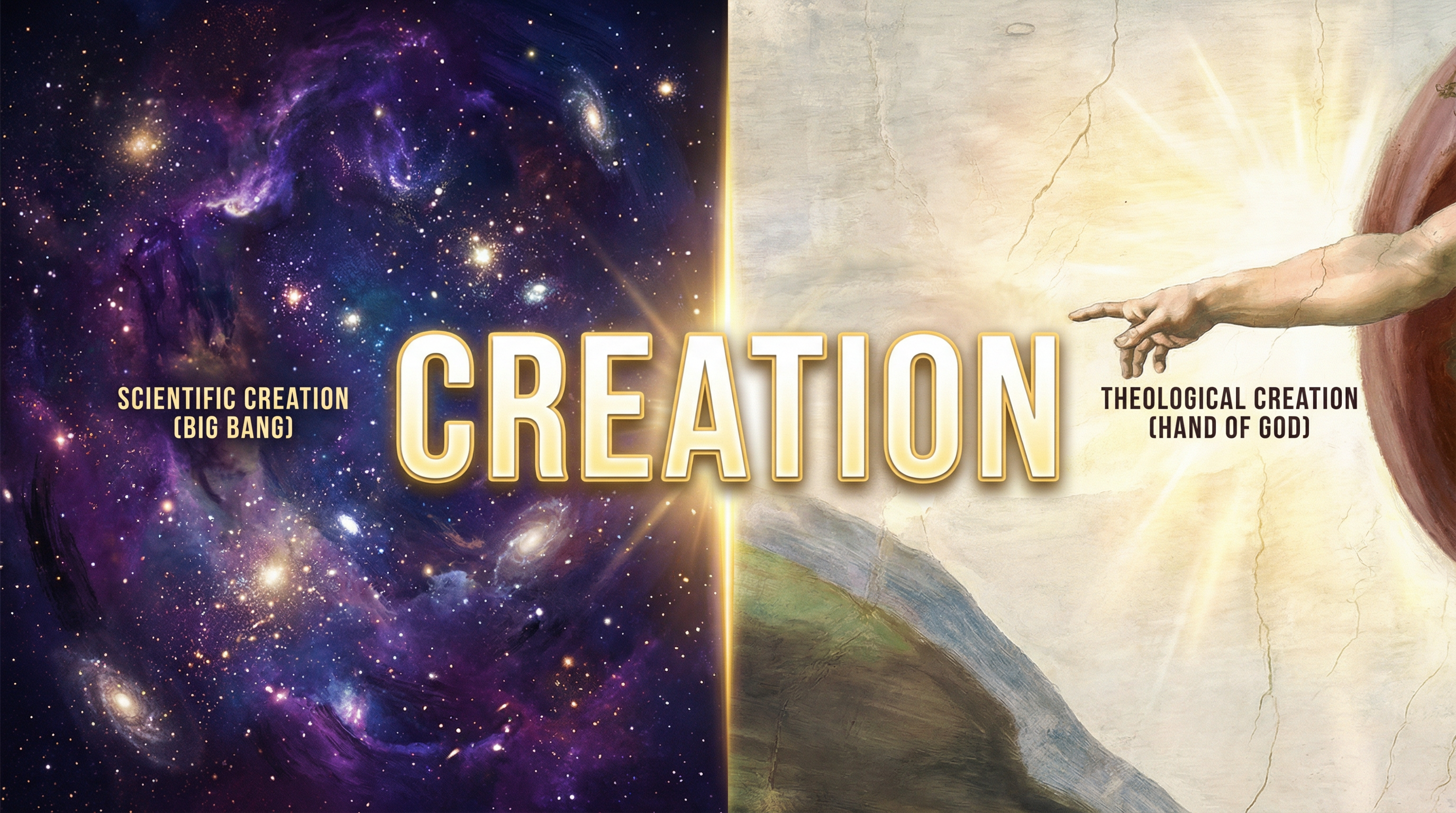
This topic delves into the Christian understanding of Creation, primarily through the lens of Genesis 1-3, and contrasts it with scientific explanations such as the Big Bang theory and evolution. For the OCR J625 specification, it is not enough for candidates to simply narrate these accounts. Credit is awarded for a deep theological analysis: understanding what the creation narratives reveal about the nature of God (e.g., Omnipotent, Benevolent, Eternal), the role of the Trinity (with specific reference to John 1:1-3), and the status of humanity as created in the 'Imago Dei' (Image of God). A crucial area of assessment is the evaluation of the relationship between religion and science. Candidates must move beyond simplistic 'conflict' narratives and explore the nuanced positions of compatibility, such as Theistic Evolution, a view formally accepted by the Catholic Church. The ethical dimensions of creation, particularly the concepts of Stewardship (Khalifah) and Dominion, are also central, requiring candidates to connect theological beliefs to contemporary moral issues like environmentalism.
Key Concepts & Beliefs
The Genesis Creation Narratives
What happened: The book of Genesis opens with two distinct accounts of creation. Genesis 1 presents a structured, seven-day creation week, where God brings the universe into existence through divine command ('Let there be light'). Genesis 2 offers a more anthropomorphic narrative, focusing on the creation of Adam from dust and Eve from Adam's rib in the Garden of Eden.
Why it matters: These narratives are the bedrock of Christian theology. Genesis 1 establishes God's omnipotence (all-powerful) and benevolence (all-good), as He declares His creation 'good'. Genesis 2 highlights the intimate relationship between God and humanity. For exam purposes, candidates must extract these theological truths rather than just retelling the story. Marks are awarded for explaining what these texts reveal about God's nature and his relationship with the world.
Specific Knowledge: Genesis 1:1 ('In the beginning God created the heavens and the earth.'), Genesis 1:27 ('So God created mankind in his own image...'), Genesis 2:7 (creation of Adam), Genesis 2:21-22 (creation of Eve).
The Role of the Word and the Spirit
What happened: Christian theology understands creation as an act of the entire Trinity. The Gospel of John explicitly states that Jesus, as the 'Word' (Logos), was instrumental in creation.
Why it matters: This concept is vital for demonstrating a sophisticated understanding of Christian doctrine. It shows that creation was not an act of God the Father alone. Citing John 1:1-3 ('In the beginning was the Word... Through him all things were made') is a direct way to access higher AO1 marks. It links the topic of Creation directly to the doctrine of the Trinity.
Specific Knowledge: John 1:1-3. The role of the Holy Spirit is also mentioned in Genesis 1:2 ('the Spirit of God was hovering over the waters'), signifying its presence and power in the creative process.
Scientific Accounts: Big Bang & Evolution
What happened: The Big Bang theory posits the universe began from a singularity around 13.8 billion years ago. The theory of evolution by natural selection, developed by Charles Darwin, explains the diversification of life on Earth over millions of years.
Why it matters: These scientific theories present an alternative explanation for origins that can be seen as conflicting with a literal reading of Genesis. A key skill for the exam is to evaluate the extent of this conflict. Candidates must avoid the common mistake of conflating the two theories; the Big Bang concerns the origin of the universe, while evolution concerns the origin of species.
Specific Knowledge: Georges Lemaître, a Catholic priest, first proposed the Big Bang theory, a crucial piece of evidence for arguing compatibility between science and faith. Charles Darwin, 'On the Origin of Species' (1859).
Christian Responses to Science
Young Earth Creationism
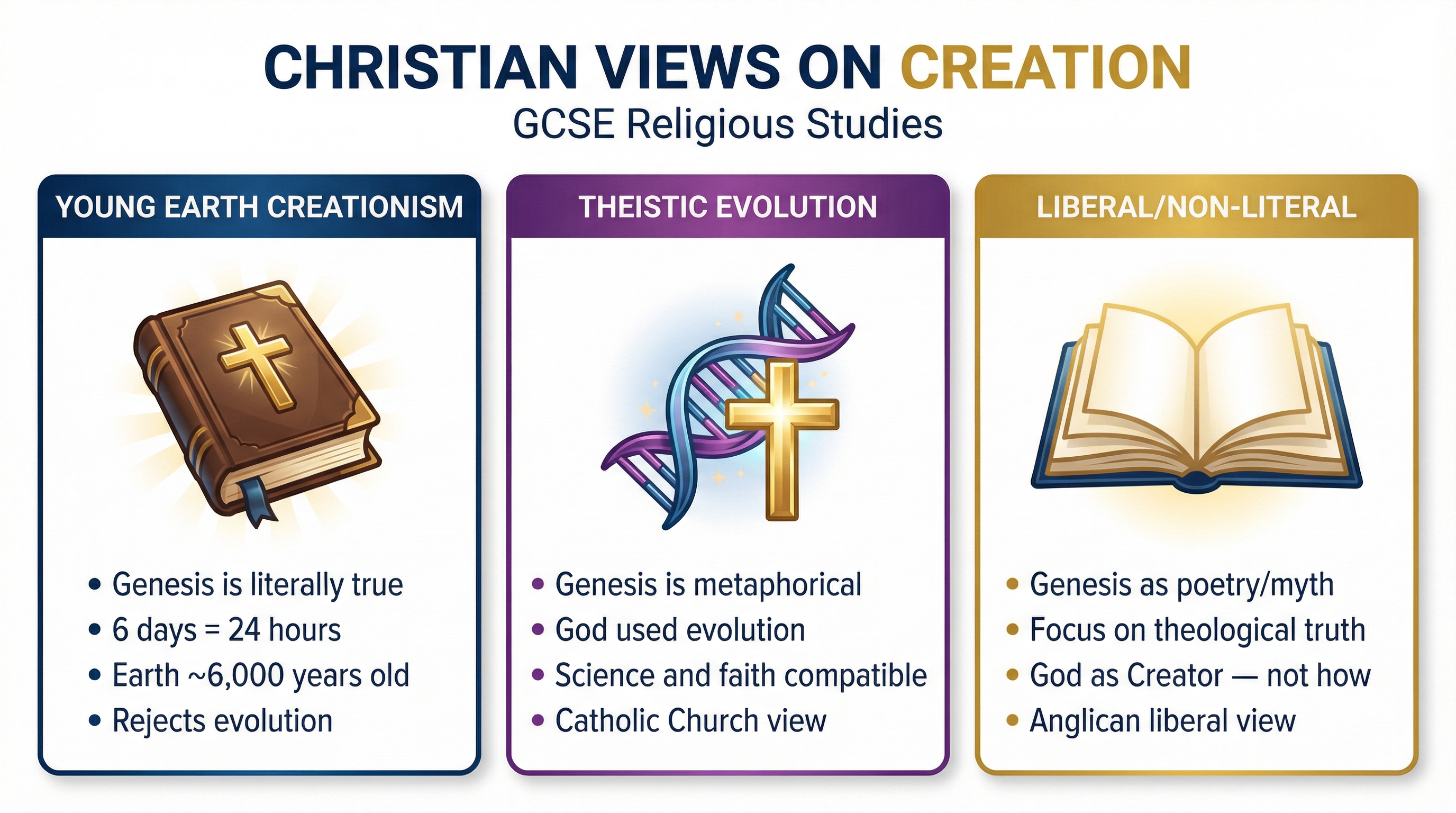
Belief: Adherents interpret the Genesis accounts as a literal, historical, and scientific record. They believe creation occurred in six 24-hour days, approximately 6,000-10,000 years ago. They reject the theories of evolution and the Big Bang.
Significance: This view represents a 'conflict' model in the science-religion debate. It prioritises the authority of a literal interpretation of scripture over scientific consensus. In an exam, this view should be presented as one end of a spectrum of Christian belief.
Theistic Evolution
Belief: This view holds that science and religion are compatible. God is the ultimate creator, but used the natural processes of the Big Bang and evolution to bring about the universe and life. The Genesis accounts are read metaphorically or as theological narratives, not scientific textbooks.
Significance: This is the official position of the Catholic Church and is widely held in Anglican and other Protestant denominations. It represents a 'compatibility' or 'complementary' model. Citing Pope John Paul II's 1996 statement that evolution is 'more than a hypothesis' is excellent specific evidence for this view.
Liberal / Non-Literal Interpretation
Belief: Liberal Christians view the Genesis stories as myths or symbolic poetry. Their purpose is to convey profound theological truths about God and humanity's relationship with Him, not to provide a scientific account of origins. For them, science asks 'how' and religion asks 'why', so there is no conflict.
Significance: This approach completely separates the 'magisteria' (realms of authority) of science and religion. It allows faith to coexist with scientific discovery without any contradiction.
Humanity, Stewardship, and Dominion
Imago Dei
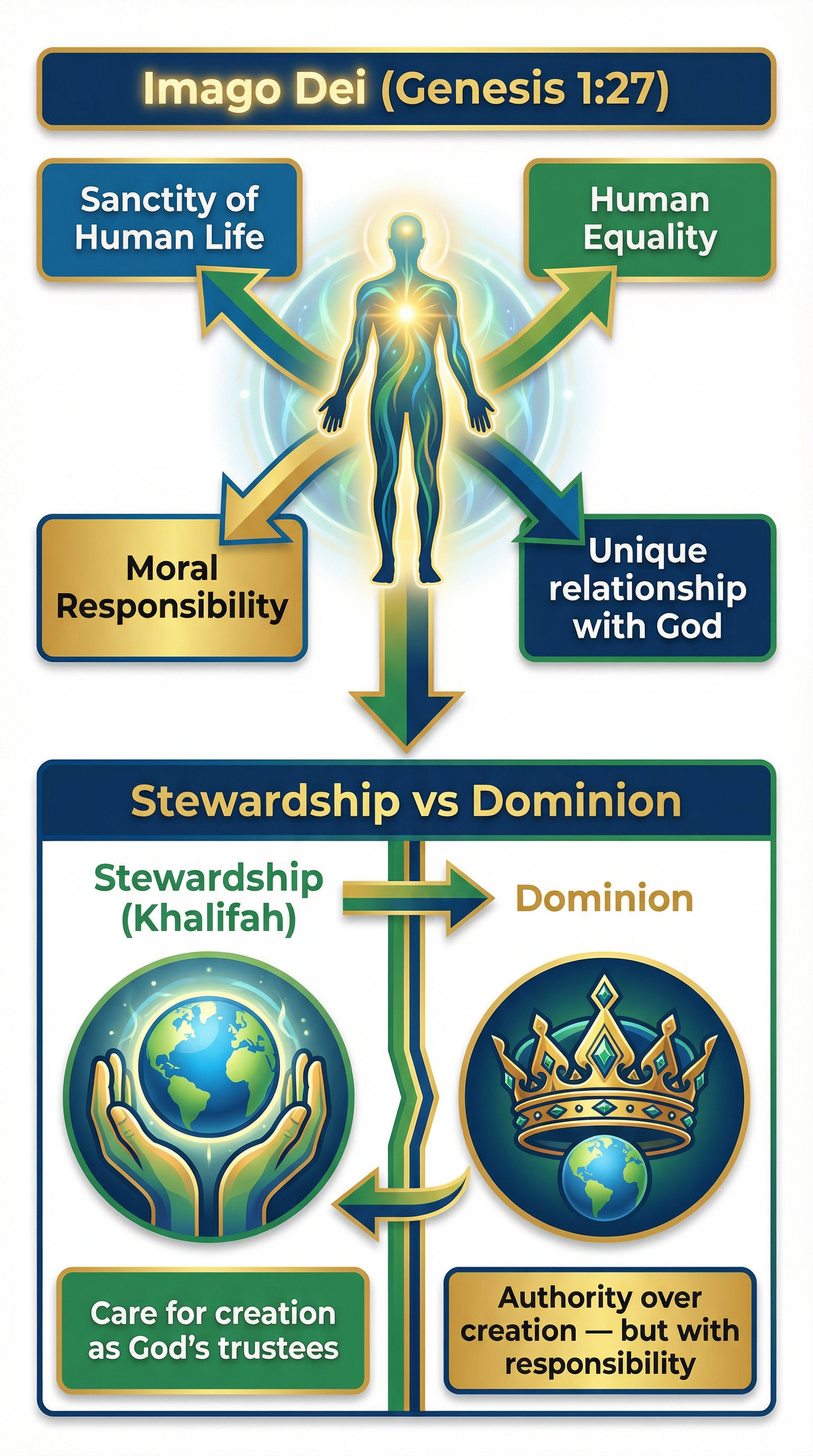
Belief: Genesis 1:27 states that humans are made in the 'Image of God'. This is a foundational concept in Christian anthropology.
Impact: 'Imago Dei' implies that all human beings possess a unique dignity, value, and purpose. It is the theological basis for the 'sanctity of life' principle, which is applied to ethical issues like abortion and euthanasia. It also underpins beliefs in human rights and equality. Marks are given for linking this theological concept to its practical ethical implications.
Stewardship and Dominion
Belief: Genesis 1:28 grants humanity 'dominion' over the Earth. This has been interpreted in two main ways. The traditional view of 'dominion' suggests humanity has the authority to rule over and use the Earth's resources. A more contemporary and widely accepted interpretation is that of 'Stewardship' (or 'Khalifah' in Islam), which argues that humans have a God-given duty to care for, manage, and protect creation as its trustees.
Impact: The concept of stewardship is central to Christian environmental ethics. It provides a powerful religious motivation for tackling climate change, pollution, and species extinction. Using the specific term 'Stewardship' is credited by examiners as precise theological language.