Study Notes
Overview
This unit explores the foundational beliefs of Islam, which shape the worldview and practices of over 1.8 billion Muslims globally. For your OCR GCSE, a precise understanding of these beliefs is not just required, it is essential for achieving high marks. Examiners expect candidates to move beyond simple definitions and demonstrate a nuanced understanding of concepts such as Tawhid (the absolute oneness of Allah), Risalah (prophethood), and Akhirah (the afterlife). Crucially, you must be able to explain the key differences between the Sunni Six Articles of Faith and the Shi'a Five Roots of Usul ad-Din, integrating specific Sources of Wisdom and Authority (SOWA) like the Qur'an and Hadith to support your points. This guide is structured to build that deep, analytical knowledge, focusing on exactly what is credited in the exam.
The Nature of Allah: Tawhid
What is it: Tawhid is the central, non-negotiable belief in the absolute oneness and uniqueness of Allah. It is the foundation upon which all other Islamic beliefs are built. This concept asserts that Allah is one, indivisible, and has no partners, children, or equals. It is a declaration of radical monotheism.
Why it matters: In the exam, Tawhid is the lens through which you should analyse almost every other aspect of Islam. It explains Muslim attitudes towards idolatry (shirk), the significance of the Shahadah (declaration of faith), and the nature of worship. Marks are awarded for explaining how Tawhid influences a Muslim's entire life, creating a direct relationship between the individual and their creator without any intermediaries.
Specific Knowledge: The most vital SOWA for Tawhid is Surah 112 (Al-Ikhlas) of the Qur'an: "Say, He is Allah, the One. Allah, the Eternal Refuge. He neither begets nor is born, nor is there to Him any equivalent." Memorising and using this quote is a direct route to AO1 marks. Candidates should also be familiar with some of the 99 Names of Allah (Asma ul-Husna), which reveal His attributes, such as Al-Rahman (The Most Gracious), Al-Qadir (The All-Powerful), and Al-Alim (The All-Knowing). These demonstrate that while Allah is transcendent (beyond human comprehension), He is also immanent (close to His creation), as stated in Surah 50:16: "And We have already created man and know what his soul whispers to him, and We are closer to him than [his] jugular vein.".
Risalah: Prophethood and Holy Books
What is it: Risalah refers to the communication channel between Allah and humanity, established through prophets (messengers). Muslims believe Allah sent prophets to every nation to guide them. This line of prophets begins with Adam and ends with Muhammad, who is known as the Khatam an-Nabiyyin (Seal of the Prophets).
Why it matters: Risalah explains how Muslims know what to believe and how to act. The guidance revealed through prophets provides the foundation for Islamic law (Shari'ah) and ethics. In an exam context, explaining the role of prophets as conduits of divine revelation is key. Credit is given for understanding that the message was consistent (worship one God) but the scriptures were updated, culminating in the Qur'an.
Specific Knowledge: Key prophets to know include Adam, Ibrahim (Abraham), Musa (Moses), Isa (Jesus), and, most importantly, Muhammad. Candidates must know that the revelation to Muhammad was delivered by the angel Jibril (Gabriel) over 23 years. It is a common mistake to confuse Jibril's role with that of Mika'il (Michael), who is associated with providing sustenance and mercy. The holy books (Kutub) associated with these prophets are the Tawrat (Torah), Zabur (Psalms), Injil (Gospel), and finally, the Qur'an, which is considered the final and incorruptible word of Allah.
Akhirah: The Afterlife and Al-Qadr
What is it: Akhirah is the belief in life after death, encompassing the Day of Judgement, resurrection, heaven (Jannah), and hell (Jahannam). This belief provides a moral framework for life, as every action is judged and has eternal consequences. Al-Qadr is the belief in divine predestination – that Allah has knowledge of and has decreed everything that will happen.
Why it matters: Akhirah is the ultimate motivation for moral living in Islam. For the exam, you must be able to explain how this belief impacts a Muslim's daily life, from prayer and charity to avoiding sin. The theological tension within Al-Qadr is a high-level concept that examiners look for. Candidates who can discuss the relationship between Allah's omniscience and human free will demonstrate strong analytical skills. Sunni and Shi'a Muslims have different approaches to this, with Shi'a theology placing a stronger emphasis on free will to align with the concept of Adalat (Divine Justice).
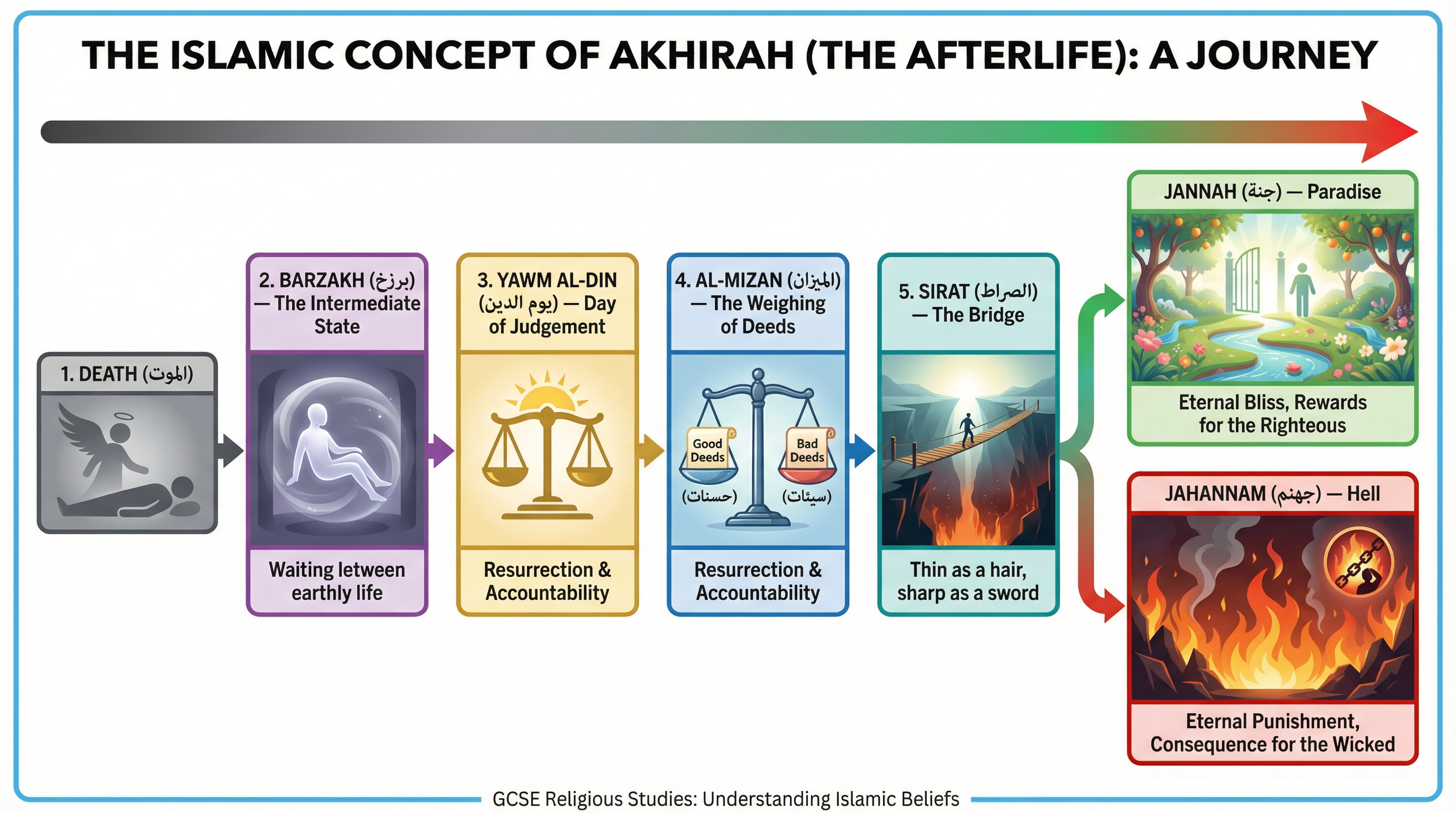
Specific Knowledge: The journey to the afterlife involves several stages: Death (taken by Azra'il, the Angel of Death) → Barzakh (the intermediate waiting state) → Yawm al-Din (Day of Judgement) where deeds are weighed on the Al-Mizan (scales) → crossing the Sirat bridge → final destination of Jannah (paradise) or Jahannam (hell). A key SOWA is Surah 99:7-8: "So whoever does an atom's weight of good will see it, And whoever does an atom's weight of evil will see it."
The Great Divergence: Sunni vs. Shi'a Beliefs
This is one of the most important areas for earning marks. While both groups share the core belief in Allah and the prophethood of Muhammad, they diverge on fundamental articles of faith that stem from the succession crisis after the Prophet's death.
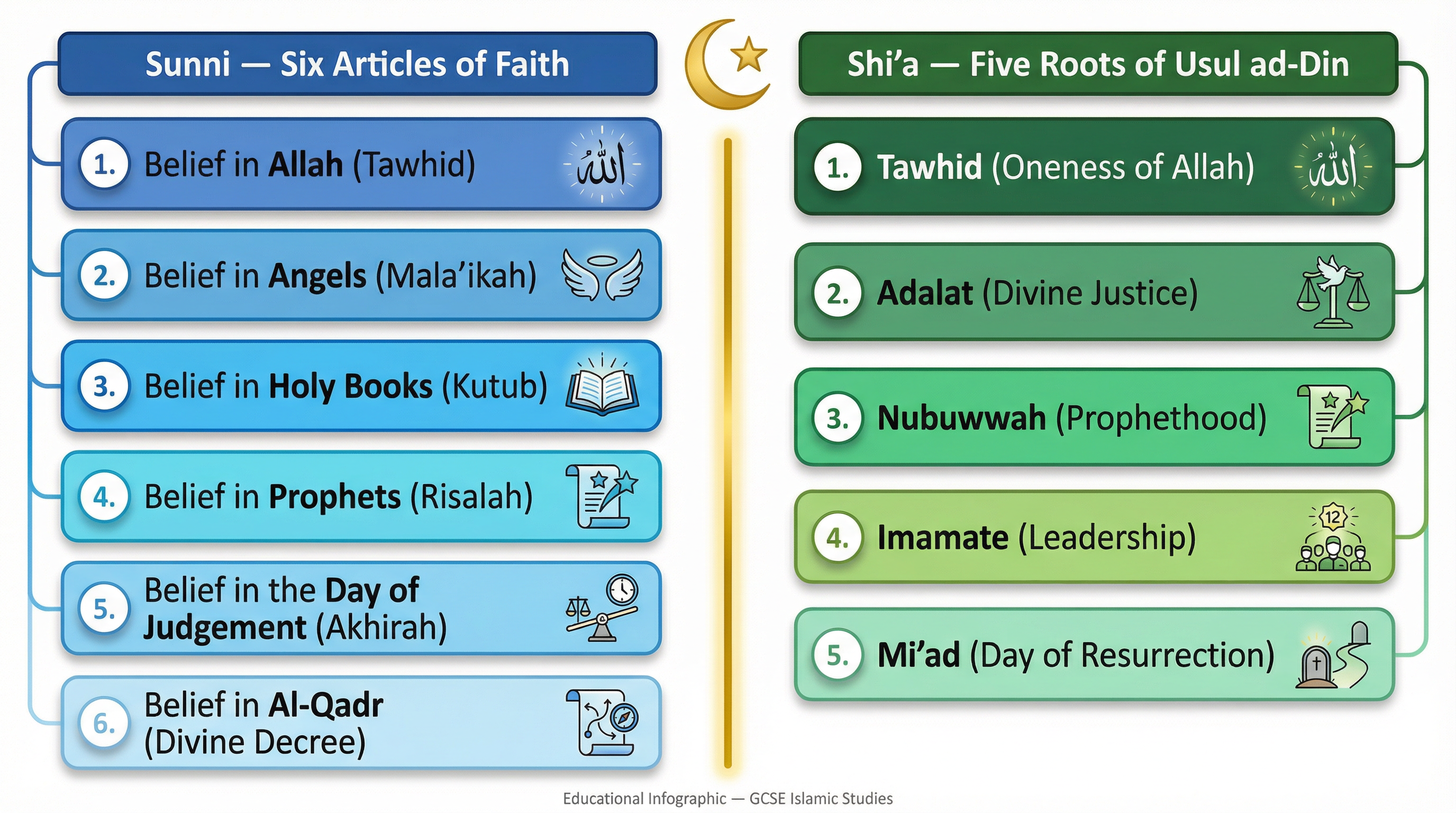
Sunni Islam: The majority of Muslims are Sunni. Their core beliefs are summarised in the Six Articles of Faith:
- Tawhid: Belief in Allah.
- Mala'ikah: Belief in Angels.
- Kutub: Belief in Holy Books.
- Risalah: Belief in Prophets.
- Akhirah: Belief in the Day of Judgement.
- Al-Qadr: Belief in Divine Decree.
Shi'a Islam: The second-largest branch of Islam. Their core beliefs are summarised in the Five Roots of Usul ad-Din:
- Tawhid: The Oneness of Allah.
- Adalat: Divine Justice. A unique root emphasising that Allah is perfectly just.
- Nubuwwah: Prophethood.
- Imamate: Leadership. The belief in twelve divinely appointed and infallible Imams to lead the community after Muhammad, starting with Ali ibn Abi Talib.
- Mi'ad: The Day of Resurrection.
Why it matters: Examiners will explicitly ask you to compare these two sets of beliefs. Marks are awarded for identifying the unique elements, particularly the Shi'a concepts of Adalat and the Imamate, and explaining why they are so significant. The Imamate is the most critical political and theological difference, shaping Shi'a identity and authority structures to this day.