Study Notes
Overview
This topic requires candidates to master the distinction between prejudice (a negative attitude) and discrimination (a harmful action). Examiners expect a rigorous analysis of this concept through the lens of both UK law, specifically the Equality Act 2010, and core Christian Sources of Wisdom and Authority (SOWA). A high-level response will not only define the key terms but also evaluate the effectiveness of religious responses to systemic issues like racism, sexism, and religious intolerance. Marks are awarded for precise use of theological language, accurate citation of scripture such as Galatians 3:28, and an appreciation of the diversity within Christian thought. Candidates must move beyond simplistic statements like 'Christians believe...' and instead explore the tension between inclusive scriptural principles and the exclusive historical practices of some denominations. This guide will equip you with the specific knowledge, analytical frameworks, and exam techniques needed to achieve the highest marks.
Key Concepts & Developments
Prejudice vs. Discrimination
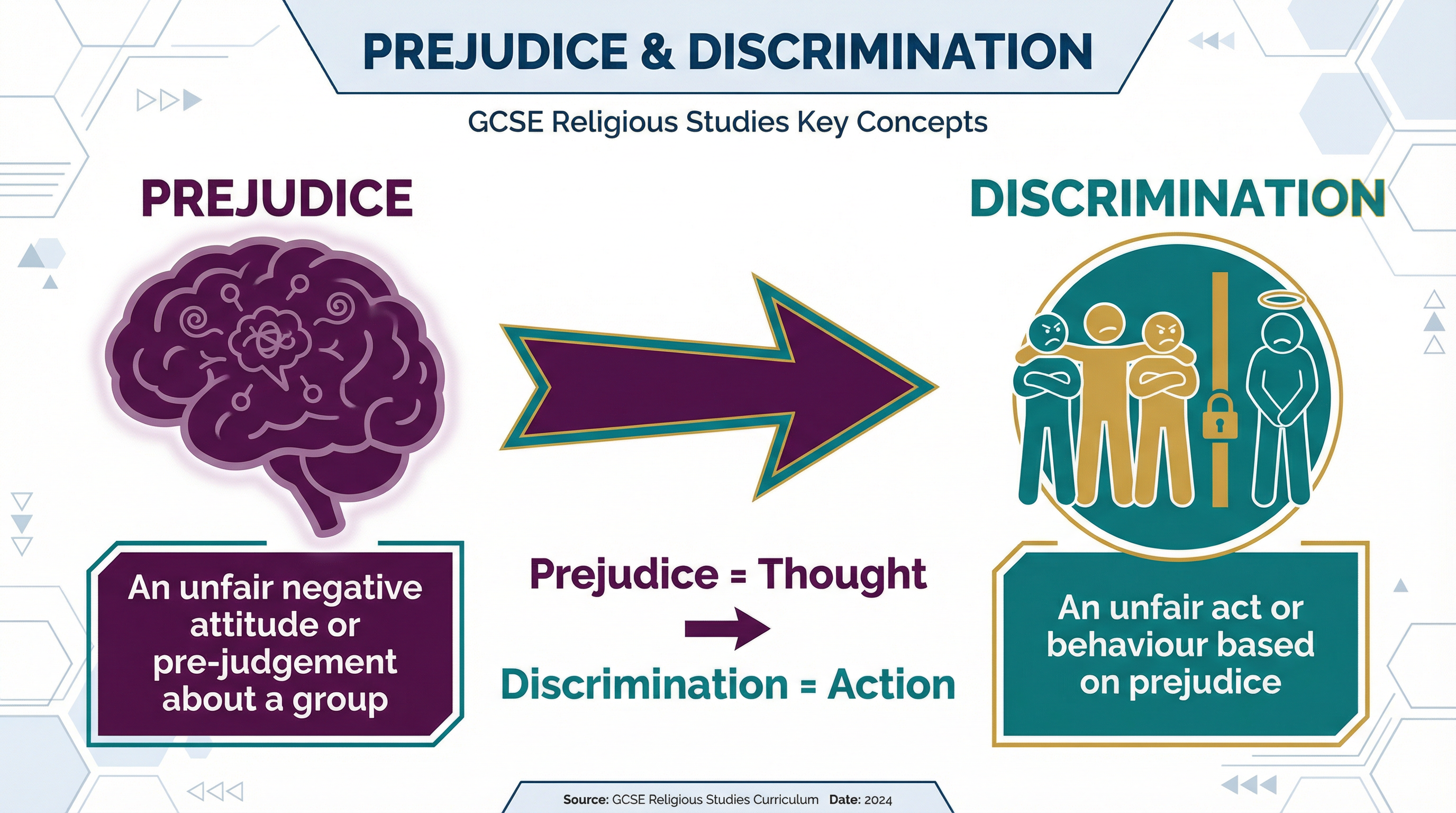
What it is: The single most important distinction in this topic. Prejudice is a pre-judgement or a negative, unfair belief about a group of people. It is an internal attitude. Discrimination is the action that results from prejudice; it is the unfair treatment of a person or group. A simple way to remember this is: Prejudice = Thought, Discrimination = Action.
Why it matters: Examiners will explicitly award marks for a clear definition and consistent application of these two distinct terms. Conflating them is a common mistake that limits candidates to lower levels.
The Equality Act 2010
Date(s): Enacted in 2010 in the UK.
What happened: This Act of Parliament consolidated and simplified previous anti-discrimination laws. It legally protects individuals from discrimination in the workplace and in wider society.
Why it matters: It provides a legal framework that reflects the ethical principles many religions advocate for. For the exam, you must know that it identifies nine protected characteristics: age, disability, gender reassignment, marriage and civil partnership, pregnancy and maternity, race, religion or belief, sex, and sexual orientation. Citing this Act shows you can connect religious ethics to contemporary secular law.
Specific Knowledge: Be able to name at least 4-5 of the nine protected characteristics.
Sources of Wisdom & Authority (SOWA)
What it is: These are the texts, traditions, and teachings that form the basis of religious belief and ethical guidance. For Christianity, this is primarily the Bible, but also includes Church teachings and the example of key figures.
Why it matters: Your entire argument in a Religious Studies essay must be grounded in SOWA. You cannot simply give your own opinion or a sociological analysis. You must use SOWA to justify your points.
Specific Knowledge: Key SOWA for this topic are Galatians 3:28, Genesis 1:27 (Imago Dei), and the Parable of the Good Samaritan (Luke 10:25-37).
Key Individuals
Martin Luther King Jr.
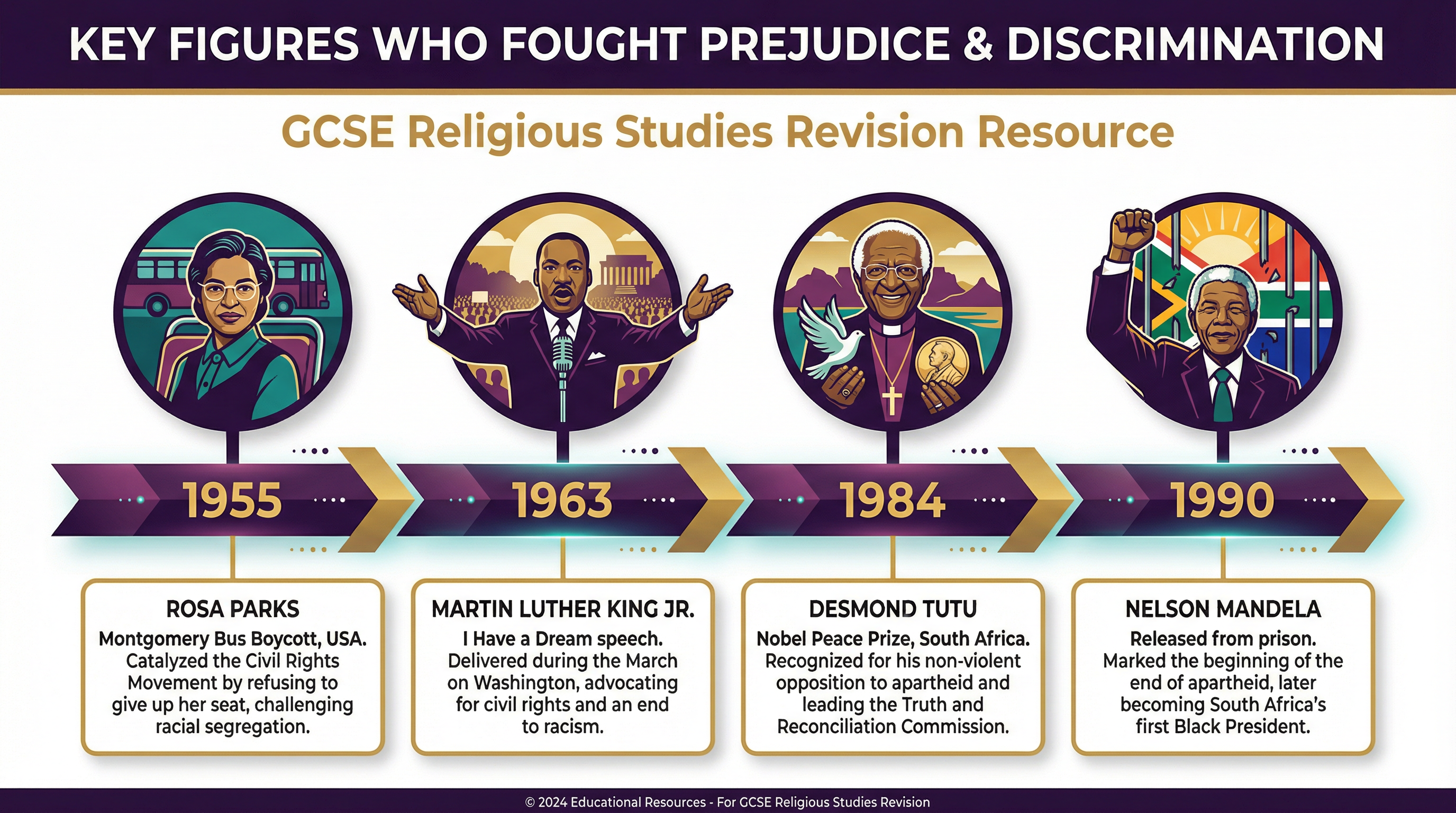
Role: Baptist Minister and leader of the American Civil Rights Movement.
Key Actions: Led non-violent protests against racial segregation in the USA, including the Montgomery Bus Boycott and the 1963 March on Washington where he delivered his famous "I Have a Dream" speech.
Impact: King's work was instrumental in the passage of the Civil Rights Act of 1964. He provides a prime example of a religious leader using Christian principles (like 'agape' love and turning the other cheek) to challenge and overcome systemic discrimination. He won the Nobel Peace Prize in 1964.
Desmond Tutu
Role: Anglican Archbishop in South Africa.
Key Actions: A leading voice against the apartheid system of racial segregation. After apartheid fell, he chaired the Truth and Reconciliation Commission, which focused on restorative justice rather than punishment.
Impact: Tutu demonstrated how theological concepts, such as the African idea of Ubuntu ("I am because we are"), could be used to fight for justice and heal a divided nation. He won the Nobel Peace Prize in 1984.
Second-Order Concepts
Causation
Prejudice is often caused by ignorance, fear of the unknown, negative past experiences, or scapegoating (blaming a group for society's problems). Discrimination is caused by prejudice being put into action, often enabled by a society's laws, structures, and social norms.
Consequence
The consequences of discrimination are severe. For the individual, it can lead to psychological harm, lack of opportunity, poverty, and physical violence. For society, it leads to division, conflict, and the loss of potential from marginalised groups.
Change & Continuity
Change: Laws like the Equality Act 2010 and the work of activists like MLK have brought about significant legal and social change, making overt discrimination less acceptable. The Church of England now ordains women as priests and bishops.
Continuity: Despite progress, prejudice and discrimination still exist. Debates within Christianity, such as the role of women in the Catholic Church or differing views on homosexuality, show that deep-rooted tensions remain.
Significance
This topic is significant because it explores the fundamental ethical question of how we should treat others. It examines the power of religion to be both a source of division and a powerful force for justice, equality, and social change.
Source Skills
For this topic, you won't be given historical sources in the same way as a History exam. Instead, your 'sources' are the Sources of Wisdom and Authority (SOWA). When you use a SOWA, you must:
- Identify it: Name the specific Bible verse (e.g., Galatians 3:28) or teaching.
- Explain it: State what it says and what it means in context.
- Apply it: Show how it supports your argument about prejudice and discrimination.