Study Notes
Overview
This unit explores the core religious practices of Sikhism, focusing on how beliefs are translated into action (Praxis). For the OCR J625 specification, candidates must demonstrate a thorough understanding of public worship (Diwan) in the Gurdwara, the significance of the community kitchen (Langar) as an expression of selfless service (Seva) and equality, and the transformative nature of key rites of passage, particularly the Amrit Sanskar initiation ceremony. Examiners expect candidates to analyse the symbolism embedded in these practices, such as the architectural features of the Gurdwara, and to use precise Gurmukhi terminology. A crucial area for evaluation is understanding the diversity of practice and belief between initiated (Amritdhari) and non-initiated (Sahajdhari) Sikhs, with reference to the authority of the Sikh code of conduct, the Rehat Maryada. High-level responses will move beyond simple descriptions to evaluate the meaning and relevance of these practices in the 21st century.
Key Practices & Institutions
The Gurdwara: The Gateway to the Guru
What it is: The Gurdwara is the Sikh place of worship and community hub. The name literally means 'the door of the Guru'. It is the physical centre of Sikh life.
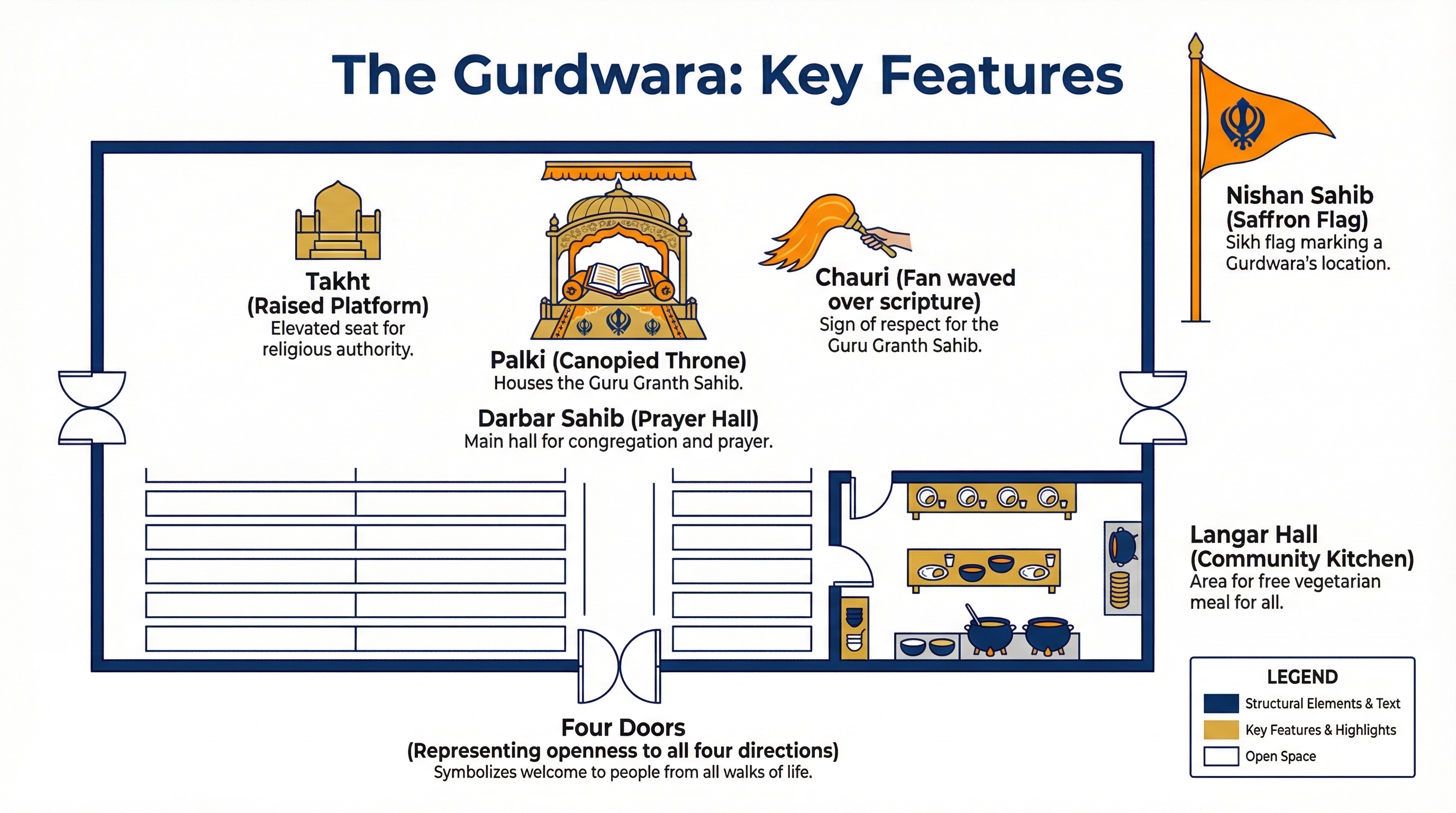
Why it matters: It is the location for congregational worship (Diwan) and the housing of the living Guru, the Guru Granth Sahib. Its design is deeply symbolic; for example, the four doors on many Gurdwaras signify that people from all four corners of the world are welcome, reflecting the Sikh belief in the equality of all humankind. Marks are awarded for linking physical features to theological concepts.
Specific Knowledge: Candidates must know the key features: Darbar Sahib (main prayer hall), Takht (throne for the Guru Granth Sahib), Palki (canopy over the Takht), Nishan Sahib (the Sikh flag outside), and the Langar hall. Using these Gurmukhi terms is essential.
Langar: The Community Kitchen
What it is: The Langar is a free, vegetarian meal served to all visitors of a Gurdwara, regardless of their faith, gender, or background. It is a cornerstone of Sikh practice.
Why it matters: Langar is the practical application of the core Sikh belief in equality. By having everyone sit together on the floor (Pangat) to eat the same food, it breaks down social distinctions of caste and wealth. It is a powerful act of Seva (selfless service). Examiners look for responses that go beyond describing it as 'free food' and analyse its role in promoting equality and community cohesion.
Specific Knowledge: Link Langar directly to the teachings of Guru Nanak, who established it to challenge the Hindu caste system. Connect it to the concept of Seva.
Seva: Selfless Service
What it is: Seva is the act of selfless service, performed without any expectation of reward. It is a form of active meditation and a core duty for all Sikhs.
Why it matters: Seva is how Sikhs put their faith into action, showing devotion to God by serving humanity. It builds humility and compassion. Examiners award credit for distinguishing between the three forms of Seva.
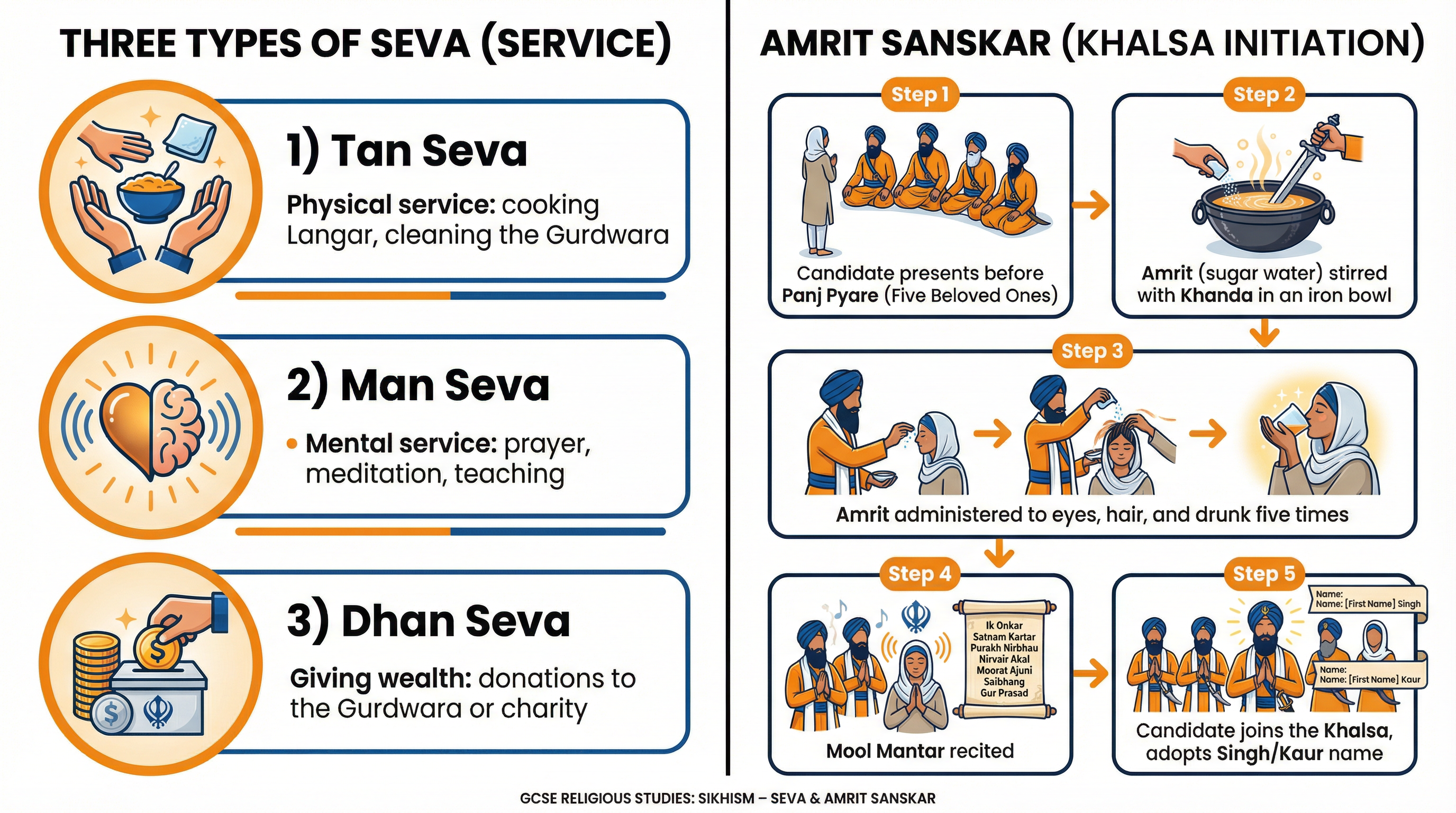
Specific Knowledge: The three types are: Tan (physical service, e.g., working in the Langar, cleaning the Gurdwara), Man (mental service, e.g., teaching others, studying scripture, meditating on God's name), and Dhan (material service, e.g., donating money or goods to charity or the Gurdwara).
Amrit Sanskar: The Khalsa Initiation Ceremony
What it is: The Amrit Sanskar is the ceremony in which a Sikh is initiated into the Khalsa, the community of committed Sikhs. It is a voluntary step for those ready to dedicate their lives fully to the Guru.
Why it matters: This ceremony, established by Guru Gobind Singh in 1699, marks a profound spiritual rebirth. The initiate (Amritdhari) commits to a strict code of conduct (the Rehat Maryada) and to wearing the five articles of faith, the Panj Kakars.
Specific Knowledge: The ceremony is conducted by the Panj Pyare (Five Beloved Ones). Amrit (sugar water stirred with a Kirpan) is prepared and given to the initiate. They adopt the name Singh (for men, meaning lion) or Kaur (for women, meaning princess). It is crucial to distinguish between Amritdhari Sikhs and Sahajdhari Sikhs, who believe in the Gurus but have not been initiated.
The Panj Kakars (The 5 Ks)
What they are: The five articles of faith worn by initiated (Amritdhari) Sikhs. They are not just symbols but are part of a spiritual discipline.
Why they matter: Each K has a deep symbolic meaning that reminds the wearer of their commitment to the Sikh path. For the exam, you must be able to explain the function and symbolism of each.
Specific Knowledge:
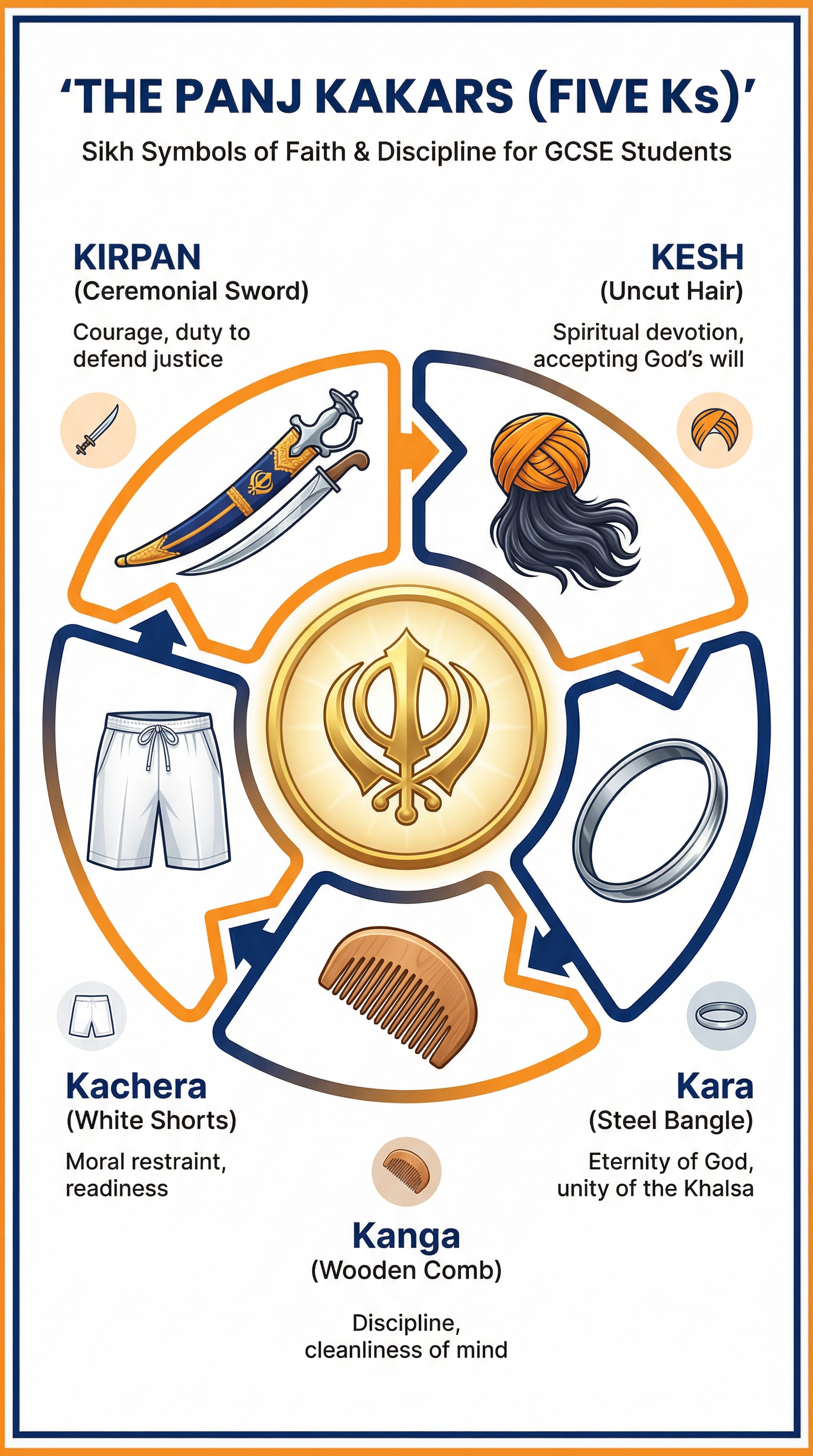
- Kesh: Uncut hair, symbolising acceptance of God's will.
- Kara: A steel bangle, symbolising the eternity of God and unity.
- Kanga: A wooden comb, symbolising cleanliness and spiritual discipline.
- Kachera: Special shorts, symbolising moral restraint and readiness.
- Kirpan: A ceremonial sword, symbolising the duty to defend justice and the oppressed.
Second-Order Concepts
Change & Continuity
Change: The establishment of the Khalsa by Guru Gobind Singh in 1699 was a major change, creating a formal community of initiated Sikhs with a distinct identity (the 5 Ks). This created a new distinction between Amritdhari and Sahajdhari Sikhs.
Continuity: The core principles of equality, service, and devotion to the one God (Waheguru), established by Guru Nanak, have remained central to all Sikh practices, from Langar to Diwan, throughout Sikh history.
Significance
The practices of Sikhism are significant because they are the living expression of its theology. Langar is not just a meal; it is a statement against inequality. The Gurdwara is not just a building; it is a physical manifestation of the Sikh commitment to inclusivity. For your exam, the significance lies in how these actions embody and preserve the core teachings of the Gurus."