Study Notes
Overview
WJEC GCSE Religious Studies requires a rigorous examination of Jewish beliefs, centering on the nature of God as One, Creator, Law-Giver, and Judge. Candidates must analyse the concept of Shekhinah (the divine presence), the specific roles of the Messiah in Orthodox versus Reform thought, and the foundational Covenants with Abraham and Moses. Mastery involves linking these theological concepts directly to Sources of Wisdom and Authority (Torah, Talmud, Tenakh) and articulating how these beliefs dictate moral behaviour (Mitzvot) and attitudes toward the sanctity of life (Pikuach Nefesh). Examiners expect precise use of Hebrew terminology and a clear understanding of the distinctions between different Jewish traditions. This guide will break down these complex ideas into manageable, exam-focused sections, complete with visual aids and audio summaries to support deep learning and recall.
Key Beliefs & Concepts
The Nature of God
What it is: The core of Judaism is absolute monotheism – the belief in one, indivisible God. This God is understood through several key attributes that candidates must be able to explain.
Why it matters: This is the foundational belief from which all others flow. Questions on the nature of God are common, and marks are awarded for explaining each attribute with supporting evidence from Jewish scripture.
Specific Knowledge:
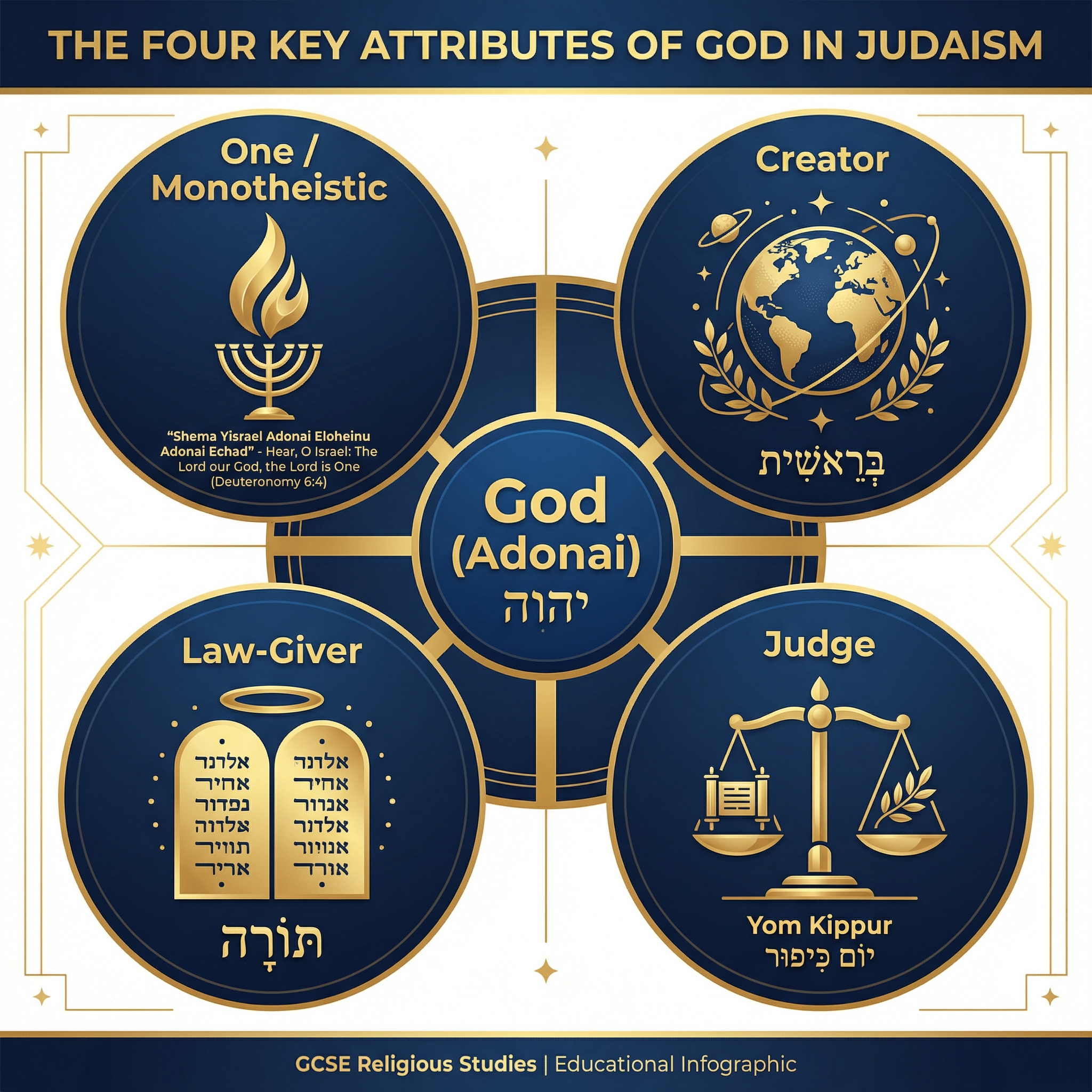
- One: God is a single, whole, indivisible being. Key source: The Shema (Deuteronomy 6:4) - "Hear, O Israel: The Lord our God, the Lord is One."
- Creator: God created the universe ex nihilo (out of nothing). Key source: Genesis 1.
- Law-Giver: God gave the Torah (the Law) to Moses on Mount Sinai, which contains the 613 Mitzvot. Key source: Exodus 20.
- Judge: God is a God of both justice and mercy, who holds people accountable for their actions. This is particularly relevant during the High Holy Days of Rosh Hashanah and Yom Kippur.
The Shekhinah
What it is: The Shekhinah is a key concept referring to the dwelling or settling of the divine presence of God. It is not God itself, but the manifestation of God's presence on Earth.
Why it matters: It allows for a personal connection to God and explains how God can be both transcendent (beyond the world) and immanent (active within it). Examiners credit the use of this specific Hebrew term.
Specific Knowledge: In the Tanakh, the Shekhinah was said to have dwelled in the Tabernacle and later the Temple in Jerusalem. After the Temple's destruction, many Jews believe the Shekhinah is present wherever the Torah is studied or when a community (a minyan) prays together.
The Covenants
What it is: A covenant (Brit in Hebrew) is a solemn, binding agreement between God and the Jewish people. Two are central to the GCSE specification.
Why it matters: The covenants establish the special relationship between God and the Jewish people, outlining mutual promises and obligations that form the basis of Jewish identity and practice.
Specific Knowledge:
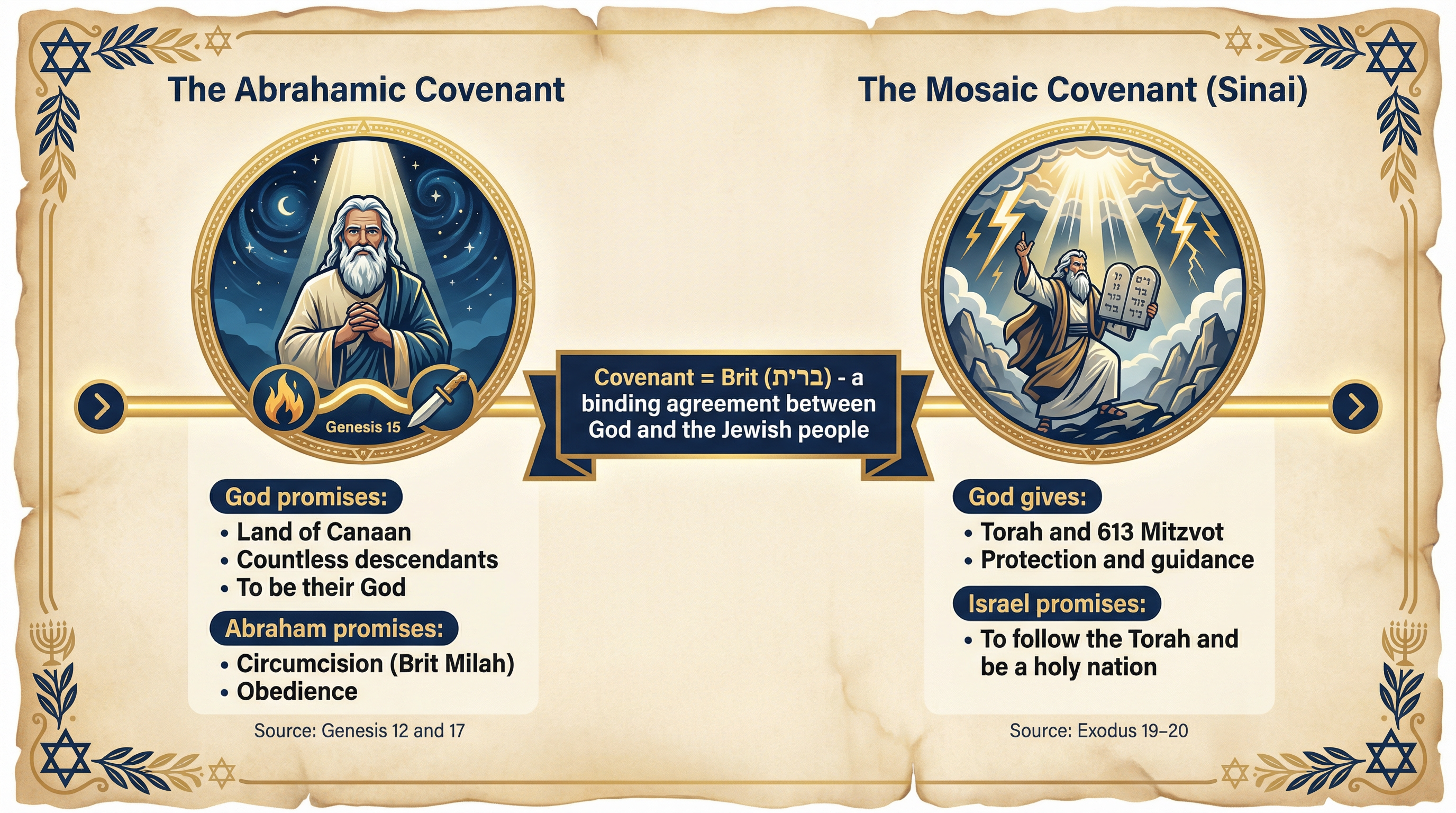
- The Abrahamic Covenant: (Genesis 12, 15, 17) God promised Abraham the Land of Canaan, countless descendants, and to be their God. In return, Abraham and his male descendants were commanded to be circumcised (Brit Milah).
- The Mosaic Covenant: (Exodus 19-20) Made at Mount Sinai, God gave Moses the Torah, including the 613 Mitzvot. In return, the people of Israel agreed to be God's holy nation and obey His laws.
The Messiah (Mashiach)
What it is: The belief in a future redeemer, the Messiah, who will bring about a new era for the Jewish people and the world. Beliefs about the Messiah are a key point of difference between Orthodox and Reform Judaism.
Why it matters: This is a core eschatological belief (belief about the end times) and a frequent topic for comparison questions. Candidates must avoid Christian interpretations.
Specific Knowledge:
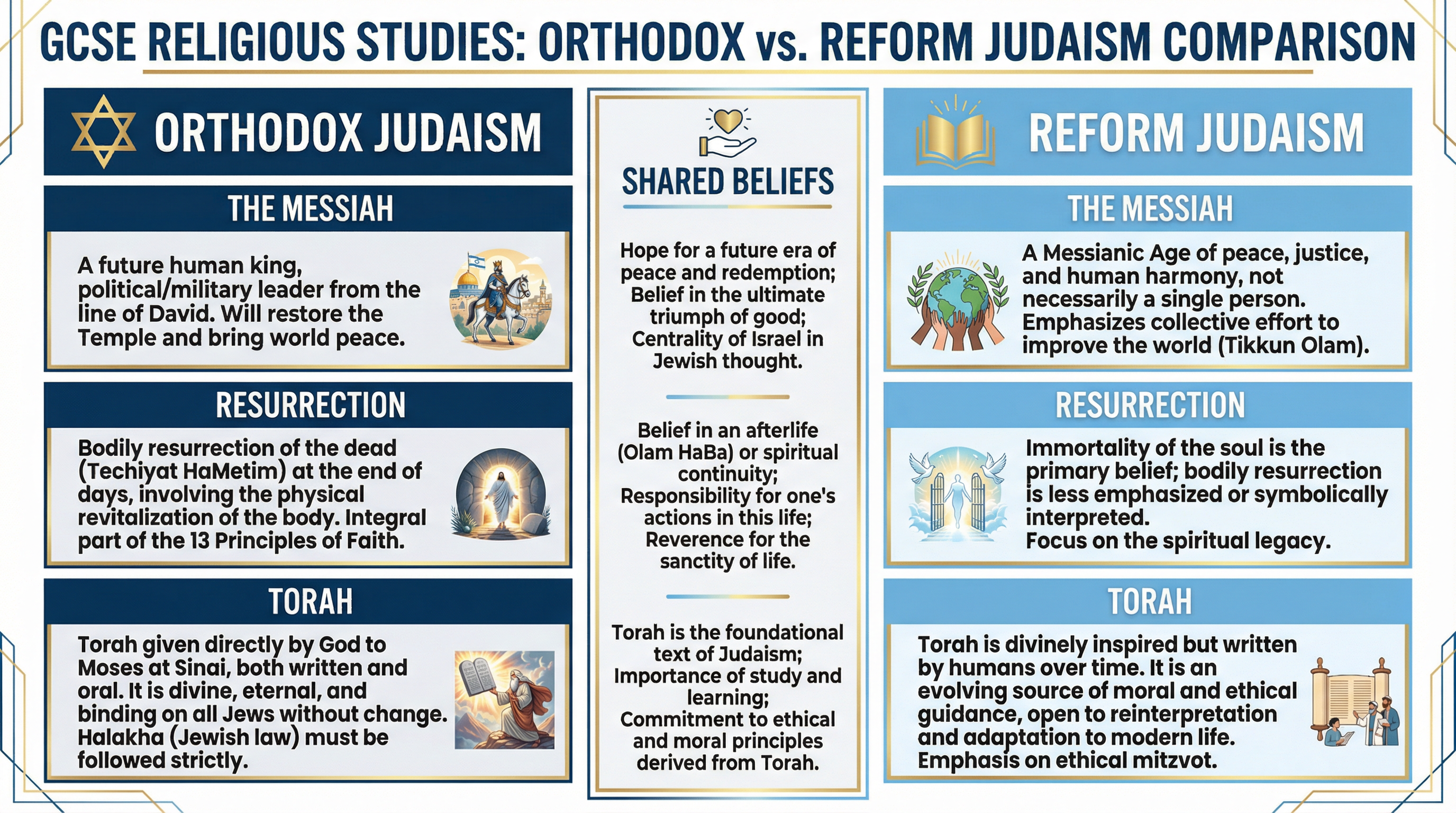
- Orthodox View: A future human king, a political and military leader descended from King David. He will rebuild the Temple, gather the Jewish people to Israel, and bring world peace. He is NOT divine.
- Reform View: Many Reform Jews believe in a 'Messianic Age' of peace and justice, which humanity has a collective responsibility to create through social action (Tikkun Olam - repairing the world), rather than a single individual.
Life, Death, and the Afterlife
What it is: Jewish beliefs about what happens after death. This is another area with significant diversity of belief.
Why it matters: It demonstrates the focus of Judaism on this life (Olam Ha-Zeh) while still acknowledging a future existence (Olam Ha-Ba). It is also a key area of difference between Orthodox and Reform traditions.
Specific Knowledge:
- Pikuach Nefesh: The principle of the sanctity of life. The preservation of human life overrides almost all other Jewish laws. For example, a doctor is permitted to drive on Shabbat to save a patient.
- Afterlife (Olam Ha-Ba): Judaism is less focused on the afterlife than other religions, but the concept exists. Orthodox Jews generally believe in the bodily resurrection of the dead (Techiyat HaMetim) at the end of days. Reform Jews tend to emphasise the immortality of the soul and see resurrection as symbolic.
Second-Order Concepts
Causation
- The belief in God as Creator is the cause of the Jewish understanding of the universe and humanity's place within it.
- The Mosaic Covenant was caused by God's desire to establish a formal legal and moral framework for the nation of Israel after their liberation from Egypt.
Consequence
- The Abrahamic Covenant has the long-term consequence of establishing circumcision as a central rite of passage and identity marker for Jewish males.
- The destruction of the Second Temple in 70 CE had the consequence of shifting the focus of the Shekhinah from a physical place to the community and the study of Torah.
Change & Continuity
- Continuity: The core belief in one God (monotheism) as expressed in the Shema has remained unchanged for millennia.
- Change: Beliefs about the Messiah have changed and diversified, with the Reform movement reinterpreting the concept as a Messianic Age rather than a single person.
Significance
- The concept of Pikuach Nefesh is highly significant as it demonstrates that Judaism is a practical religion where the preservation of life is the highest moral value, influencing ethical decisions in medicine and daily life.
- The Covenants are significant because they define the unique, reciprocal relationship between God and the Jewish people, forming the narrative backbone of the Torah and Jewish history.
Source Skills
When approaching sources on Jewish beliefs, consider the following:
- Provenance: Is the source from the Torah (the most sacred text), the Talmud (rabbinic commentary), or a modern Jewish scholar? An Orthodox source will present the Torah as the literal word of God, while a Reform source may see it as divinely inspired but open to interpretation. This directly impacts its purpose and reliability as a representation of 'all' Jewish belief.
- Content: Identify specific beliefs being discussed. Does the source quote the Shema? Does it refer to the Mitzvot? Is it discussing the role of the Messiah? Highlight the specific theological language used.
- Evaluation: How useful is the source for understanding Jewish belief today? A passage from Exodus is foundational but needs to be understood in the context of how it is lived and interpreted by modern Jews, both Orthodox and Reform. A statement from a Reform rabbi is useful for understanding that perspective but cannot be generalised to all Jews.