Study Notes
Overview
Prayer is one of the most fundamental practices in Christianity and a core topic on the WJEC GCSE Religious Studies specification. This study guide covers the full scope of what examiners expect: the function of prayer using the ACTS framework (Adoration, Confession, Thanksgiving, Supplication), the significance of the Lord's Prayer in Matthew 6:9-13 as a model for Christian worship, the distinction between liturgical, non-liturgical, and informal prayer, and the theological importance of both private and communal prayer. Candidates who achieve the highest marks are those who consistently link practice to belief — demonstrating that every type of prayer reflects something specific about the Christian understanding of God. AO1 and AO2 are weighted equally at 50% each, so knowledge must always be paired with analysis.
The ACTS Framework
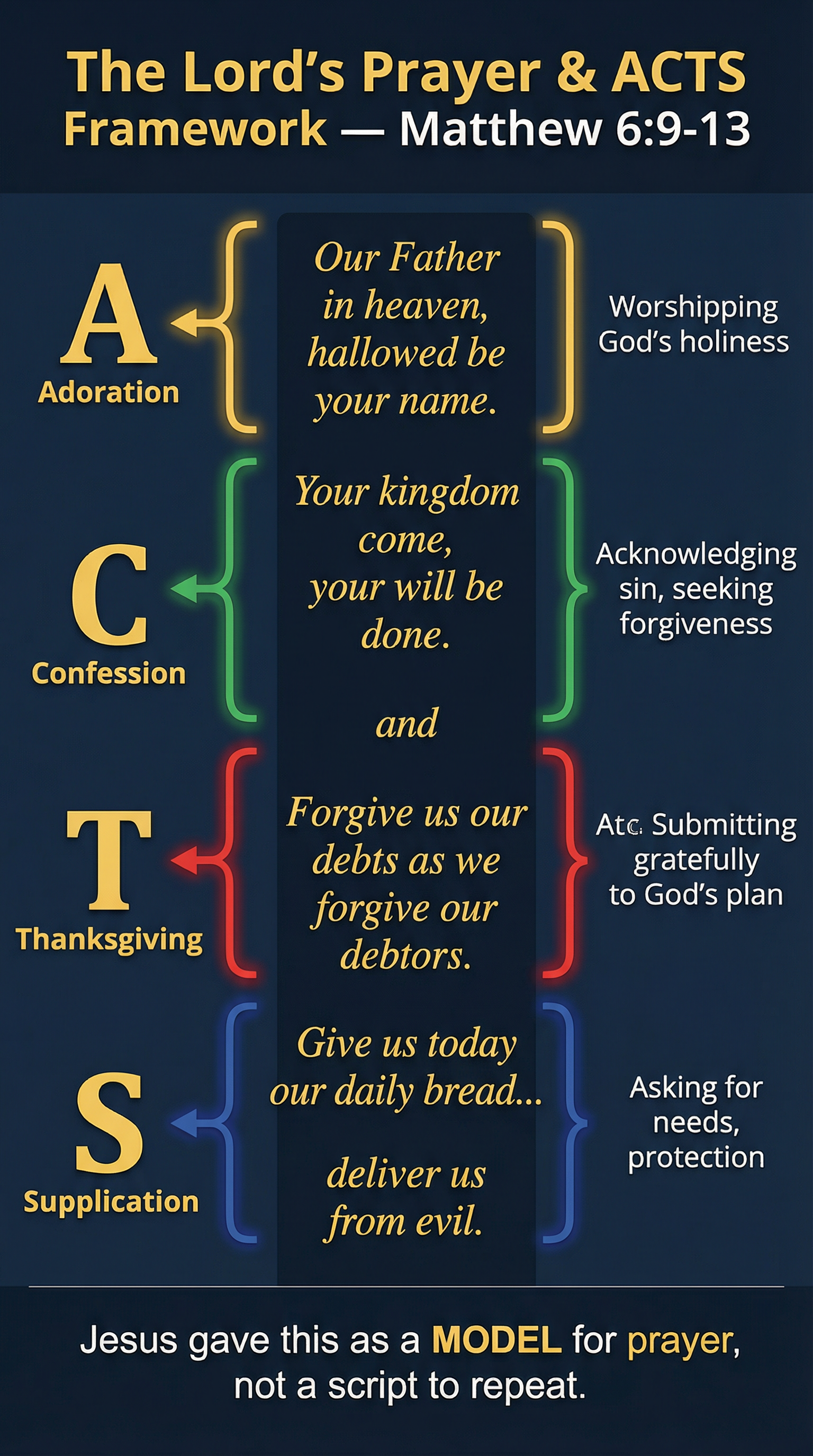
The ACTS acronym provides the most reliable structure for answering descriptive questions about prayer. Each letter represents a distinct function of prayer, and each function carries specific theological significance that examiners reward.
Adoration
What it is: Worshipping and praising God for who He is — His holiness, power, and love — not for what He has done.
Theological link: Adoration reflects the Christian belief in a transcendent, holy God who is worthy of worship. The opening of the Lord's Prayer — 'Our Father in heaven, hallowed be your name' (Matthew 6:9) — is a direct act of adoration, acknowledging God's sacred nature before any request is made.
Why it matters for the exam: Candidates who explain that adoration prioritises God's nature over human need demonstrate a sophisticated theological understanding that earns marks in the higher bands.
Confession
What it is: Acknowledging sin and asking God for forgiveness.
Theological link: Confession reflects the dual belief that God is both a perfectly just Judge and a perfectly merciful Forgiver. The Lord's Prayer states: 'Forgive us our debts, as we also have forgiven our debtors' (Matthew 6:12). This is theologically rich: it links the forgiveness Christians receive from God to the forgiveness they must extend to others, reflecting Jesus's teaching on grace and reconciliation.
Why it matters for the exam: Examiners award credit for candidates who note that confession is not merely about listing sins, but about restoring the relationship between the believer and God.
Thanksgiving
What it is: Expressing gratitude to God for His blessings, creation, and provision.
Theological link: Thanksgiving reflects the belief in God as Creator and Provider — a God who sustains life and gives good gifts. It also reflects humility: acknowledging that good things come from God, not from human effort alone.
Why it matters for the exam: Candidates should note that thanksgiving is distinct from adoration — adoration praises God for who He is; thanksgiving praises God for what He has done.
Supplication
What it is: Asking God for things — for oneself (petition) or for others (intercession).
Theological link: This is the most theologically loaded category. Supplication only makes sense if the person praying believes in an omnipotent, interventionist God — one who is all-powerful and who actively responds to human requests. The Lord's Prayer includes 'Give us today our daily bread' and 'deliver us from the evil one' (Matthew 6:11, 13). Intercessory prayer — praying for others — is particularly significant as it demonstrates love for neighbour and trust in God's power to act.
Why it matters for the exam: Examiners specifically look for candidates who link supplication to the belief in an interventionist God. This is a key synoptic link across the specification.
The Lord's Prayer: Matthew 6:9-13
The Lord's Prayer is the single most important text for this topic. Jesus taught it to His disciples in the Sermon on the Mount when they asked Him how to pray. Its significance lies not in the words themselves being magical or mandatory, but in the model it provides.
'This, then, is how you should pray: Our Father in heaven, hallowed be your name, your kingdom come, your will be done, on earth as it is in heaven. Give us today our daily bread. And forgive us our debts, as we also have forgiven our debtors. And lead us not into temptation, but deliver us from the evil one.' — Matthew 6:9-13
Key points examiners expect candidates to know:
- Jesus introduced it with 'This is how you should pray' — indicating a pattern or template, not a script.
- It contains all four ACTS elements, demonstrating that complete prayer addresses God's glory, human sin, daily needs, and protection.
- It begins with relationship ('Our Father') — establishing that prayer is a personal, relational act, not a formal transaction.
- The communal pronoun 'our' (not 'my') signals that even private prayer is connected to the wider Christian community.
Types of Prayer
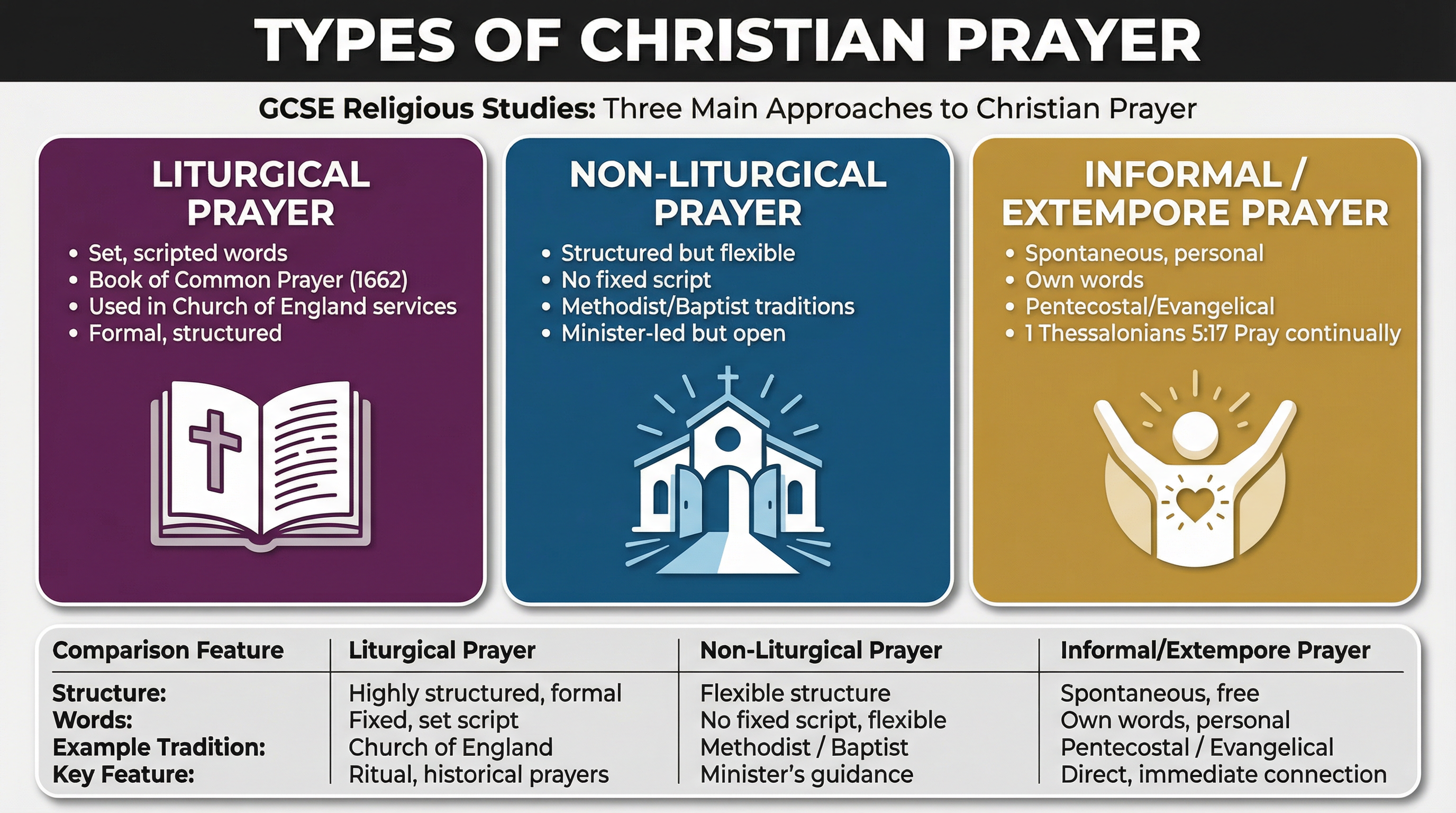
WJEC requires precise differentiation between three types of prayer. Candidates who conflate these categories lose marks.
Liturgical Prayer
Liturgical prayer uses set, scripted words that are fixed and repeated. The prime example is the Book of Common Prayer, first published in 1549 under Archbishop Thomas Cranmer and revised in 1662. It is used in Church of England (Anglican) services.
| Feature | Detail |
|---|---|
| Structure | Highly formal; every word is prescribed |
| Tradition | Church of England; Roman Catholic Mass |
| Key text | Book of Common Prayer (1662) |
| Strength | Unity, theological precision, historical continuity |
| Weakness | Can become mechanical; may lack personal authenticity |
Non-Liturgical Prayer
Non-liturgical prayer is structured but flexible — there is a framework or order of service, but no fixed script. The minister or leader prays in their own words. This is common in Methodist and Baptist traditions.
| Feature | Detail |
|---|---|
| Structure | Ordered but not scripted |
| Tradition | Methodist, Baptist, many Protestant denominations |
| Strength | More personal than liturgical; still ordered |
| Weakness | Less historical continuity; dependent on leader's ability |
Informal / Extempore Prayer
Informal or extempore prayer is completely spontaneous — the believer prays in their own words, in the moment, from the heart. This is characteristic of Pentecostal and Evangelical traditions.
The key scripture is 1 Thessalonians 5:17 — 'Pray continually' (Paul). This suggests prayer should be a constant, natural part of life rather than a formal act confined to services. Informal prayer embodies this: it can happen anywhere, at any time, in any words.
Private vs. Communal Prayer
WJEC also requires understanding of the distinction between private and public prayer.
Private prayer is personal, individual, and often silent. Jesus modelled this by regularly withdrawing to pray alone (Luke 5:16). In Matthew 6:6, Jesus instructs: 'When you pray, go into your room, close the door and pray to your Father, who is unseen.' This emphasises the intimacy and authenticity of private prayer — it is between the believer and God alone, free from the performance that public prayer might invite.
Communal prayer is prayer shared by a group of believers. Matthew 18:20 provides the key endorsement: 'For where two or three gather in my name, there am I with them.' This suggests that corporate prayer has a special quality — Christ is particularly present when believers pray together. This underpins the importance of church services, prayer meetings, and shared worship.
Named Examples Bank
- Thomas Cranmer (1489-1556): Archbishop of Canterbury who compiled the first Book of Common Prayer in 1549, establishing the template for Anglican liturgical worship.
- The Lord's Prayer (Matthew 6:9-13): The model prayer taught by Jesus; contains all four ACTS elements and establishes prayer as relational, not transactional.
- 1 Thessalonians 5:17: Paul's instruction to 'pray continually' — the scriptural foundation for informal, ongoing private prayer.
- Matthew 18:20: Jesus's promise that He is present 'where two or three gather in my name' — the theological basis for communal prayer.
- The Book of Common Prayer (1662): The definitive text of Anglican liturgical prayer, still used in Church of England services today.
- Pentecostal worship (20th century onwards): The tradition most associated with extempore, Spirit-led prayer, emphasising spontaneous, personal communication with God.
- Matthew 6:6: Jesus's instruction to pray privately — the scriptural basis for the value of individual, intimate prayer.