Study Notes
Overview
This study guide covers the essential WJEC GCSE Religious Studies topic of Prejudice and Discrimination, a core component of Unit 1 (Issues of Human Rights). Examiners expect candidates to critically analyse both religious and non-religious perspectives on this issue. A key skill is the ability to distinguish clearly between prejudice (the thought or attitude) and discrimination (the resulting action). You will need to apply core theological concepts such as Imago Dei (in Christianity) and the Ummah (in Islam) to contemporary issues like racism, gender inequality, and religious freedom. Furthermore, a high-level analysis will explore the tension that can exist between sacred texts, which guide believers, and UK legislation, specifically the Equality Act 2010. This guide will equip you with the specific knowledge, key terms, and exam techniques required to achieve top marks.
Key Concepts & Developments
Prejudice vs. Discrimination
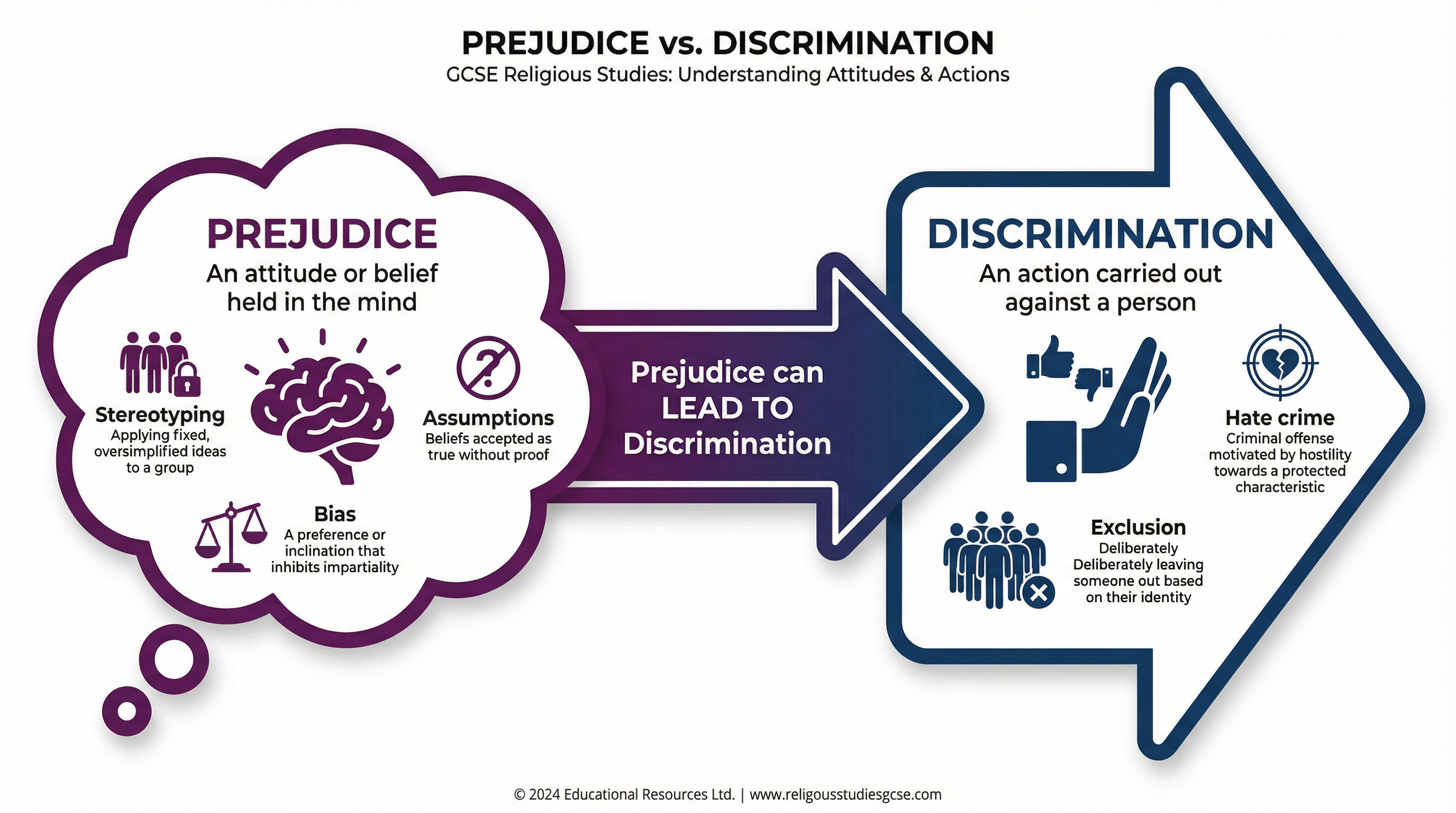
What it is: The foundational distinction for this topic. Prejudice is a preconceived opinion or attitude, often negative, that is not based on reason or actual experience. It exists in the mind. Discrimination is the unjust or prejudicial treatment of different categories of people, especially on the grounds of race, age, or sex. It is an action.
Why it matters: Examiners award specific marks for a clear definition and distinction. Conflating the two is a common mistake that limits marks. For example, stating 'Prejudice is treating someone unfairly' is incorrect; that is discrimination.
Specific Knowledge: You must be able to define both terms and provide examples (e.g., prejudice is stereotyping a group; discrimination is refusing to hire someone from that group).
The Equality Act 2010
Date(s): Enacted in 2010
What happened: This key piece of UK legislation legally protects people from discrimination in the workplace and in wider society. It brought together various anti-discrimination laws into a single Act.
Why it matters: It provides the legal framework for equality in the UK. For your exam, it represents the secular, legal viewpoint that often must be evaluated against religious perspectives. You must be able to name the Act and identify some of its nine protected characteristics (e.g., age, disability, gender reassignment, marriage and civil partnership, pregnancy and maternity, race, religion or belief, sex, sexual orientation).
Specific Knowledge: Equality Act 2010, protected characteristics.
Key Individuals
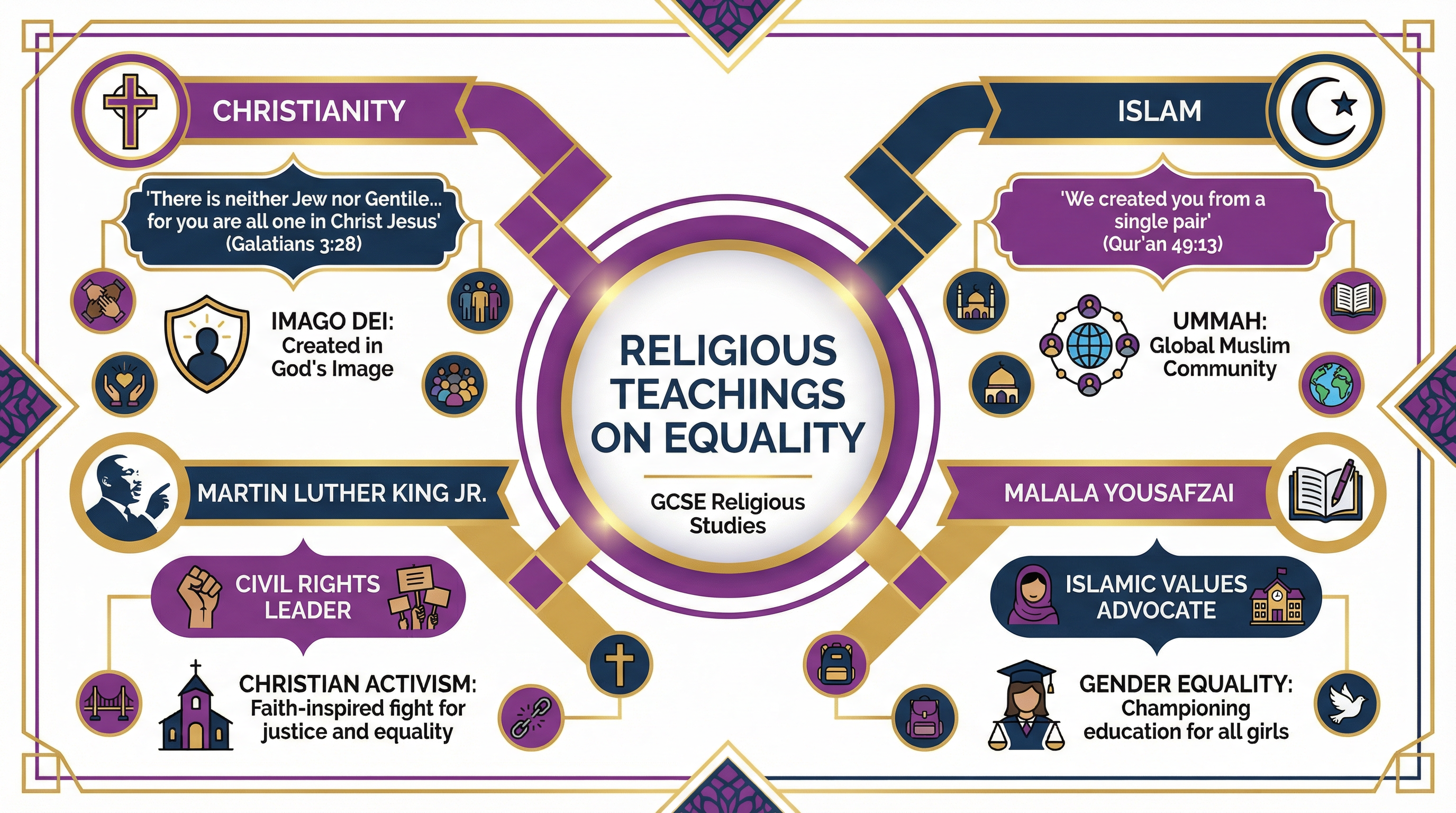
Martin Luther King Jr.
Role: Baptist Minister and American Civil Rights Leader
Key Actions: Led the Montgomery Bus Boycott (1955-56). Delivered the "I Have a Dream" speech at the March on Washington (1963). Advocated for non-violent protest (civil disobedience) to challenge racial segregation laws in the USA.
Impact: His activism was instrumental in the passage of the Civil Rights Act of 1964. For your exam, you must link his actions directly to his Christian faith. He saw racism as a sin because it violated the principle of Imago Dei – that all humans are made in the image of God and therefore possess equal worth.
Malala Yousafzai
Role: Muslim activist for female education and Nobel Peace Prize laureate.
Key Actions: Spoke out against the Taliban's ban on education for girls in her native Swat Valley, Pakistan. Survived an assassination attempt by a Taliban gunman in 2012. Co-founded the Malala Fund to advocate for girls' education worldwide.
Impact: Malala provides a powerful contemporary example of a religious believer fighting discrimination. She argues from an Islamic perspective that denying girls education is a misinterpretation of the faith and a form of gender discrimination. She champions the Islamic value of seeking knowledge for all.
Second-Order Concepts
Causation
Prejudice is often caused by a combination of factors including ignorance, fear of the unknown, upbringing (socialisation), and negative media portrayals. Discrimination is caused by prejudice being put into action, often enabled by a lack of legal protection or a societal structure that permits it.
Consequence
The consequences of discrimination are severe. For the individual, it can lead to psychological harm, lack of opportunity, poverty, and physical violence. For society, it leads to division, conflict, and the loss of potential from marginalised groups.
Change & Continuity
Change: Over the last century, significant changes have occurred, such as the introduction of laws like the Equality Act 2010 and the dismantling of segregation in the US. Public attitudes towards many forms of prejudice have shifted. Continuity: Despite legal protections, prejudice and discrimination persist in more subtle forms (e.g., unconscious bias) and in overt acts of hate crime. The struggle for genuine equality continues.
Significance
This topic is significant because it addresses fundamental questions of justice, fairness, and human dignity. For religious traditions, it tests the application of core beliefs to real-world ethical problems. For society, it is a constant struggle to live up to the ideal of equality for all citizens.
Source Skills
When given a source (e.g., a quote from a religious text or a statement from a religious leader), you must analyse it effectively. A good approach is:
- Identify the Core Message: What is the source saying about prejudice, discrimination, or equality?
- Analyse the Provenance: Who said it? When? What is their authority (e.g., sacred text, modern thinker)? This affects its weight.
- Apply to the Question: How does this source support or challenge a particular viewpoint? Use it as evidence in your argument.