Study Notes
Overview
Islamic Practices is one of the most content-rich and exam-demanding topics in the WJEC GCSE Religious Studies course. Candidates are required to demonstrate accurate, detailed knowledge of the Five Pillars of Sunni Islam and the Ten Obligatory Acts of Shi'a Islam, and to analyse how these practices shape the lives of individual Muslims and the wider Ummah — the global Muslim community. WJEC examiners place particular emphasis on the ability to distinguish between Sunni and Shi'a practice, to deploy specific Sources of Wisdom and Authority (Qur'anic references and Hadith), and to evaluate the contemporary relevance of ancient practices such as Hajj. The split between AO1 (knowledge and understanding, 50%) and AO2 (analysis and evaluation, 50%) means that candidates must be equally confident in explaining practices and in constructing sustained, justified arguments about their significance.
The Five Pillars of Sunni Islam
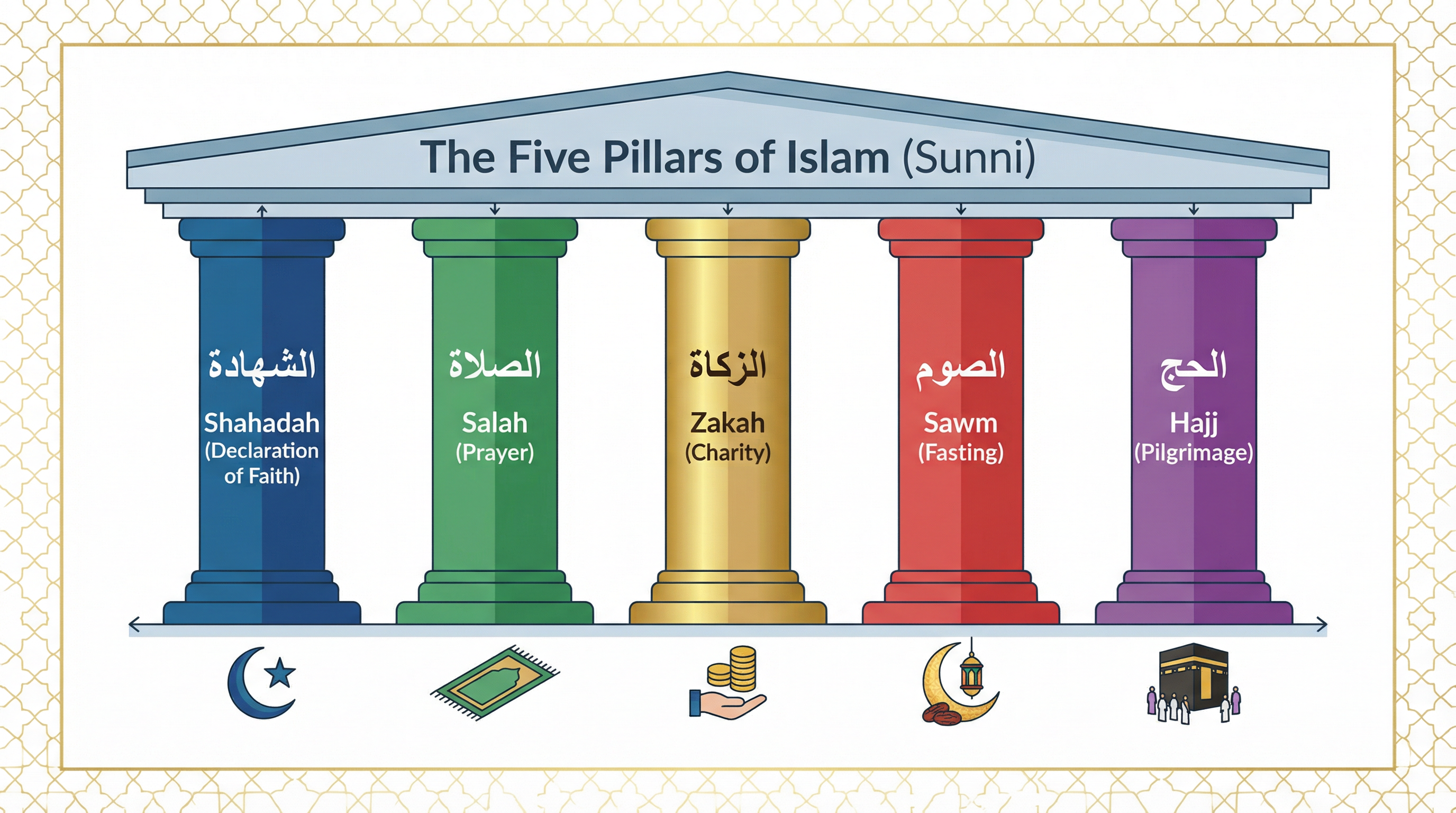
1. Shahadah — Declaration of Faith
What it is: The Shahadah is the foundational statement of Islamic belief: 'Ash-hadu an la ilaha ill-Allah, wa ash-hadu anna Muhammadan rasul-Allah' — 'I bear witness that there is no god but Allah, and I bear witness that Muhammad is His messenger.' It is the first of the Five Pillars and the entry point into Islam.
Why it matters: The Shahadah is not merely a verbal formula; it is a lived commitment to Tawhid — the absolute oneness of God — and to the prophethood of Muhammad. It is whispered into the ear of a newborn and recited at the moment of death, framing an entire Muslim life. Examiners credit candidates who explain that the Shahadah shapes all other practices: prayer, fasting, and pilgrimage are all expressions of the submission declared in the Shahadah.
Specific Knowledge: The Hadith of Gabriel (Jibril) — recorded in Sahih Muslim — presents the Five Pillars in dialogue form and is a key Source of Wisdom examiners expect candidates to reference.
2. Salah — Ritual Prayer
What it is: Salah is the obligatory ritual prayer performed five times daily: Fajr (dawn), Dhuhr (midday), Asr (afternoon), Maghrib (sunset), and Isha (night). Each prayer consists of a set number of Rak'ahs (units of prayer) and involves specific physical postures, including Qiyam (standing), Ruku (bowing), and Sujud (prostration).
Why it matters: The physical act of Sujud — placing the forehead on the ground — is the most powerful symbol of submission to Allah. Examiners award marks for candidates who link the physical action to its spiritual meaning: the body enacts what the heart believes. The Qur'an states in Surah 29:45: 'Prayer prohibits immorality and wrongdoing' — a versatile quote applicable to multiple exam questions. Before prayer, Muslims perform Wudu (ritual washing), which examiners expect candidates to distinguish from mere physical hygiene: it is spiritual purification. Friday Jumu'ah prayer at the mosque reinforces communal identity and the unity of the Ummah.
Specific Knowledge: Five prayer times; Wudu required beforehand; Imam leads congregation; Adhan (call to prayer) announces each prayer time; Qur'an 29:45 is the key source.
3. Zakah — Compulsory Almsgiving
What it is: Zakah requires Muslims to give 2.5% of their annual savings that exceed the Nisab (minimum threshold) to those in need. It is distributed across eight categories of recipients specified in the Qur'an (Surah 9:60), including the poor (Fuqara), those in debt, and travellers.
Why it matters: The Arabic root of Zakah means 'purification' — wealth is spiritually purified by sharing it. Examiners credit candidates who explain that Zakah is not voluntary charity but a religious obligation (Fard), reflecting the Islamic principle that wealth ultimately belongs to Allah. Zakah directly strengthens the Ummah by reducing inequality and expressing solidarity between Muslims globally.
Specific Knowledge: 2.5% of savings above Nisab; eight categories of recipients (Qur'an 9:60); Qur'an 2:177 commands it; distinct from Sadaqah (voluntary charity).
4. Sawm — Fasting During Ramadan
What it is: Sawm is the obligation to fast from dawn (Fajr) to sunset (Maghrib) throughout Ramadan, the ninth month of the Islamic lunar calendar. During daylight hours, Muslims abstain from food, drink, smoking, and sexual relations. The fast is broken each evening with Iftar, traditionally beginning with dates and water.
Why it matters: The Qur'an commands Sawm in Surah 2:183: 'O you who believe, fasting is prescribed for you as it was prescribed for those before you, that you may become righteous (Taqwa).' The purpose is Taqwa — God-consciousness — a heightened spiritual awareness. Examiners reward candidates who explain that Sawm is not simply about hunger but about self-discipline, empathy with the poor, and renewed focus on Allah. Ramadan ends with Eid ul-Fitr, the Festival of Breaking the Fast. Candidates must not confuse this with Eid ul-Adha, which marks the end of Hajj.
Specific Knowledge: Qur'an 2:183 (key source); Taqwa as the spiritual goal; Laylat al-Qadr (Night of Power) in the last ten nights of Ramadan; exemptions for the ill, elderly, pregnant women, and travellers.
5. Hajj — Pilgrimage to Mecca
What it is: Hajj is the annual pilgrimage to Mecca, obligatory once in a lifetime for every Muslim who is physically and financially able (Qur'an 3:97). It takes place during the twelfth Islamic month, Dhul Hijjah.
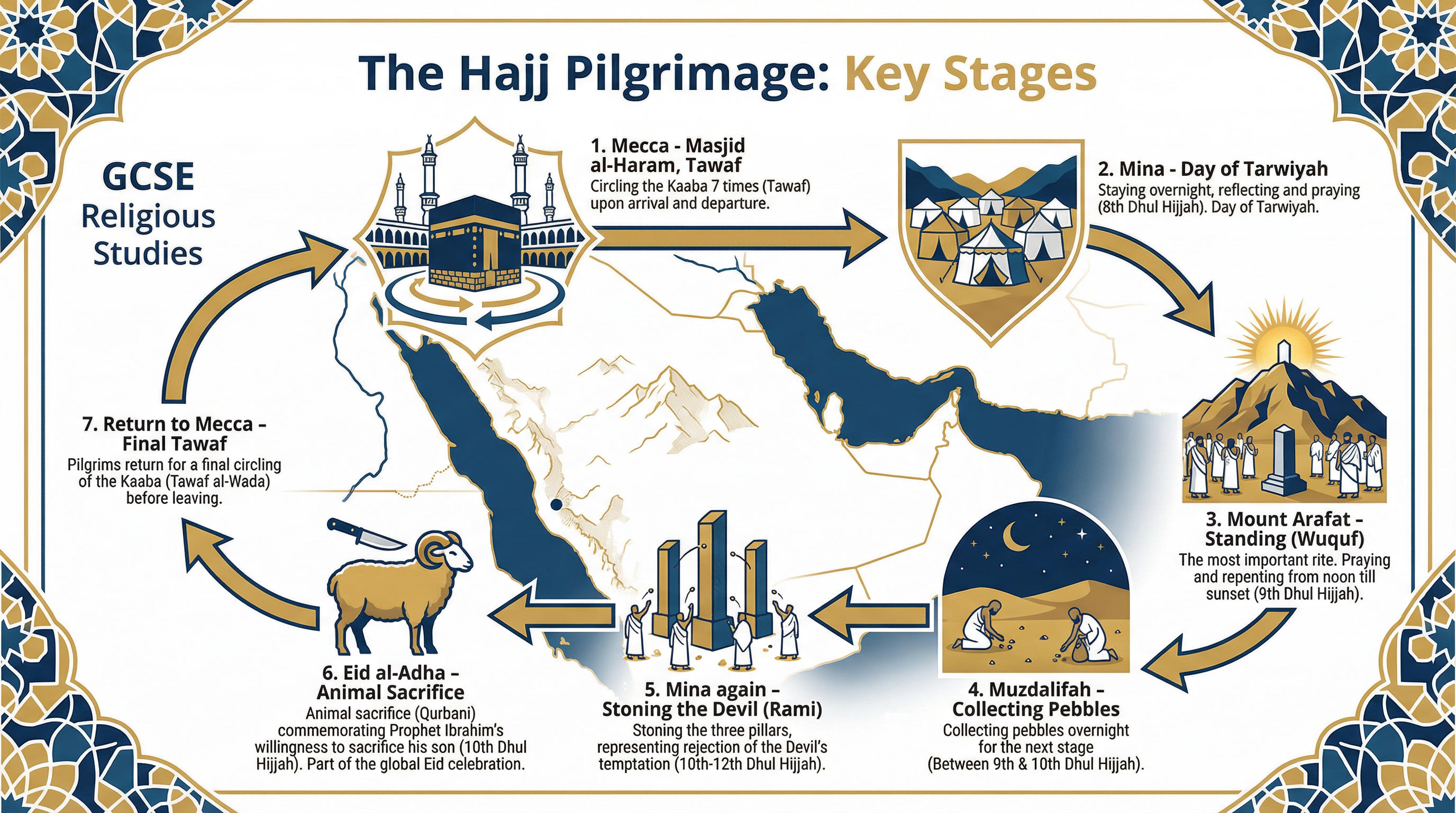
Key stages of Hajj:
| Stage | Location | Significance |
|---|---|---|
| Ihram | Miqat (entry point) | White garments symbolise equality and purity |
| Tawaf | Masjid al-Haram, Mecca | Circling the Kaaba 7 times anti-clockwise |
| Sa'i | Between Safa and Marwa | Commemorates Hagar's search for water |
| Wuquf | Mount Arafat, 9th Dhul Hijjah | Standing in prayer — the spiritual climax of Hajj |
| Muzdalifah | Open plain | Overnight stay; collecting pebbles for Rami |
| Rami | Mina — three pillars (Jamarat) | Stoning the devil; rejection of temptation |
| Qurbani | Mina | Animal sacrifice commemorating Ibrahim's obedience |
| Final Tawaf | Masjid al-Haram | Tawaf al-Wada — farewell circling of the Kaaba |
Why it matters: Hajj is the most powerful demonstration of the Ummah's unity — approximately 2.5 million Muslims from every nation, race, and class gather in identical white Ihram garments, erasing worldly distinctions. Examiners expect candidates to evaluate whether Hajj remains relevant in the modern world, offering both secular critiques (environmental impact, cost, crowd safety) and robust religious counter-arguments (spiritual transformation, fulfilment of divine command, Qur'an 3:97).
Sunni vs Shi'a: Obligations in Islam
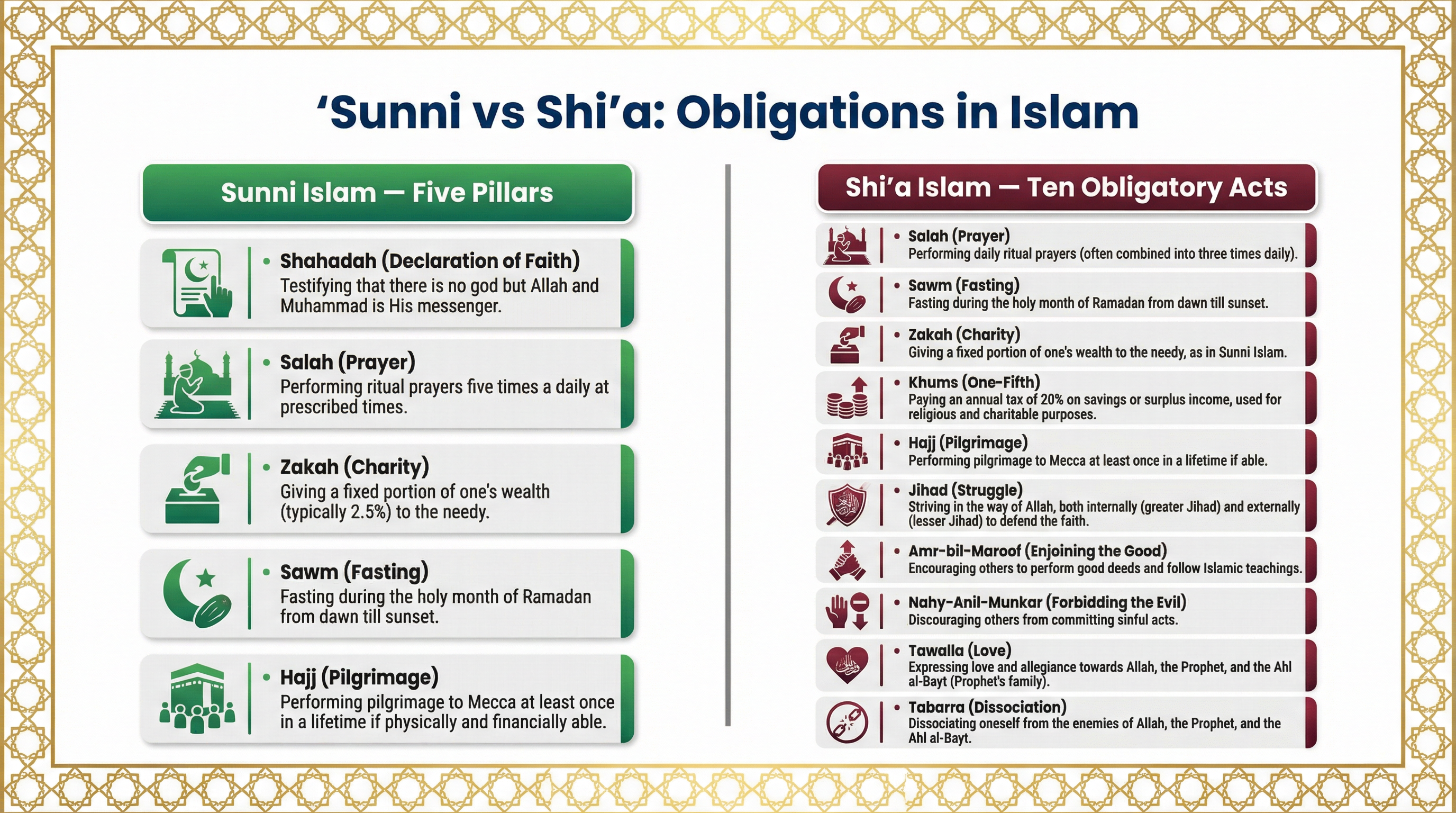
The distinction between Sunni and Shi'a obligations is a high-priority exam area. While Sunni Islam organises practice around the Five Pillars, Shi'a Islam articulates Ten Obligatory Acts (Furu ad-Din).
| Sunni Five Pillars | Shi'a Ten Obligatory Acts |
|---|---|
| 1. Shahadah | 1. Salah |
| 2. Salah | 2. Sawm |
| 3. Zakah | 3. Zakah |
| 4. Sawm | 4. Khums |
| 5. Hajj | 5. Hajj |
| — | 6. Jihad |
| — | 7. Amr-bil-Maroof (Enjoining Good) |
| — | 8. Nahy-Anil-Munkar (Forbidding Evil) |
| — | 9. Tawalla (Love of the Prophet's family) |
| — | 10. Tabarra (Dissociation from enemies of the faith) |
Khums (meaning 'one fifth') requires Shi'a Muslims to pay 20% of their surplus annual income to religious authorities — half to the poor and half to the Imam or his representatives. This is distinct from Zakah (2.5% of savings above Nisab).
Tawalla and Tabarra reflect the Shi'a emphasis on the Ahl al-Bayt — the Prophet's family. Tawalla is the expression of love and allegiance to Allah, the Prophet, and his family. Tabarra is the dissociation from their enemies. These acts are rooted in the events of Karbala (680 CE), when Husayn ibn Ali, the Prophet's grandson, was martyred.
Ashura and Festivals
Ashura (10th Muharram) is observed differently by Sunni and Shi'a Muslims — a distinction examiners specifically test:
- Shi'a: A day of mourning and lamentation for the martyrdom of Husayn ibn Ali at Karbala (680 CE). Processions, recitation of elegies, and dramatic re-enactments of the Battle of Karbala are central to Shi'a observance.
- Sunni: A day of voluntary fasting, commemorating Moses (Musa) and the Israelites' deliverance from Pharaoh. The Prophet Muhammad is reported to have fasted on this day.
Eid ul-Fitr celebrates the end of Ramadan — a joyful festival of communal prayer, feasting, and giving of Zakat al-Fitr (a special form of charity). Eid ul-Adha marks the end of Hajj and commemorates Ibrahim's willingness to sacrifice his son Isma'il in obedience to Allah. An animal sacrifice (Qurbani) is performed, and the meat is shared with the poor.
Jihad
Jihad means 'struggle' or 'striving in the way of Allah.' Examiners penalise candidates who define it exclusively as 'Holy War.'
- Greater Jihad (al-Jihad al-Akbar): The internal, personal struggle against one's own desires, sins, and weaknesses. This is considered the more important form by many scholars.
- Lesser Jihad (al-Jihad al-Asghar): The external struggle, which may include physical defence of the faith under strict conditions. In Shi'a Islam, Jihad is listed as one of the Ten Obligatory Acts.
The Prophet Muhammad is reported to have said upon returning from battle: 'We have returned from the lesser jihad to the greater jihad.' This Hadith is a key Source of Wisdom for exam answers on this topic.