Study Notes
Overview
This topic explores the foundations of religious belief and practice. For WJEC candidates, a robust understanding of how authority is constructed in Christianity and Islam is non-negotiable for achieving high grades. Examiners expect candidates to analyse the hierarchy of guidance, from sacred texts revealed by God, like the Bible and Qur'an, to the interpretations of religious leaders and the role of individual conscience. You will need to compare the Protestant principle of Sola Scriptura (Scripture Alone) with the Catholic reliance on Scripture, Tradition, and the Magisterium. Similarly, you must grasp the distinction between Sunni and Shi'a authority structures in Islam. Marks are awarded for moving beyond simple descriptions to evaluating the relative importance of these sources and how they are applied to modern ethical dilemmas. This guide will equip you with the specific knowledge and exam techniques to do just that.
Key Concepts & Developments
The Bible as a Source of Authority
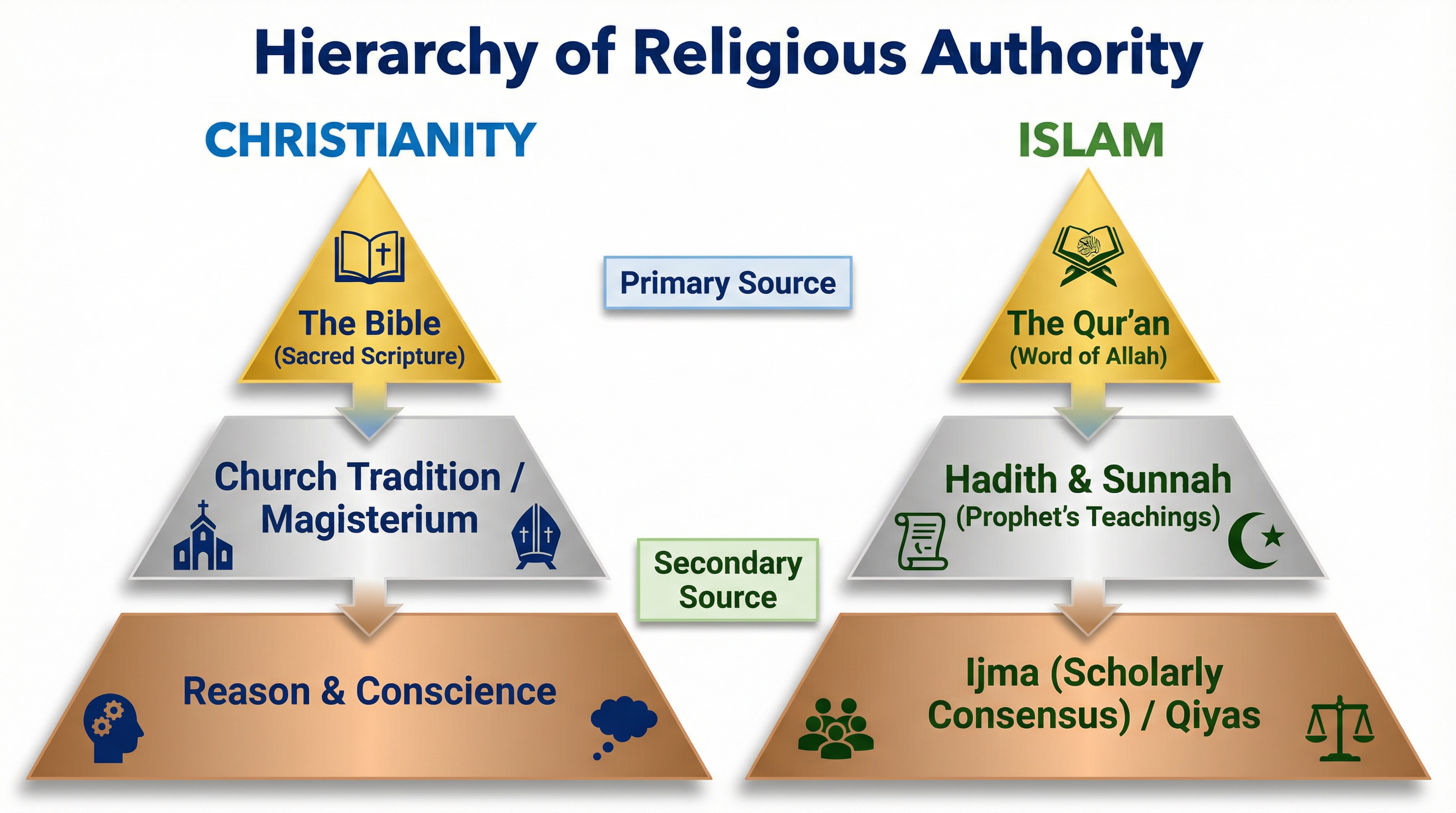
What it is: The Christian sacred text, comprising the Old and New Testaments. For all Christians, it is the primary source of authority, containing the teachings of God and the life of Jesus.
Why it matters: It is the foundational document for all Christian denominations. Examiners credit candidates who can cite specific texts, such as the Ten Commandments (Exodus 20) for moral law or Jesus' Sermon on the Mount (Matthew 5-7) for ethical teachings. Understanding the Bible's role is essential for any question on Christian belief.
Specific Knowledge: Distinguish between literalist/fundamentalist interpretations (the Bible is the literal, inerrant word of God) and liberal interpretations (the Bible is divinely inspired but requires interpretation for modern contexts).
Sola Scriptura vs. Catholic Tradition
What happened: A major theological split during the Protestant Reformation (16th Century), catalysed by Martin Luther.
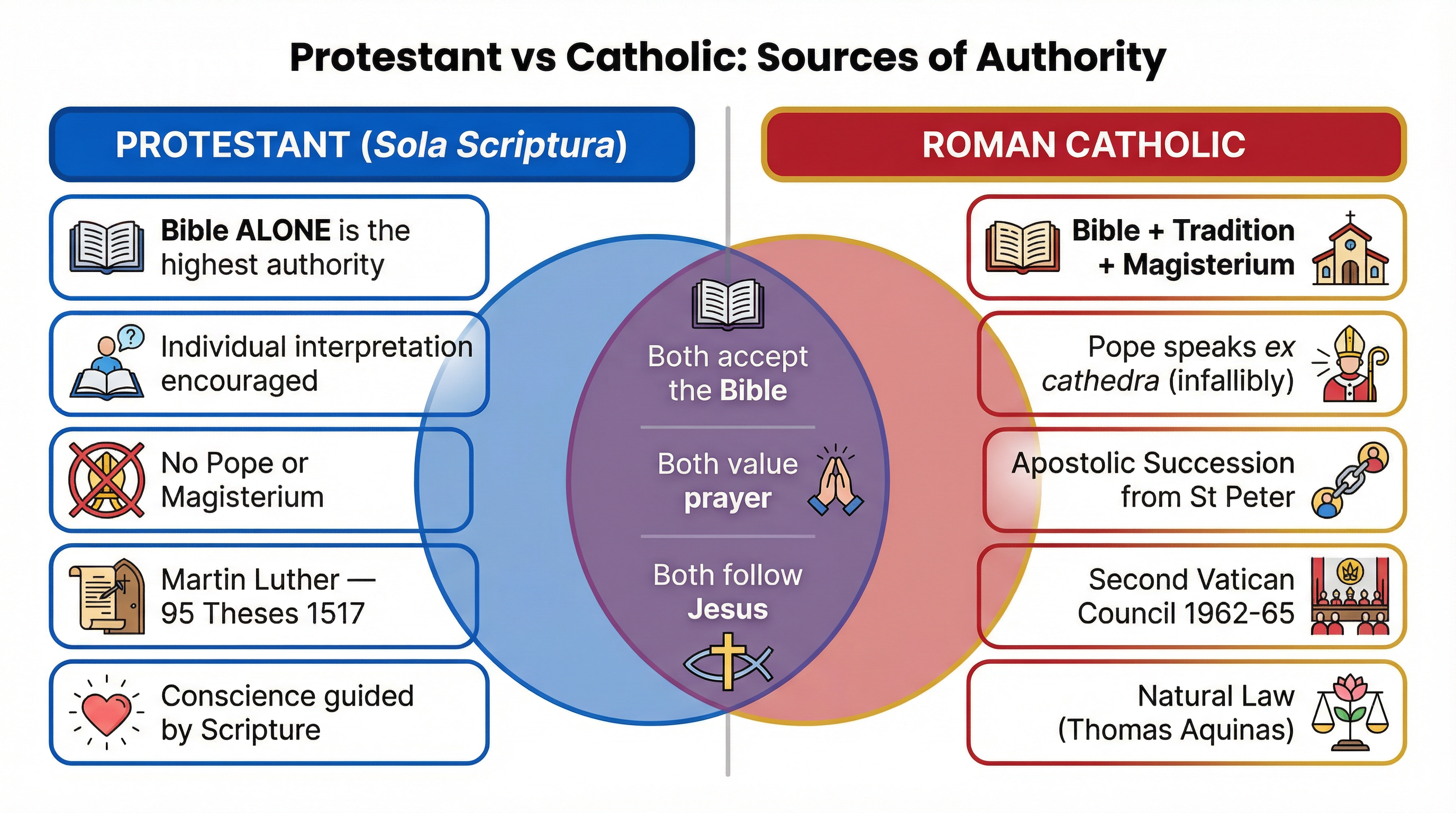
Why it matters: This is a core area of denominational difference. Protestants (e.g., Baptists, Methodists) adhere to Sola Scriptura, believing the Bible is the sole source of authority. Roman Catholics believe authority rests on a three-legged stool: Scripture, Sacred Tradition, and the Magisterium (the teaching authority of the Church). Credit is given for explaining this divergence clearly.
Specific Knowledge: Martin Luther's 95 Theses (1517), The Council of Trent (1545-1563) which reaffirmed the Catholic position, Apostolic Succession (the belief that the Pope's authority is passed down from St. Peter).
The Qur'an as a Source of Authority
What it is: The Islamic sacred text, believed by Muslims to be the literal, unchanged word of Allah, revealed to the Prophet Muhammad.
Why it matters: For Muslims, the Qur'an is the ultimate and most important source of authority, superseding all others. It is the direct speech of God. Candidates must treat it with this level of significance, explaining that it provides the basis for all aspects of a Muslim's life, forming the basis of Shari'ah Law.
Specific Knowledge: The revelation began in 610 CE. Key texts include Surah 112 (Al-Ikhlas) on Tawhid (the oneness of God). Unlike the Bible, it is considered by Muslims to be perfectly preserved in its original Arabic.
The Hadith and Sunnah
What it is: The Hadith are collections of the sayings of the Prophet Muhammad, while the Sunnah is his way of life and example. Together, they are the second most important source of authority in Islam.
Why it matters: They provide the practical application of the Qur'an's teachings. For example, the Qur'an commands prayer (Salah), but the Hadith and Sunnah explain how to pray. Marks are awarded for explaining this relationship.
Specific Knowledge: Key collections were compiled by scholars like Imam al-Bukhari. There is a distinction between Sunni and Shi'a collections and their acceptance of different narrators.
Key Individuals
Martin Luther (1483-1546)
Role: German monk and theologian, key figure in the Protestant Reformation.
Key Actions: Famously published his 95 Theses in 1517, challenging the Catholic Church's practices, particularly the sale of indulgences. He translated the Bible into German, making it accessible to ordinary people.
Impact: His actions led to the creation of Protestantism and the principle of Sola Scriptura, fundamentally altering the landscape of Christian authority in Europe.
The Pope (The Bishop of Rome)
Role: Leader of the Roman Catholic Church, believed by Catholics to be the successor to St. Peter.
Key Actions: The Pope heads the Magisterium. He can issue teachings and encyclicals. In certain circumstances, he can speak ex cathedra (from the chair), and such statements are considered infallible by Catholics.
Impact: The Pope is the ultimate human source of authority for over a billion Catholics worldwide, representing the continuity of Sacred Tradition.
Prophet Muhammad (570-632 CE)
Role: The final prophet in Islam, who received the revelations of the Qur'an from Allah.
Key Actions: Relayed the divine message of the Qur'an to humanity. His life example (Sunnah) and sayings (Hadith) provide the model for all Muslims to follow.
Impact: He is the central figure in Islam. While not worshipped, his authority as the vehicle for God's final revelation is absolute.
Second-Order Concepts
Causation
The Protestant Reformation was caused by a combination of factors: long-term corruption in the Catholic Church, the rise of humanism and critical thinking during the Renaissance, the political ambitions of German princes who wanted independence from the Pope, and the trigger event of Martin Luther's 95 Theses.
Consequence
The immediate consequence of the Reformation was a century of religious wars and the fragmentation of European Christianity. A long-term consequence is the diversity of Christian denominations that exist today, each with a slightly different model of authority.
Change & Continuity
Change: The Reformation brought a radical change in the concept of authority for Protestants, shifting it from the institution of the Church to the individual believer and their Bible. Continuity: The Catholic Church maintained its hierarchical structure and its belief in the authority of Tradition and the Magisterium, a continuity that stretches to the present day.
Significance
The debate over sources of authority is historically significant because it has shaped nations, caused wars, and continues to be the primary reason for the division between Christian denominations. In Islam, the historical disagreement over succession after the Prophet Muhammad is the origin of the Sunni-Shi'a split, a division with profound geopolitical significance today.
Source Skills
When analysing a source (e.g., a quote from the Bible, a statement from the Pope), WJEC examiners expect you to consider its provenance. Ask yourself:
- Who wrote/said this? (e.g., St. Paul, the Pope, Martin Luther)
- When was it written? (e.g., 1st Century CE, during the Reformation)
- What type of source is it? (e.g., Sacred text, a personal letter, a Church council document)
- Why was it written? (e.g., To guide a community, to challenge an opponent, to clarify a doctrine)
This allows you to evaluate its authority and usefulness for the question."