Study Notes
Overview
This topic explores the profound ethical and religious challenges posed by terrorism and the existence of Weapons of Mass Destruction (WMDs). For the WJEC GCSE exam, candidates are expected to analyse the tension between the principle of the Sanctity of Life and utilitarian arguments for nuclear deterrence. You must be able to evaluate religious responses to terrorism, contrasting Just War criteria with absolute pacifism, and support your arguments with specific sources of wisdom and sacred texts. Examiners are looking for a clear understanding of key terms, the ability to apply religious principles to modern-day issues, and a nuanced evaluation in longer 'Discuss' questions. This guide will equip you with the core knowledge, exam skills, and analytical frameworks needed to confidently tackle any question on this subject.
Key Concepts & Debates
Terrorism vs. Legitimate Warfare
What it is: Terrorism is the unlawful use of violence and intimidation, especially against civilians, in the pursuit of political, religious, or ideological aims. This contrasts with legitimate warfare, which is governed by international laws and conventions (like the Geneva Conventions) and, in religious ethics, by frameworks like the Just War Theory.
Why it matters: Examiners will award marks for a precise definition that distinguishes terrorism from other forms of conflict. A key error to avoid is conflating the Islamic concept of 'Lesser Jihad' with modern terrorism. Lesser Jihad is a regulated, defensive struggle with strict rules, whereas terrorism is by definition unlawful and indiscriminate.
Specific Knowledge: You must be able to define terrorism accurately. Key elements: unlawful violence, targeting civilians, political/ideological goals.
Weapons of Mass Destruction (WMDs)
What they are: WMDs are a category of weapons that can kill and bring significant harm to a large number of humans. The three types you must know are:
- Nuclear: Weapons that use nuclear reactions to create a devastating explosion.
- Biological: Weapons that use pathogens or toxins (like viruses or bacteria).
- Chemical: Weapons that use toxic chemicals to inflict death or harm.
Why it matters: You need to understand not just what they are, but why they pose a unique ethical problem. Their inability to discriminate between soldiers and civilians and the sheer scale of their destructive power are central to religious objections.
Memory Hook (Acronym): Remember the three types with NBC - Nuclear, Biological, Chemical.
The Sanctity of Life vs. Utilitarianism
The Core Tension: This is the central ethical conflict in the WMD debate.
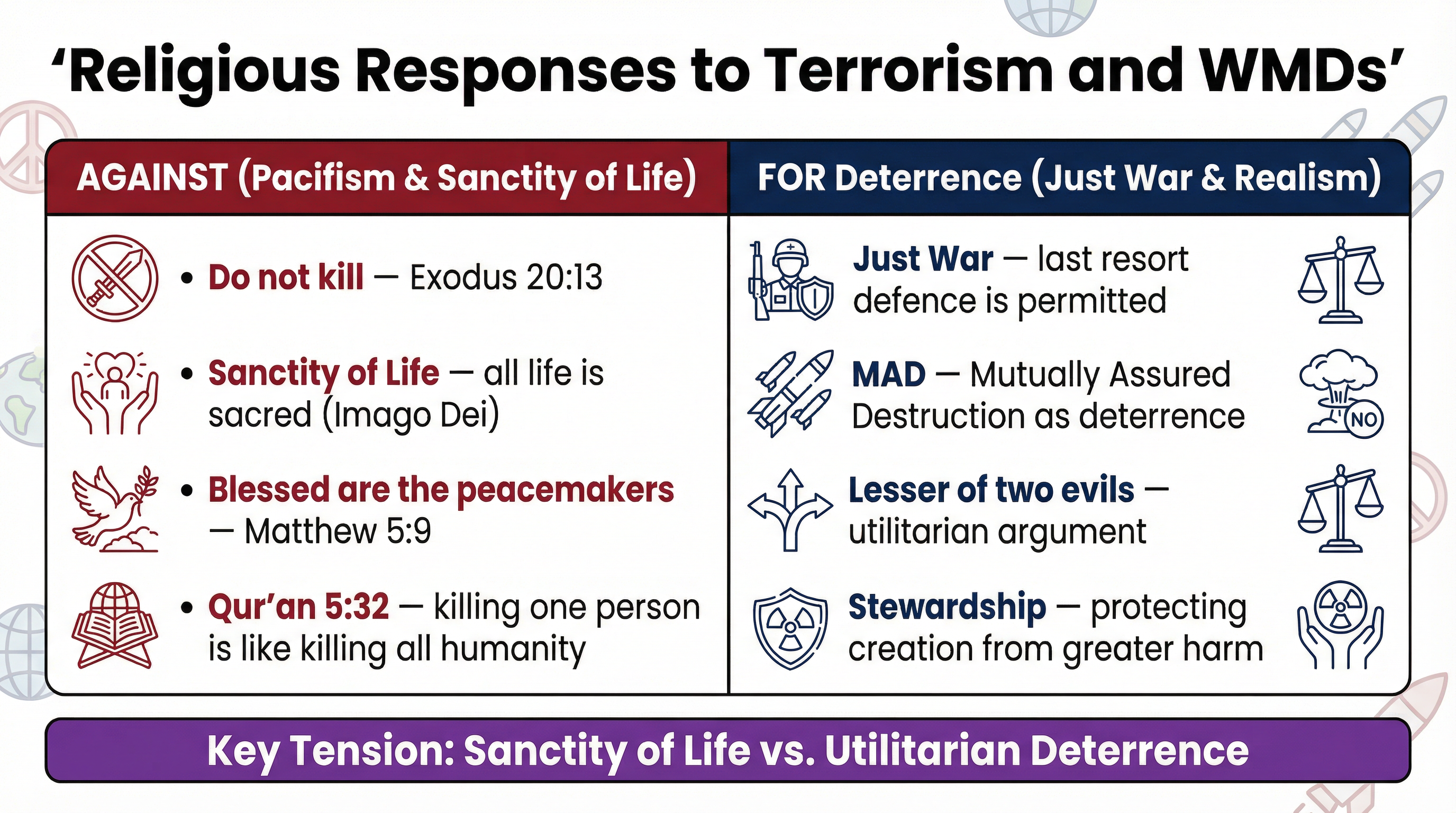
- Sanctity of Life: This principle, central to Abrahamic religions, holds that life is sacred, holy, and created by God. Therefore, only God has the right to take it. Key quote: Genesis 1:27 (humans made in God's image - Imago Dei). In Islam, Qur'an 5:32 states killing one person is like killing all of humanity.
- Utilitarianism: This is an ethical theory that argues the most moral action is the one that maximizes good for the greatest number of people. In the context of WMDs, this leads to the theory of deterrence.
Deterrence & MAD: The argument is that possessing WMDs can prevent war. The main theory is Mutually Assured Destruction (MAD). If two countries both have nuclear weapons, neither will use them for fear of being destroyed in retaliation. A utilitarian would argue that while possessing these weapons is bad, it prevents a far worse outcome (a major war), thus creating the 'greatest good' (or least harm).
Religious Frameworks
The Just War Theory
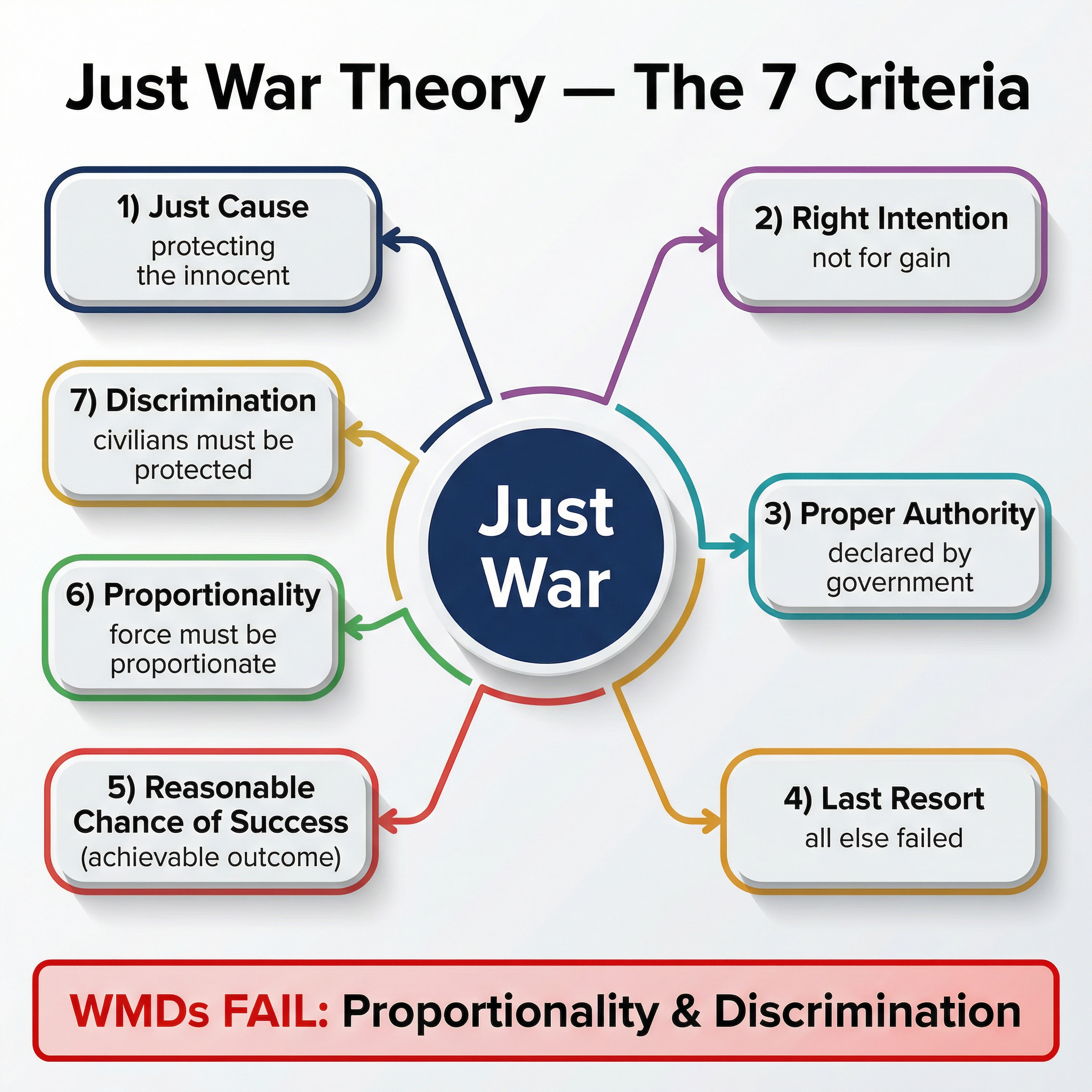
What it is: A Christian framework, most associated with St. Thomas Aquinas, that sets out conditions for when a war can be morally justified (jus ad bellum) and how it should be fought (jus in bello).
Why it matters: WMDs fundamentally challenge the Just War criteria, especially those for conduct in war. Examiners expect you to apply these criteria directly.
Application to WMDs:
- Proportionality: The force used must be proportionate to the wrong suffered. The devastation caused by a single WMD is almost impossible to justify as a proportionate response.
- Discrimination: There must be a clear distinction between combatants and non-combatants (civilians). WMDs are inherently indiscriminate, killing everyone in their blast radius.
Conclusion: The use of WMDs can never be justified under Just War theory because they violate the principles of Proportionality and Discrimination. This is a key argument for your essays.
Pacifism
What it is: The belief that all violence and war is wrong. Absolute pacifists, like the Quakers, believe violence is never the answer, regardless of the situation. They follow the teachings of Jesus, such as:
- Matthew 5:9: "Blessed are the peacemakers."
- Matthew 5:44: "Love your enemies and pray for those who persecute you."
Why it matters: Pacifism provides a clear, absolute moral stance against both terrorism and WMDs. It is an essential viewpoint to include in 'Discuss' questions to provide a counter-argument to Just War or utilitarian perspectives."