
Study Notes
Overview
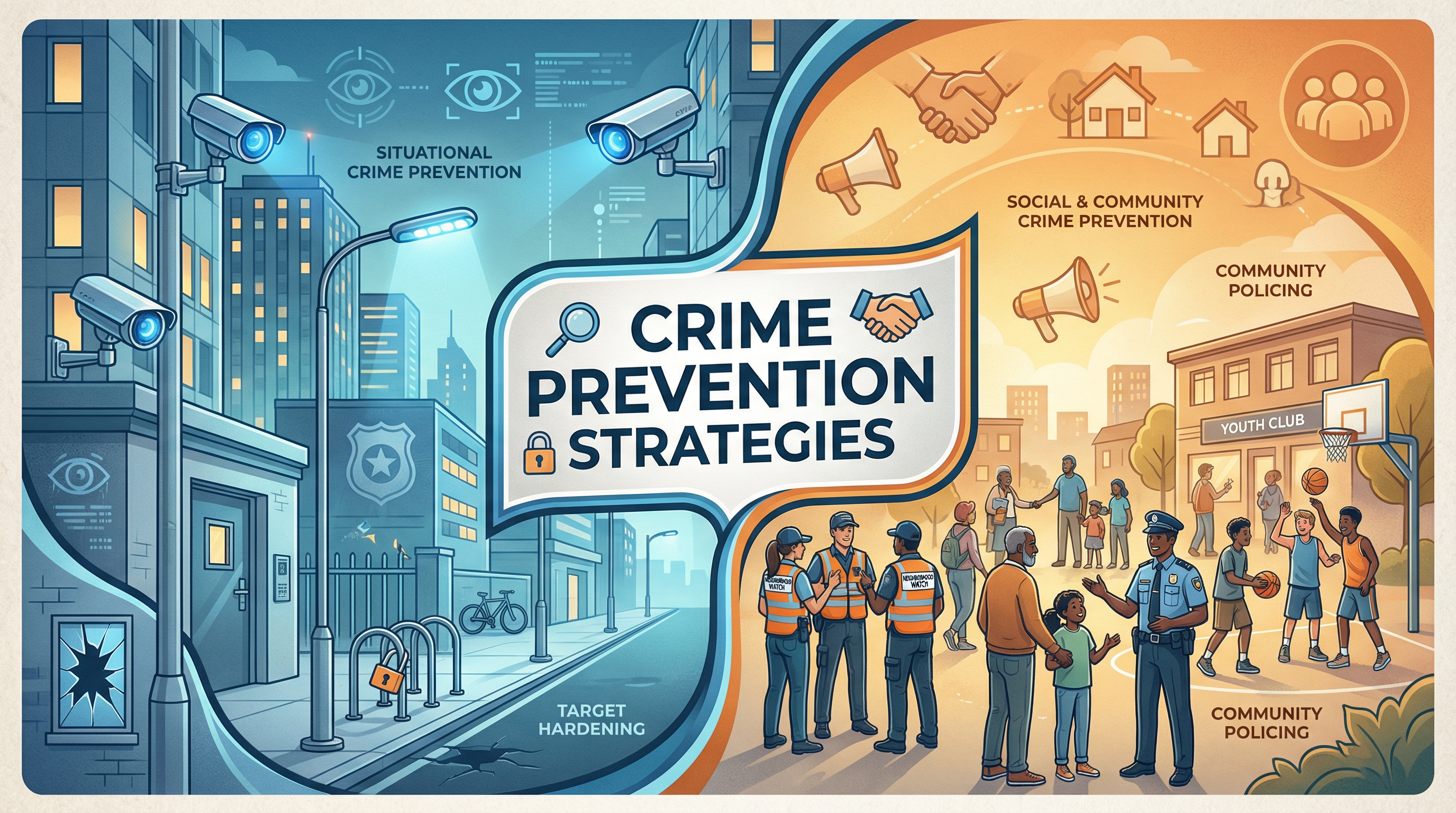
This guide delves into the critical area of crime prevention strategies, a cornerstone of the AQA GCSE Sociology specification. Examiners expect candidates to demonstrate a nuanced understanding of the formal and informal mechanisms of social control. This includes a clear distinction between Situational Crime Prevention (SCP), Environmental strategies, and Social/Community approaches. A key focus for achieving high marks is the ability to evaluate these strategies through the lens of sociological perspectives such as Functionalism, Marxism, and Interactionism, and to critically assess their effectiveness, particularly in relation to the concept of crime displacement versus genuine reduction. This guide will equip you with the necessary terminology, theoretical knowledge, and evaluative skills to confidently tackle any question on this topic.
Key Concepts & Strategies
Situational Crime Prevention (SCP)
What it is: SCP focuses on altering the immediate environment to make crime a less attractive choice. It operates on the principles of increasing the risks and effort for potential offenders while reducing the rewards. This approach is heavily influenced by Right Realism and Rational Choice Theory, which posit that criminals are rational actors who weigh the costs and benefits before committing an offence.
Key Actions:
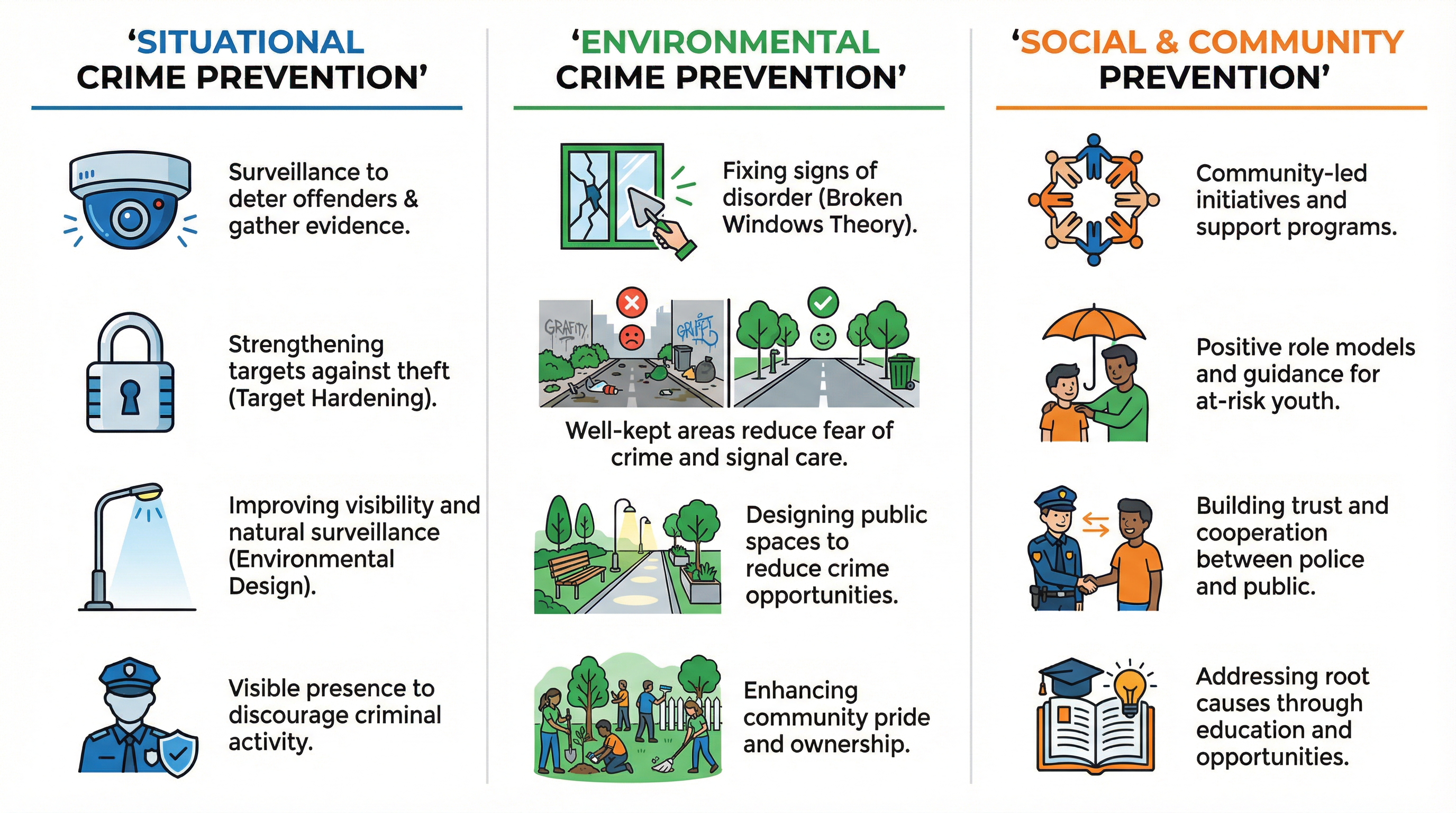
- Target Hardening: Making potential targets more resistant to attack. Examples include installing stronger locks, window bars, and anti-climb paint.
- Increased Surveillance: Both formal (CCTV, security guards) and informal (Neighbourhood Watch schemes) methods to increase the likelihood of offenders being seen.
- Designing Out Crime: Architectural design that reduces opportunities for crime, such as clear lines of sight and eliminating hidden alleyways.
Why it matters: SCP is a popular and practical approach to crime prevention. However, for exam purposes, you must critically evaluate its limitations. The main criticism is that it doesn't solve the root causes of crime but simply displaces it.
Environmental Crime Prevention
What it is: This strategy is based on the idea that a disorderly environment can breed more serious crime. It is famously associated with Wilson and Kelling's 'Broken Windows' theory.
Key Actions:
- Zero-Tolerance Policing: Cracking down on minor offences (e.g., graffiti, littering, fare-dodging) to send a message that no level of crime is acceptable.
- Environmental Improvements: Rapid repair of vandalism, cleaning up streets, and improving public spaces to foster a sense of community pride and ownership.
Why it matters: This approach highlights the link between the physical environment and criminal behaviour. It suggests that maintaining an orderly environment can be a powerful tool in crime prevention. However, critics, particularly Marxists, argue that it can lead to the targeting and displacement of marginalized groups and fails to address the structural inequalities that cause crime.
Social and Community Crime Prevention
What it is: Unlike the other two strategies, this approach focuses on the root causes of crime. It aims to tackle the social conditions that might lead individuals to offend in the first place.
Key Actions:
- Intervention Programmes: Providing support and resources to at-risk groups, such as youth mentoring schemes, parenting classes, and drug rehabilitation programmes.
- Community Cohesion: Initiatives aimed at strengthening community bonds and promoting social inclusion.
- Educational and Employment Opportunities: Improving access to education and jobs to provide legitimate pathways to success.
Why it matters: This is a long-term strategy that seeks to create a society where crime is less likely to occur. It is heavily supported by Left Realists who argue that crime is a product of relative deprivation and social exclusion. The main criticism is that such programmes are often expensive, difficult to implement, and their success can be hard to measure.
The Debate: Displacement vs. Reduction
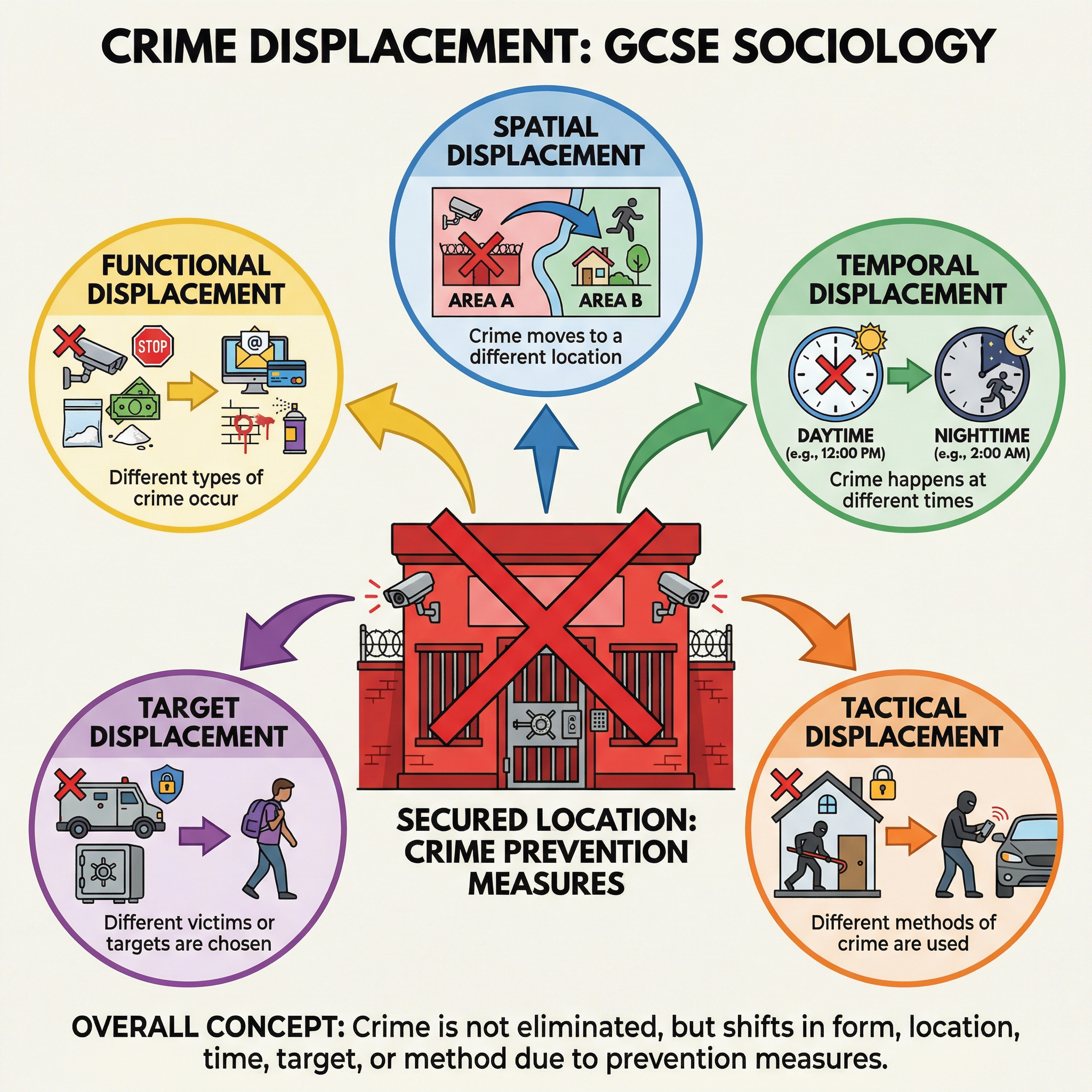
A central debate in this topic is whether crime prevention strategies genuinely reduce crime or simply displace it. Displacement means that crime is not eliminated, but simply moved. Examiners will award significant credit for candidates who can identify and explain the different types of displacement:
- Spatial Displacement: Crime moves from one area to another.
- Temporal Displacement: Crime is committed at a different time.
- Target Displacement: Offenders choose a different victim.
- Tactical Displacement: Offenders use a different method to commit the crime.
- Functional Displacement: Offenders commit a different type of crime.