Study Notes
Overview
Culture is the lifeblood of any society, encompassing the shared beliefs, values, and practices that bind people together. For an OCR GCSE Sociology student, understanding culture is not just about appreciating diversity; it is about dissecting the very mechanisms that make us human. This guide will explore the fundamental concepts of culture, socialisation, and identity, providing you with the analytical tools and specific knowledge required by examiners. We will delve into the 'nature versus nurture' debate, analyse the agencies of socialisation, and apply core sociological theories to understand how culture operates as both a source of unity and a tool of power. Mastering this topic is crucial as it forms the bedrock upon which all other sociological analysis is built.
Key Concepts: The Building Blocks of Culture
Norms, Values, Roles, and Status
To analyse culture sociologically, candidates must be precise with their terminology. These four concepts are the essential toolkit for understanding how culture shapes our daily lives.
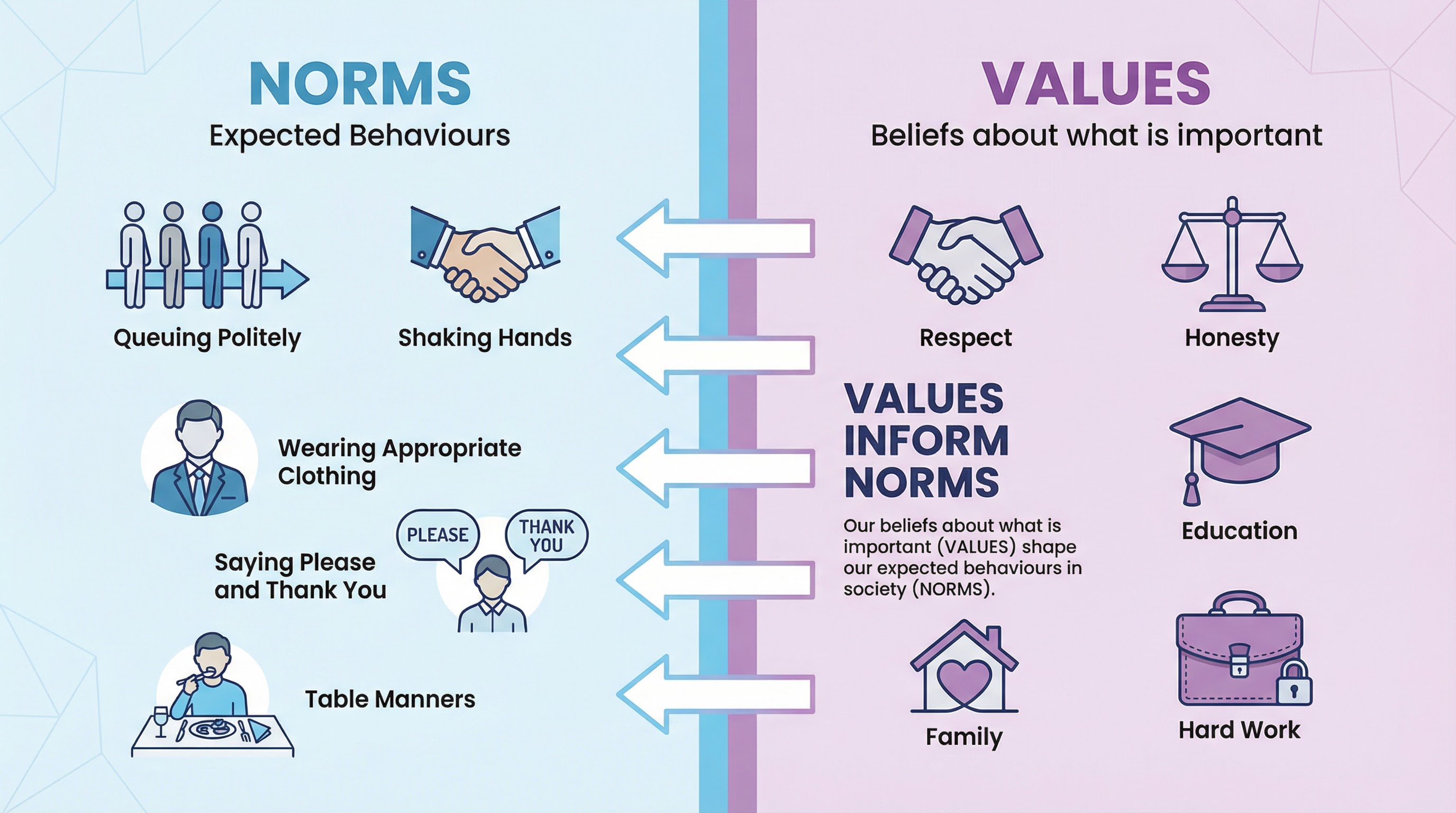
Values are the foundational beliefs and principles that a society holds as important. They are the general guidelines for how people should live their lives. For example, a common value in many societies is the idea of 'honesty' or 'respect for the elderly'. Values are abstract and broad.
Norms, in contrast, are the specific, unwritten rules of behaviour that are derived from a society's values. If the value is 'honesty', a corresponding norm would be not to steal or lie. If the value is 'respect for the elderly', the norm would be to give up your seat on a bus for an older person. Examiners award credit for distinguishing clearly between these two terms. A common mistake is to use them interchangeably.
Status refers to the social position that an individual holds within a society. Status can be ascribed (fixed at birth, such as being a son or daughter, or a member of a particular ethnic group) or achieved (earned through effort, such as becoming a doctor, a musician, or a student). Status is the position you occupy.
Roles are the patterns of behaviour expected of an individual who holds a particular status. For example, the role of a 'student' involves attending classes, completing assignments, and respecting teachers. The role of a 'parent' involves caring for children, providing for them, and teaching them right from wrong. Roles are the behaviours associated with a status.
The Nature vs. Nurture Debate
This is a classic debate in sociology and a favourite of examiners. It questions whether our behaviour is determined by our biology (nature) or learned through our social environment (nurture).
The 'Nature' Argument suggests that our behaviour is instinctual and based on our genetic makeup. This perspective, often associated with biology and psychology, argues that certain behaviours are 'hardwired' into us.
The 'Nurture' Argument is the sociological perspective. It argues that our behaviour is learned through the process of socialisation. The most powerful evidence for this comes from studies of feral children—individuals who have grown up with little or no human contact. Cases like Genie Wiley (discovered in California in 1970, having been isolated in a room for 13 years) or Oxana Malaya (found in Ukraine in 1991, having lived with dogs for six years) show that without social interaction, humans do not develop the behaviours we consider 'normal', such as language, walking upright, or basic social skills. This demonstrates that these behaviours are learned, not innate. Candidates who cite these specific examples will gain credit.
Agencies of Socialisation
Socialisation is the lifelong process of learning the culture of a society. It is carried out by various 'agencies'.
Primary Socialisation occurs during early childhood, primarily within the family. This is where we learn the most basic norms and values. The family teaches us language, basic manners, and the fundamental distinction between right and wrong. Processes involved include imitation (copying the behaviour of parents and siblings) and manipulation (parents rewarding good behaviour and punishing bad behaviour).
Secondary Socialisation continues throughout our lives and involves institutions and groups outside the family, including:
- Education: Schools teach us not only academic subjects but also a 'hidden curriculum' of norms like punctuality, obedience, and respect for authority. The process involves formal sanctions (detentions, rewards) and informal peer pressure.
- Media: Television, social media, and advertising present powerful role models and shape our desires and beliefs. The media uses role modelling, where we might imitate the behaviour of celebrities or influencers.
- Peer Group: Friends and colleagues influence our behaviour through peer pressure and the desire for acceptance. This agency becomes particularly powerful during adolescence.
- Religion: Religious institutions provide a clear set of moral values and norms for their followers, often reinforced through rituals and community.
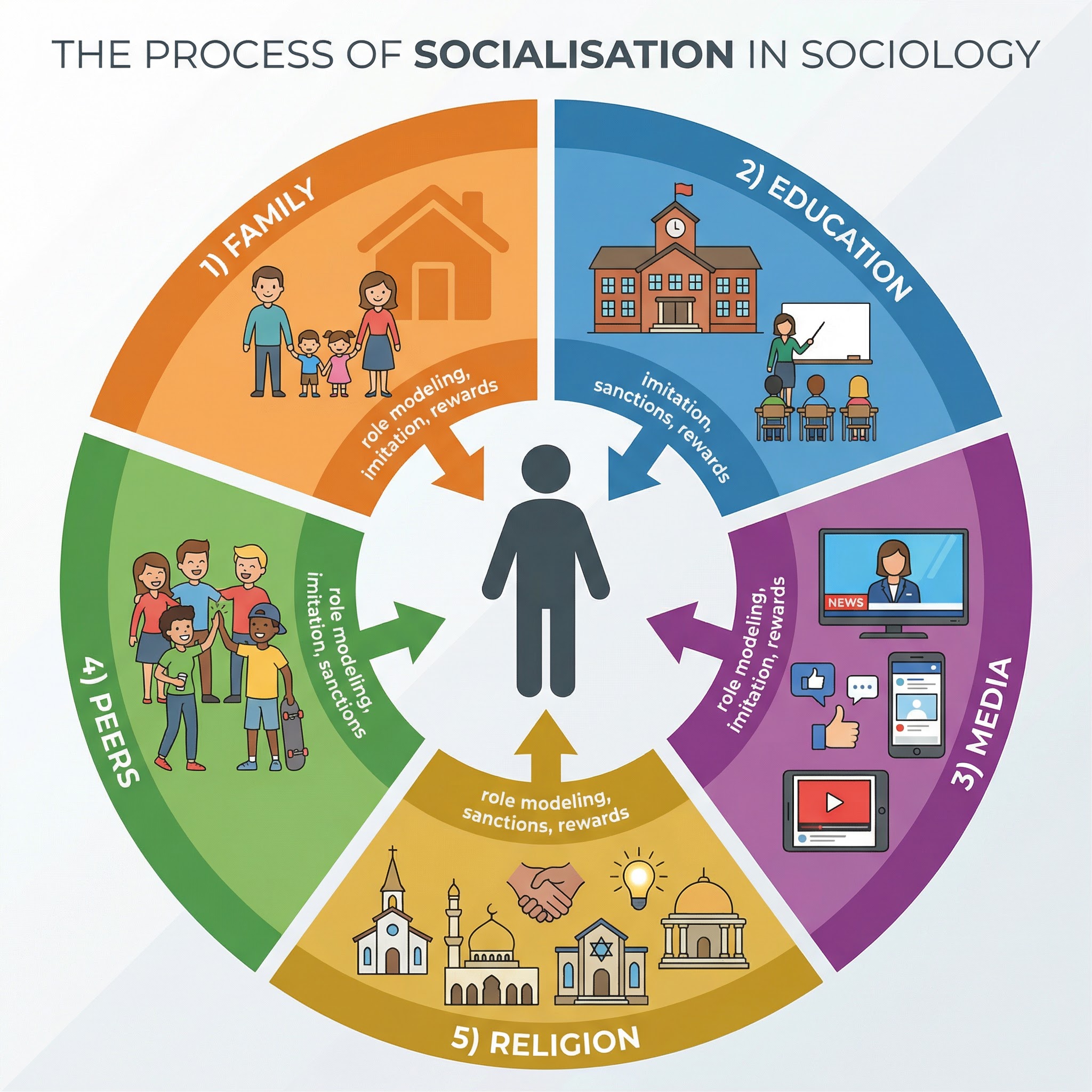
A critical point for examiners: it is not enough to simply list these agencies. You must explain the process of how they transmit culture. Use terms like 'imitation', 'role modelling', 'sanctions', 'rewards', and 'canalisation' (channelling children towards gender-specific activities).
Theoretical Perspectives on Culture
To achieve the highest marks (AO2), you must apply sociological theories to analyse culture.
Functionalism
Functionalists see culture as the 'social glue' that holds society together. They argue that a shared culture creates a collective conscience (a term coined by Émile Durkheim), leading to social harmony and stability. For Functionalists, the agencies of socialisation work together to ensure that everyone shares the same core values, creating a state of consensus. This prevents anomie (a state of normlessness) and ensures social order. Culture, from this perspective, is beneficial and necessary for society to function.
Marxism
Marxists offer a critical perspective. They argue that the culture of a society is dominated by the values and beliefs of the ruling class (bourgeoisie). This dominant ideology is a form of ideological control, which tricks the working class (proletariat) into accepting their own exploitation. From this viewpoint, agencies like the media and education system are tools for reproducing class inequality. The media, for example, promotes consumerism and the idea that success is measured by wealth, which benefits the ruling class. Marxists see culture as a tool of oppression, not unity.
Feminism
Feminists argue that culture is often patriarchal, meaning it is dominated by men and serves to reinforce gender inequality. They point to how gender roles are taught through socialisation, with the family and media often promoting stereotypes that limit women's opportunities. For example, the concept of canalisation (channelling children towards gender-specific toys and activities) reinforces traditional gender roles from a young age. Girls are given dolls and encouraged to be nurturing, while boys are given action figures and encouraged to be aggressive. Feminists argue that this cultural conditioning limits both men and women.
Social Control
How does society ensure that people conform to its norms? Through social control.
Formal Social Control is based on written rules and laws, enforced by official state agencies. Examples include the police, the courts, and the prison system. The sanctions are formal and codified, such as fines, imprisonment, or community service. Formal social control is used for serious breaches of norms (crimes).
Informal Social Control is based on unwritten rules and is enforced more subtly through social pressure. It includes mechanisms like peer pressure, gossip, and ostracisation (social exclusion). The sanctions are informal, such as a disapproving look, being excluded from a social group, or being the subject of gossip. Informal social control is used for minor breaches of norms (e.g., being rude or dressing inappropriately).
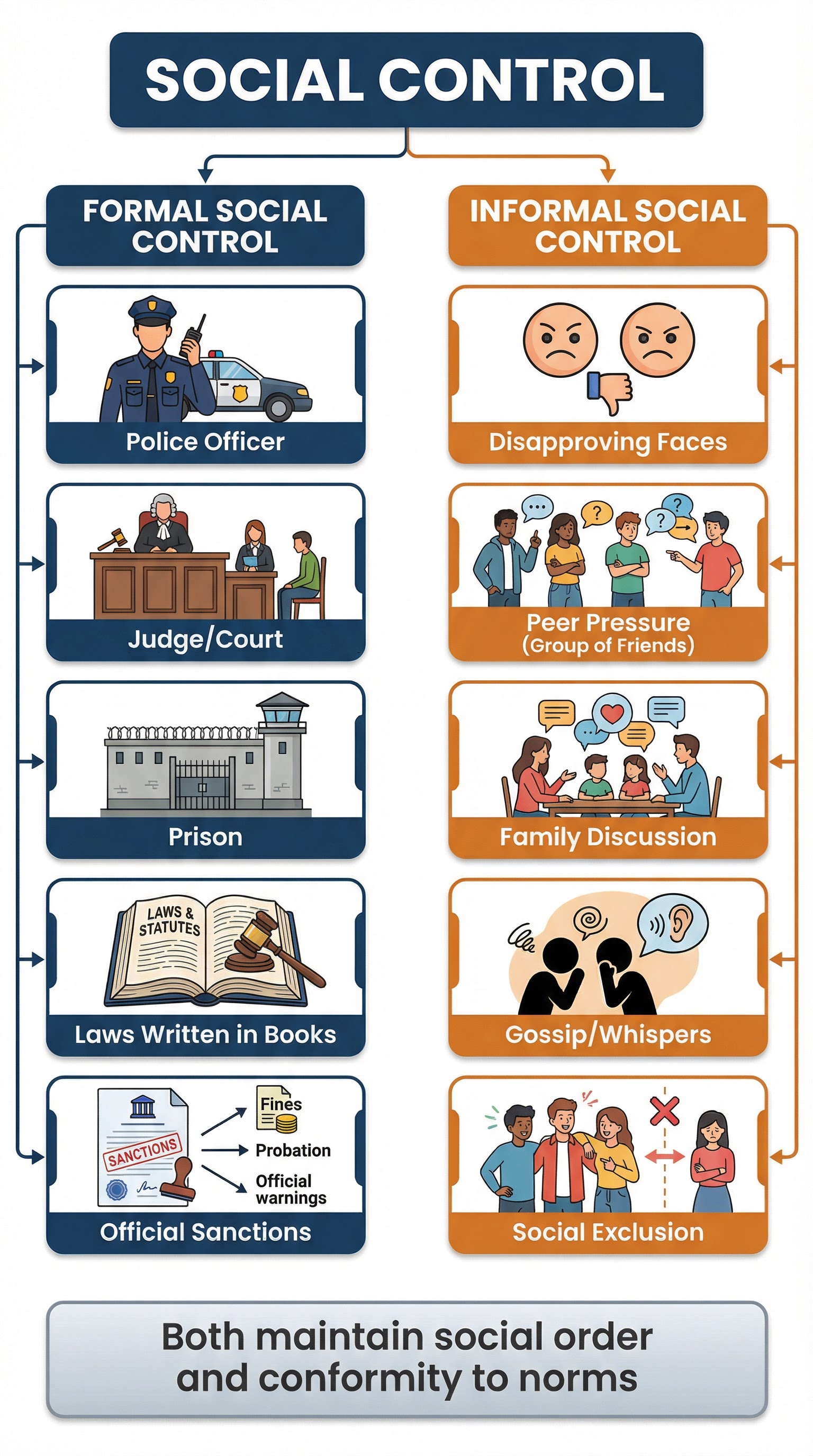
Examiners reward candidates who can distinguish clearly between these two types and provide specific examples.
Cultural Diversity
Culture is not universal. What is considered normal in one society may be considered deviant in another. This is known as cultural diversity or cultural relativism.
A classic example is Margaret Mead's study of three tribes in New Guinea (1935). She found that the Arapesh (both men and women were gentle and nurturing), the Mundugumor (both men and women were aggressive and competitive), and the Tchambuli (women were dominant and men were passive) had vastly different gender roles. This challenged the idea that gender roles are biologically determined and showed that they are culturally constructed.
Other examples of cultural diversity include:
- Dietary norms: Eating beef is normal in the UK but taboo in Hindu culture. Eating pork is normal in the UK but forbidden in Islamic and Jewish cultures.
- Clothing norms: Wearing a hijab is a norm for many Muslim women but not for women in Western secular societies.
- Family structures: Nuclear families are common in the UK, but extended families are more common in South Asian cultures.
Candidates who demonstrate awareness of cultural diversity and avoid ethnocentrism (judging other cultures by the standards of your own) will achieve higher marks.
Identity
Identity is how we see ourselves and how others see us. It is shaped by our culture and socialisation.
Types of Identity:
- Gender Identity: Our sense of being male, female, or non-binary, shaped by socialisation and cultural norms.
- Ethnic Identity: Our sense of belonging to a particular ethnic or cultural group.
- Class Identity: Our sense of belonging to a particular social class (working class, middle class, upper class).
- National Identity: Our sense of belonging to a particular nation (e.g., British, Scottish, Welsh).
Identity is not fixed; it is fluid and can change over time. It is also influenced by the agencies of socialisation. For example, the media can shape our gender identity by presenting particular images of masculinity and femininity.
Subcultures
A subculture is a group within a larger culture that has its own distinct norms, values, and lifestyle. Subcultures often emerge among young people and can be based on music, fashion, or shared interests.
Examples include:
- Youth subcultures: Punks, Goths, Mods, Rockers, Emos.
- Religious subcultures: Amish communities, Hasidic Jews.
- Deviant subcultures: Criminal gangs.
Subcultures can be seen as a form of resistance to the dominant culture (a Marxist interpretation) or as a way for individuals to express their identity and find belonging (a Functionalist interpretation).