Study Notes
Overview
This guide covers the OCR J202 specification on Identity, focusing on the social construction of identity through socialisation and social control. Examiners expect candidates to move beyond common-sense understandings to analyse the interplay between 'nature' (biology) and 'nurture' (social learning). A key requirement is to understand how various agencies of socialisation—family, education, media, peer groups, workplace, and religion—shape our gender, class, ethnic, and national identities. Furthermore, high marks are awarded for the ability to contrast and evaluate major theoretical perspectives, including Functionalism, Marxism, Feminism, and Interactionism. This topic forms a foundation for understanding social inequality and the dynamics of contemporary society, making it essential for a robust sociological understanding.
Key Concepts: The 'Nature vs. Nurture' Debate
The central debate in the study of identity is whether our identities are a product of nature or nurture.
Nature: This perspective argues that identity is determined by biological factors. This is known as biological determinism. It suggests that our genes, hormones, and innate characteristics dictate our personalities and behaviours. For example, some sociobiologists argue that gender roles are a result of evolutionary adaptations.
Nurture: In contrast, sociology champions the nurture argument. This perspective asserts that identity is socially constructed through the process of socialisation—the lifelong process of learning the norms, values, customs, and roles of a society. Evidence from studies of feral children, such as Oxana Malaya, who was raised by dogs, strongly supports this view. These children fail to develop recognisable human identities without social interaction, demonstrating that our sense of self is learned, not innate.
Agencies of Socialisation
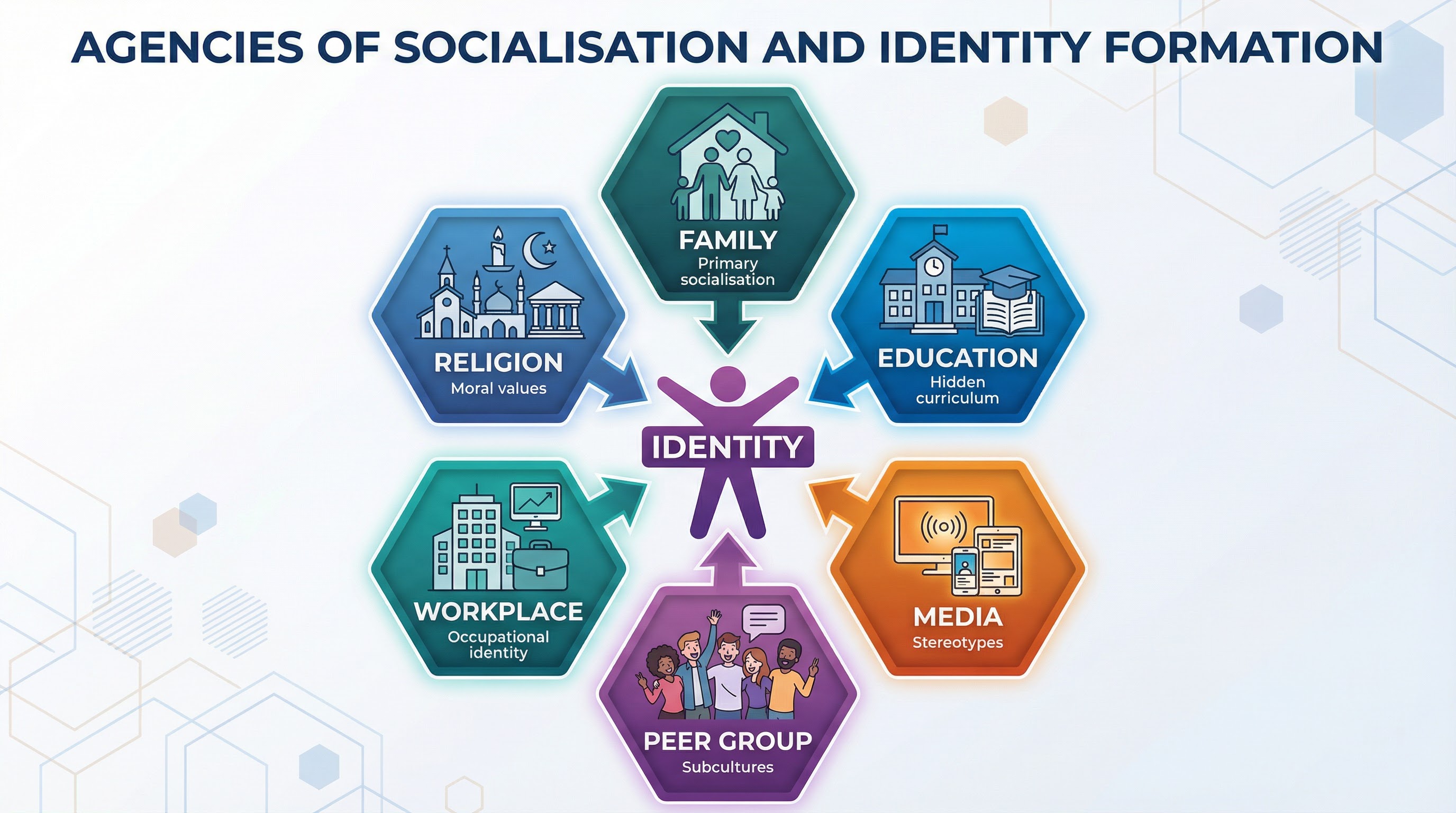
Candidates must be able to explain how different agencies of socialisation contribute to identity formation. Credit is given for linking specific agencies to specific types of identity.
1. The Family
- Role: The primary agent of socialisation. It is where we first learn basic norms and values.
- Processes: Ann Oakley (1982) identified four key processes of gender socialisation within the family:
- Manipulation: Parents encourage or discourage behaviour based on gender norms (e.g., telling a boy not to cry).
- Canalisation: Parents channel children's interests into gender-appropriate toys and activities (e.g., dolls for girls, cars for boys).
- Verbal Appellations: Using different words and phrases for different genders (e.g., 'gentle' for a girl, 'strong' for a boy).
- Different Activities: Encouraging children to participate in gender-specific activities (e.g., baking with mum, football with dad).
- Impact: Shapes gender, class, and ethnic identity from birth.
2. Education
- Role: A key agent of secondary socialisation.
- Processes: Education transmits identity through both the formal curriculum (what is explicitly taught) and the hidden curriculum. The hidden curriculum consists of the informal messages and lessons that teach pupils punctuality, obedience, hierarchy, and competition, preparing them for the world of work.
- Impact: According to Marxists like Pierre Bourdieu, education reproduces class inequality by valuing the cultural capital (the knowledge, attitudes, and skills) of the middle class, giving them an unfair advantage.
3. The Media
- Role: An increasingly powerful agent of socialisation in contemporary society.
- Processes: The media represents different social groups in particular ways, often through stereotypes. This can influence our perceptions and self-perceptions.
- Impact: Feminists argue the media often reinforces patriarchal ideology through the 'male gaze' (Mulvey) and by portraying women in a limited range of roles. It also shapes our understanding of ethnic and national identities.
4. Peer Group
- Role: Particularly influential during adolescence.
- Processes: Peer groups offer a sense of belonging and can exert pressure to conform to group norms. This can lead to the formation of youth subcultures with distinct styles, values, and behaviours.
- Impact: Can challenge the values instilled by the family and shape consumption choices, language, and social habits. Paul Willis's study, 'Learning to Labour', showed how a working-class 'lads' subculture rejected school values.
5. Workplace
- Role: A key agent of adult socialisation.
- Processes: We learn a new set of norms and values associated with our occupation, a process known as occupational socialisation. This includes formal rules and informal expectations.
- Impact: Our job can become a significant part of our identity, influencing our class identity, lifestyle, and social circle.
6. Religion
- Role: Provides a moral framework and a set of beliefs that can shape identity.
- Processes: Religious institutions teach specific values and codes of conduct. For some, religion can become a master status—an identity that overrides all others.
- Impact: Shapes moral values and can be a significant source of ethnic and national identity, as well as providing a sense of community.
Types of Identity
Examiners expect candidates to understand how identity is multi-faceted.
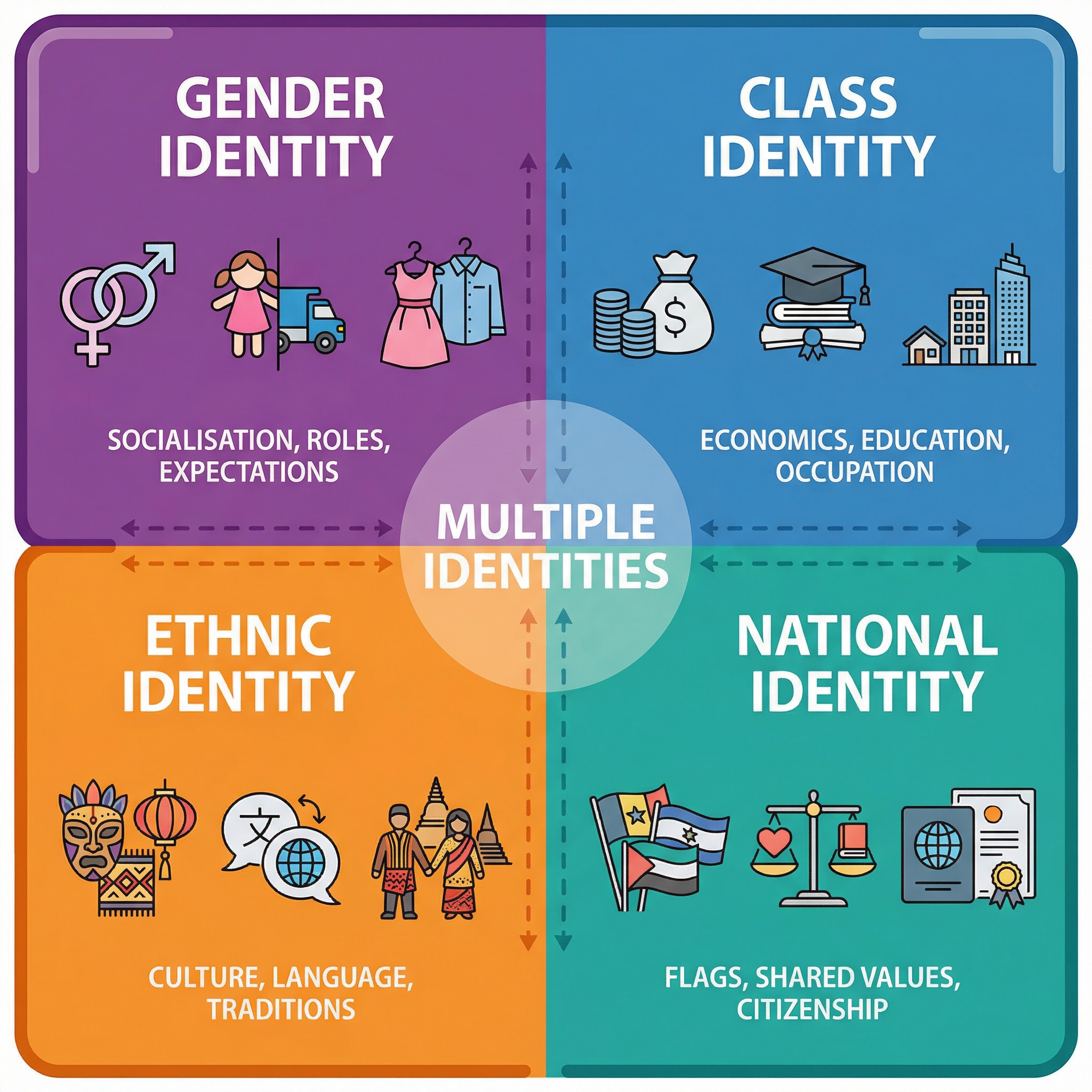
- Gender Identity: Socially constructed roles, behaviours, and expectations associated with being male or female. This is distinct from biological sex. Concepts like hegemonic masculinity and emphasised femininity are crucial here.
- Class Identity: An identity based on economic position and social status. Marxists see this as the most fundamental identity, shaping life chances and social experiences.
- Ethnic Identity: An identity based on a shared culture, religion, language, or heritage. It is a source of pride and belonging but can also be the basis for prejudice and discrimination.
- National Identity: An identity based on belonging to a particular nation-state. It is fostered through shared symbols (flags), values (democracy), and traditions.
Theoretical Perspectives on Identity
High-level responses must contrast and evaluate different sociological theories.
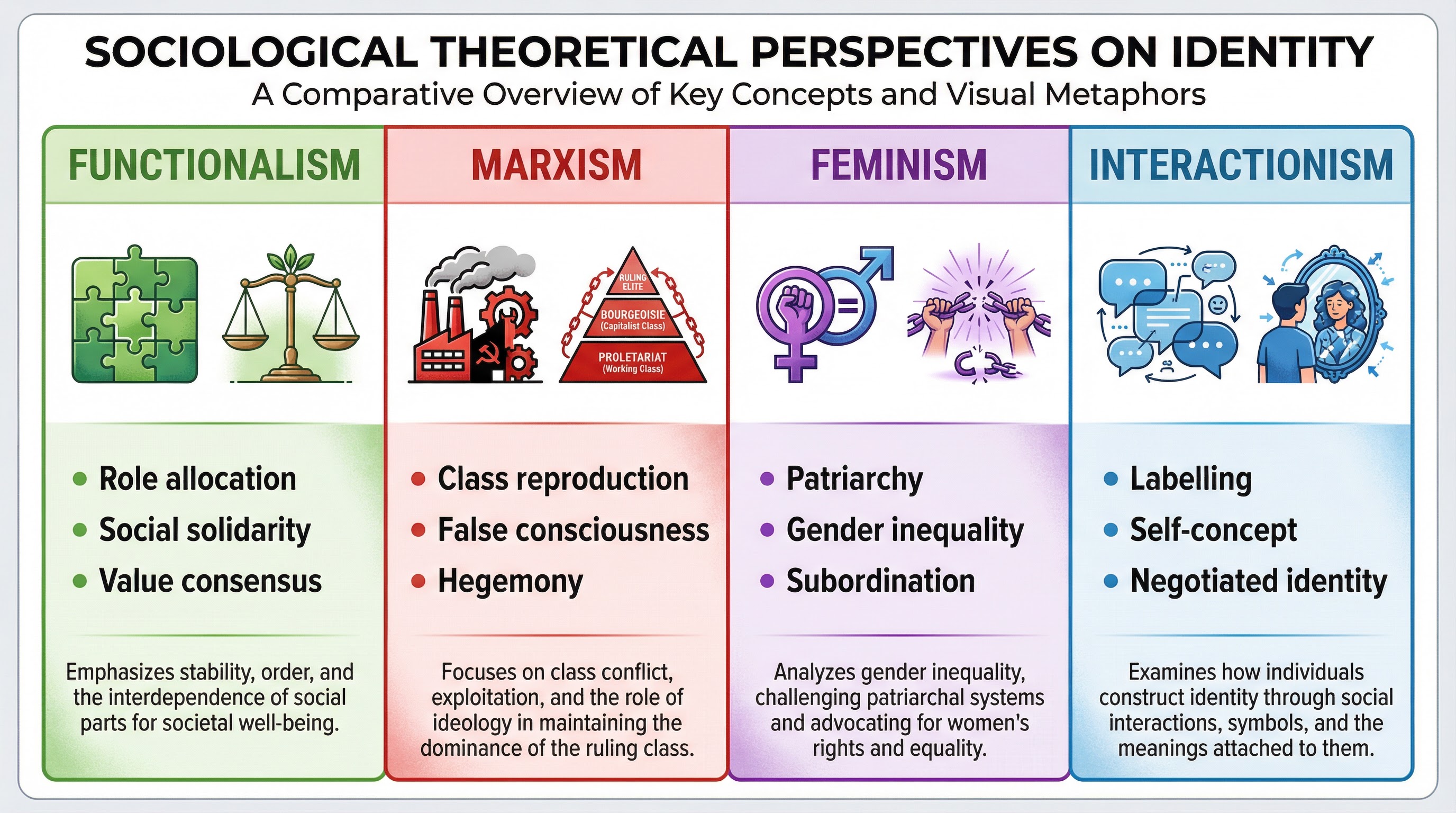
| Perspective | View on Identity Formation | Key Concepts | Sociologists |
|---|---|---|---|
| Functionalism | Socialisation integrates individuals into a shared culture (value consensus), creating social solidarity. Each agency performs a positive function. | Role allocation, Social solidarity | Durkheim, Parsons |
| Marxism | Socialisation reproduces class inequality. The ruling class transmits its ideology through agencies like education and media to maintain its power. | Class reproduction, False consciousness, Hegemony | Marx, Bourdieu, Althusser |
| Feminism | Socialisation reinforces patriarchy. Agencies like the family and media construct gender roles that subordinate women. | Patriarchy, Gender inequality, Subordination | Oakley, Mulvey, Sharpe |
| Interactionism | Identity is not fixed but is actively created and negotiated through social interaction. We develop a self-concept based on how others see us (the 'looking-glass self'). | Labelling, Self-concept, Dramaturgy | Cooley, Goffman, Becker |