Study Notes
Overview
Socialisation is a cornerstone of sociological study, and for the OCR J204 specification, it is a topic that demands both detailed knowledge and analytical precision. This guide will explore the fundamental processes by which individuals are integrated into society. We will examine the distinction between primary and secondary socialisation, analysing the crucial role of agencies such as the family, education, media, and peer groups. Examiners expect candidates to move beyond common-sense understandings of 'growing up' and apply specific sociological concepts like the hidden curriculum, social control, and gender socialisation. A key area of focus is the 'Nature vs Nurture' debate, where you will be expected to use evidence from cases of feral children to evaluate the arguments. This guide will provide you with the conceptual toolkit, specific examples, and exam strategies to deconstruct questions and construct high-scoring answers. By mastering this topic, you will build a strong foundation for understanding social identity, inequality, and the very fabric of society itself.
Key Concepts & Debates
Primary vs Secondary Socialisation
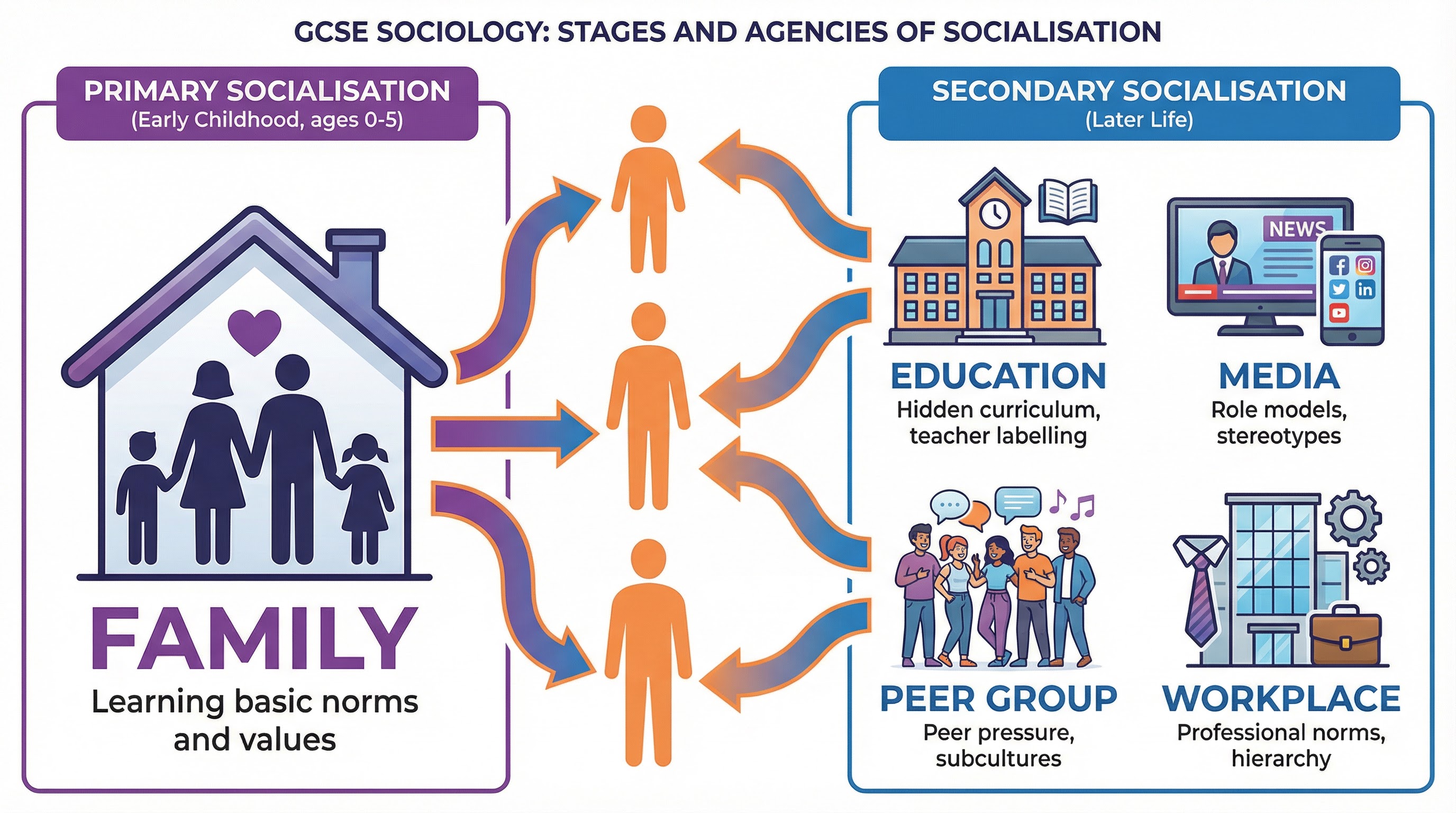
What is it?: Socialisation is divided into two key stages. Primary Socialisation occurs during early childhood (approx. 0-5 years) within the family. This is where we learn fundamental norms, values, and language. Secondary Socialisation continues throughout our lives, involving agencies outside the family that build upon the foundations of primary socialisation.
Why it matters: Examiners award marks for a clear distinction between these two stages. You must be able to identify the key agencies for each and explain their specific roles in the socialisation process. For example, the family's role in teaching basic manners (primary) versus the school's role in teaching punctuality and respect for authority (secondary).
Specific Knowledge: Candidates must know the main agencies of secondary socialisation: Education, the Media, Peer Groups, and the Workplace. You should be able to provide specific examples of what is learned from each.
Formal vs Informal Social Control
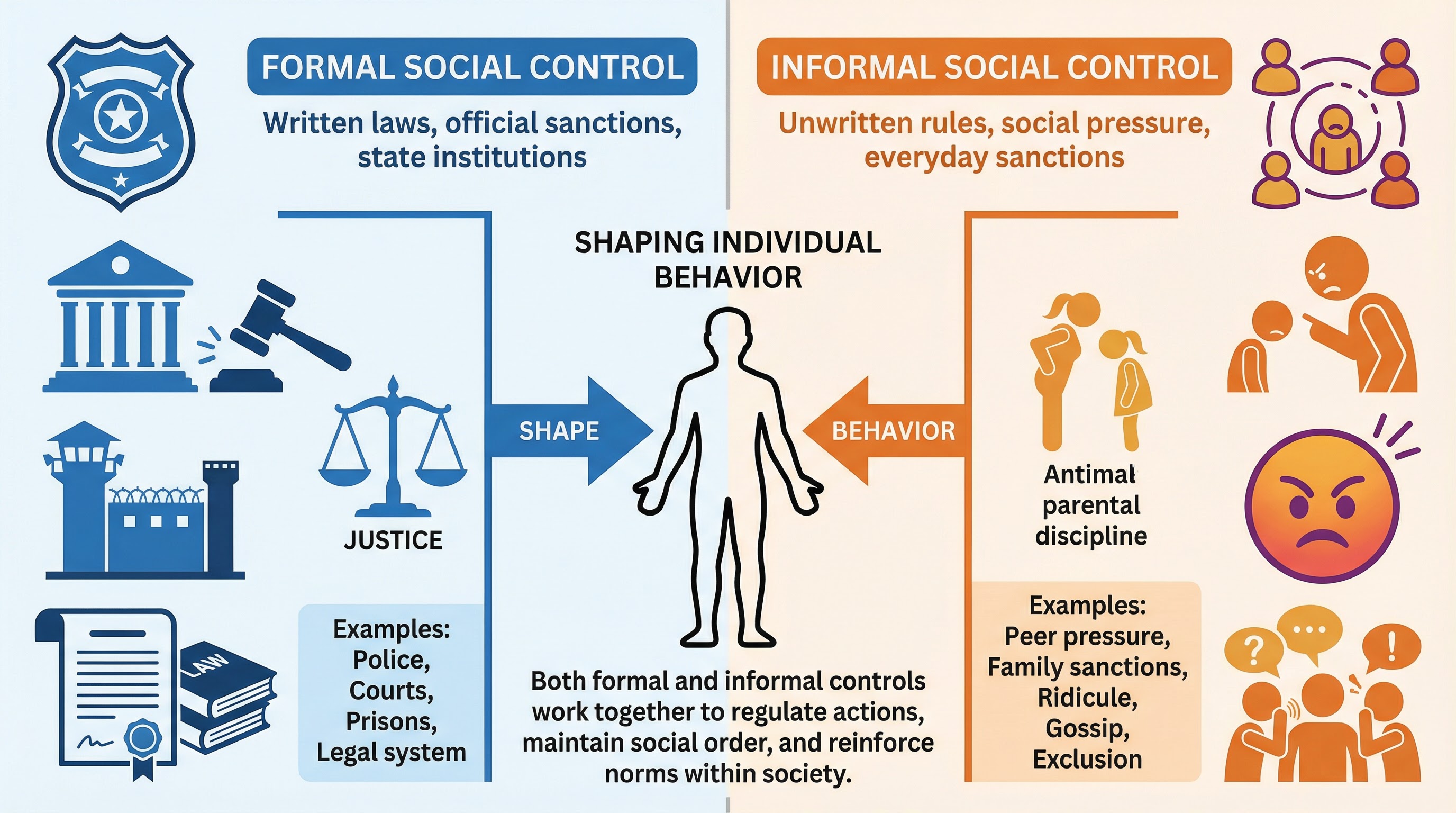
What is it?: Social control refers to the mechanisms society uses to ensure conformity to its norms and values. Formal Social Control is based on written laws and official, state-sanctioned punishments (e.g., police, courts, prisons). Informal Social Control is based on unwritten rules and social pressure, enforced through everyday interactions (e.g., peer pressure, gossip, parental discipline).
Why it matters: This distinction is crucial for understanding how social order is maintained. High-level responses will explain how both formal and informal controls work together to regulate individual behaviour. For instance, the fear of a formal sanction (a speeding ticket) and the informal sanction of social disapproval both discourage dangerous driving.
Specific Knowledge: Be able to provide clear examples for each type of control. Formal: arrest by police, a prison sentence. Informal: being excluded from a friendship group, a disapproving look from a parent.
The Nature vs Nurture Debate
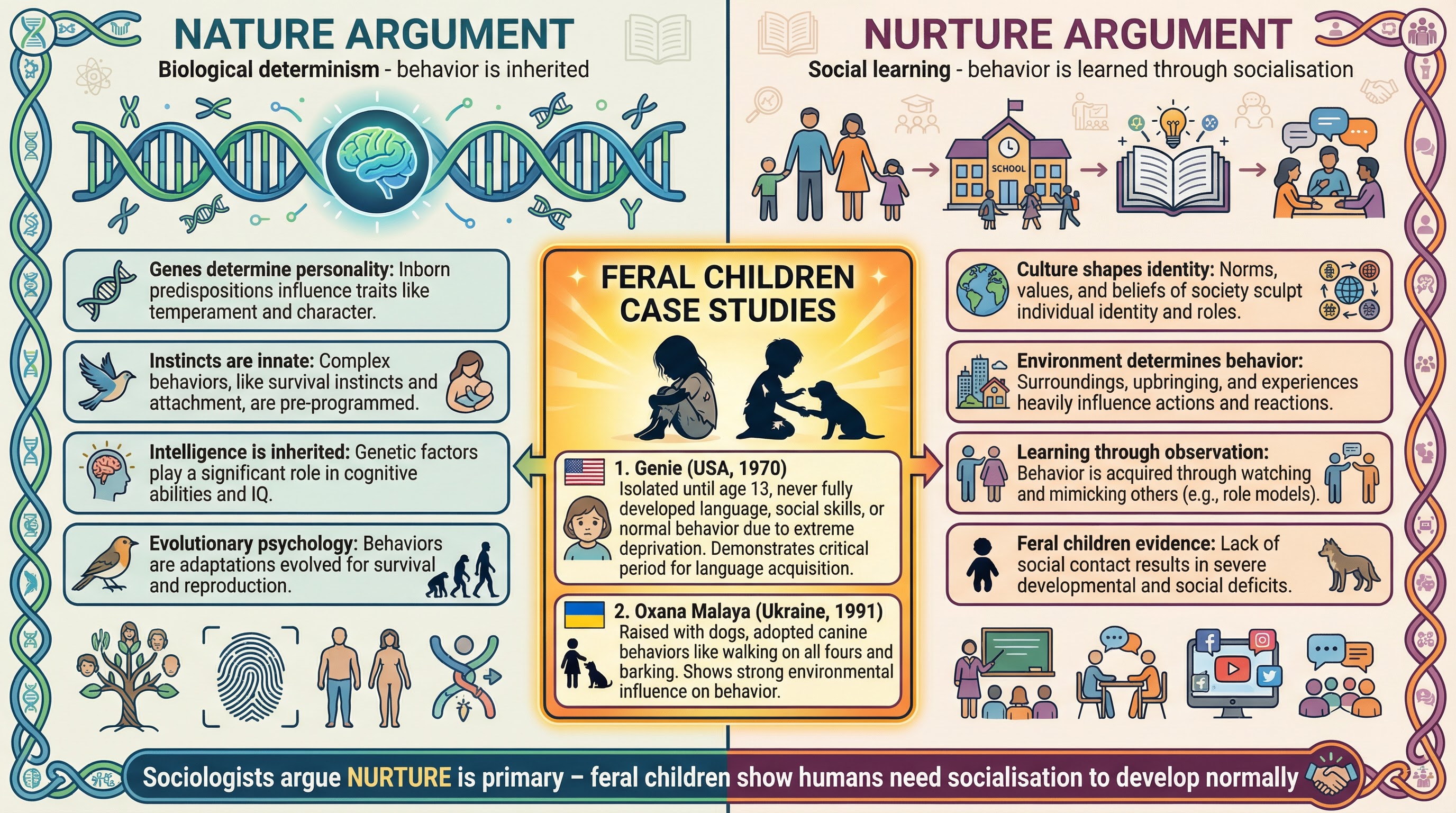
What is it?: This is a central debate in sociology. The Nature argument suggests that human behaviour is determined by biology, genetics, and instincts (biological determinism). The Nurture argument, which is favoured by sociologists, posits that behaviour is learned through the process of socialisation and interaction with the social environment.
Why it matters: This debate allows you to evaluate the core sociological claim that society shapes the individual. To earn high marks, you must use evidence to support the nurture argument. The most powerful evidence comes from studies of 'feral children' – individuals raised with little or no human contact.
Specific Knowledge: You MUST cite specific case studies. Genie, a girl discovered in the USA in 1970 after being isolated in her room for 13 years, never fully acquired language, demonstrating the critical period for social learning. Oxana Malaya, found in Ukraine in 1991, was raised by dogs and adopted their behaviours, such as walking on all fours and barking. These cases are powerful evidence that human characteristics we often think of as 'natural' are in fact learned through socialisation.
Key Individuals & Theories
Ann Oakley
Role: Feminist Sociologist
Key Actions: Oakley identified four key processes through which families socialize children into gender roles. These are essential for explaining gender inequality.
Impact: Her work provides a clear framework for analysing how gender is socially constructed. In exams, naming Oakley and her four processes (Manipulation, Canalisation, Verbal Appellation, Different Activities) will gain you significant AO1 credit.
Talcott Parsons
Role: Functionalist Sociologist
Key Actions: Parsons argued that socialisation is essential for creating social solidarity and value consensus. He saw the family as a 'personality factory', producing children who are committed to society's shared norms and values.
Impact: Parsons' view represents the Functionalist perspective on socialisation. It's a positive view, suggesting socialisation benefits everyone by creating a stable and integrated society. You can contrast this with the Marxist view.
Karl Marx (and Marxists)
Role: Conflict Theorist
Key Actions: Marxists argue that socialisation is a tool used by the ruling class (the bourgeoisie) to transmit ruling class ideology. Agencies like the education system and the media teach the working class (the proletariat) to be passive, obedient workers who accept their own exploitation.
Impact: This provides a critical perspective on socialisation. Instead of creating consensus, Marxists argue it reproduces inequality and false consciousness. Contrasting the Functionalist and Marxist views is a key skill for earning AO3 (analysis and evaluation) marks.