Study Notes

Overview
Values are the bedrock of culture and social life, representing the general principles and beliefs about what is good, right, and desirable in a society. For OCR GCSE Sociology, a precise understanding of values is not just recommended; it is essential for high-level analysis. Examiners expect candidates to distinguish values from norms, analyse their cultural and historical relativity, and explain their transmission through various agencies of socialisation. Furthermore, marks are consistently awarded for applying the theoretical perspectives of Functionalism and Marxism to evaluate the role values play in either creating social cohesion or reinforcing social inequality. This guide will equip you with the specific knowledge, analytical skills, and exam techniques required to confidently tackle any question on this fundamental topic.
Defining and Understanding Values
Values vs. Norms
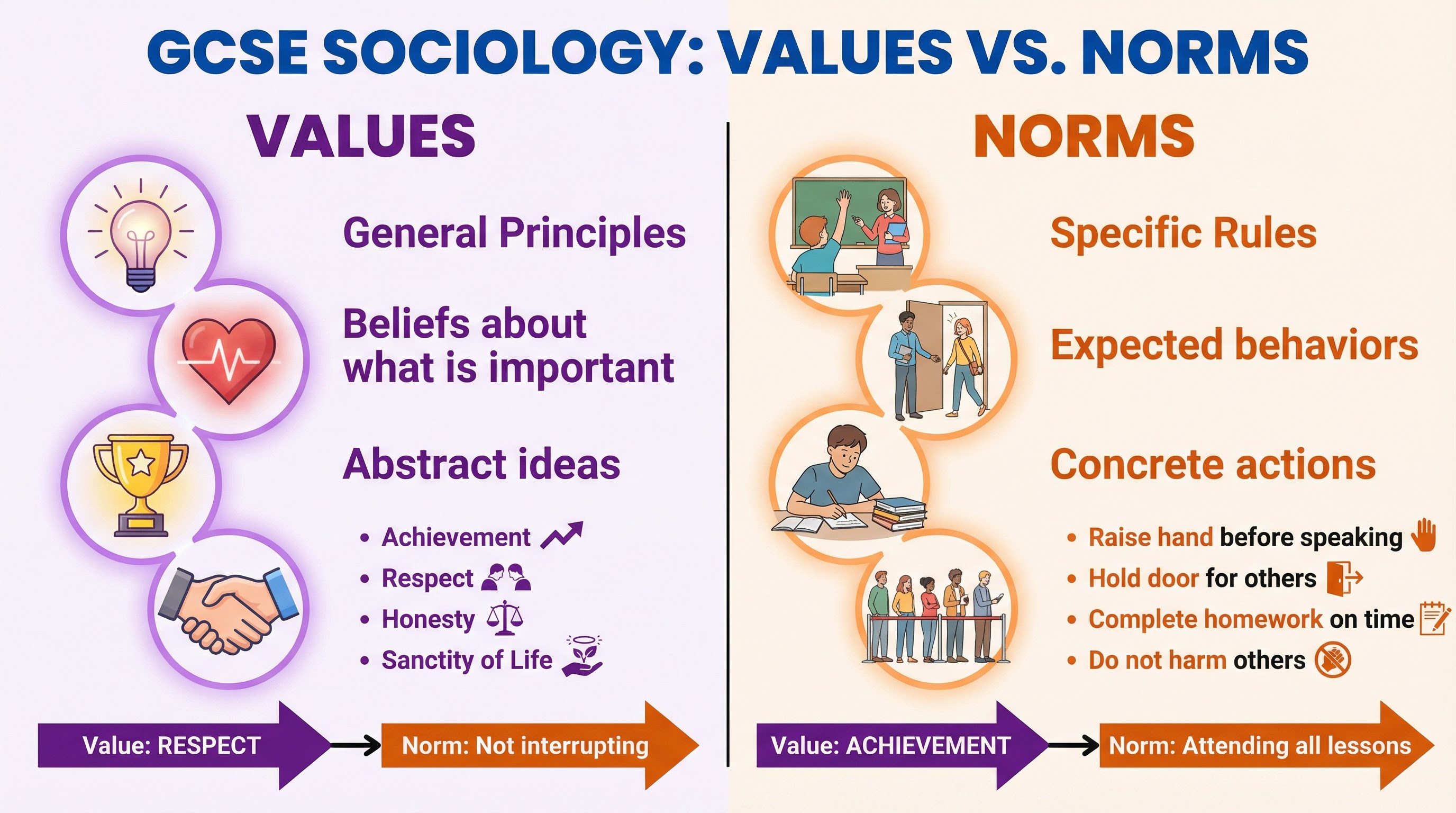
One of the most common pitfalls for candidates is confusing values with norms. The distinction is simple but crucial:
- Values are abstract, general principles (e.g., honesty, achievement, respect).
- Norms are the specific, concrete rules of behaviour that arise from those values (e.g., telling the truth, completing homework, not interrupting).
Examiners reward candidates who can clearly link a value to a corresponding norm. For instance, the value of 'sanctity of life' leads to the norm of 'not harming others'.
The Relativity of Values
Values are not fixed or universal; they are socially constructed and vary significantly across different contexts:
- Cultural Relativity: A value prominent in one culture may be less so in another. For example, many Western cultures prioritise the value of individualism, celebrating personal achievement and autonomy. In contrast, many East Asian cultures prioritise collectivism, where group harmony and loyalty are considered more important than individual desires.
- Historical Relativity: Values within a single society can change dramatically over time. In the UK, the value placed on traditional gender roles has declined significantly over the past 50 years, replaced by a stronger emphasis on gender equality.
The Transmission of Values: Agencies of Socialisation
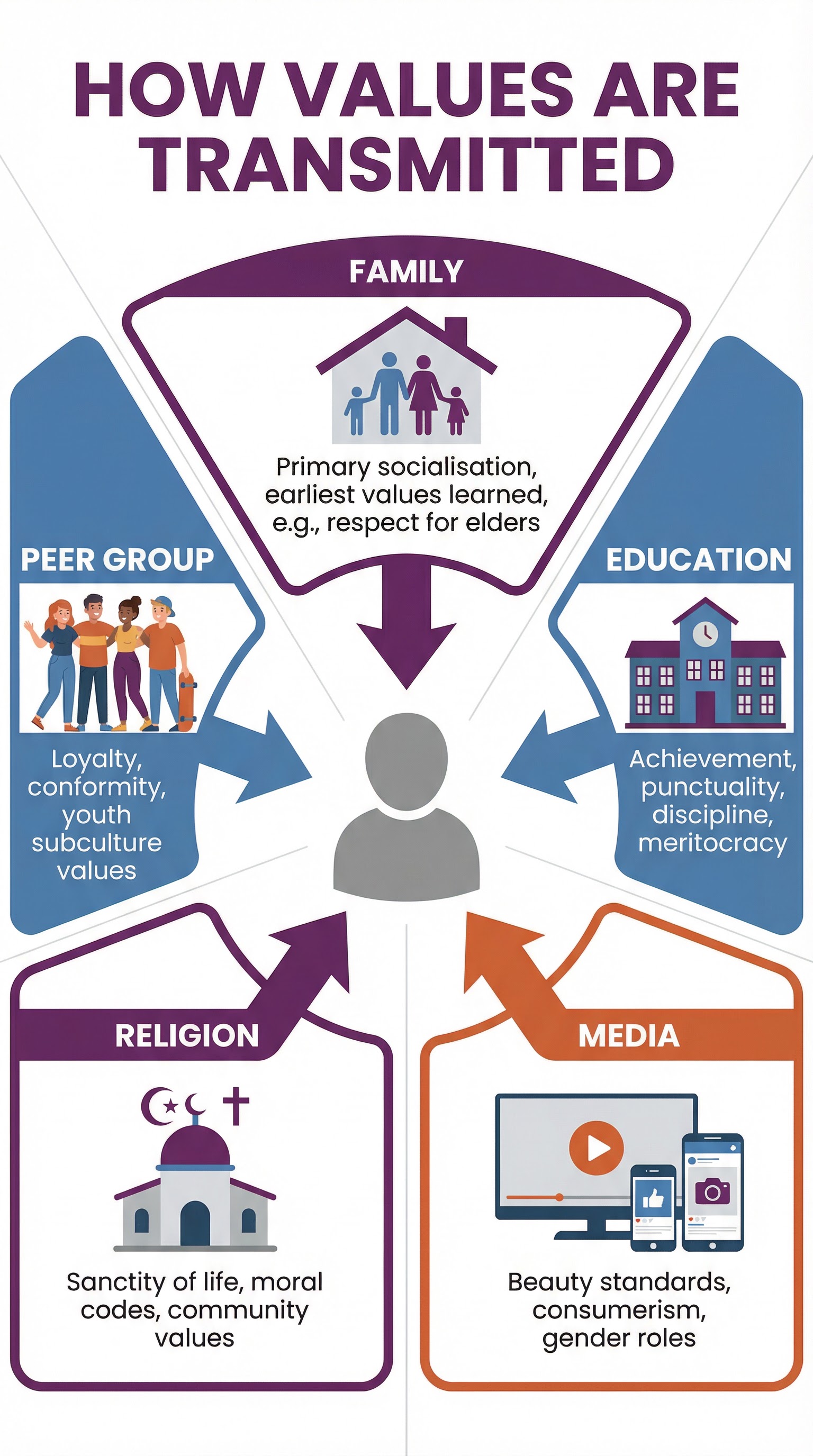
Values are learned and internalised through a process called socialisation, which occurs via several key agencies. You must be able to name these agencies and explain how they transmit specific values.
Theoretical Perspectives on Values
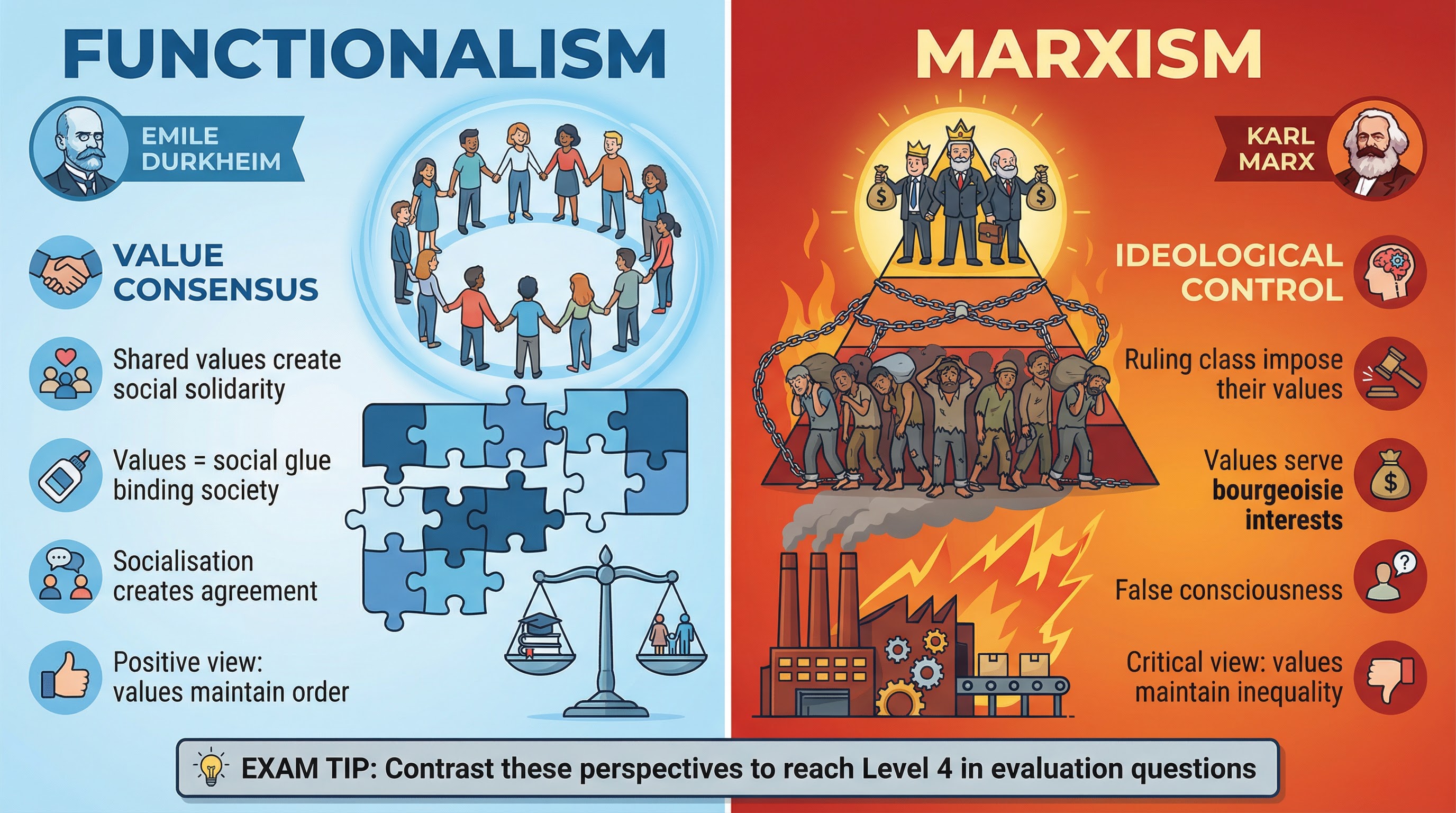
To achieve the highest marks (AO3), you must engage with the theoretical debate surrounding the function of values in society. The two key perspectives are Functionalism and Marxism.
Functionalism: Value Consensus
- Key Thinker: Émile Durkheim
- Core Idea: Functionalists argue that for society to function smoothly, there must be a value consensus—a broad agreement on what is important. These shared values act as a form of 'social glue', creating social solidarity and integrating individuals into the wider community.
- Function: Values guide behaviour and ensure people are committed to the collective good, maintaining social order and stability.
Marxism: Ideological Control
- Key Thinker: Karl Marx
- Core Idea: Marxists offer a critical perspective, arguing that the values of a society are the values of the ruling class (the bourgeoisie). These values are imposed on the working class (the proletariat) through agencies like the media and education.
- Function: Values serve to maintain and legitimise the capitalist system. For example, the value of 'meritocracy' promotes the idea that anyone can succeed through hard work, creating a false consciousness that distracts workers from the reality of their exploitation and prevents them from challenging the status quo.