
Study Notes
Overview
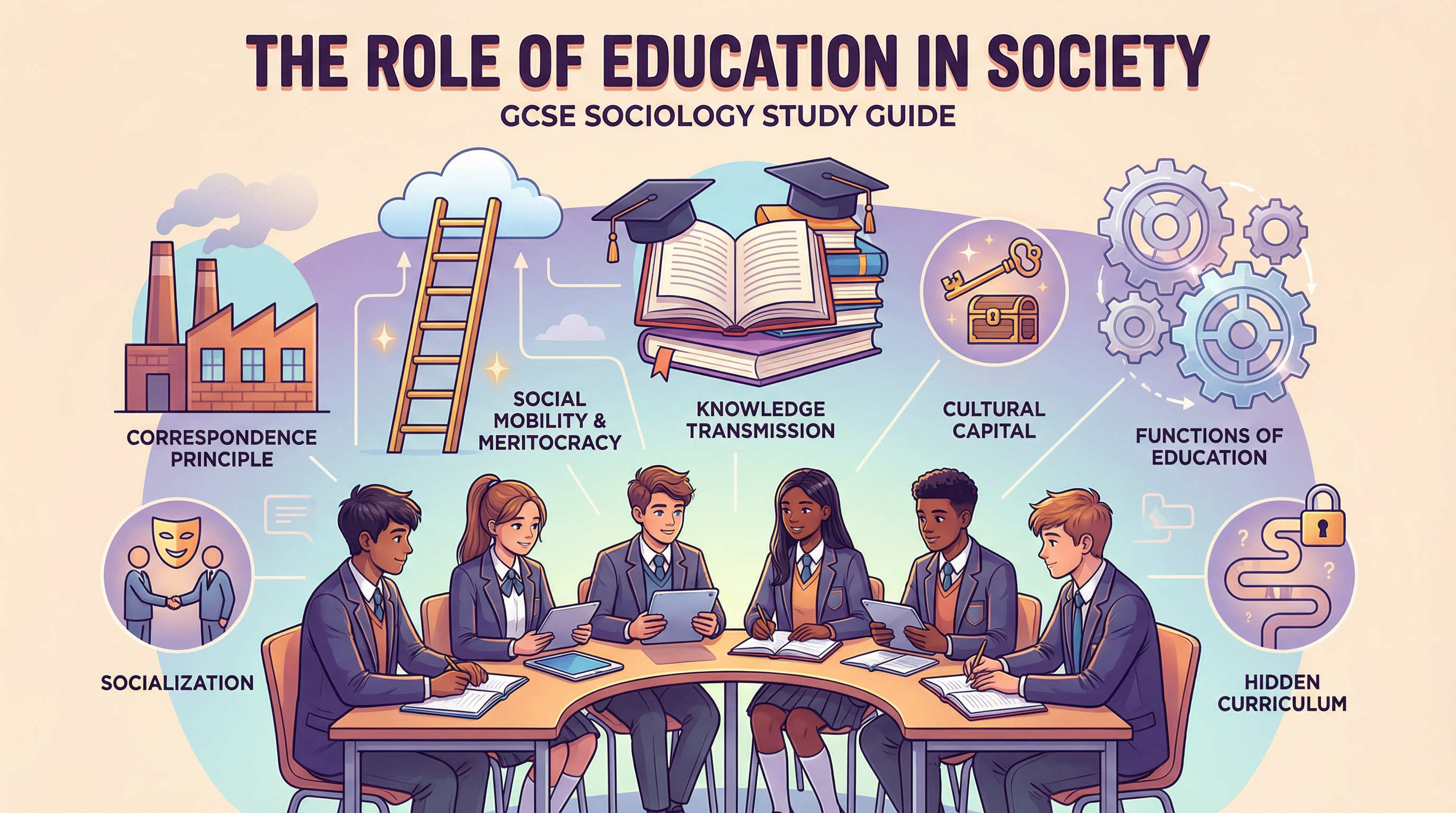
This topic explores the central role of the education system in modern society, a cornerstone of OCR J202 Component 01. Examiners expect candidates to move beyond simplistic descriptions of schooling and engage critically with major sociological theories. You will need to contrast the Functionalist view, which sees education as a positive institution that promotes social solidarity and meritocracy, with the Marxist perspective, which argues that education is an instrument of class domination that reproduces social inequality. A strong understanding of key concepts like social solidarity, meritocracy, the correspondence principle, and cultural capital is essential. Furthermore, credit is given for evaluating these theories, using evidence to weigh their strengths and weaknesses. This guide will provide the detailed knowledge, analytical frameworks, and specific examples needed to excel.
Key Sociological Perspectives
Functionalism: Education as a Positive Force
Core Idea: Functionalists see society as a complex system whose parts work together to promote stability and solidarity. They believe education serves positive functions for both the individual and society.
Key Functions:
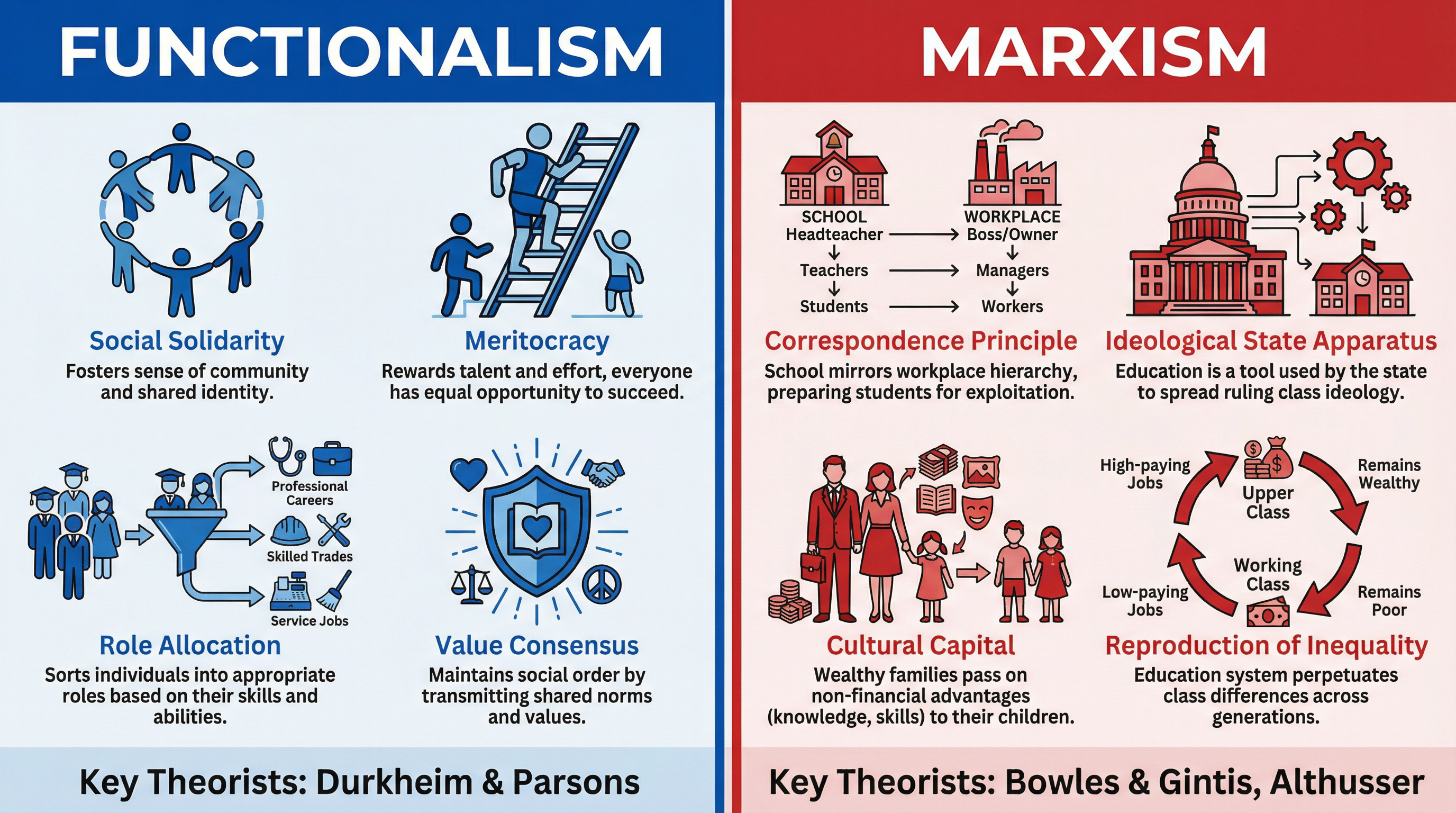
- Creating Social Solidarity: Émile Durkheim argued that society can only survive if its members share a common set of beliefs and values (a 'value consensus'). Education, particularly the teaching of a nation's history and culture, instills a sense of shared identity and commitment to the wider social group. This creates social cohesion and prevents societal breakdown.
- Teaching Specialist Skills: In complex industrial societies, a diverse range of skills is needed for the economy to function. Education equips individuals with the specialist knowledge and skills required for their future roles in the division of labour.
- Role Allocation (Meritocracy): Talcott Parsons argued that schools are meritocratic. This means they provide an equal opportunity for all individuals to achieve their full potential. Through exams and assessments, schools sift and sort individuals based on their talents and efforts, allocating them to the most appropriate jobs. This ensures the most talented people fill the most important roles.
- Acting as a Social Bridge: Parsons also saw school as a bridge between the family and wider society. Within the family, a child is judged by 'particularistic standards' (i.e., they are treated as a special individual). However, in school and society, they are judged by 'universalistic standards' (i.e., the same rules and standards apply to everyone). This transition prepares children for life in a modern, impersonal society.
Marxism: Education as an Instrument of Control
Core Idea: Marxists see society as being based on class conflict between the bourgeoisie (the ruling class) and the proletariat (the working class). They argue that all social institutions, including education, serve the interests of the ruling class.
Key Functions:
- The Ideological State Apparatus (ISA): Louis Althusser argued that the state controls the population through two types of apparatus. The Repressive State Apparatus (RSA) maintains control through force (e.g., police, army). The Ideological State Apparatus (ISA) maintains control by shaping people's beliefs and values. Althusser saw education as the most important ISA, as it transmits a ruling-class ideology that presents capitalism as fair and just, thus legitimising inequality.
- The Correspondence Principle: In their famous study, 'Schooling in Capitalist America' (1976), Samuel Bowles and Herbert Gintis argued that there is a close correspondence between the social relationships in school and those in the workplace. Schools are organised along hierarchical lines, demand punctuality and obedience, and reward conformity. This prepares working-class pupils for their future as exploited, alienated workers.
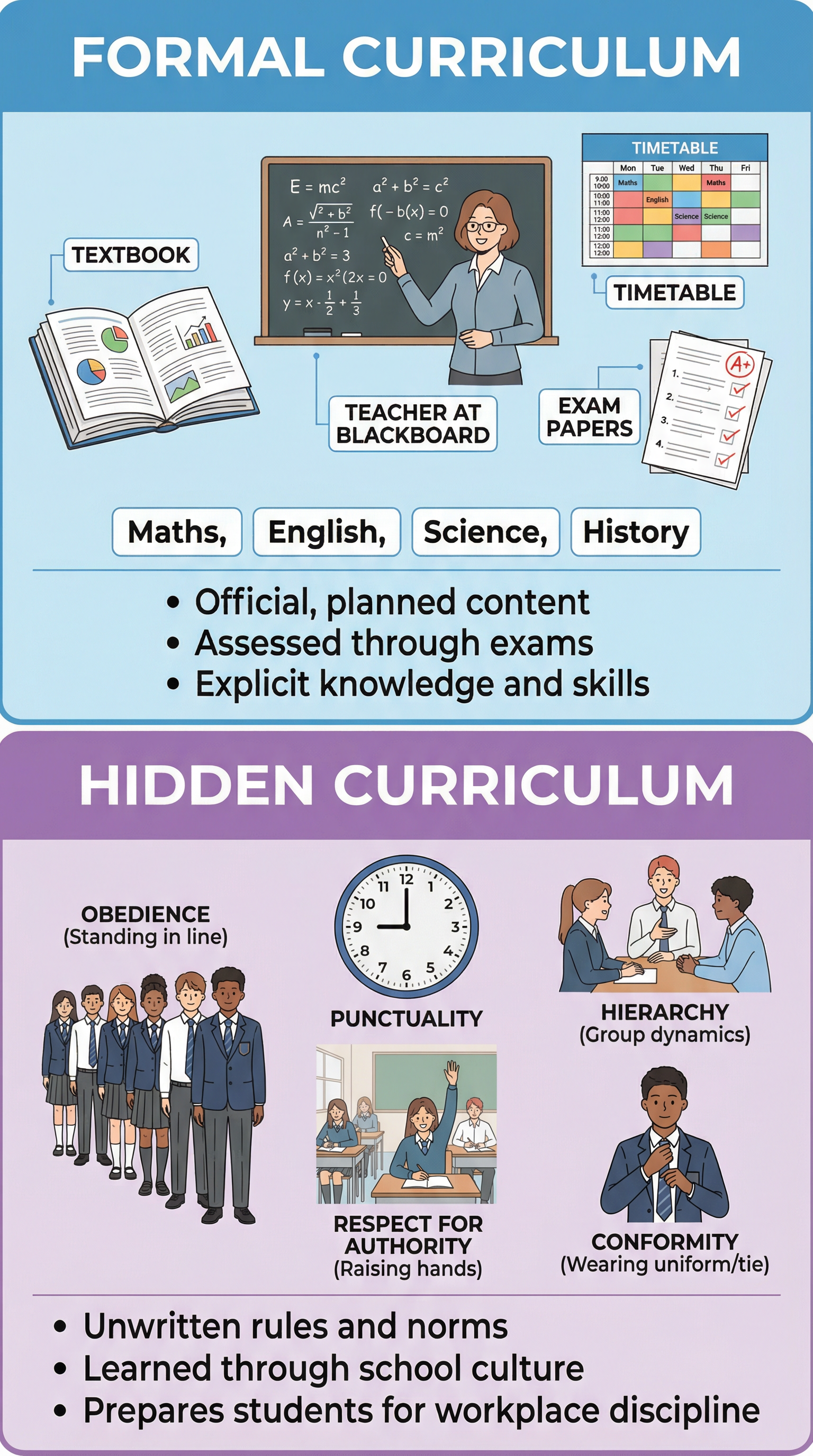
- The Hidden Curriculum: While the formal curriculum consists of the subjects taught in lessons, the hidden curriculum refers to the unwritten rules and values that pupils learn simply by being part of the school environment. Marxists argue that the hidden curriculum teaches pupils to accept hierarchy, competition, and their subordinate position, which is essential for maintaining a capitalist society.
- Reproduction of Class Inequality: Pierre Bourdieu argued that middle-class pupils come to school with more 'cultural capital' – the knowledge, attitudes, and values of the middle class. The education system is biased towards this culture, so middle-class pupils have a built-in advantage, while working-class pupils are more likely to fail. This ensures that class inequality is reproduced from one generation to the next.
Key Individuals
Émile Durkheim (1858-1917)
Role: A founding father of sociology and a key Functionalist thinker.
Key Actions: Analysed the function of social institutions. Argued that education's primary role is to create social solidarity and transmit a shared culture.
Impact: His ideas form the basis of the Functionalist perspective on education, emphasizing its positive contribution to social stability.
Talcott Parsons (1902-1979)
Role: A leading American Functionalist sociologist.
Key Actions: Developed the concepts of meritocracy, role allocation, and the school as a bridge between family and society.
Impact: His work built on Durkheim's ideas, providing a more detailed account of how education serves the needs of a modern industrial society.
Louis Althusser (1918-1990)
Role: A French Marxist philosopher.
Key Actions: Introduced the concept of the Ideological State Apparatus (ISA), arguing that education is the key ISA for maintaining ruling-class power.
Impact: His work provided a more sophisticated Marxist theory of education, moving beyond simple economic determinism.
Samuel Bowles & Herbert Gintis (Contemporary)
Role: American Marxist economists and sociologists.
Key Actions: Authored 'Schooling in Capitalist America' (1976), where they developed the correspondence principle.
Impact: Their study provided influential evidence for the Marxist view that schools prepare pupils for their role as exploited workers in a capitalist system.