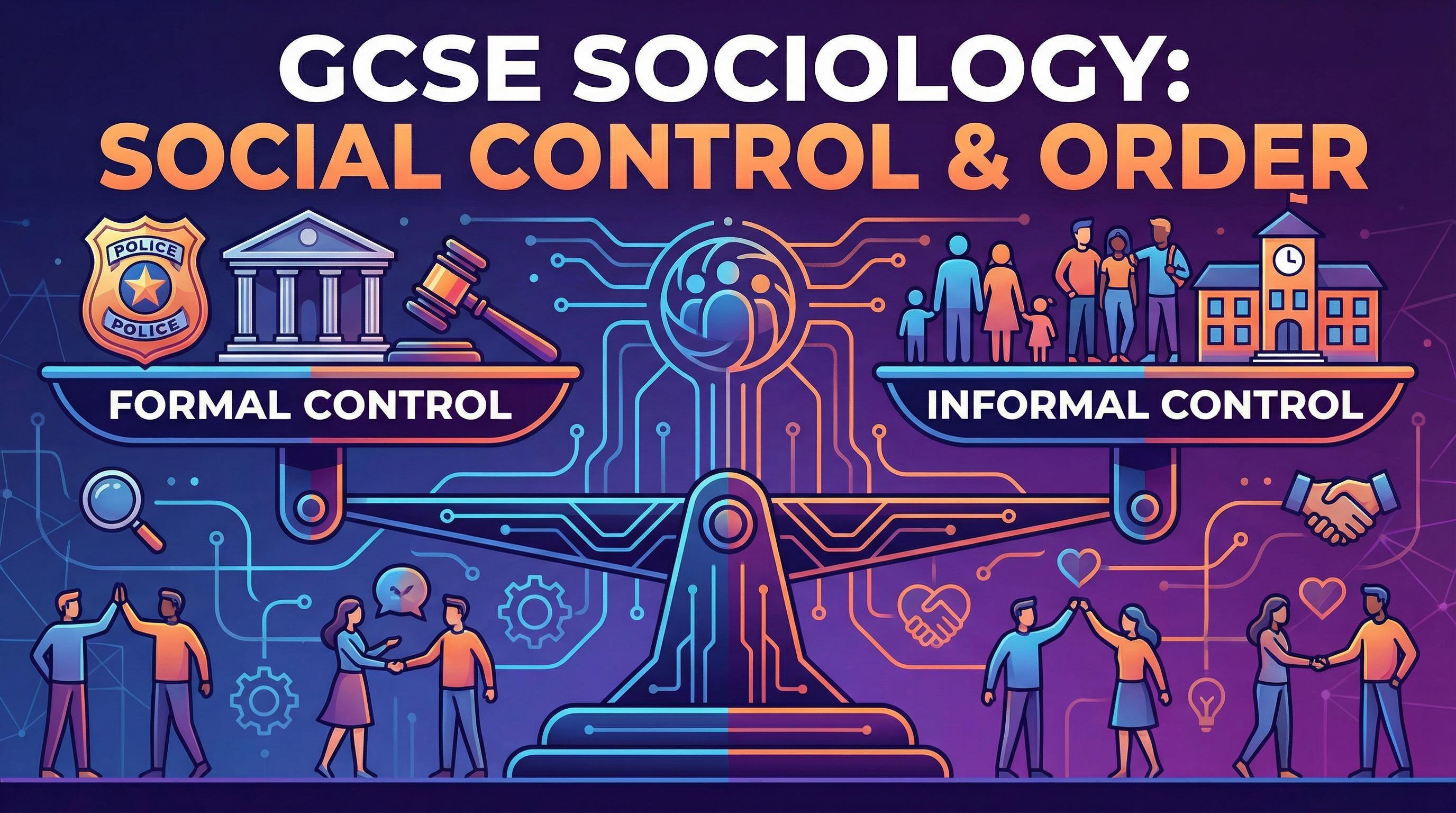
Social Control — WJEC GCSE study guide illustration

    Social Control

    WJEC
    GCSE
    Sociology

    This study guide examines the critical sociological topic of Social Control, exploring how society maintains order through both visible, formal rules and subtle, informal pressures. It is essential for understanding the fundamental forces that shape our behaviour, from family life to the justice system, and for tackling high-mark questions on social order and conflict.

    5
    Min Read
    3
    Examples
    5
    Questions
    6
    Key Terms
    🎙 Podcast Episode
    Social Control
    0:00-0:00

    Study Notes

    An illustration balancing the formal agencies of control (police, courts) against the informal agencies (family, peers).

    Overview

    Social Control is a cornerstone of the WJEC GCSE Sociology specification, focusing on the mechanisms societies use to ensure conformity and maintain order. For examiners, this topic is a test of a candidate’s ability to differentiate between the overt and covert ways behaviour is regulated. A strong response will demonstrate a clear understanding of the distinction between formal control, enforced by official state agencies like the police and judiciary, and informal control, exercised by social institutions like the family and peer groups. Candidates are expected to analyse the specific methods—or sanctions—these agencies use, from legal punishment to social ostracism. Furthermore, high-level analysis requires engagement with the core theoretical debate: do these control mechanisms serve the common good, as Functionalists argue, or do they perpetuate the power of a dominant class, as Marxists contend? This guide will equip you with the precise terminology, theoretical knowledge, and analytical frameworks needed to deconstruct exam questions and secure maximum marks.

    Listen to our 10-minute guide on Social Control, covering key concepts, theories, and exam tips.

    Formal vs. Informal Social Control

    At the heart of this topic is the fundamental distinction between formal and informal social control. Marks are explicitly awarded for demonstrating a clear understanding of this dichotomy.

    Formal Social Control

    This is the enforcement of laws and official rules by agencies given legal authority by the state. It is explicit, codified, and often involves the threat of legal punishment.

    • Agencies: Police, Courts, Judiciary, Prisons, Parliament (Government), and the formal aspects of the Education system.
    • Mechanisms: The use of sanctions, which are rewards or punishments to enforce norms. Formal sanctions are officially recognised.
      • Positive Formal Sanctions: Official rewards for conforming to rules (e.g., a medal for bravery, a promotion, an acquittal in court).
      • Negative Formal Sanctions: Official punishments for breaking rules (e.g., a fine, a prison sentence, a formal warning, expulsion from school).

    Informal Social Control

    This is the enforcement of social norms and values through unofficial social pressures. It is often subtle, unwritten, and relies on the power of social relationships.

    • Agencies: Family, Peer Groups, Media, Religious Institutions, and the informal aspects of the Education system (e.g., peer pressure in the playground).
    • Mechanisms: The use of informal sanctions.
      • Positive Informal Sanctions: Unofficial rewards for conformity (e.g., praise from parents, a smile, a nod of approval, acceptance into a friendship group).
      • Negative Informal Sanctions: Unofficial punishments for deviance (e.g., criticism, disapproval, being ignored or ‘sent to Coventry’ (ostracism), gossip).
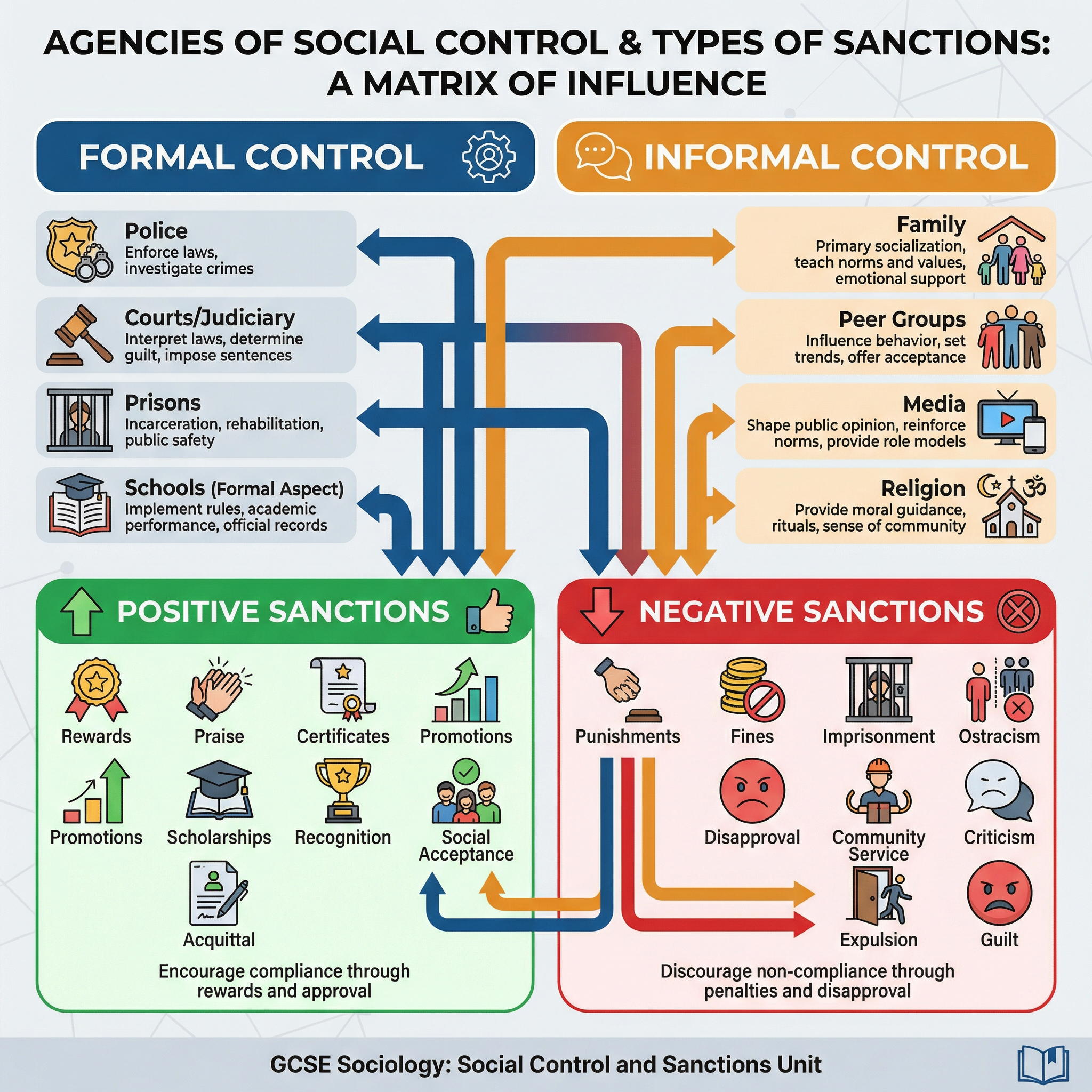
    A diagram mapping formal and informal agencies to the positive and negative sanctions they employ.

    Theoretical Perspectives on Social Control

    Examiners expect candidates to apply sociological theories to this topic, especially in higher-mark evaluation questions. The central debate is between consensus and conflict theories.

    Functionalism: Control for Consensus

    Functionalists, like Émile Durkheim, view social control as a vital and positive function for society. They argue:

    • Maintains Social Order: Without control, society would descend into anomie (a state of normlessness and chaos).
    • Enforces Value Consensus: Social control reinforces the shared norms and values that most people agree on, creating social solidarity.
    • Benefits Everyone: The agencies of control (police, courts) work on behalf of the whole of society to keep people safe and maintain a stable social structure.

    Marxism: Control for Conflict

    Marxists, following the ideas of Karl Marx, see social control as a tool used by the ruling class (the bourgeoisie) to maintain power and control over the working class (the proletariat).

    • Protects Ruling Class Interests: The laws and the agencies that enforce them are not neutral; they are designed to protect the private property and wealth of the powerful.
    • Coercion not Consent: Order is maintained not because everyone agrees on the rules, but because the working class is forced to comply through the threat of punishment (coercion).
    • Maintains Inequality: Social control mechanisms suppress dissent and revolution, ensuring the capitalist system and its inherent inequalities continue unchallenged.
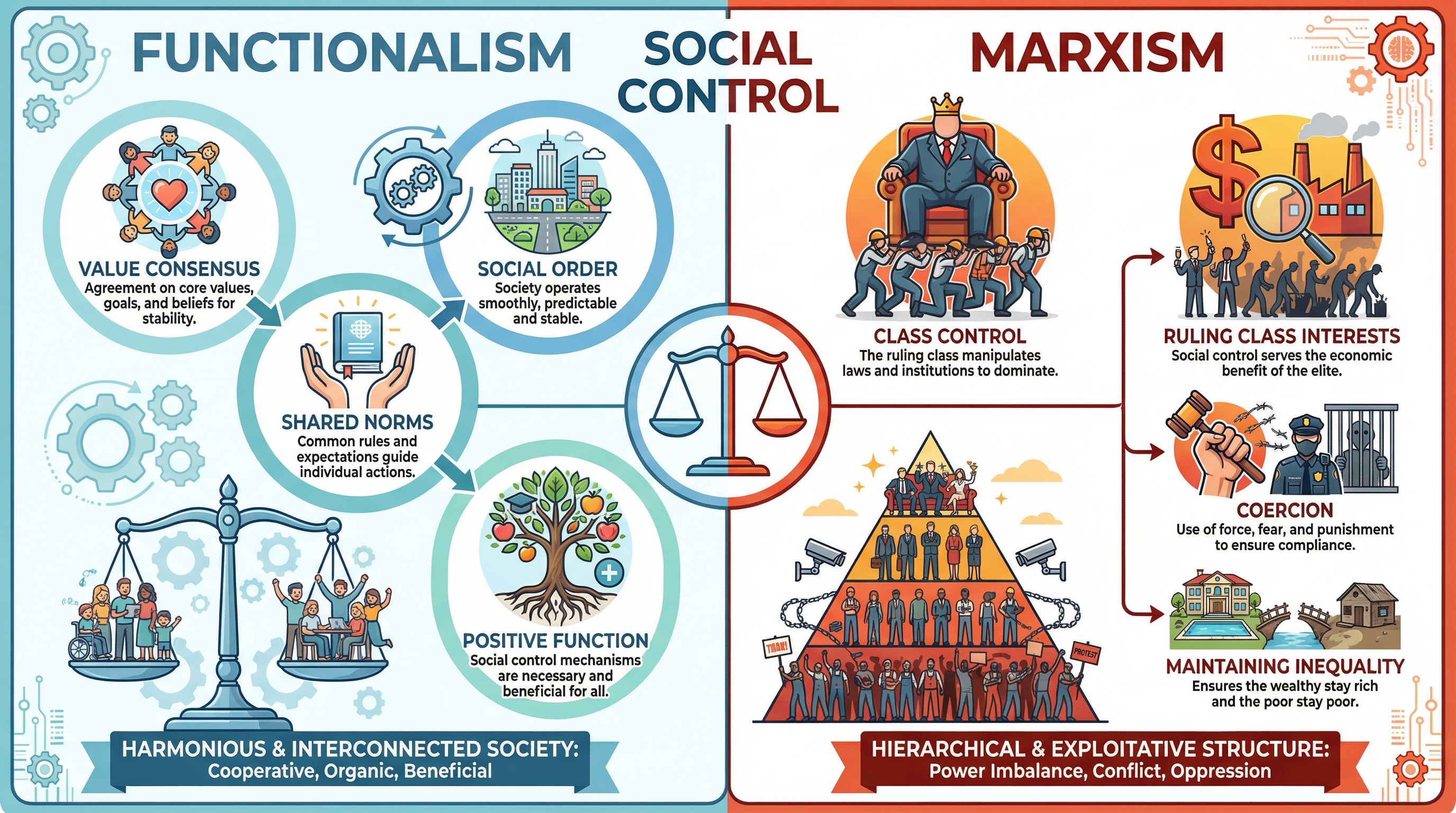
    A visual breakdown of the Functionalist (consensus) versus Marxist (conflict) views on social control.

    Worked Examples

    3 detailed examples with solutions and examiner commentary

    Practice Questions

    Test your understanding — click to reveal model answers

    Q1

    Describe two types of informal sanction.

    4 marks
    standard

    Hint: Think about rewards and punishments that don't involve the law. Remember to give one positive and one negative example.

    Q2

    Explain why the media is considered an agency of social control.

    6 marks
    standard

    Hint: Think about how the media influences our ideas of what is normal and deviant. Consider representation and stereotypes.

    Q3

    Explain the difference between formal and informal social control, using the example of education.

    8 marks
    hard

    Hint: Education is a unique agency that uses both types of control. Separate your answer into two paragraphs, one for each type.

    Q4

    Describe the Functionalist view of social control.

    4 marks
    standard

    Hint: Think 'consensus' and 'harmony'. Why do Functionalists see control as a good thing?

    Q5

    Evaluate the Marxist view that social control serves only the interests of the ruling class. (15 marks)

    15 marks
    hard

    Hint: This is an essay question. Argue for the Marxist view (using concepts like coercion, ideology, selective law enforcement) and then argue against it (using Functionalist ideas or pointing out laws that benefit everyone).

    Key Terms

    Essential vocabulary to know

    More Sociology Study Guides

    View all

    Socialisation

    WJEC
    GCSE

    This guide explores the process of socialisation, a cornerstone of WJEC GCSE Sociology. It examines how we learn society's rules and develop our identity, a crucial concept for understanding all social behaviour and a topic that frequently appears in exams.

    The impact of government policies on education

    Edexcel
    GCSE

    This study guide examines the evolution of UK government education policies and their profound impact on social inequality. From the post-war Tripartite System to the market-driven reforms of today, we explore how policy has shaped the life chances of students based on class, ethnicity, and gender, providing essential knowledge for top marks in your Edexcel GCSE Sociology exam.

    Identity

    Edexcel
    GCSE

    This study guide delves into the sociological concept of Identity, a cornerstone of the Edexcel GCSE specification. It explores how our sense of self is not born but built, shaped by the powerful forces of family, school, media, and friends. Prepare to challenge common-sense ideas and analyse your own identity through the critical lenses of major sociological theories.

    Ethnic Inequality

    Edexcel
    GCSE

    This study guide delves into the complex issue of ethnic inequality in the UK, a core component of the Edexcel GCSE Sociology curriculum. It provides a detailed analysis of how ethnicity impacts life chances across key social institutions, equipping students with the theoretical knowledge and specific evidence needed to excel in their exams.

    Surveys

    Edexcel
    GCSE

    Master the #1 quantitative method for Edexcel GCSE Sociology: Surveys. This guide breaks down everything from sampling to structured interviews, giving you the examiner's perspective on how to secure top marks. Understand the crucial difference between reliability and validity to ace your research methods questions.

    Theories of the Family

    OCR
    GCSE

    This study guide provides a comprehensive overview of the key sociological theories of the family for OCR GCSE Sociology. It is designed to be exam-focused, helping students to understand and critically evaluate Functionalist, Marxist, Feminist, and New Right perspectives to secure top marks.