Study Notes
Overview
Drawing is the cornerstone of Art and Design. For OCR GCSE candidates, it is not merely an endpoint but the primary engine for visual thinking, investigation, and communication. It is the most direct way to evidence your engagement with the world (AO3), develop your creative voice (AO1), refine your technical skills (AO2), and present a resolved personal vision (AO4). Examiners value drawing that is investigative, analytical, and experimental, rather than just a series of neat copies. This guide will break down how to make your drawing practice the strongest element of your portfolio.
Key Knowledge & Theory
Core Concepts
To excel, candidates must move beyond simply 'drawing what they see' and engage with the core concepts that underpin effective practice. The most crucial distinction is between Primary and Secondary Sources. A primary source is any object, person, or place you observe directly from life. A secondary source is a pre-existing image, like a photograph or an internet printout. Credit is overwhelmingly given for drawing from primary sources as it demonstrates a higher level of perceptual skill and analytical understanding. Your ability to translate a 3D form onto a 2D surface, capturing its specific light, texture, and presence, is a key differentiator.
Mark-making is the language of drawing. Every line, dot, and smudge is a deliberate choice. You must build a vocabulary of marks to describe:
- Form: The three-dimensional shape and structure of an object.
- Tone: The range of light and shadow that creates an illusion of volume and depth.
- Texture: The surface quality of an object—is it rough, smooth, soft, or hard?
- Line: The use of contour, weight, and quality of line to define edges and express emotion.
Key Practitioners/Artists/Composers
Your investigation of other artists (AO1) must be more than superficial. You need to analyse how they draw and connect their techniques to your own work.
| Name | Period/Style | Key Works | Relevance |
|---|---|---|---|
| Egon Schiele | Austrian Expressionism | Self-Portraits (1910-1918) | Master of expressive, angular contour lines. His work shows how line alone can convey intense psychological states. Candidates should analyse his use of broken, nervous lines to inform their own figure drawings. |
| Käthe Kollwitz | German Expressionism | 'Woman with Dead Child' (1903) | A master of tone and emotional weight. Her charcoal and chalk drawings demonstrate how to build form and atmosphere through dense, layered mark-making. Excellent for studying how to convey social commentary. |
| Henry Moore | Modernist Sculpture | 'Shelter Drawings' (1940-41) | Moore used drawing to explore form and space. His use of wax-resist with watercolour wash is a key experimental technique. Candidates can learn how to combine media to create texture and depth. |
| David Hockney | Pop Art / Contemporary | iPad Drawings (2010-present) | Demonstrates that drawing is a contemporary practice that evolves with technology. His use of vibrant colour and layered digital marks in apps like Procreate shows how traditional observation can be translated to new media. |
Technical Vocabulary
Using precise terminology in your annotations and any written responses is essential. It shows the examiner you have a sophisticated understanding of the subject.
- Chiaroscuro: The use of strong contrasts between light and dark, usually bold contrasts affecting a whole composition.
- Foreshortening: The technique of depicting an object or human body in a picture so as to produce an illusion of projection or extension in space.
- Sgraffito: A form of decoration made by scratching through a surface to reveal a lower layer of a contrasting colour.
- Gestural Drawing: A style of drawing that is rapid, expressive, and concerned with capturing movement and essence over fine detail.
- Tonal Range: The spectrum of light to dark values within a drawing.
- Contour Line: The line which defines a form or an edge. It can be used to suggest mass and volume.
Practical Skills
Techniques & Processes
Mastering a range of techniques is crucial for AO2 (Refine). You must experiment with different ways of making marks to find the most appropriate language for your ideas. Below are some fundamental techniques you should explore and evidence in your sketchbook.
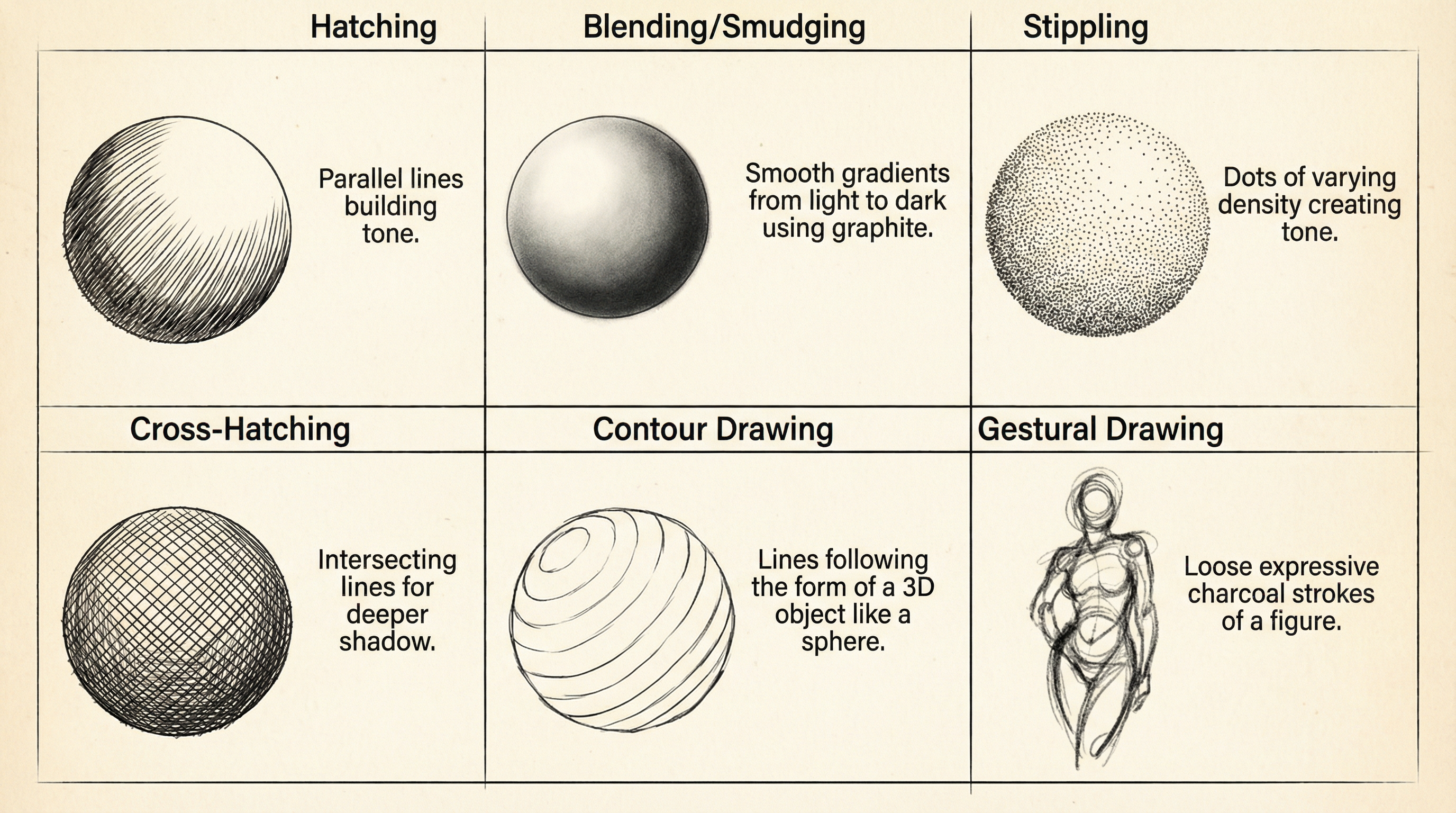
- Hatching & Cross-Hatching: Building up tone with parallel or intersecting lines. The closer the lines, the darker the tone. This is a very controlled method, excellent for showing form.
- Stippling: Creating tone and texture using thousands of tiny dots. This is a time-consuming but highly effective technique for creating subtle, detailed surfaces.
- Blending/Smudging: Using a finger, tortillon, or cloth to smooth graphite or charcoal to create soft, continuous gradients of tone.
- Contour Drawing: Focusing solely on the outlines and visible edges of a subject. 'Blind' contour drawing, where you don't look at the paper, is an excellent exercise for improving hand-eye coordination.
- Gestural Drawing: Using fast, expressive, and sweeping marks to capture the energy and movement of a subject, often used in life drawing.
Materials & Equipment
Your choice of media directly impacts the outcome of your drawing. You should experiment with a wide range and annotate your reasons for selecting specific materials.
- Graphite Pencils: Available in a range of hardnesses (e.g., 2H to 8B). Harder pencils (H) produce light, precise lines, while softer pencils (B) create dark, rich, and easily smudged marks.
- Charcoal: Comes in willow (soft, dusty) and compressed (dark, dense) forms. Excellent for large-scale, expressive work and creating deep blacks.
- Ink: Can be applied with dip pens, brushes, or fineliner pens. Offers strong, permanent lines and can be watered down to create washes.
- Pastels & Conté: Provide rich colour and a painterly quality. They can be blended easily but require a fixative to prevent smudging.
- Digital Tools: Apps like Procreate or Adobe Fresco on a tablet allow for endless experimentation with brushes, layers, and effects, fully recognised by OCR.
Portfolio/Coursework Guidance
Assessment Criteria
Your entire portfolio is assessed against four equally weighted Assessment Objectives. Understanding what each one asks for is the key to building a successful project.
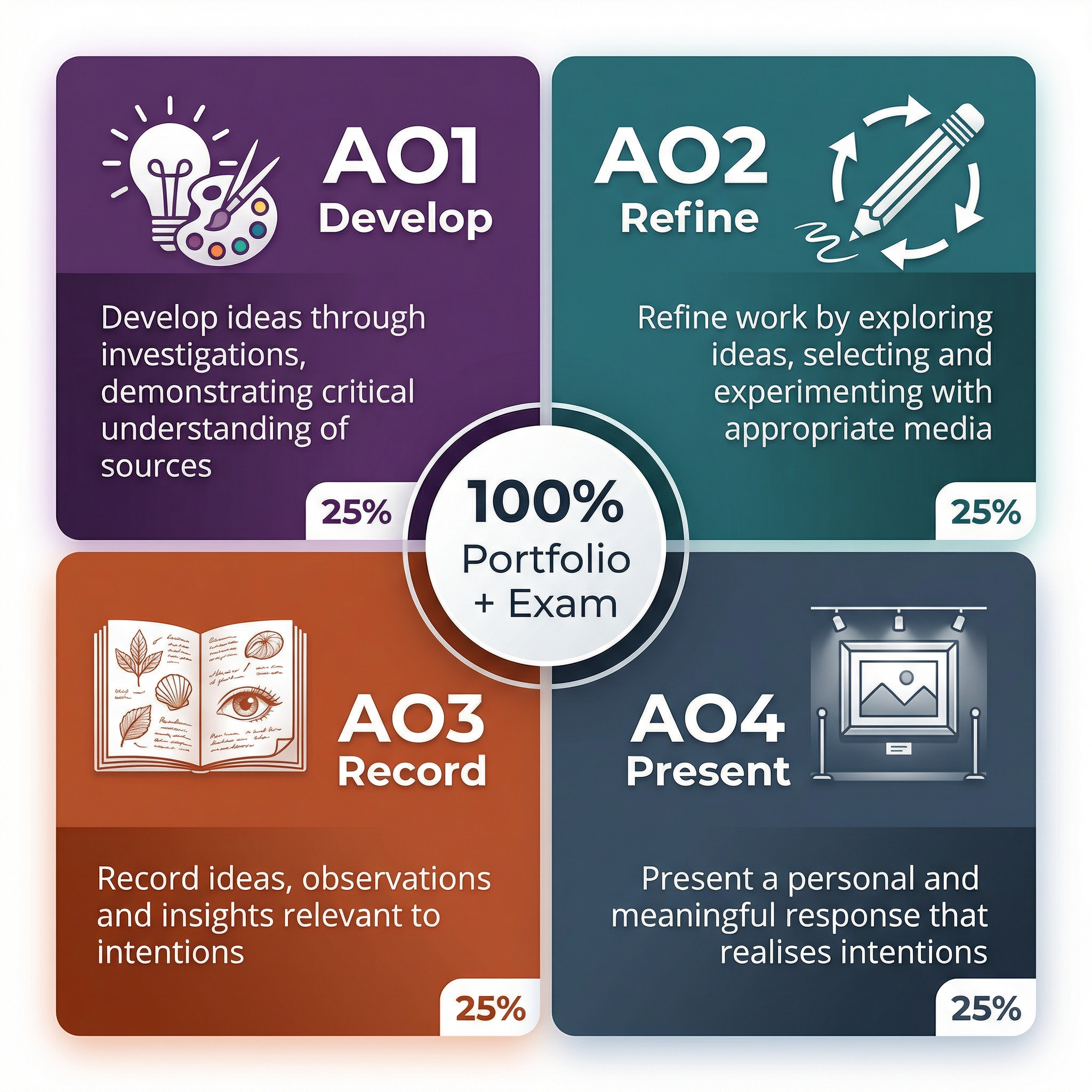
- AO1: Develop (25%): How well do you investigate and critically understand sources? This is where your artist research and analysis sits. You must show that your ideas are not random, but have developed from a clear line of inquiry.
- AO2: Refine (25%): How do you explore ideas and experiment with media? This is your journey of trial and error. Examiners want to see you take risks, make mistakes, and learn from them. A sketchbook full of 'perfect' drawings is less successful than one showing a messy, thoughtful process.
- AO3: Record (25%): How do you record observations and insights? This is your observational drawing from primary sources, your photographs, your annotations. It is the evidence of your engagement with the world.
- AO4: Present (25%): How well do you present a personal and meaningful response? This is your final outcome. It should be a culmination of all your research and experimentation, realising your initial intentions in a resolved and coherent way.
Building a Strong Portfolio
- Show Your Process: Your sketchbook should be a working document, not a gallery of your best bits. Include mind maps, initial sketches, experiments that went wrong, and reflective annotations. This is the evidence for AO2.
- Annotate Everything: Your annotations are your voice, explaining your thinking to the examiner. Use them to justify your choices, analyse your observations, and link your work to your chosen artists. A drawing without annotation is a missed opportunity.
- Quality over Quantity: A few in-depth, well-analysed artist studies are worth more than a dozen copied images with no commentary. The same applies to your own drawings; a sustained, highly-observational study from a primary source is more valuable than pages of quick, unconsidered sketches.
Exam Component
Written Exam Knowledge
While Art and Design is primarily practical, your portfolio must demonstrate critical and contextual understanding. This is often evidenced through your annotations. In some cases, centres may use written tasks to assess this, but for most candidates, the 'written' component is embedded in the portfolio. You must be able to articulate the connections between an artist's work and your own, using appropriate specialist vocabulary.
Practical Exam Preparation
The Externally Set Task (EST) is a timed practical exam where you respond to a chosen starting point. You will have a preparatory period to develop ideas in a sketchbook, just like your main portfolio. The key to success is to treat it as a mini-project. You must show evidence for all four AOs within the time limit.
- During Prep Time: Research artists, make primary source recordings, and experiment with media (AO1, AO2, AO3).
- In the Timed Exam: Produce a final outcome that is a clear culmination of your prep work (AO4). Do not introduce new ideas in the exam itself; it is about realising your refined intentions.