Study Notes
Overview
Welcome to the study guide for Drawing and Painting, a core component of the OCR GCSE Art and Design specification. This area of study requires candidates to systematically explore drawing and painting media, integrating critical analysis of sources with practical refinement. Assessment prioritizes the journey of technical development and the realization of personal intentions over isolated technical skill. A visible lineage from initial observation to resolved outcome is crucial for achieving high marks.
Key Knowledge & Theory
Core Concepts
Success in this component is built on a solid foundation of theoretical knowledge. Candidates must understand the formal elements of art: line, tone, colour, form, texture, and composition. A deep understanding of these concepts allows for purposeful decision-making and sophisticated annotation. For instance, understanding colour theory (primary, secondary, complementary colours) enables a candidate to justify their palette choices in relation to the work of a chosen artist, directly addressing AO1.
Key Practitioners/Artists/Composers
| Name | Period/Style | Key Works | Relevance |
|---|---|---|---|
| Egon Schiele | Expressionism | Self-Portraits | Master of expressive, angular line work; essential for figure drawing and conveying emotion. |
| Georgia O'Keeffe | Modernism | 'Black Iris III' | Brilliant for studying composition, organic form, and translating observation into a personal visual language. |
| Paul Cézanne | Post-Impressionism | Still Life with Apples and Oranges | Essential for understanding how to use colour and geometric form to build up compositions and create depth. |
| Käthe Kollwitz | Expressionism | 'Woman with Dead Child' | Extraordinary use of charcoal and graphite to create powerful tonal depth and emotional impact. |
| David Hockney | Pop Art / Contemporary | 'A Bigger Splash' | Explores perspective, colour, and new media, demonstrating that drawing and painting are evolving practices. |
Technical Vocabulary
Using precise, subject-specific terminology is essential for high-level annotation and written responses. Examiners award credit for candidates who can articulate their ideas with clarity and sophistication.
- Mark-making: The different lines, dots, marks, and textures created in a drawing or painting.
- Tonal Gradation: The gradual transition from light to dark values.
- Impasto: A technique where paint is laid on an area of the surface in very thick layers.
- Wash: A transparent layer of diluted paint or ink.
- Composition: The arrangement of elements within a work of art.
- Visual Language: The way in which the formal elements are used to create meaning and express ideas.
- Iterative Development: A cyclical process of creating, evaluating, and refining work.
Practical Skills
Techniques & Processes
Mastering a range of techniques is fundamental. Your sketchbook must evidence rigorous experimentation (AO2). Below are key processes to explore.
Drawing Techniques:
- Observational Drawing: Drawing from primary sources (life) is paramount. Focus on capturing proportion, form, and texture accurately.
- Mark-Making Exploration: Experiment with a wide variety of marks to see how they can describe different surfaces and create different moods. See the reference sheet below.
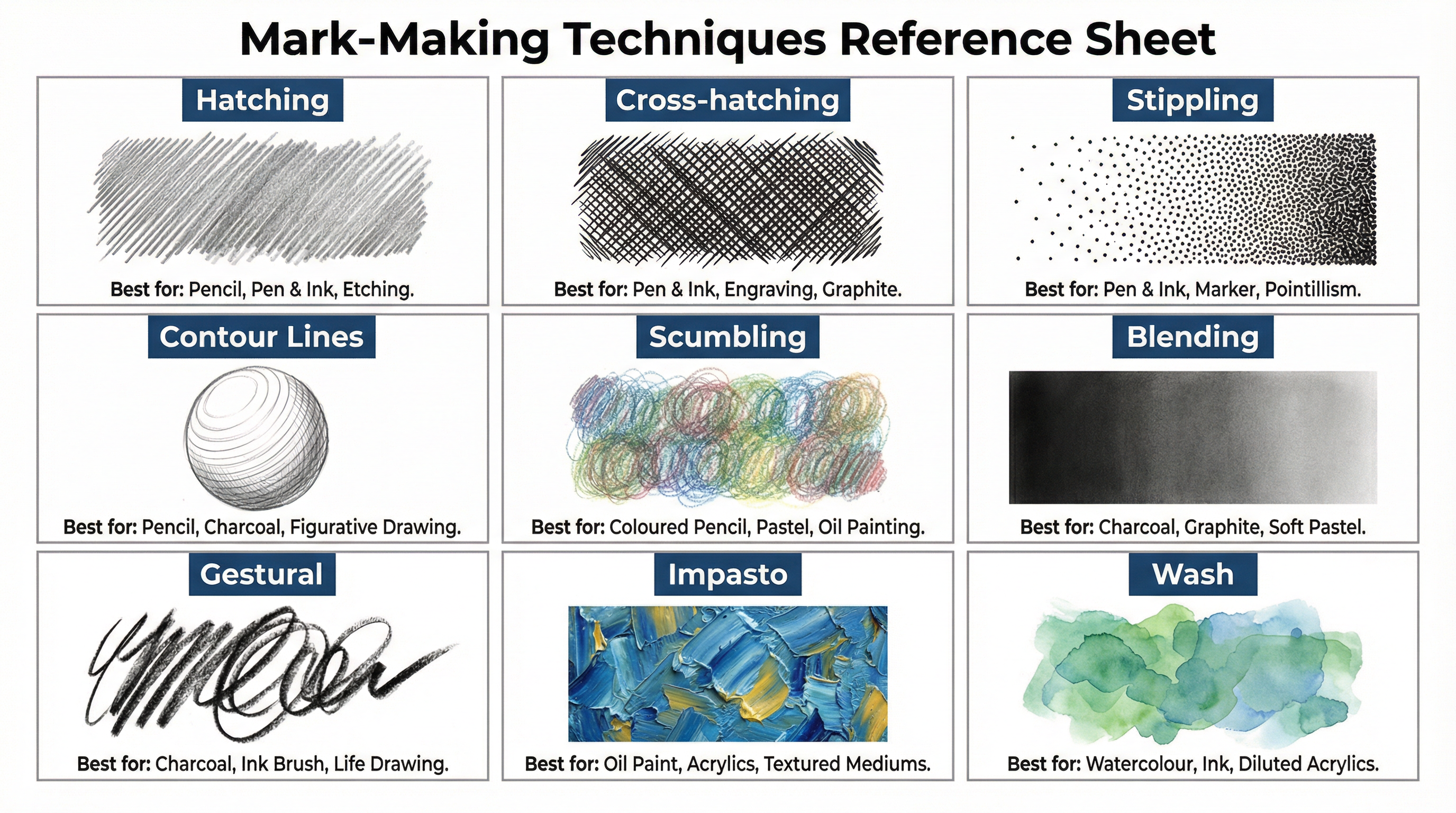
- Tonal Studies: Practice creating a full range of tones from light to dark using different pressures and pencil grades (e.g., 2H to 6B). Avoid over-blending, which can flatten your work.
Painting Techniques:
- Colour Mixing: Develop your ability to mix a wide range of colours accurately. Create colour-matching studies from your primary sources.
- Application Methods: Explore different ways of applying paint – wet-on-wet, wet-on-dry, scumbling, glazing, and impasto. Document the effects of each.
- Underpainting: Try starting a painting with a single-colour underpainting (e.g., in burnt sienna) to establish the tonal structure before adding colour.
Materials & Equipment
Understanding your materials is crucial. Your annotations should justify your choice of media for your final outcome.
- Drawing Media: Graphite pencils, charcoal (willow and compressed), fine-liner pens, pastels (oil and chalk).
- Painting Media: Watercolours, gouache, acrylics, oil paints. Each has unique properties of transparency, drying time, and texture.
- Surfaces: Cartridge paper, watercolour paper (of varying weights/textures), canvas, board. The surface you choose will significantly impact the final look of your work.
- Safety: Always ensure good ventilation when using solvents (like turpentine for oil paints) or fixatives for charcoal and pastel drawings.
Portfolio/Coursework Guidance
Assessment Criteria
Your portfolio is assessed against four equally weighted Assessment Objectives. A strong portfolio gives equal attention to all four.
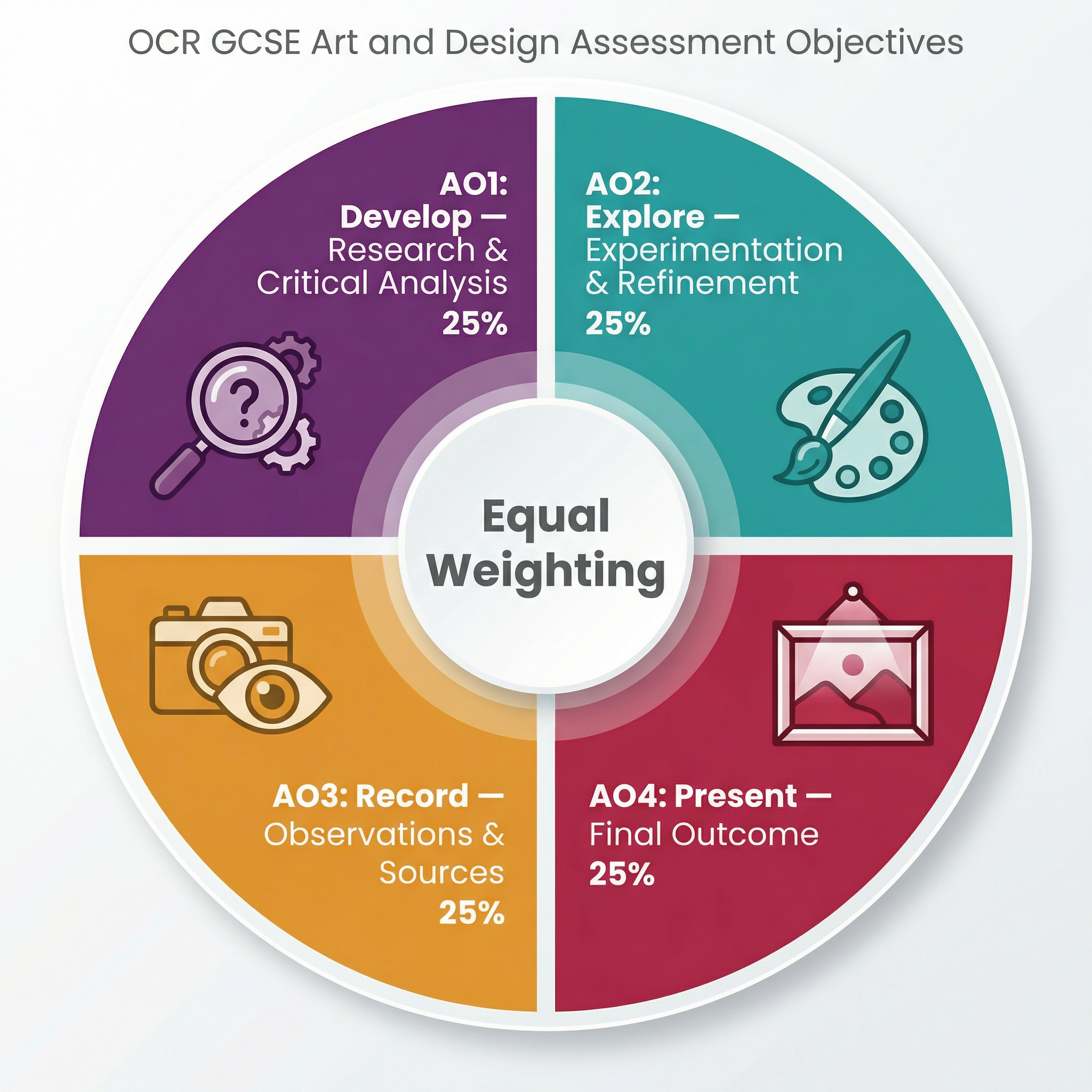
- AO1 (Develop): Show that you have researched artists and used their work to inform your own ideas. This is not just about writing facts; it's about visual analysis and response.
- AO2 (Explore): Evidence your experimentation with different media, techniques, and compositions. Show your journey of refinement, including what didn't work and why.
- AO3 (Record): Demonstrate your ability to record observations and ideas from primary sources. This includes observational drawings, photography, and annotations.
- AO4 (Present): Your final piece should be a confident, personal, and meaningful outcome that is a clear culmination of all your preparatory work.
Building a Strong Portfolio
- Tell a Story: Your sketchbook should have a clear narrative, showing how your ideas have evolved from initial research to final piece.
- Annotate Everything: Explain your thinking. Why did you choose that artist? Why did you select that material? How does this experiment link to your final idea? Annotations are your chance to speak directly to the examiner.
- Quality over Quantity: A few pages of in-depth, meaningful experimentation are worth more than a whole sketchbook of superficial studies.
- Cross-Reference: Use arrows and notes to link different parts of your sketchbook together, showing how an early idea was developed later on.
Exam Component
Written Exam Knowledge
While the majority of marks are for the portfolio, some specifications include a written or externally set task. The knowledge required for this is the same as that needed for your portfolio annotations. You will be expected to use technical vocabulary and refer to the work of other artists to justify your ideas.
Practical Exam Preparation
For the externally set task (the 'exam'), you will be given a theme or starting point and a set period of preparatory time before a timed practical exam (e.g., 10 hours).
- Deconstruct the Theme: Spend time brainstorming and mind-mapping ideas related to the theme. Research relevant artists.
- Plan Your Time: Break down the timed exam into manageable chunks: e.g., 2 hours for composition and underdrawing, 6 hours for the main body of work, 2 hours for refinement.
- Prepare Your Sources: During the preparatory period, gather high-quality primary source images and make observational studies that you can take into the exam with you.
- Practice under Timed Conditions: Do a mock exam to get a feel for the pace required.