Study Notes
Overview
Printed Textiles is a practical component of the OCR GCSE Art and Design specification where candidates explore the creation of decorated surfaces through a variety of printing methods. This area of study is not just about making patterns; it is a deep dive into how visual ideas, drawn from primary sources, can be translated onto fabric. Success requires a seamless integration of contextual research (AO1), technical experimentation (AO2), observational recording (AO3), and the creation of a personal, resolved outcome (AO4). As this is a coursework-based topic, your portfolio, which documents your entire creative journey, is your examination. Every decision, every experiment, and every annotation contributes to your final mark.
Key Knowledge & Theory
Core Concepts
Theoretical understanding in Printed Textiles is fundamentally linked to practical application. Candidates must grasp the principles of pattern, repeat, and colour theory. A key concept is the translation of a 2D design from paper to a 3D textile surface, considering how the fabric's properties (drape, texture, weight) will interact with the printed design. Understanding the historical and cultural context of textile design is also crucial for developing a meaningful personal response. For instance, recognising the political and social motivations behind the Arts and Crafts Movement provides a deeper understanding of William Morris's work beyond its aesthetic appeal.
Key Practitioners/Artists/Composers
| Name | Period/Style | Key Works | Relevance |
|---|---|---|---|
| William Morris | 19th Century / Arts & Crafts | 'Strawberry Thief', 'Willow Bough' | A foundational figure who championed traditional craft methods like block printing. His work exemplifies complex, nature-inspired repeat patterns and a philosophy of integrating art into everyday life. Studying Morris is essential for understanding the roots of modern surface design. |
| Lucienne Day | 20th Century / Modernism | 'Calyx' (1951) | A pioneer of post-war British textile design. Day's work, often screen-printed, introduced abstract, modern art principles to domestic textiles. She provides a vital contrast to Morris, showing a move towards graphic, bold, and abstract forms. |
| Orla Kiely | Contemporary | 'Stem' Print | A contemporary designer known for her stylised, retro-inspired motifs and strong brand identity. Kiely's work is an excellent case study in how a simple, recognisable motif can be successfully applied across a wide range of products through clever use of colour and repeat. |
| Zandra Rhodes | Contemporary / Punk & New Wave | 'Conceptual Chic' collection | Known for her bold, theatrical, and often unconventional approach to screen printing. Rhodes treats the textile as a canvas, often incorporating her own handwriting and drawings directly into her prints. She is a great example of a designer who breaks traditional rules. |
Technical Vocabulary
Using subject-specific language is critical for high-level annotation and analysis. Examiners look for candidates who can articulate their ideas with precision.
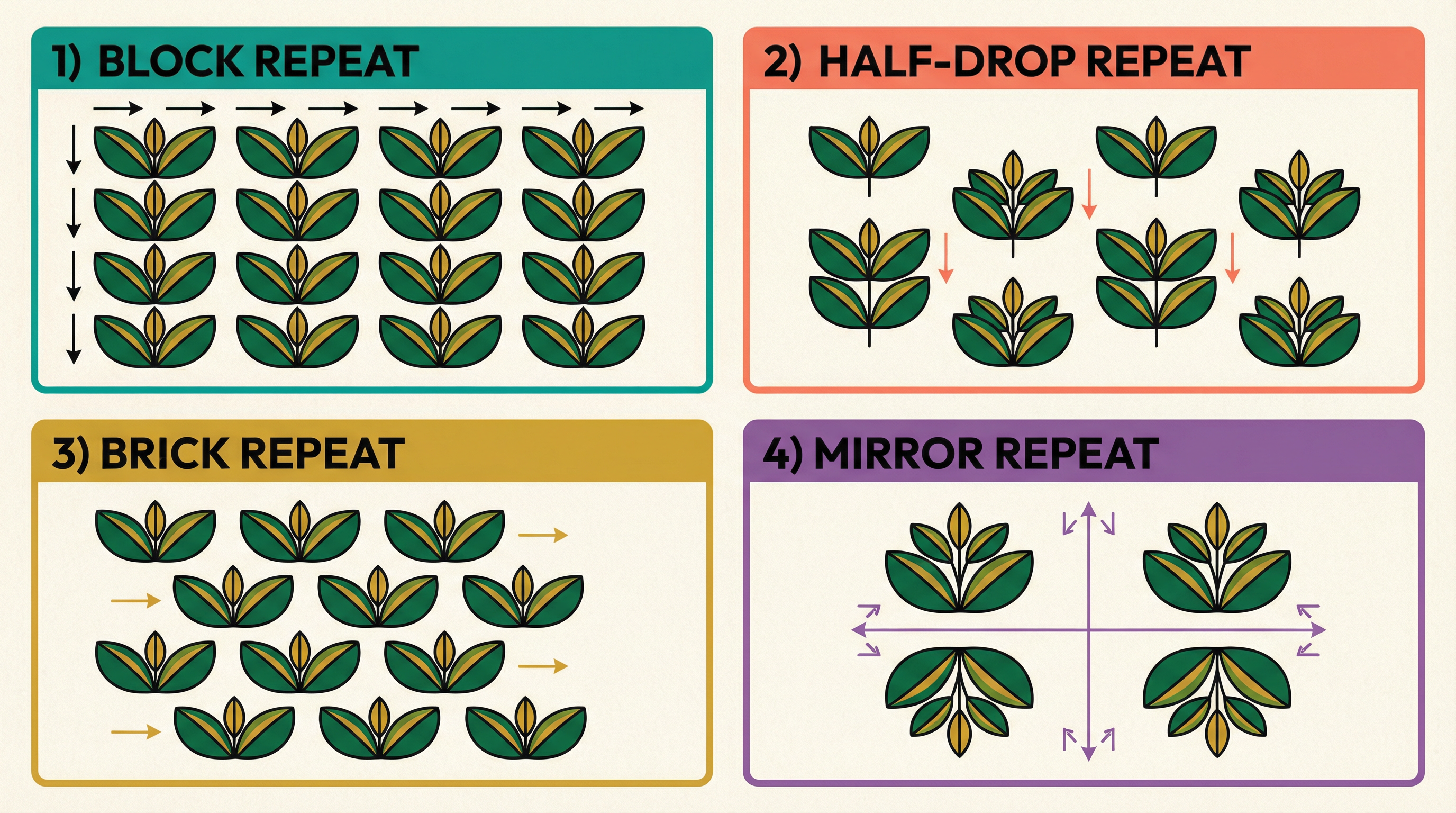
- Repeat Structure: The framework for how a motif is repeated across a surface (e.g., block, half-drop, brick, mirror).
- Motif: A single, recurring decorative design element in a pattern.
- Registration: The precise alignment of separate print layers or colours.
- Squeegee: The tool used in screen printing to force ink through the mesh screen.
- Lino Block: A piece of linoleum carved to create a relief surface for block printing.
- Sublimation: A digital printing process where heat turns ink into a gas to bond it with synthetic fabric.
- Selvedge: The finished edge of a piece of fabric that prevents it from unravelling.
- Placement Print: A design printed in a specific, pre-determined position on a garment or product, rather than as a repeating pattern.
Practical Skills
Techniques & Processes
Candidates must demonstrate practical competence in a range of printing techniques. It is vital to document experimentation with each method to show a developing understanding.
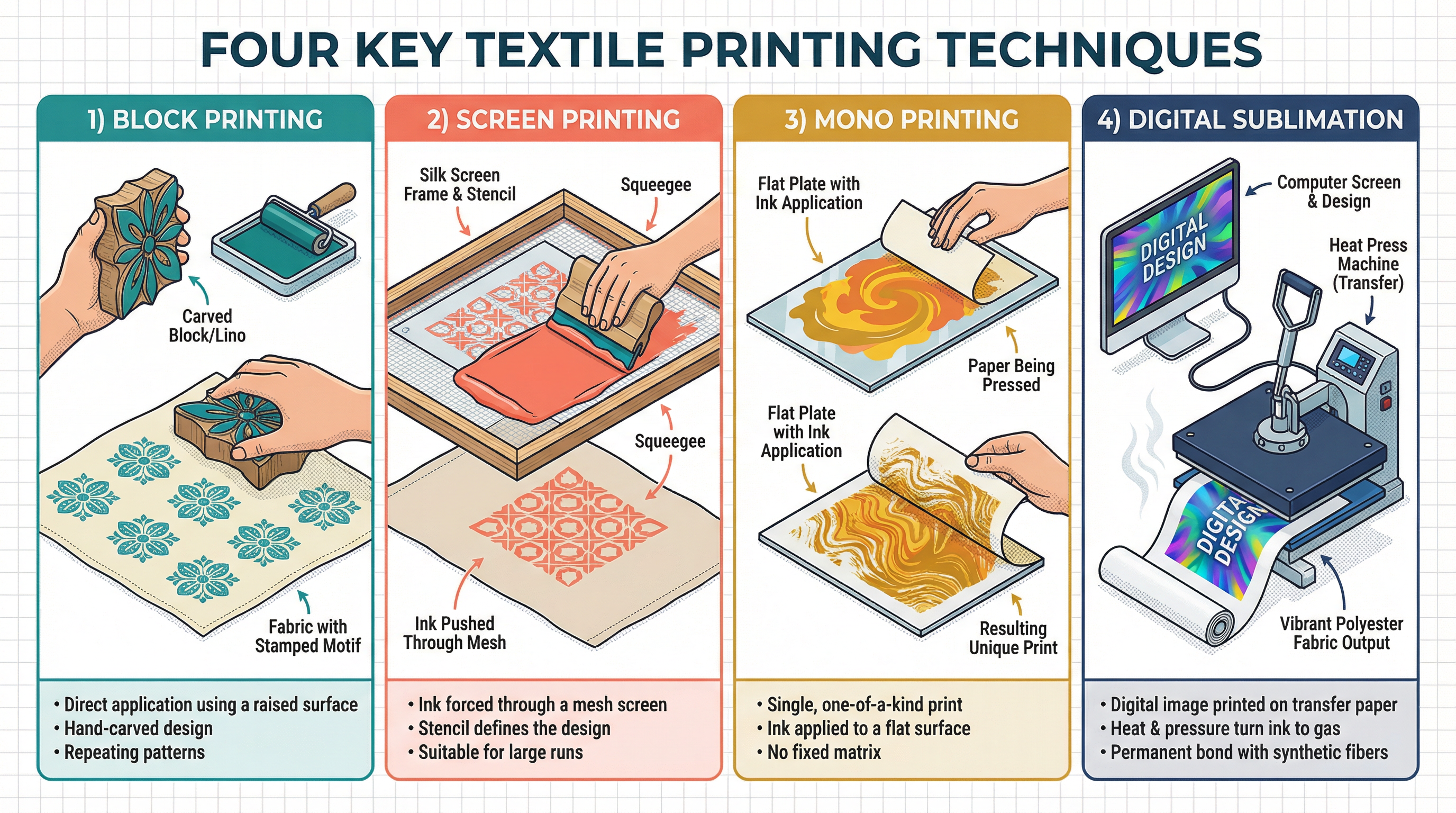
- Block Printing: Involves carving a design into a lino, wood, or foam block. Ink is applied with a roller, and the block is pressed onto fabric. This technique allows for direct, hands-on creation of patterns. Candidates should explore variations in pressure, ink consistency, and layering to alter the outcome.
- Screen Printing: A stencil-based method where ink is forced through a fine mesh screen onto fabric. This is ideal for creating bold, graphic designs with flat areas of colour. Experimentation should involve creating different types of stencils (e.g., paper, drawing fluid, photo emulsion) and managing registration for multi-colour prints.
- Mono Printing: A technique for creating one-off, unique prints. Ink is applied to a flat plate (like perspex) and manipulated before being transferred to fabric. It is an excellent method for exploratory mark-making and generating initial ideas.
- Digital Sublimation: A modern process using a heat press to transfer a digitally printed design onto polyester fabric. This allows for photographic quality and unlimited colour. Candidates should show how they have developed their digital designs from primary source material.
Materials & Equipment
Understanding the relationship between materials and processes is a core skill. Candidates should annotate why they chose specific materials.
- Fabrics: Natural fibres (cotton, linen, silk) are best for block and screen printing with standard textile inks. Synthetic fibres (polyester) are required for sublimation printing. The weight and weave of the fabric will significantly impact the final print's appearance.
- Inks: Textile inks are water-based and require heat setting (ironing) to become permanent. Sublimation inks are specialist inks used with transfer paper. The opacity and viscosity of the ink are key variables to control.
- Safety: Always work in a well-ventilated area. Wear appropriate protective clothing (aprons) and handle craft knives for lino cutting with care, always cutting away from your body.
Portfolio/Coursework Guidance
Assessment Criteria
Your portfolio is assessed against four equally weighted Assessment Objectives (AOs). A balanced project is essential.
- AO1 (Contextual Understanding): Show you have researched relevant artists and designers. Your research must be more than just biography; you must analyse their techniques and concepts and make clear connections to your own work.
- AO2 (Creative Making): This is where you evidence your experimentation. Show tests, trials, and samples. Annotate what worked, what didn't, and what you learned. This demonstrates your ability to refine and develop your technical skills.
- AO3 (Recording): High-quality primary source recording is non-negotiable. This includes observational drawing, photography, and mark-making. Your final designs must clearly evolve from this initial recording.
- AO4 (Personal Response): Your final outcome(s) should be a culmination of your journey. It must be a personal, meaningful, and well-executed piece that successfully resolves your initial ideas.
Building a Strong Portfolio
- Document Everything: Photograph your process at every stage. A print that went wrong can be as valuable as a perfect one if you annotate it to explain what you learned.
- Annotate with Purpose: Your annotations should explain your thinking. Use the 'What, How, Why' model: What did you do? How did you do it? Why did you do it that way? Link your decisions back to your research and your primary sources.
- Show Development: Your ideas should clearly evolve. Show how your initial sketches were developed into motifs, how you experimented with colour palettes, and how you tested different repeat structures before arriving at your final design.
Exam Component
Written Exam Knowledge
While Art and Design is a practical subject, there is no separate written exam for the coursework components. All theoretical knowledge must be demonstrated through your portfolio annotations and the critical analysis of your own work and the work of others. You must write about your work as a reflective practitioner, using technical vocabulary correctly to explain and justify your creative choices. The 'exam' is the portfolio itself, and your writing is a key part of how it is assessed.
Practical Exam Preparation
For the Externally Set Assignment (ESA), you will receive a theme or starting point from the exam board. You will have a preparatory period to develop ideas in a sketchbook, followed by a timed practical exam (typically 10 hours) to create a final outcome.
- Prep Period is Key: Use this time to its fullest. Conduct all your primary source recording (AO3) and artist research (AO1). Experiment with media and techniques (AO2) and plan your final piece thoroughly.
- Time Management: In the 10-hour exam, you must work efficiently. Have a clear plan of what you need to achieve. Don't get bogged down in one area. The goal is to produce a resolved final outcome (AO4) that is the culmination of your prep work.
- Be Prepared: Arrive at the exam with all your materials, research, and preparatory work organised and ready to go. The supervised time is for creating, not for last-minute research.