Chromatography

    AQA
    GCSE
    Chemistry

    This guide provides a comprehensive overview of Chromatography for AQA GCSE Chemistry students. It covers the core principles of separation, the required practical, and the calculation of Rf values, all tailored to help you secure maximum marks in your exam.

    5
    Min Read
    3
    Examples
    5
    Questions
    0
    Key Terms
    🎙 Podcast Episode
    Chromatography
    0:00-0:00

    Study Notes

    header_image.png

    Overview

    Chromatography is a powerful analytical technique used to separate and identify substances within a mixture. For your AQA GCSE Chemistry exam, understanding chromatography is crucial as it's a guaranteed topic, especially through questions on Required Practical 6. This guide will break down the process into simple, memorable steps, explain the science behind it, and show you how to apply your knowledge to exam-style questions. We'll explore how substances are separated based on their distribution between a stationary phase (the paper) and a mobile phase (the solvent), and how to use Rf values to identify them. Mastering this topic will not only prepare you for the exam but also provide a solid foundation for A-Level Chemistry.

    chromatography_podcast.wav

    Key Concepts

    Concept 1: Phases and Separation

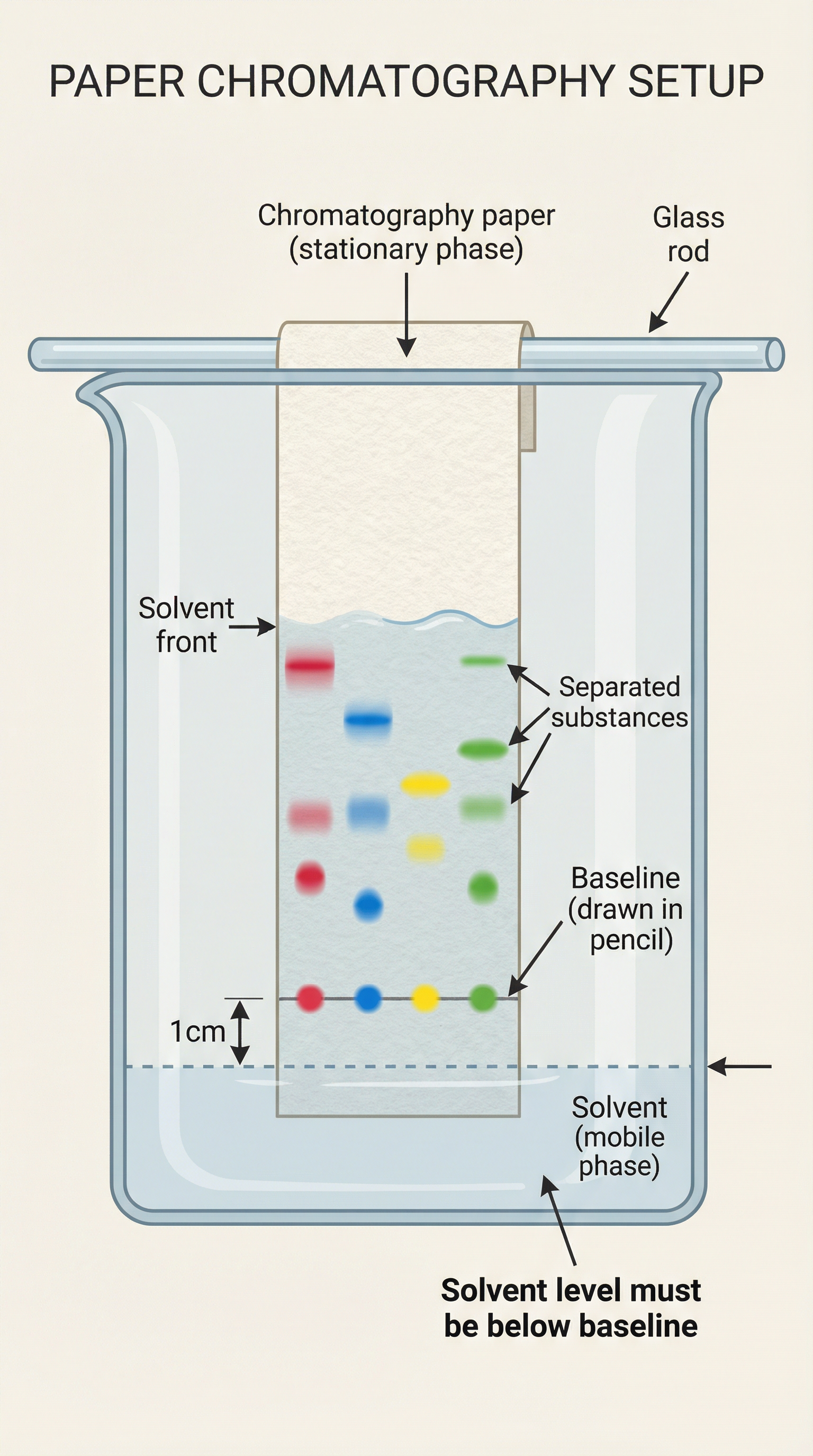
    At its heart, chromatography is a story of two phases: the stationary phase and the mobile phase. In paper chromatography, the stationary phase is the chromatography paper, and the mobile phase is the solvent that moves up the paper. The separation of a mixture into its components depends on how each component distributes itself between these two phases.

    • High solubility in mobile phase + Low attraction to stationary phase = Travels far up the paper.
    • **Low solubility in mobile phase + High attraction to stationary phase = Travels a short distance up the paper.**This differential movement is the key to separation. Imagine a race where some runners are more drawn to the track (stationary phase) while others are more carried along by a moving walkway (mobile phase). The ones on the walkway will travel furthest!
    chromatography_setup.png

    Concept 2: Required Practical 6 - Method and Common Errors

    The AQA exam board loves to test your practical skills. Here's a breakdown of the method for paper chromatography:

    1. Draw a baseline: Use a pencil to draw a straight line about 1-2 cm from the bottom of the chromatography paper. Crucially, it must be pencil. Graphite is insoluble in the solvent, whereas the ink from a pen would dissolve and interfere with the results. This is a classic exam question!
    2. Spot the samples: Place a small, concentrated spot of each sample onto the baseline.
    3. Place in solvent: Suspend the paper in a beaker containing a small amount of solvent, ensuring the solvent level is below the baseline. If the solvent covers the baseline, the samples will dissolve into the solvent at the bottom of the beaker instead of travelling up the paper.
    4. Allow separation: Cover the beaker with a lid (e.g., a watch glass) to create a saturated atmosphere and prevent the solvent from evaporating. Allow the solvent to travel up the paper.
    5. Mark the solvent front: Once the solvent has travelled most of the way up the paper, remove it from the beaker and immediately mark the position of the solvent front with a pencil.
    6. Calculate Rf values: Measure the distance travelled by each spot and by the solvent, then use the Rf formula.

    Mathematical/Scientific Relationships

    The Rf Value Formula

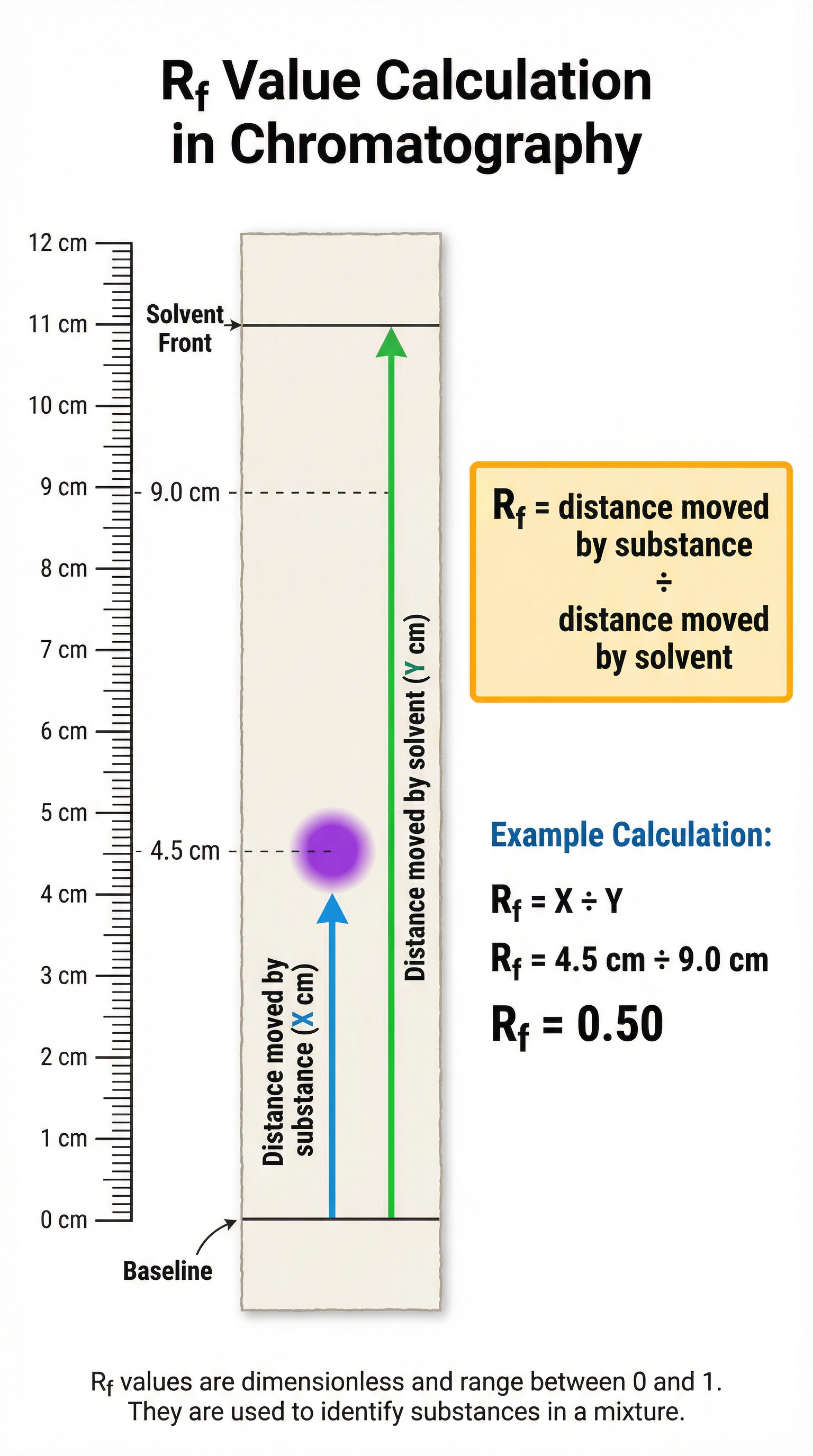
    The Rf (Retention factor) value is a ratio that is constant for a particular substance in a given solvent, under the same conditions. It allows you to identify unknown substances by comparing their Rf values to those of known substances.

    Formula:

    Rf = Distance moved by substance / Distance moved by solvent

    • This formula must be memorised. It is not given on the formula sheet.
    • Distance moved by substance: Measured from the baseline to the centre of the spot.
    • Distance moved by solvent: Measured from the baseline to the solvent front.
    • Rf values are always between 0 and 1 and have no units.
    rf_calculation.png

    Practical Applications

    Chromatography isn't just a classroom experiment; it has many real-world applications:

    • Forensic Science: To identify substances at a crime scene, such as drugs or explosives.
    • Food Industry: To separate the components of food colourings to check for illegal additives.
    • Pharmaceuticals: To ensure the purity of drugs.
    • Medical Testing: To test for drugs in urine samples.

    Worked Examples

    3 detailed examples with solutions and examiner commentary

    Practice Questions

    Test your understanding — click to reveal model answers

    Q1

    Describe how you would use chromatography to separate a mixture of coloured inks. (6 marks)

    6 marks
    standard

    Hint: Think about the key steps of the required practical. What are the essential details for each step?

    Q2

    A substance is known to have an Rf value of 0.38 in a particular solvent. A student runs a chromatogram and finds the solvent front has travelled 8.0 cm. Calculate the distance the substance will have travelled. (2 marks)

    2 marks
    standard

    Hint: Rearrange the Rf formula to solve for the distance moved by the substance.

    Q3

    Explain, in terms of phases, why substances separate during chromatography. (3 marks)

    3 marks
    challenging

    Hint: Use the keywords 'mobile phase', 'stationary phase', 'solubility' and 'attraction'.

    Q4

    A food colouring is suspected to contain an illegal dye. How could chromatography be used to confirm this? (4 marks)

    4 marks
    challenging

    Hint: Think about how you would compare the unknown food colouring to the known illegal dye.

    Q5

    A student performs a chromatography experiment but forgets to cover the beaker. Explain the effect this would have on the calculated Rf value. (2 marks)

    2 marks
    challenging

    Hint: How does covering the beaker affect the solvent? How would this change the solvent front?

    More Chemistry Study Guides

    View all

    Factors Affecting Reaction Rate

    Edexcel
    GCSE

    This topic explores how temperature, concentration, surface area, and catalysts affect the speed of chemical reactions through collision theory. Mastering this content is essential for both Foundation and Higher Tier candidates, as it combines theoretical understanding with practical investigation skills and mathematical graph analysis—all heavily weighted in Edexcel assessments.

    The Periodic Table

    OCR
    GCSE

    This guide provides a comprehensive overview of the Periodic Table for OCR GCSE Chemistry. It covers atomic structure, groups, periods, and reactivity trends, with a strong focus on exam technique to help you secure top marks.

    Fractional Distillation

    Edexcel
    GCSE

    Unlock top marks in your Edexcel GCSE Chemistry exam by mastering fractional distillation. This guide breaks down how crude oil is separated into vital products like petrol and diesel, showing you exactly what examiners want to see in your answers.

    Crude Oil Composition

    Edexcel
    GCSE

    Master Edexcel GCSE Chemistry Topic 2.7 by exploring the journey of crude oil from a raw mixture to the essential fuels that power our world. This guide will equip you with the knowledge to tackle exam questions on fractional distillation, hydrocarbon properties, and alkane chemistry with confidence.

    Elements, compounds and mixtures

    OCR
    GCSE

    This guide breaks down the essential principles of elements, compounds, and mixtures for your OCR GCSE Chemistry exam. It covers how to classify substances, determine purity using melting point data, and master the separation techniques that frequently appear in exams. Secure top marks by understanding not just what these concepts are, but why they work and how examiners will test you on them.

    Group 1 elements (the alkali metals)

    AQA
    GCSE

    This guide explores the Group 1 alkali metals, a family of highly reactive elements. We'll dissect why their reactivity soars as you descend the group and master the exam techniques needed to describe their dramatic reactions with water, chlorine, and oxygen, ensuring you can confidently tackle 4- and 6-mark questions.