
Metallic bonding — OCR GCSE study guide illustration

    Metallic bonding

    OCR
    GCSE
    Chemistry

    Unlock top marks in your OCR GCSE Chemistry exam by mastering metallic bonding. This guide breaks down the essential 'electron sea' model, explaining exactly how to describe and draw the giant metallic lattice and link its structure to the classic properties of metals like conductivity and malleability.

    4
    Min Read
    3
    Examples
    5
    Questions
    6
    Key Terms
    🎙 Podcast Episode
    Metallic bonding
    0:00-0:00

    Study Notes

    Header image for Metallic Bonding

    Overview

    Welcome to the essential guide for Metallic Bonding (OCR GCSE Chemistry, Topic 1.8). This topic is fundamental, not just for questions directly about metals, but for higher-level questions that require you to compare and contrast different types of chemical structures. Examiners are looking for precise language and a clear understanding of the 'electron sea' model. You will be expected to describe the giant metallic lattice, composed of positive ions surrounded by delocalised electrons, and use this model to explain physical properties. A common exam question style is the 6-mark extended response, where you must link structure to properties in a logical, well-structured answer. Mastering this topic provides a strong foundation for understanding materials science and electrochemistry, which appear later in the specification.

    Key Concepts

    Concept 1: The Giant Metallic Lattice

    At the heart of this topic is the structure of metals. Unlike simple molecules, metals form a giant metallic lattice. The word 'giant' is crucial as it signifies a vast, repeating three-dimensional arrangement of particles. These particles are not atoms, but positive ions (or cations). This is a point where candidates frequently lose marks. The metal atoms have lost their outer shell electrons, leaving them with a positive charge. These positive ions are packed closely together in regular, orderly layers.
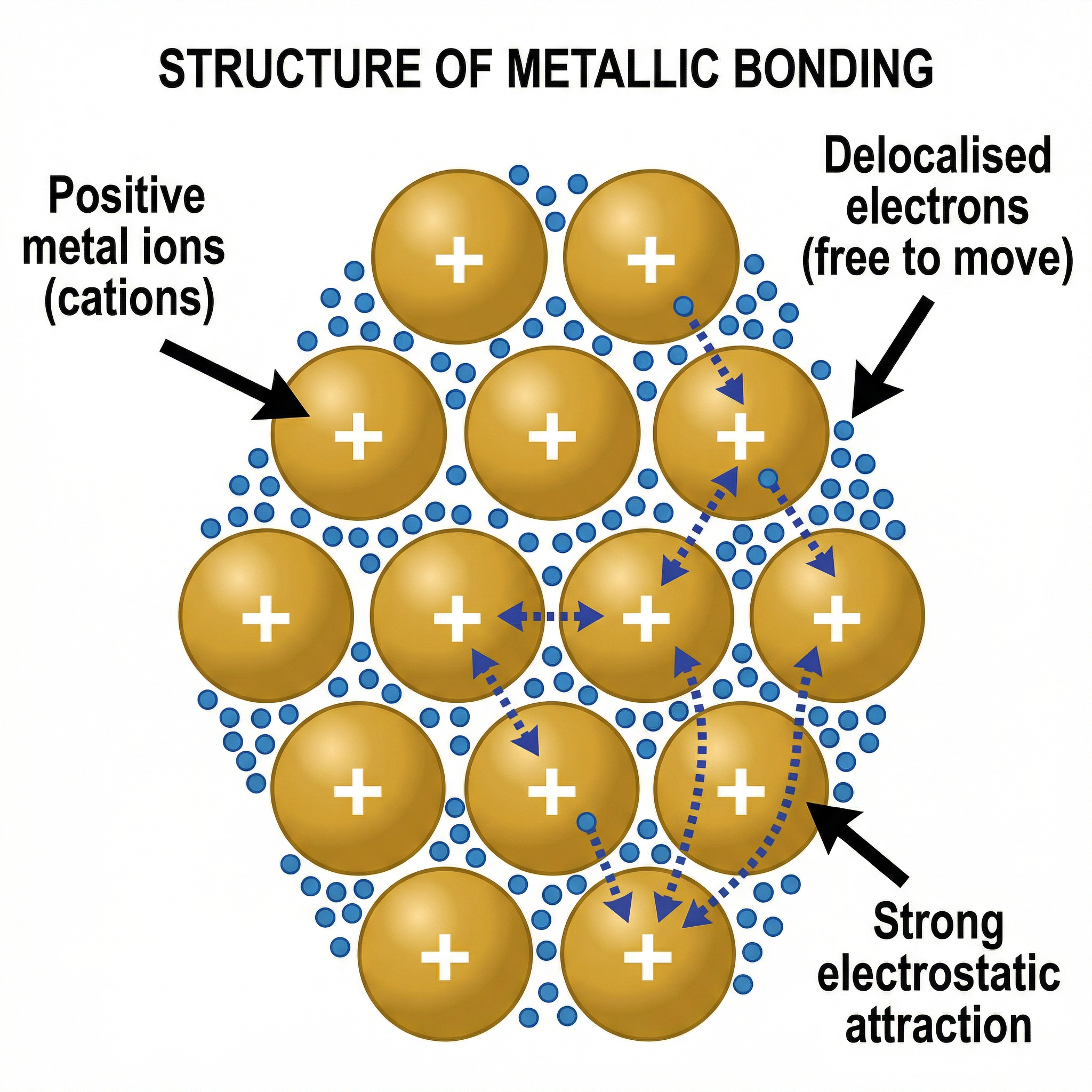
    The structure of a giant metallic lattice

    Concept 2: The Sea of Delocalised Electrons

    The electrons lost from the outer shells of the metal atoms are not attached to any single ion. Instead, they become delocalised, meaning they are free to move throughout the entire lattice. This creates what is often described as a 'sea of delocalised electrons' surrounding the fixed positive ions. It is vital to use the term 'delocalised' in an exam answer to secure the mark. This mobility of electrons is the key to explaining many of the properties of metals.

    Concept 3: The Metallic Bond

    The metallic bond itself is the strong electrostatic force of attraction between the positive metal ions and the delocalised sea of electrons. It is this powerful attraction that holds the entire lattice together, giving metals their strength and high melting points. It is incorrect to describe this as an attraction between positive and negative ions (that's ionic bonding) or as sharing of electrons between atoms (that's covalent bonding). The metallic bond is unique.

    Linking Structure to Properties

    Examiners will almost always ask you to use the model to explain properties. You must explicitly link the features of the structure to the resulting physical property.
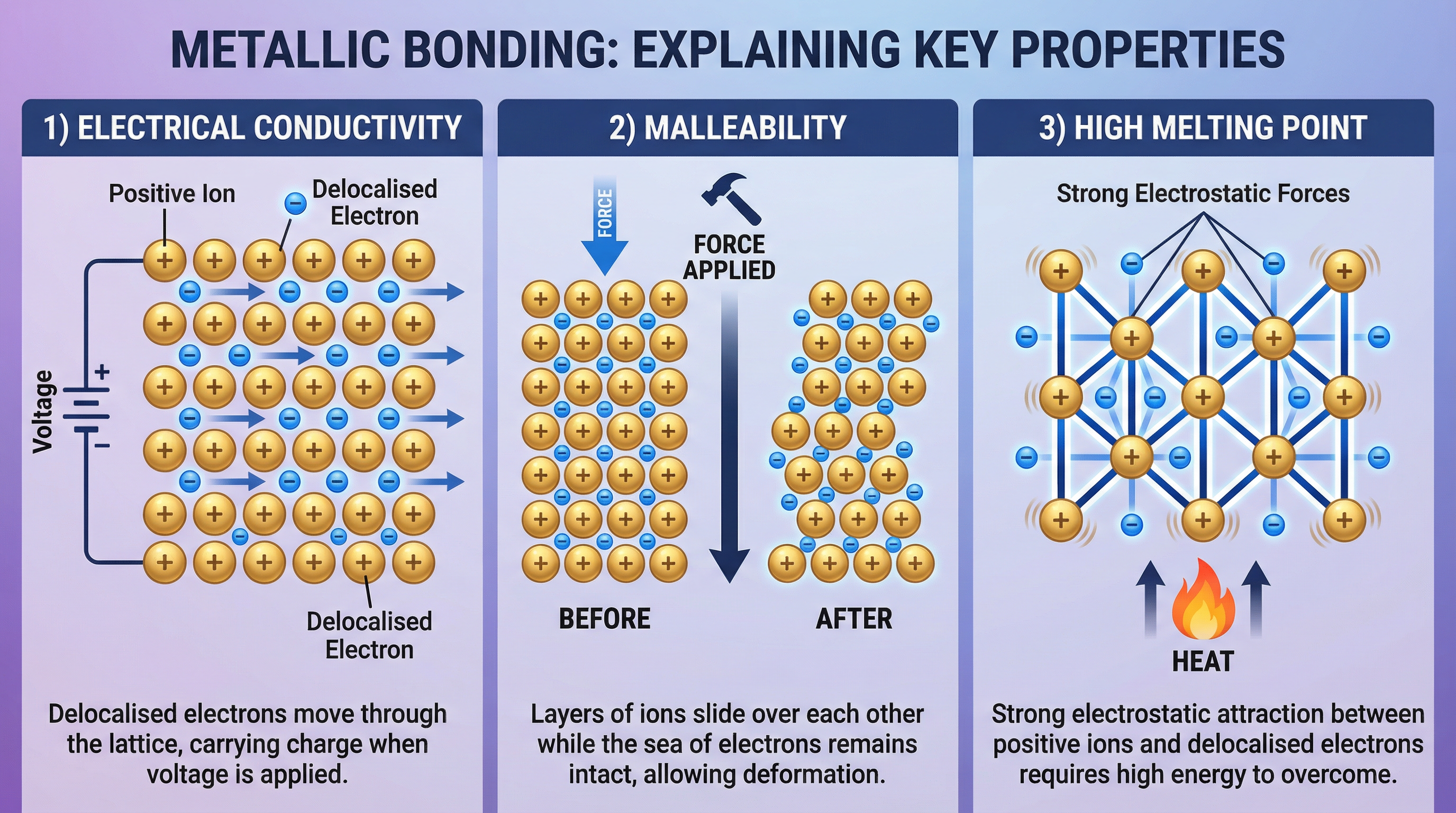
    Explaining the properties of metals

    • Electrical Conductivity: Metals are excellent electrical conductors because the delocalised electrons are free to move and carry charge through the lattice when a voltage is applied. The positive ions themselves do not move; they vibrate in fixed positions.
    • Malleability and Ductility: Metals can be hammered into shape (malleable) or drawn into wires (ductile). This is because the regular layers of positive ions can slide over one another when a force is applied. The delocalised electrons move with the layers, maintaining the electrostatic attraction, so the metallic bond does not break. The lattice is distorted, not shattered.
    • High Melting and Boiling Points: A large amount of thermal energy is required to overcome the strong electrostatic forces of attraction between the positive ions and the delocalised electrons. This is why most metals are solid at room temperature and have high melting points.
    • Thermal Conductivity: The delocalised electrons can also transfer kinetic energy quickly throughout the lattice, making metals excellent thermal conductors.

    Worked Examples

    3 detailed examples with solutions and examiner commentary

    Practice Questions

    Test your understanding — click to reveal model answers

    Q1

    Describe two differences between metallic bonding and ionic bonding. (2 marks)

    2 marks
    standard

    Hint: Think about what particles are involved and how the electrons behave in each case.

    Q2

    Explain why an alloy of copper and zinc (brass) is harder than pure copper. (3 marks)

    3 marks
    challenging

    Hint: Consider how the different sized atoms affect the regular lattice structure.

    Q3

    State the two particles that make up a metallic lattice. (1 mark)

    1 marks
    foundation

    Hint: One is positive, one is negative.

    Q4

    Explain, in terms of its structure and bonding, why iron has a high melting point. (3 marks)

    3 marks
    standard

    Hint: What needs to be overcome for a substance to melt?

    Q5

    A student wrote in their notes: 'Metals are malleable because the atoms can slide over each other.' Explain two mistakes in this statement. (2 marks)

    2 marks
    standard

    Hint: What is the correct term for the particles in the lattice? What is missing from the explanation of malleability?

    Key Terms

    Essential vocabulary to know

    More Chemistry Study Guides

    View all

    Factors Affecting Reaction Rate

    Edexcel
    GCSE

    This topic explores how temperature, concentration, surface area, and catalysts affect the speed of chemical reactions through collision theory. Mastering this content is essential for both Foundation and Higher Tier candidates, as it combines theoretical understanding with practical investigation skills and mathematical graph analysis—all heavily weighted in Edexcel assessments.

    The Periodic Table

    OCR
    GCSE

    This guide provides a comprehensive overview of the Periodic Table for OCR GCSE Chemistry. It covers atomic structure, groups, periods, and reactivity trends, with a strong focus on exam technique to help you secure top marks.

    Fractional Distillation

    Edexcel
    GCSE

    Unlock top marks in your Edexcel GCSE Chemistry exam by mastering fractional distillation. This guide breaks down how crude oil is separated into vital products like petrol and diesel, showing you exactly what examiners want to see in your answers.

    Crude Oil Composition

    Edexcel
    GCSE

    Master Edexcel GCSE Chemistry Topic 2.7 by exploring the journey of crude oil from a raw mixture to the essential fuels that power our world. This guide will equip you with the knowledge to tackle exam questions on fractional distillation, hydrocarbon properties, and alkane chemistry with confidence.

    Elements, compounds and mixtures

    OCR
    GCSE

    This guide breaks down the essential principles of elements, compounds, and mixtures for your OCR GCSE Chemistry exam. It covers how to classify substances, determine purity using melting point data, and master the separation techniques that frequently appear in exams. Secure top marks by understanding not just what these concepts are, but why they work and how examiners will test you on them.

    Chromatography

    AQA
    GCSE

    This guide provides a comprehensive overview of Chromatography for AQA GCSE Chemistry students. It covers the core principles of separation, the required practical, and the calculation of Rf values, all tailored to help you secure maximum marks in your exam.