Study Notes
Overview
Animal welfare is a significant topic in the AQA GCSE Food Preparation and Nutrition specification, carrying considerable ethical and social weight. Examiners expect candidates to demonstrate a balanced understanding of different farming systems, moving beyond simple judgements to a nuanced analysis of their respective costs and benefits. This guide covers the core knowledge required: the distinction between intensive and free-range farming, the role and guarantees of key UK assurance schemes, and the ethical considerations that underpin consumer choices. A mastery of this topic is essential for tackling higher-mark 'discuss' and 'evaluate' questions, where credit is given for a well-structured argument that considers multiple perspectives, including the economic necessity of affordable food production and the moral imperative for humane treatment of animals.
Key Farming Systems: A Comparison
Intensive Farming
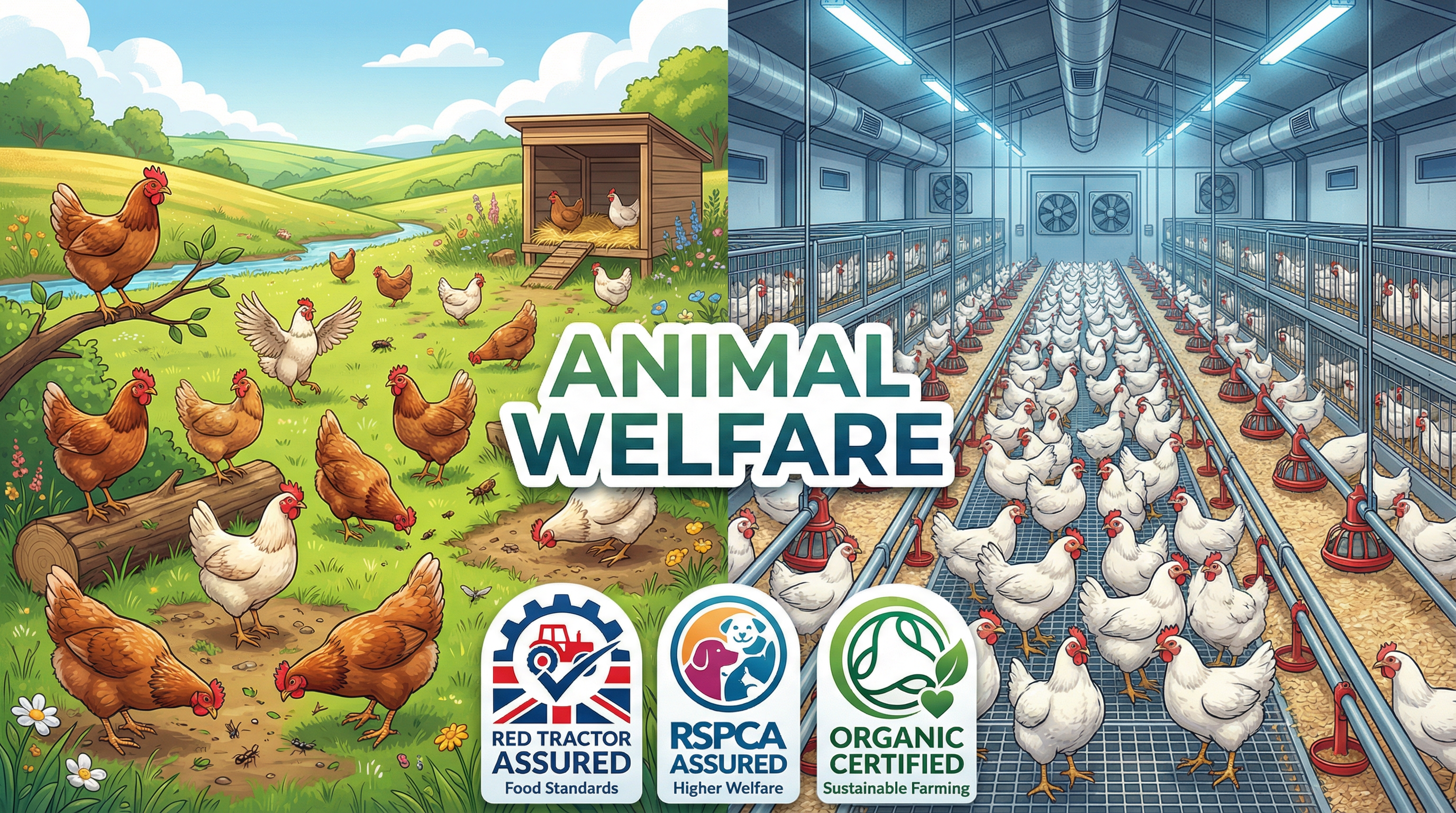
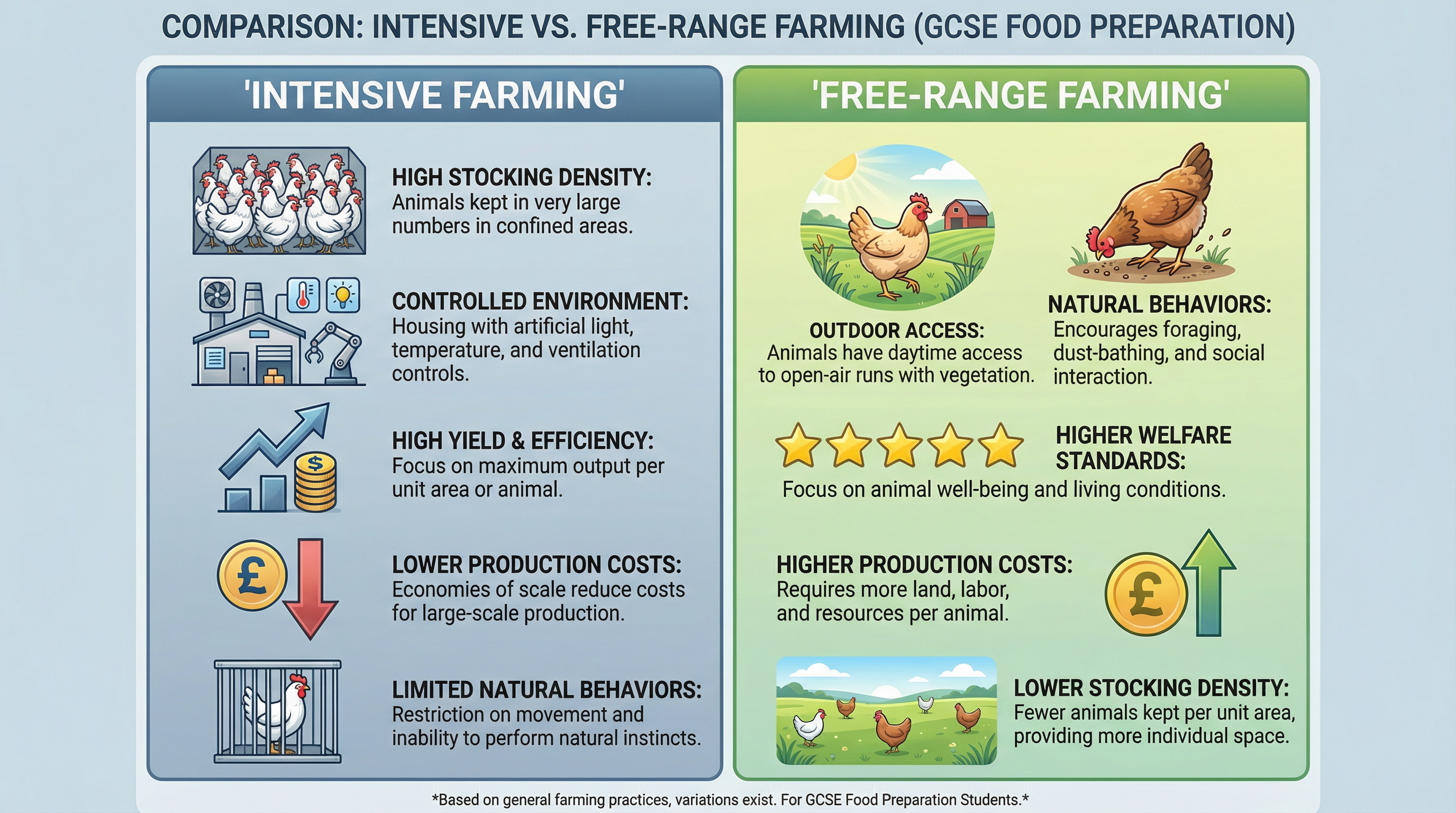
What it is: Intensive farming, often called 'factory farming', prioritises efficiency and high yield. Animals are housed in large numbers within controlled indoor environments where factors like temperature, lighting, and feeding are automated and regulated. This system is designed to produce the maximum amount of meat, eggs, or milk at the lowest possible cost.
Why it matters: This system is fundamental to modern food security, producing vast quantities of affordable protein for a growing population. For the exam, candidates must acknowledge its benefits, such as lower retail prices for consumers and greater control over disease. Marks are awarded for recognising the economic drivers behind intensive systems.
Specific Knowledge: Key characteristics include high stocking density, automated systems, and a focus on fast growth and high output. Candidates should be able to link these features to lower production costs due to economies of scale.
Free-Range Farming
What it is: Free-range systems provide animals with daytime access to outdoor areas, allowing them to express natural behaviours. This includes foraging, dust-bathing, and exploring. While stocking densities are lower than in intensive systems, the term 'free-range' primarily refers to this outdoor access.
Why it matters: This system represents a consumer-driven demand for higher animal welfare standards. In an exam context, it provides the crucial counterpoint to intensive farming. Credit is given for explaining how the ability to perform natural behaviours leads to reduced stress and better quality of life for the animal, but also results in higher production costs.
Specific Knowledge: Key characteristics include lower stocking density, daytime access to open-air runs with vegetation, and an environment that encourages natural behaviours. It is vital not to confuse 'free-range' with 'organic'.
Key Assurance Schemes: What Do The Logos Mean?
Red Tractor
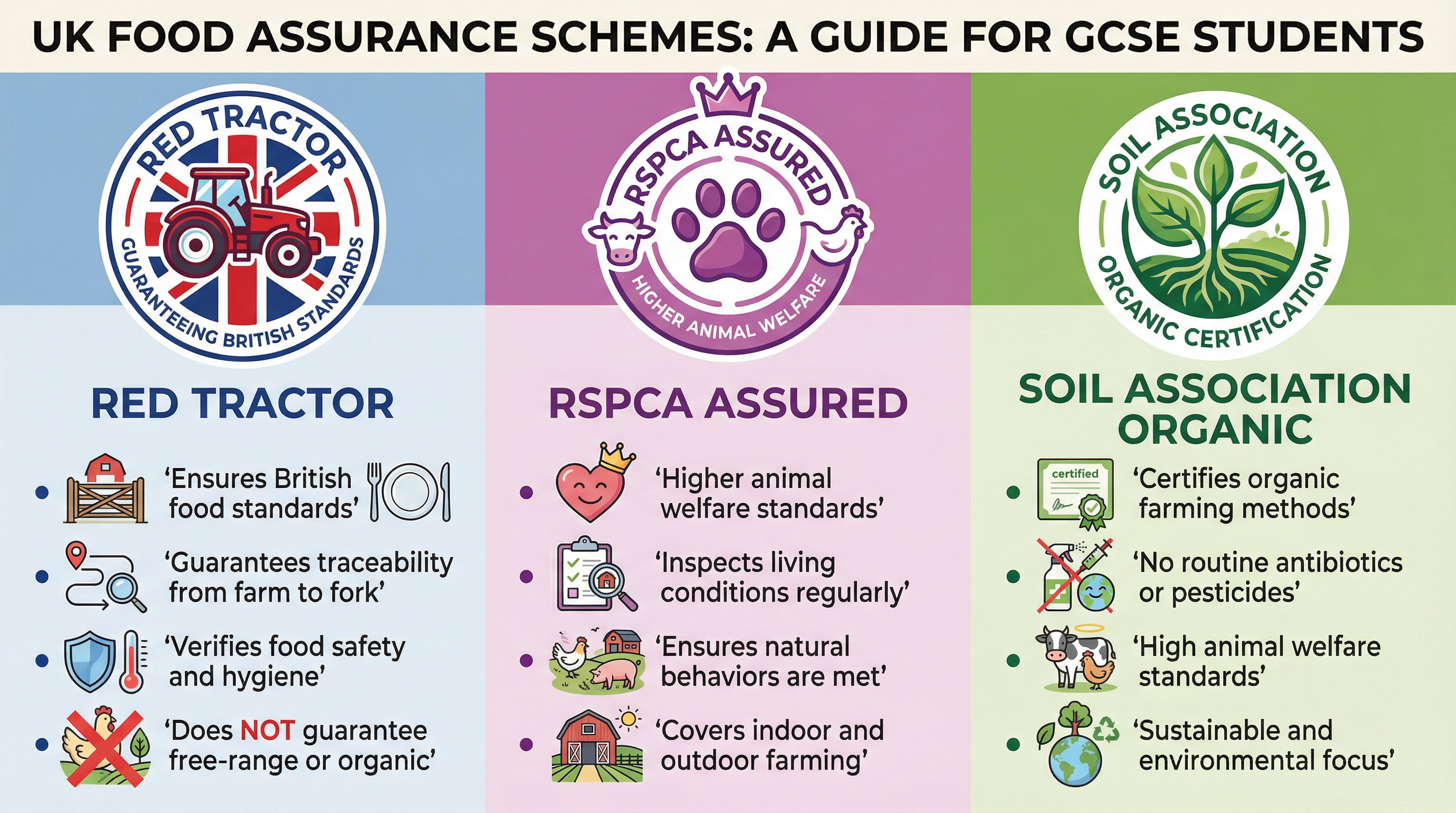
Role: The UK's largest farm and food standards scheme, covering animal welfare, food safety, traceability, and environmental protection.
Key Guarantees: The Red Tractor logo guarantees that food is traceable, safe, and farmed with care. It ensures that food has been produced to British standards from farm to fork. Crucially, it does NOT guarantee that a product is free-range or organic. An intensively farmed chicken can still carry the Red Tractor logo if it meets the scheme's welfare, safety and hygiene standards.
Impact: It provides a baseline of assurance for consumers but can be misunderstood. Examiners often test the limitations of this scheme.
RSPCA Assured
Role: This scheme focuses solely on improving the welfare of farm animals. It is the RSPCA's dedicated farm animal welfare assurance scheme.
Key Guarantees: The RSPCA Assured logo means that the animals have been cared for according to the RSPCA's strict welfare standards, which go above and beyond standard industry practice. It covers both indoor and outdoor farming systems, ensuring animals have better living conditions and are able to express natural behaviours.
Impact: It provides a clear indicator of higher welfare standards, whether the animal was raised indoors or outdoors. It is a key differentiator from baseline schemes.
Soil Association Organic
Role: This is the UK's leading organic certification body. It sets the highest standards for animal welfare, environmental protection, and sustainability.
Key Guarantees: The Soil Association logo guarantees that the food is produced using organic farming methods. This means no routine use of antibiotics or pesticides, encouragement of biodiversity, and adherence to the highest possible animal welfare standards, which always includes free-range access for animals.
Impact: Represents the 'gold standard' for consumers concerned with welfare, environmental impact, and the avoidance of chemicals. These products command a premium price.
Second-Order Concepts
Causation
Why have different farming systems emerged? The primary cause is the economic pressure to produce affordable food for a large population, which drove the development of intensive farming. The rise of free-range and organic systems is a direct consequence of increased consumer awareness and ethical concerns about animal welfare, creating a market for higher-welfare products.
Consequence
What are the effects of these systems? The consequences of intensive farming include lower food prices but also significant ethical debates and potential environmental impacts. The consequences of higher-welfare systems include improved animal quality of life but also higher retail prices, which can create social inequality in access to food.
Change & Continuity
What has changed? There has been a significant change in consumer attitudes over the last 30 years, with a growing demand for transparency and higher welfare. This has led to the growth of assurance schemes. What has stayed the same? The fundamental economic tension between cost and welfare remains a constant challenge for the food industry.