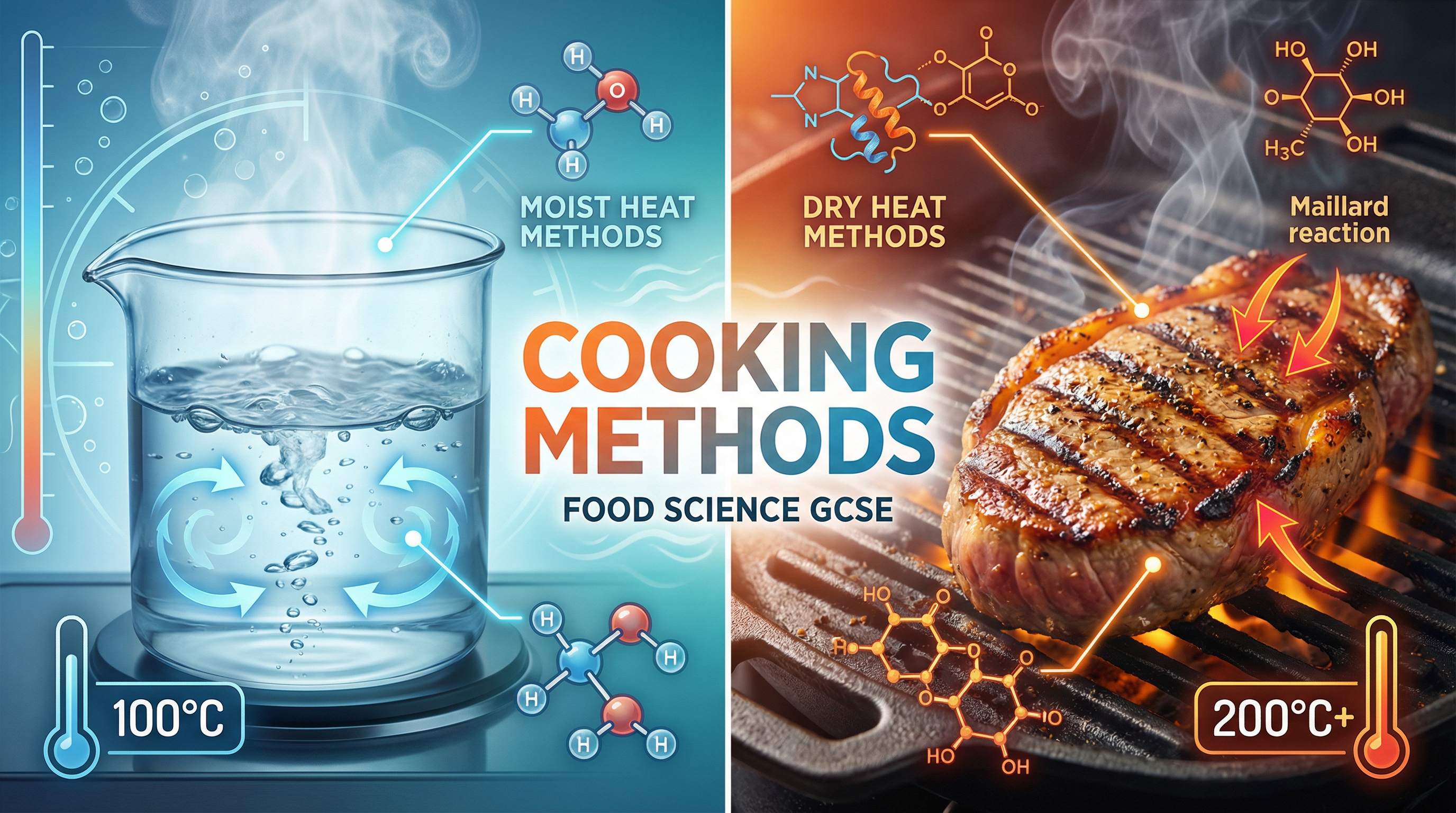
Cooking methods — Edexcel GCSE study guide illustration

    Cooking methods

    Mastering cooking methods is fundamental to excelling in your GCSE Food Preparation and Nutrition exam. This guide breaks down the core science of heat transfer and chemical changes, giving you the precise language and analytical skills examiners reward. Move beyond simply following recipes to scientifically justifying your cooking choices for top marks.

    7
    Min Read
    3
    Examples
    5
    Questions
    6
    Key Terms
    🎙 Podcast Episode
    Cooking methods
    0:00-0:00

    Study Notes

    Header image for Cooking Methods

    Overview

    This study guide delves into the scientific principles underpinning cooking methods, a cornerstone of the Edexcel GCSE Food Preparation and Nutrition specification. Examiners expect candidates to demonstrate a clear understanding of how heat is transferred to food and the subsequent physicochemical changes that occur. A high-scoring answer moves beyond descriptive accounts of cooking, instead providing a robust scientific explanation. You will be expected to link the three methods of heat transfer—conduction, convection, and radiation—to specific cooking techniques and explain their impact on ingredients. Furthermore, you must be able to articulate how these processes alter the nutritional value, texture, and flavour of food, using precise terminology such as denaturation, coagulation, gelatinisation, and the Maillard reaction. This guide will equip you with the detailed knowledge and analytical framework required to explain not just how to cook, but why specific methods are chosen to achieve desired outcomes.

    Cooking Methods Revision Podcast

    The Science of Heat Transfer

    Understanding how heat energy moves is critical. All cooking methods rely on one or more of these three transfer mechanisms. Credit is awarded for identifying the primary method of heat transfer for a given cooking process.
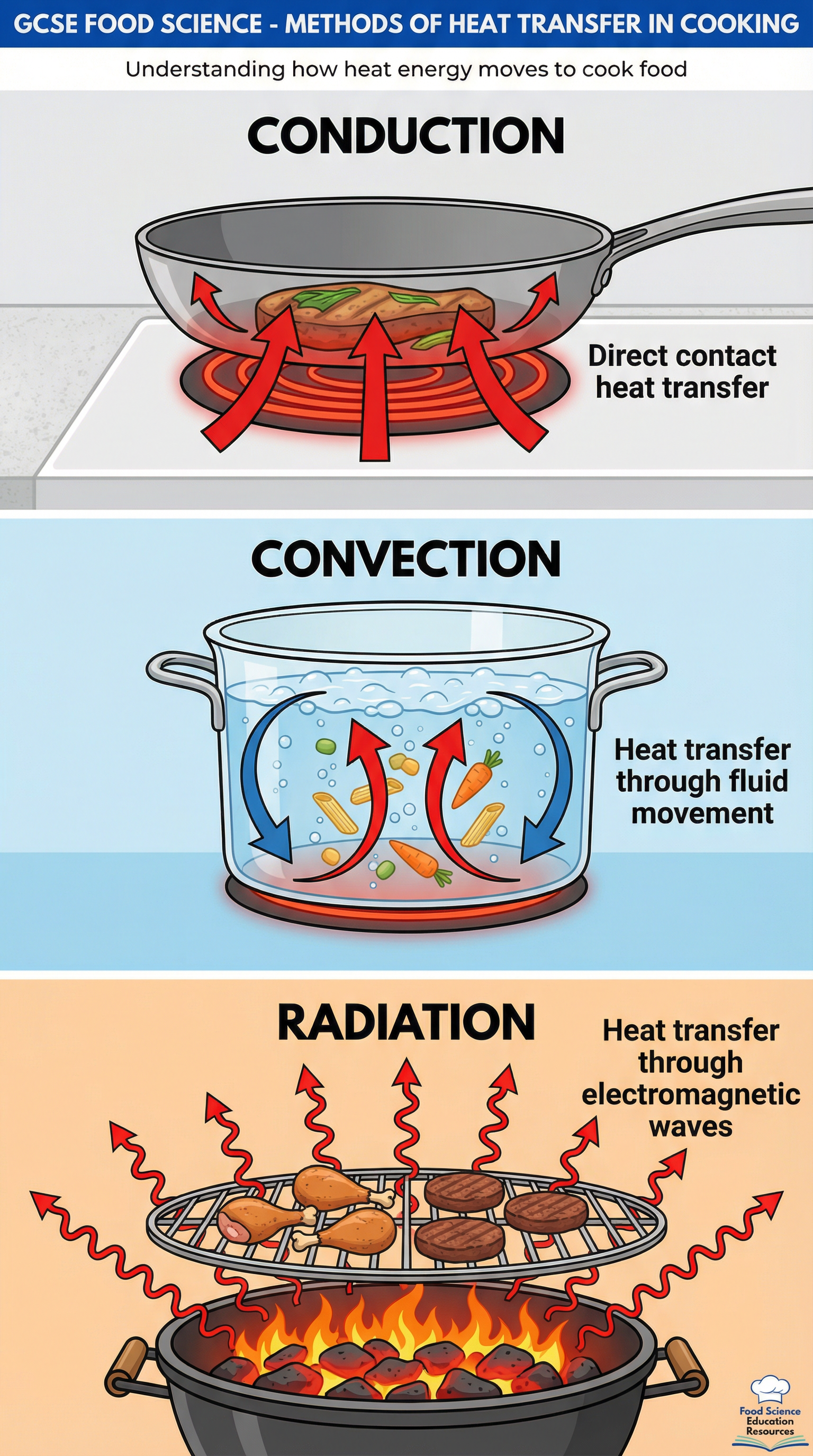
    The Three Methods of Heat Transfer in Cooking

    Conduction

    What it is: The transfer of heat through direct contact. Heat energy excites molecules, which vibrate and pass the energy to adjacent molecules.

    How it works: When a frying pan is placed on a hot hob, the metal heats up. When food is added to the pan, the heat is transferred directly from the pan to the surface of the food. Metals like copper and aluminium are excellent conductors, which is why they are used for cookware.

    Exam Example: "In pan-frying, heat is transferred to the chicken breast via conduction from the hot surface of the pan."

    Convection

    What it is: The transfer of heat through the movement of fluids (liquids or gases). When a fluid is heated, it becomes less dense and rises. Cooler, denser fluid sinks to take its place, creating a circular flow called a convection current.

    How it works: In a conventional oven, the air is heated by an element. This hot air circulates around the food, cooking it. In a pot of boiling water, convection currents ensure the water is evenly heated, cooking the food submerged within it.

    Exam Example: "Baking a cake relies on convection currents, as the hot air circulates within the oven to cook the batter evenly."

    Radiation

    What it is: The transfer of heat via infrared electromagnetic waves. Unlike conduction and convection, it does not require a medium to travel through.

    How it works: A grill or toaster uses a heating element that emits intense infrared radiation. These waves travel through the air and are absorbed by the surface of the food, causing it to heat up rapidly. This is why grilling is excellent for browning surfaces.

    Exam Example: "Grilling a sausage cooks it primarily through radiation, where infrared waves from the heating element are absorbed by the meat's surface."

    Key Chemical Changes in Food

    Cooking is applied chemistry. You must be able to name and explain the key chemical changes that occur when proteins, carbohydrates, and fats are heated.

    Protein: Denaturation & Coagulation
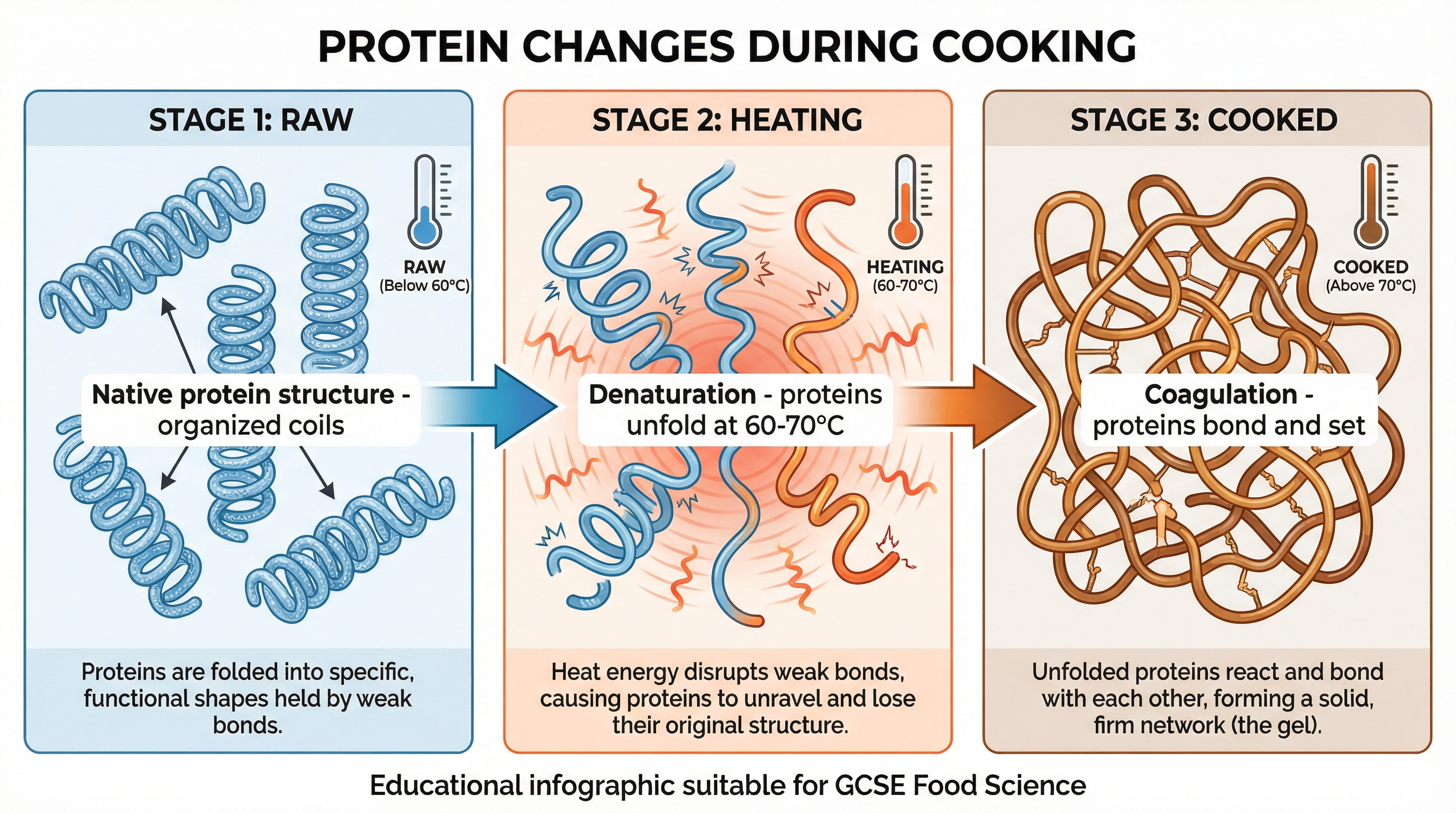
    Protein Changes During Cooking

    Proteins are long chains of amino acids, folded into complex, specific shapes. Heat disrupts these structures.

    1. Denaturation: This is the initial unfolding and uncoiling of the protein's natural structure. The weak bonds holding the protein in its shape are broken by heat energy (typically between 60-70°C). The protein changes from a complex 3D shape to a more linear chain. This change is irreversible.
    2. Coagulation: As heating continues, the denatured protein chains bond with each other, forming a solid, firm network. Water becomes trapped within this network. A clear example is a raw egg (liquid) turning solid and opaque upon cooking.

    Exam Knowledge: Use these terms to describe changes in meat, fish, eggs, and dairy.

    Carbohydrates: Gelatinisation, Dextrinisation & Caramelisation

    Carbohydrates undergo several important changes when heated.

    1. Gelatinisation: This occurs when starch granules are heated in the presence of a liquid. The granules absorb the liquid, swell, and eventually rupture (at around 85°C), releasing starch molecules that thicken the liquid. This is the principle behind thickening sauces with flour or cornflour.
    2. Dextrinisation: This is the browning of starch when subjected to dry heat. The heat breaks down the long starch molecules into smaller, sweeter-tasting molecules called dextrins. This is responsible for the brown colour and crisp texture of toast and baked goods.
    3. Caramelisation: This is the breakdown of sugar by heat (at high temperatures, ~160°C+). The sugar melts and undergoes a series of chemical reactions, creating a range of brown-coloured, nutty, and bitter flavour compounds. It is distinct from the Maillard reaction as it involves only sugar, not protein.

    Fats: Melting & Smoking

    Fats simply melt when heated, changing from a solid to a liquid state. If heated to a very high temperature, fats will begin to break down, producing a blue smoke. This is known as the 'smoke point' and indicates the fat is degrading.

    The Maillard Reaction: The Science of Browning

    The Maillard reaction is one of the most important reactions in food chemistry and a favourite of examiners. It is a complex chemical reaction between amino acids (from proteins) and reducing sugars that occurs in the presence of dry heat. It is responsible for the characteristic brown colour and savoury flavour of many cooked foods, such as seared steak, baked bread, and roasted coffee.

    Conditions Required: Dry heat (conduction or radiation), temperatures above 140°C.

    Outcome: Development of a brown crust, complex aromas, and deep, savoury flavours.

    Impact of Cooking on Nutritional Value

    Cooking can both improve and diminish the nutritional content of food. A key area for exam questions is the effect of cooking on vitamins.
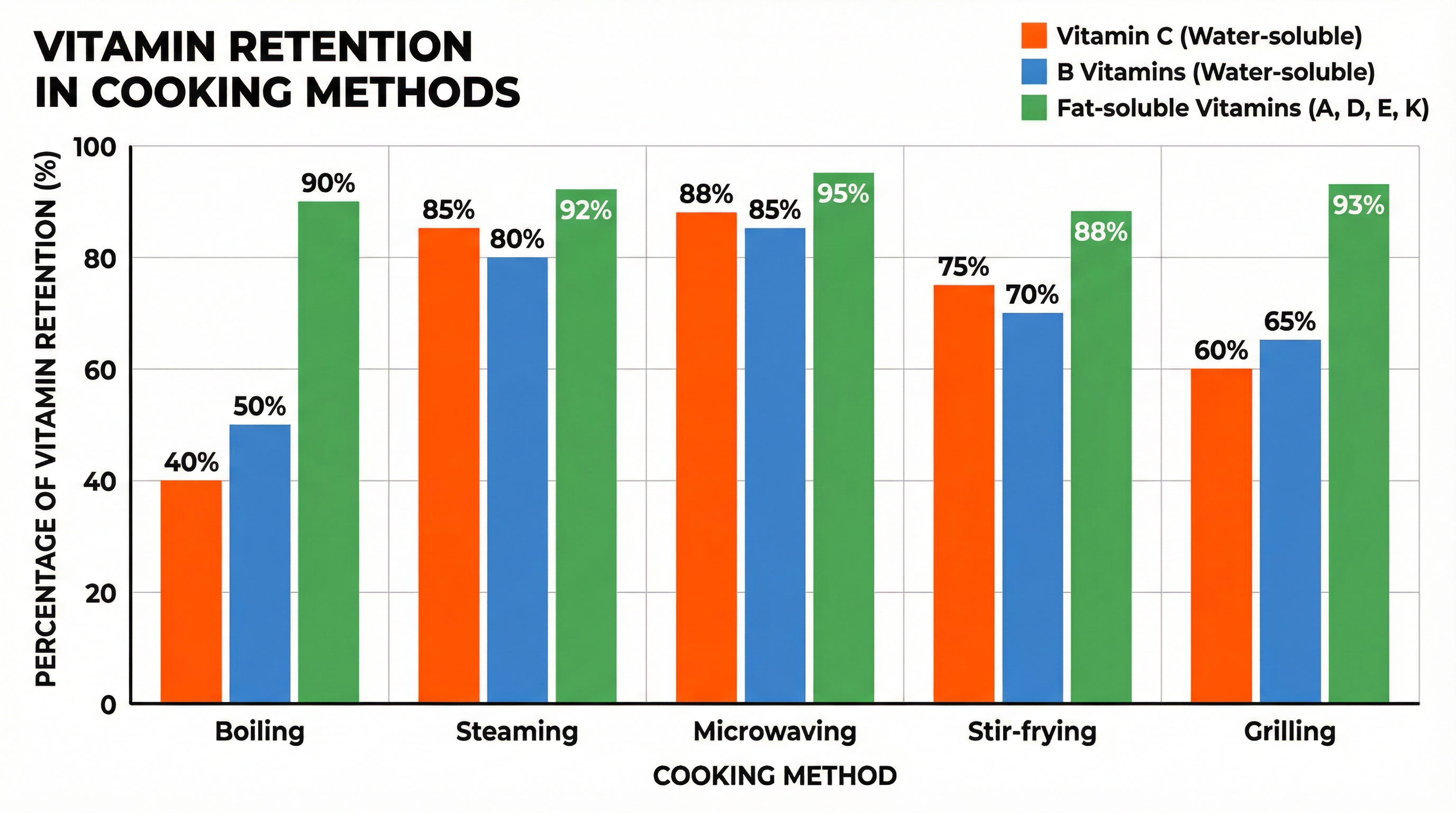
    Vitamin Retention in Cooking Methods

    • Water-Soluble Vitamins (Vitamin C and B-Group): These are volatile and easily destroyed by heat and light. They also leach (dissolve) into cooking water. Boiling causes the highest loss of these vitamins. Methods like steaming, stir-frying, and microwaving, which use less water and shorter cooking times, result in much better retention.
    • Fat-Soluble Vitamins (A, D, E, K): These are more stable to heat than water-soluble vitamins. They are not lost in cooking water but can be lost if the fat they are dissolved in is discarded.
    • Minerals: Minerals are stable to heat but can be leached into cooking water during boiling.

    Exam Tip: When asked to evaluate a cooking method, always consider its impact on water-soluble vitamins. Credit is given for suggesting methods that conserve nutritional value, such as steaming vegetables instead of boiling them.

    Worked Examples

    3 detailed examples with solutions and examiner commentary

    Practice Questions

    Test your understanding — click to reveal model answers

    Q1

    Explain why a stir-fry is considered a healthy cooking method that retains nutrients. (8 marks)

    8 marks
    standard

    Hint: Think about the heat transfer method, cooking time, and the amount of liquid used. Relate this to water-soluble vitamins.

    Q2

    A chef is making a lemon meringue pie. Describe the scientific changes happening to the egg proteins in both the lemon filling and the meringue topping. (6 marks)

    6 marks
    hard

    Hint: Consider the different treatments of the egg yolks (in the filling) and egg whites (in the meringue). Think about heat, acid, and mechanical agitation.

    Q3

    Explain why slow, moist cooking methods like braising are used for tough cuts of meat. (4 marks)

    4 marks
    standard

    Hint: Think about the different types of protein in meat. What is collagen and what happens to it during slow cooking?

    Q4

    Describe two differences between the Maillard reaction and caramelisation. (4 marks)

    4 marks
    standard

    Hint: Consider the molecules involved and the resulting flavours.

    Q5

    Evaluate the use of a microwave oven for reheating a slice of leftover pizza, considering the scientific principles of heat transfer and the effect on sensory properties. (6 marks)

    6 marks
    hard

    Hint: How do microwaves work? What effect does this have on the different components of the pizza (bread, cheese, sauce)?

    Key Terms

    Essential vocabulary to know

    More Food Preparation and Nutrition Study Guides

    View all

    Sauce making

    AQA
    GCSE

    Mastering sauce making is a gateway to understanding core food science principles for the AQA GCSE exam. This guide deconstructs the science of gelatinisation, emulsification, and reduction, providing the specific knowledge required to secure top marks by linking the functional properties of ingredients to sensory outcomes.", "podcast_script": "SAUCE MAKING PODCAST SCRIPT - AQA GCSE Food Preparation and Nutrition Duration: 10 minutes Voice: Female, warm, conversational, enthusiastic educator [INTRO - 1 minute] Hello and welcome to your GCSE Food Preparation and Nutrition study podcast! I'm here to help you master one of the most scientifically fascinating topics on the AQA specification: sauce making. Now, I know what you might be thinking - sauces? Really? But trust me, this topic is absolutely packed with marks-earning potential. Examiners LOVE sauce making questions because they test your understanding of the science behind cooking, not just the practical skills. And the best news? Once you understand the three key processes - gelatinisation, emulsification, and reduction - you'll be able to tackle any sauce question with confidence. In the next ten minutes, we're going to break down the science, explore what examiners are looking for, highlight the most common mistakes students make, and finish with a quick-fire quiz to test your recall. So grab a pen, get comfortable, and let's dive into the delicious world of sauce science! [CORE CONCEPTS - 5 minutes] Let's start with the big one: gelatinisation. This is the process that thickens starch-based sauces like béchamel, and it's tested in almost every exam paper. Here's what you absolutely must know. Gelatinisation is the process where starch granules absorb liquid, swell, and eventually burst to create a thick gel network. But here's the crucial detail that separates a Level 2 answer from a Level 4 answer: you need to know the TEMPERATURES at which this happens. At 60 degrees Celsius, starch granules begin to absorb water and swell. Between 60 and 80 degrees, they continue swelling. At 80 degrees Celsius, the granules burst, releasing amylose and amylopectin molecules. And at 100 degrees - boiling point - gelatinisation is complete, and you get that smooth, thick sauce consistency. Now, here's where students lose marks: saying "the sauce thickens because it gets hot" is NOT enough. You must explain that the starch granules swell and burst, forming a gel network. And don't forget - constant stirring is essential to prevent lumps. If you don't agitate the mixture, the starch granules stick together instead of dispersing evenly. Let's move on to emulsification - this is all about getting oil and water to mix, which they naturally don't want to do. Think mayonnaise or hollandaise sauce. The magic ingredient here is lecithin, found in egg yolk. Lecithin is an emulsifier. It has a hydrophilic head - that means water-loving - and a hydrophobic tail - that means oil-loving. When you whisk egg yolk with oil and an acidic liquid like lemon juice or vinegar, the lecithin molecules surround tiny oil droplets. The hydrophobic tails face inward into the oil, and the hydrophilic heads face outward into the water phase. This creates a stable emulsion. Examiners will award marks if you can identify lecithin as the emulsifier and explain its dual nature. Don't just say "egg yolk helps them mix" - explain HOW it works at a molecular level. Now, the third process: reduction. This is when you simmer a liquid sauce to evaporate water, which intensifies flavour and increases viscosity. The key here is understanding that as water evaporates, the concentration of flavour compounds increases, and the sauce becomes thicker because there's less liquid relative to the solids. A common exam question asks you to explain why a reduced sauce has a stronger flavour. The answer: evaporation removes water but leaves behind the flavour molecules, so the concentration increases. Simple, but you need to use the word "concentration" or "evaporation" to get full credit. One more thing about reduction - it's often combined with the Maillard reaction in meat-based sauces. The Maillard reaction occurs when proteins and sugars are heated together above 140 degrees Celsius, creating complex brown flavours. This is why a reduced meat jus tastes so rich and deep. [EXAM TIPS & COMMON MISTAKES - 2 minutes] Right, let's talk exam strategy. The AQA mark scheme rewards candidates who use precise scientific language and link functional properties to sensory outcomes. What does that mean in practice? First, always use specific temperatures. Don't say "heat the sauce" - say "heat to 100 degrees Celsius to complete gelatinisation." This shows depth of knowledge. Second, when describing faults in sauces, give the scientific reason. If a sauce is lumpy, don't just say "they didn't stir it." Say "the sauce is lumpy because the starch granules were not agitated during heating, causing them to clump together instead of dispersing evenly." That's a Level 4 answer. Third, know your ratios. A standard roux uses a 1 to 1 ratio of fat to flour, and then a 1 to 10 ratio of roux to liquid. So for 50 grams of butter and 50 grams of flour, you'd add 500 millilitres of milk. This comes up in multiple-choice questions all the time. Now, the biggest mistake students make: confusing gelatinisation with coagulation. Gelatinisation is about STARCH thickening. Coagulation is about PROTEIN setting, like when you make custard and the egg proteins set. Don't mix these up! Another common error: saying an emulsion is stable "because you whisked it." No! It's stable because the emulsifier - lecithin - surrounds the oil droplets and prevents them from recombining. Always explain the role of the emulsifier. And finally, for dietary adaptations: if a question asks how to make a sauce suitable for someone with coeliac disease, you need to substitute the wheat flour with a gluten-free starch like cornflour. But here's the key - you must also explain that cornflour still undergoes gelatinisation, so the functional property is maintained. That's the kind of detail that gets you into the top mark band. [QUICK-FIRE RECALL QUIZ - 1 minute] Okay, time to test yourself! I'll ask a question, pause for a few seconds, then give you the answer. Ready? Question 1: At what temperature do starch granules begin to burst during gelatinisation? ... The answer is 80 degrees Celsius. Question 2: What is the name of the emulsifier found in egg yolk? ... Lecithin. Question 3: What is the ratio of fat to flour in a standard roux? ... 1 to 1. Question 4: Why does a reduced sauce have a more intense flavour? ... Because water evaporates, increasing the concentration of flavour compounds. Question 5: Name one gluten-free starch that can replace wheat flour for someone with coeliac disease. ... Cornflour, or you could also say rice flour or potato starch. How did you do? If you got all five, brilliant! If not, go back and review those sections. [SUMMARY & SIGN-OFF - 1 minute] Let's wrap up. Today we've covered the three essential processes in sauce making: gelatinisation, where starch granules swell and burst at specific temperatures to thicken a sauce; emulsification, where lecithin in egg yolk allows oil and water to mix by surrounding oil droplets; and reduction, where evaporation intensifies flavour and increases viscosity. Remember: examiners want to see scientific language, specific temperatures, and explanations that link ingredients to outcomes. Don't just describe what happens - explain WHY it happens at a molecular level. Before your exam, make sure you can explain each process step-by-step, identify common faults and their causes, and adapt recipes for dietary needs while maintaining functional properties. You've got this! Sauce making might seem complex, but once you understand the science, it all makes sense. Good luck with your revision, and remember - precision, explanation, and scientific terminology are your keys to top marks. Thanks for listening, and happy studying!

    Food miles and sustainability

    AQA
    GCSE

    This study guide delves into the critical topic of food miles and sustainability, a key area of the AQA GCSE Food Preparation and Nutrition specification. It explores the environmental impact of our food choices, equipping candidates with the analytical skills needed to evaluate food provenance and secure top marks in their exam.

    Food preservation methods

    AQA
    GCSE

    Unlock top marks in your AQA GCSE Food exam by mastering the science of food preservation. This guide breaks down how stopping microbial growth through temperature, water removal, and chemical means is not just a cooking technique, but a core scientific principle essential for food safety and product development.

    Food waste

    AQA
    GCSE

    This study guide tackles the critical issue of food waste, a key component of the AQA GCSE Food Preparation and Nutrition specification (Section 5: Food Provenance). It explores the environmental, economic, and social impacts of waste, providing candidates with the specific knowledge and exam techniques needed to achieve top marks. Understanding this topic is vital for explaining the link between consumer behaviour and global food sustainability.

    Seasonal foods

    AQA
    GCSE

    This study guide explores the crucial topic of seasonal foods within the AQA GCSE Food Preparation and Nutrition specification. Understanding seasonality is vital for exam success, as it connects directly to food provenance, sustainability, and the organoleptic qualities of ingredients, allowing candidates to achieve higher marks by demonstrating a deep and applied knowledge of where food comes from.

    Energy balance and its relationship to weight management.

    OCR
    GCSE

    This study guide provides a comprehensive, exam-focused breakdown of energy balance and weight management for OCR GCSE Food Preparation and Nutrition. It decodes the science of BMR and PAL, explains the calorific value of macronutrients, and provides specific strategies to help candidates secure top marks by avoiding common pitfalls and using precise terminology.